

Mathematics Concept Notes for Class 11: Chapter 14 Mathematical Reasoning
Review targeted revision notes for Class 11 Mathematics with the CBSE Class 11 Mathematics Mathematical Reasoning Notes. Built according to official educational guidelines for the 2026-27 academic year, these downloadable summaries for Chapter 14 Mathematical Reasoning support daily study and last-minute exam readiness.
Download Chapter 14 Mathematical Reasoning Revision Notes PDF
View or download the dedicated Chapter 14 Mathematical Reasoning revision resource below. Engaging with these structured concept notes daily ensures continuous academic progress and mastery of the 2026-27 curriculum for Mathematics.
Class XI
Chapter:14 Mathematical Reasoning
Chapter Notes
Key Concepts
1. There are two types of reasoning the deductive and inductive. Deductive reasoning was developed by Aristotle, Thales, Pythagoras in the classical Period (600 to 300 B.C.).
2. In deduction, given a statement to be proven, often called a conjecture or a theorem, valid deductive steps are derived and a proof may or may not be established. Deduction is the application of a general case to a particular case.
3. Inductive reasoning depends on working with each case, and developing a conjecture by observing incidence till each and every case is observed.
4. Deductive approach is known as the top-down" approach”. Given the theorem which is narrowed down to specific hypotheses then to observation. Finally the hypotheses is tested with specific data to get the confirmation (or not) of original theory.
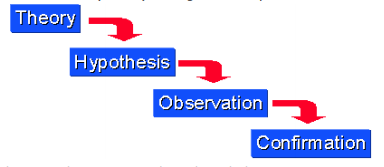
5. Mathematical reasoning is based on deductive reasoning. The classic example of deductive reasoning, given by Aristotle, is
· All men are mortal.
· Socrates is a man.
· Socrates is mortal.6. The basic unit involved in reasoning is mathematical statement.
7. A sentence is called a mathematically acceptable statement if it is either true or false but not both. A sentence which is both true and false simultaneously is called a paradox.
8. Sentences which involve tomorrow, yesterday, here, there etc i.e variables etc are not statements.
9. The sentence expresses a request, a command or is simply a question are not statements.
10.The denial of a statement is called the negation of the statement.
11.Two or more statements joined by words like “and” “or” are called Compound statements. Each statement is called a component statement. “and” “or” are connecting words.
12.An “ And” statement is true if each of the component statement is true and it is false even if one component statement is false.
13.An “OR” statement is will be true when even one of its components is true and is false only when all its components are false
14.The word “OR” can be used in two ways (i) Inclusive OR (ii) Exclusive OR. If only one of the two options is possible then the OR used is Exclusive OR. If any one of the two options or both the options are possible then the OR used is Inclusive OR.
15.There exists “$” and “For all” " are called quantifiers.
16.A statement with quantifier “There exists” is true, if it is true for at least one case.
17.If p and q are two statements then a statement of the form 'If p then q' is known as a conditional statement. In symbolic form p implies q is denoted by p Þ q.
18.The conditional statement p Þ q can be expressed in the various other forms:
(i) q if p (ii) p only if q (iii) p is sufficient for q (iv) q is necessary for p.
19. A statement formed by the combination of two statements of the form if p then q and if q then p is p if and only if q. It is called conditional statement.
20. Contrapositive and converse can be obtained by a if then statement
The contrapositive of a statement p ⇒ q is the statement - q ⇒ -p
The converse of a statement p ⇒ q is the statement q ⇒ p
21. Truth values of various statement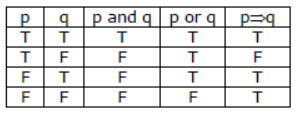
22. Two prove the truth of an if p- then q statement . there are two ways : the first is assume p is true and prove q is true. This is called the direct method.
Or assume that q is false and prove p is false. This is called the Contrapositive method.
23. To prove the truth of “ p if and only if q” statement , we must prove two things , one that the truth of p implies the truth of q and the second that the truth of q implies the truth of p.
24. The following methods are used to check the validity of statements:
(i) Direct method
(ii) Contra positive method
(iii) Method of contradiction
(iv) Using a counter example
25. To check whether a statement p is true , we assume that it is not true, i.e. ∼p is true . Then we arrive at some result which contradicts our assumption.
Please click the link below to download pdf file for CBSE Class 11 Mathematics Mathematical Reasoning Notes.
Free study material for Mathematics
Study Material and Revision Notes for Class 11 Mathematics Chapter 14 Mathematical Reasoning
Quick Revision Notes: Chapter 14 Mathematical Reasoning (CBSE)
Explore reliable chapter overviews for Chapter 14 Mathematical Reasoning tailored for Class 11 learners. Use these structured points to grasp difficult themes and ensure solid preparation for upcoming assessments.
Expert Study Material for Class 11 Mathematics
Built using the official NCERT book for Class 11 Mathematics, these notes provide reliable academic guidance. Pair your summary review with our recommended NCERT solutions to master optimal problem-solving approaches.
Complete Your Chapter Revision
Wrap up your chapter revision by testing your knowledge against standard question formats. Everything on our platform is provided free of charge.
FAQs
You can download the teacher prepared revision notes for CBSE Class 11 Mathematics Mathematical Reasoning Notes from StudiesToday.com. These notes are designed as per 2026-27 academic session to help Class 11 students get the best study material for Mathematics.
Yes, our CBSE Class 11 Mathematics Mathematical Reasoning Notes include 50% competency-based questions with focus on core logic, keyword definitions, and the practical application of Mathematics principles which is important for getting more marks in 2026 CBSE exams.
Yes, our CBSE Class 11 Mathematics Mathematical Reasoning Notes provide a detailed, topic wise breakdown of the chapter. Fundamental definitions, complex numerical formulas and all topics of CBSE syllabus in Class 11 is covered.
These notes for Mathematics are organized into bullet points and easy-to-read charts. By using CBSE Class 11 Mathematics Mathematical Reasoning Notes, Class 11 students fast revise formulas, key definitions before the exams.
No, all study resources on StudiesToday, including CBSE Class 11 Mathematics Mathematical Reasoning Notes, are available for immediate free download. Class 11 Mathematics study material is available in PDF and can be downloaded on mobile.