

Official Class 3 Computers Revision Material: CBSE Class 3 Computer Science About Desktop And Computer Peripherals Notes
Explore reliable concept summaries and revision materials through the CBSE Class 3 Computer Science About Desktop And Computer Peripherals Notes. Tailored for Class 3 learners, utilizing these notes for Computers About Desktop And Computer Peripherals ensures thorough preparation and strengthens core academic definitions before final evaluations.
Chapter-wise Concept Summaries: About Desktop And Computer Peripherals
Access the complete concept summary PDF for About Desktop And Computer Peripherals below. Regular review of these targeted notes builds familiarity with complex Class 3 Computers themes and helps secure higher marks in final school evaluations.
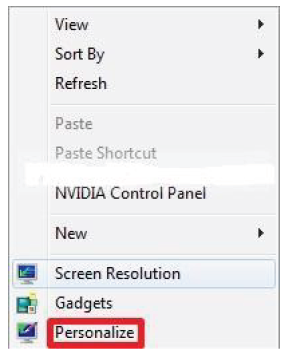
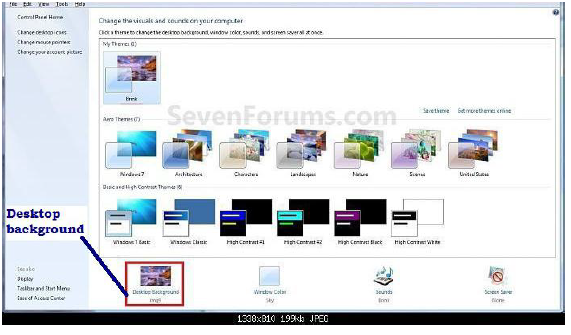
NOTE:To use another regional wallpaper, see the yellow TIP box at the top of the tutorial. To remove a folder from the Picture location (not clear)
B) Select the picture folder and click on Select Folder.
4. Select a Desktop Background
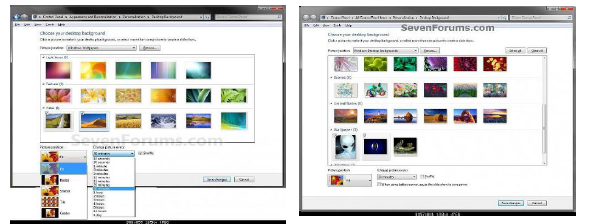
A) Right click on an available picture, or click (check) on the box in the upper left corner of the picture, to select (see screenshot below step 7)
NOTE:You can continue to right click on the images to see it previewed on your desktop until you decide which one you like best.
5. Select the Picture Position
A) Click on the drop down arrow menu, and click on the picture position you want for the desktop background. (see bottom of screenshot below step 7)
6. For a Desktop SlideShow
A) select more than one picture to create a Desktop Slideshow
7.Click on Save changes to apply the changes. (see screenshots below)
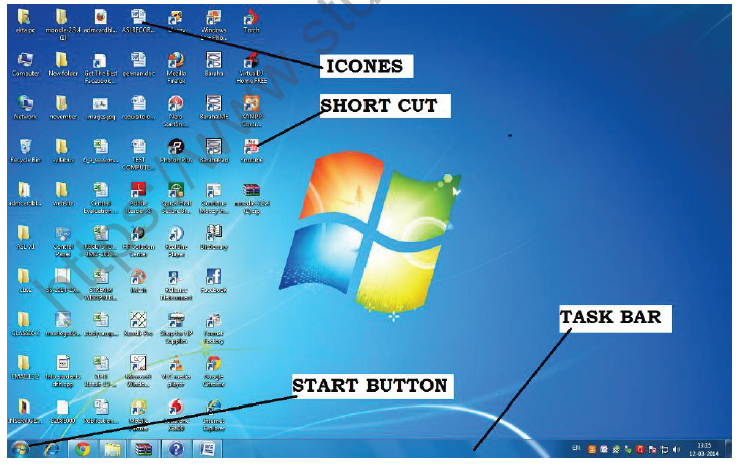
Identify Icons on Desktop –
- An icon is a small graphic representation of a program or file that, when clicked on, will be run or opened. Icons are used with Graphical User Interface (GUI) Operating Systems such as MicrosoftWindows and the AppleMac.
- When you double-click or open an icon the associated file or program will be opened.
For example, if you double-click on the My Computer icon, it will open Windows Explorer and double-clicking a document or file icon it will open that document in the associated program.
Start button and Taskbar
The start Menu is used to open programs and folders, search for things on your computer and turn off your computer.

Task bar is a horizontal bar located at the bottom of the screen where running programs are shown when minimized represented by icons.
My Computer – My Computer icon is a pictogram displayed on a computer screen in order to help user navigate a computer system.

My Computer icon that is available on the desktop is use to find out the resource of your pc.
My computer consists of number of icons.- Hard Disk Drive, Devices with Removable Storage and Network location.
Recycle bin- The Recycle bin acts just like a dustbin. Whenever a file is deleted automatically it goes to the recycle bin. Whenever a file is further needed it may be recovered, it is done by simply pressing the restore button in the recycle bin.

Input and Output Devices
Input device- The input devices are used for transferring user’s data to the computer. Some of the Input devices are
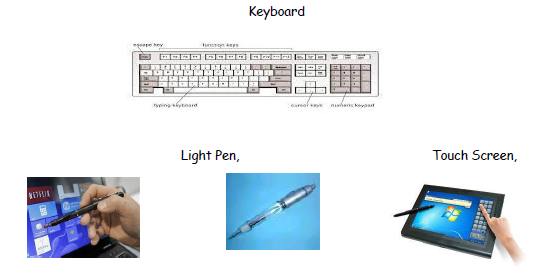
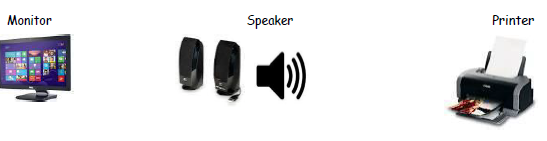
Output devices- An output device is any electronic or electromechanical equipment connected to a computer and used to transfer data out of the computer in the form of text, images, sounds, or other media. Examples of output devices include speakers, headphones, printer and screen/monitor.
Processing
Working on data to get the meaningful information is called processing. In computer calculation and manipulation is done inside the Central Processing Unit(CPU) . It act as brain of the Computer.
The performance of your computer is based on simple mathematical operations.
CPU is the device, that controls all the operations. The CPU has integrated ALU (Arithmetical Logical Unit). This unit is responsible for all mathematical and logical operations.

In the CPU there are three separate units such as
- Control Unit
- Memory Unit
- Arithmetic and Logical Unit
Control Unit:-The control unit is a component of a computer's CENTRALPROCESSINGUNIT (CPU) which directs operation of the processor. It controls communication and co-ordination between input/output devices. It reads and interprets instructions and determines the sequence for processing the data.
It directs the operation of the other units by providing timing and control signals. All computer resources are managed by the CU (Control Unit). It directs the flow of data between the Central Processing Unit (CPU) and the other devices.
Memory Unit:- When a program is fed into the input unit, the information is translated into the machine language and stored in the main memory only on the instruction of the Control Unit. When the instruction is given to the computer by the user to execute the program, the control unit instructs the memory unit to supply the data and information to ALU for processing. The processed date and results are sent back by the ALU to the memory unit to store them in separate location for future use by the instructions of Control Unit.
Arithmetic and Logic Unit:- This unit handles both arithmetic and logic operations. On the instructions of the Control unit and data available from the main memory, the ALU operates on the data and sends the processed results back to the main memory to store in separate locations. This unit does Mathematical (+,-,X,/) relational(<,>,=,>=,<=,!=) logical operations(AND, OR).
Let us do practice now
Type-I (Short answered based questions)
- What is function of Recycle bin?
- Write the steps to delete the files on the desktop.
- List any two Input and Output devices.
- What is need of Icon and draw any two Icons.
- What is brain of Computer?
Type –II (Fill in the blanks)
- Mouse is ____________ adevice.
- CPU can do__________and __________.
- Printer can give the output on _________________.
- The most common Character input device is ____________.
- _________ is a dustbin of your computer.
Type –III (Match the Columns)
Lab session
- Save the word file on the different location of the computer.
About Desktop And Computer Peripherals Concepts and Summary for Class 3 Computers
About About Desktop And Computer Peripherals Revision Notes
Explore reliable chapter overviews for About Desktop And Computer Peripherals tailored for Class 3 learners. Use these structured points to grasp difficult themes and ensure solid preparation for upcoming assessments.
How to Use These Revision Notes
Built using the official NCERT book for Class 3 Computers, these notes provide reliable academic guidance. Pair your summary review with our recommended NCERT solutions to master optimal problem-solving approaches.
Enhance Practice with MCQs and Worksheets
Explore our broader library of printable assignments, chapter notes, and mock tests designed to support continuous revision and secure higher marks in CBSE assessments.
FAQs
You can download the teacher prepared revision notes for CBSE Class 3 Computer Science About Desktop And Computer Peripherals Notes from StudiesToday.com. These notes are designed as per 2026-27 academic session to help Class 3 students get the best study material for Computers.
Yes, our CBSE Class 3 Computer Science About Desktop And Computer Peripherals Notes include 50% competency-based questions with focus on core logic, keyword definitions, and the practical application of Computers principles which is important for getting more marks in 2026 CBSE exams.
Yes, our CBSE Class 3 Computer Science About Desktop And Computer Peripherals Notes provide a detailed, topic wise breakdown of the chapter. Fundamental definitions, complex numerical formulas and all topics of CBSE syllabus in Class 3 is covered.
These notes for Computers are organized into bullet points and easy-to-read charts. By using CBSE Class 3 Computer Science About Desktop And Computer Peripherals Notes, Class 3 students fast revise formulas, key definitions before the exams.
No, all study resources on StudiesToday, including CBSE Class 3 Computer Science About Desktop And Computer Peripherals Notes, are available for immediate free download. Class 3 Computers study material is available in PDF and can be downloaded on mobile.