

Class 9 Computer Science Practice Assignments: CBSE Class 9 Computers Boolean Algebra Assignments
Access comprehensive school assignments for Boolean Algebra using the CBSE Class 9 Computers Boolean Algebra Assignments. Designed to align with the 2026-27 CBSE academic guidelines, these practice sets help Class 9 Computer Science students reinforce core concepts and improve their problem-solving accuracy.
Download Boolean Algebra Assignment PDF with Solutions
Access the complete assignment PDF for Class 9 Computer Science below. Regular practice with these targeted academic tasks builds familiarity with standard question patterns and helps secure higher marks in final school evaluations.
Question: What is Boolean Algebra? What are the uses of Boolean algebra?
Answer: The Boolean algebra was developed by the English mathematician George Boole; it is algebra of logic. It deals with statements in mathematical logic, and puts them in the form of algebraic equations.
Uses of Boolean algebra:
Boolean algebra is used in designing of logic circuits inside the computer. These circuits perform different types of logical operations. Thus, Boolean algebra is also known as logical algebra or switching algebra. The mathematical expressions of the Boolean algebra are called Boolean expressions.
Question: Define the following
Answer: Constants, Variables, truth table, Boolean expression, AND operation, OR operation.
Constants
Boolean algebra uses binary values 0 and 1 as Boolean constants.
Variable
The variables used in the Boolean algebra are represented by letters such as A, B, C, x, y, z etc, with each variable having one of two and only two distinct possible values 0 and 1.
Truth Table
A truth table is a breakdown of a logic function by listing all possible values the function can attain. Such a table typically contains several rows and columns, with the top row representing the logical variables and combinations, in increasing complexity leading up to the final function.
Boolean Expression:
An expression that results in a value of either TRUE or FALSE is called Boolean expression.
For example, the expression 2 < 5 (2 is less than 5)
is a Boolean expression because the result is TRUE. All expressions that contain relational operators , such as the less than sign (<), are Boolean. The operators — AND, OR, XOR, NOR, and NOT — are Boolean operators.
Boolean expressions are also called comparison expressions, conditional expressions, and relational expressions.
AND Operation
In Boolean algebra AND operator is represented by a dot or by the absence of any symbol between the two variables and is used for logical multiplication. For example A.B = X or AB = X.
Thus X is 1 if both A and B are equal to 1 otherwise X will be 0 if either or both A and B are 0 i.e.
1.1 = 1
1.0 = 0
0.1 = 0
0.0 = 0
OR Operation
OR operation is represented by a plus sign between two variables. In Boolean algebra OR is used for logical addition. For example A+B = X.
The resulting variable X assumes the value 0 only when both A nd B are 0, otherwise X will be 1 if either or both of A and B are 1 i.e.
1+1 = 1
1+0 = 1
0+1 = 1
0+0 = 0
Laws of Boolean Algebra
There are three basic laws of Boolean algebra; these are the same as ordinary algebra.
1. Commutative Law
2. Associative Law
3. Distributive Law
1. Commutative Law
It is defined as the law of addition for two variables and it is written as:
A + B = B + A
This law states that the order in which the variables are added makes no difference. Remember that in Boolean algebra addition and OR operation are same.
It is also defined as the law of multiplication for two variables and it is written as:
A.B = B.A
2. Associative Law
The associative law of addition is written as follows for three variables:
A + (B + C) = (A + B) + C
This law states that when ORing more than two variables, the result is the same regardless of the grouping of the variables.
The associative law of multiplication is written as follows for three variables.
A(BC) = (AB)C
This law states that it makes no difference in what order the variables are grouped when ANDing more than two variables.
3. Distributive Laws
The distributive law is written for three variables is as follows:
A(B+C) = AB + AC
This law states that ORing two or more variables and then ANDin the result with a single variable is equivalent to ANDing the single variable with each of the two or more variables and then ORing the products. The distributive law also expresses the process of factoring in which the common variable A is factored out of the product terms. For example:
AB + AC = A (B + C)
Postulates and Theorems of Boolean algebra
Assume A, B, and C are logical states that can have the values 0 (false) and 1 (true).
“+” means OR, “·” means AND, and NOT[A] means NOT A.
Postulates
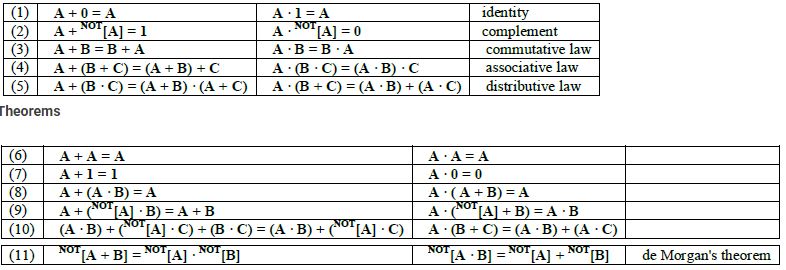
Question: what are the Laws and Theorems of Boolean algebra?
Laws and Theorems of Boolean algebra:
Theorem 1 (a) (Idempotent Law):

Answer: Proof:
x + x = (x + x) . 1 by Axiom 2(b)
(Refer to Axion in previous topic)
= (x + x) . (x + x’) Axiom 5(a)
= x + x.x’ Axiom 4(b) = x + 0 Axiom 5(b)
= x Axiom 2(a)
Theorem 1(b) (Idempotent Law):
x.x = x
Proof:
x.x = x.x + 0 2(a) (Refer to Axion in previous topic)
= x.x + x.x’ Axiom 5(b)
= x. (x + x’) Axiom 4(a)
= x.1 Axiom 5(a)
= x Axiom 2(b)
Theorem 2(a) (Boundedness Law):
x + 1 = 1
Proof: x + 1 = 1.(x + 1) 2(b) (Refer to Axion in previous topic)
= (x +x’) . (x + 1) Axiom 5(a)
= x + x’.1 Axiom 4(b)
= x + x’ Axiom 2(b)
= 1 Axiom 5(a)
Theorem 2(b) :
x.0 = 0
Proof :
x.0
= x.0 + 0 2(a) (Refer to Axion in previous topic)
= x.0 + x.x’ Axiom (5)
=x(0 + x’) Axiom 4(a)
= x.x’ Axiom 2(a)
= 0 Axiom (5)
Theorem 3 (Involution Law):
(x’)’ = x
Proof :
We know that x’ is the complement of x.
If x + x’ = 1 and x.x’ = 0, then
x + x’ = 1 ⇒ x’ + x =1 and x. x’ = 0 ⇒ x’.x = 0 (3a and 3b)
complement of x
x is the com’ (x’)’ = x
Theorem 4(a) (Absorption Laws):
x + x.y = x
Proof:
x + x.y = x.1 + x.y by 2(b) (Refer to Axion in previous topic)
= x.(1 + y) Axiom 4(a)
= x.(y + 1) Axiom 3(a)
= x.1 Axiom 2(a)
= x Axiom 2(b)
Theorem 4(b):
x.(x + y) = x
Proof:
x.(x+y)
= (x + 0)(x + y) 2(a) (Refer to Axion in previous topic)
= x + (0.y) Axiom 4(a)
= x + (y.0) Axiom 3(b)
= x + 0 (Theorem 2)
= x Axiom 2(a)
Theorem 5(a):
If B is a Boolean algebra, for any x, y in B, then 0′ = 1.
Proof:
x + 1 = 1 (Theorem 2a)
In particular for x = 0, we have
0 + 1 = 1 …(1)
x.0 = 0 (Theorem 2b)
In particular, for x =1
1.0 = 0
⇒ 0.1 = 0 (3a) …(2)
From (1) and (2), we have
For 0 ∈ B, 0 + 1 = 1
0.1 = 0
⇒ 1 is the complement of 0.
0′ = 1 (5)
Theorem 5(b):
In a Boolean algebra B, we have 1′ = 0
Proof:
x + 1 = 1 (Theorem 2a)
In particular, for x = 0
0 + 1 =1
⇒ 1 + 0 = 1 …(1) (Axiom 3a)
x . 0 = 0
In particular for 1 B, we have
1 . 0 = 0 …(2)
From (1) and (2), we have 0 is the complement of 1 (Axiom 5)
Question: State and prove duality principle.
Duality Principle:
Answer: Duality principle states that any result deduced from the axioms of Boolean algebra remains valid if the following steps are performed.
All 0’s in the result are changed to 1 and vice versa
The . in the original result is changed to + and vice versa
Example: prove that x.y = x + y
We know from the theorem 5 that x + y = x.y now applying the principle of duality on x + y = x.y it gives us the result
x.y = x + y hence proved.
Download Practice Assignments: Class 9 Computer Science Boolean Algebra
Chapter Practice Questions for Class 9 Computer Science
Review targeted chapter assignments for Class 9 Computer Science Boolean Algebra. Built according to official CBSE guidelines, these downloadable problem sets help students build accuracy and prepare effectively for school tests.
Why Practice Class 9 Computer Science Assignments?
- Exam Alignment: Questions strictly follow contemporary CBSE sample papers and grading schemes.
- Comprehensive Coverage: Features objective drills, case studies, and structured descriptive problems for Boolean Algebra.
- Pacing & Precision: Regular problem-solving builds critical calculation speed and test-taking accuracy.
Effective Strategy for Class 9 Computer Science Assignments
- Textbook Review: Always study the core NCERT book for Class 9 Computer Science prior to beginning the assignment.
- Independent Attempt: Solve Boolean Algebra questions on your own initially before cross-checking with expert solutions.
- Error Tracking: Record challenging concepts in a dedicated notebook and practice online MCQ tests for revision.
FAQs
You can download free PDF assignments for Class 9 Computer Science Boolean Algebra from StudiesToday.com. These practice sheets have been updated for the 2026-27 session covering all concepts from latest NCERT textbook.
Yes, our teachers have given solutions for all questions in the Class 9 Computer Science Boolean Algebra assignments. This will help you to understand step-by-step methodology to get full marks in school tests and exams.
Yes. These assignments are designed as per the latest CBSE syllabus for 2026. We have included huge variety of question formats such as MCQs, Case-study based questions and important diagram-based problems found in Boolean Algebra.
Practicing topicw wise assignments will help Class 9 students understand every sub-topic of Boolean Algebra. Daily practice will improve speed, accuracy and answering competency-based questions.
Yes, all printable assignments for Class 9 Computer Science Boolean Algebra are available for free download in mobile-friendly PDF format.