

Value Based Questions (VBQs) for Class 7 Science
Access comprehensive Value Based Questions (VBQs) for Chapter 08 Winds Storms and Cyclones using the CBSE Class 7 Science Winds Storms and Cyclones VBQs. Designed to align with the 2026-27 CBSE academic guidelines, these competency-based resources help Class 7 Science students apply theoretical knowledge to real-world scenarios.
Practice Class 7 Science VBQs: Chapter 08 Winds Storms and Cyclones
Access the complete VBQ PDF for Class 7 Science below. Regular practice with these targeted competency-based questions builds familiarity with expected application-level question patterns to help secure higher marks.
Choose The Correct Answer.
Question. Which of the following is not an example of air exerting pressure:
a) Flying a kite
b) Filling air in bicycle tube
c) Filling air in balloon
d) Hot air balloon
Answer : D
Question. Which is the property of air:
a) Expands on cooling
b) Contracts on heating
c) Expands on heating
d) None of the above
Answer : C
Question. High speed winds can cause:
a) Thunderstorms
b) Cyclones
c) Tornado
d) All of the above
Answer : D
Question. Winds are produced due to:
a) Heating of air
b) Cooling of land
c) Heating of water
d) Uneven heating of land and water
Answer : D
Question. Moving air is called ………….
a) Wind
b) Cyclone
c) Lightening
d) Storm
Answer : A
Fill In The Blanks.
(i) Air exerts pressure.
(ii) Moving air is called wind.
(iii) Near earth the hot air rises up and cold air comes down.
(iv) Winds are generated due to uneven heating of earth.
(v) The centre of a cyclone is called its eye.
Write True Or False.
Question. A bicycle tube expands when we fill air in it. (True)
Answer : True
Question. We should ignore the cyclone warning. (False)
Answer : False
Question. The speed of wind can be measured by an instrument called Anemometer. (True)
Answer : True
Question. Thunder is a loud sound produced by lightening. (True)
Answer : True
Question. Air moves from a region of low pressure to high pressure. (False)
Answer : False
Match The Columns:
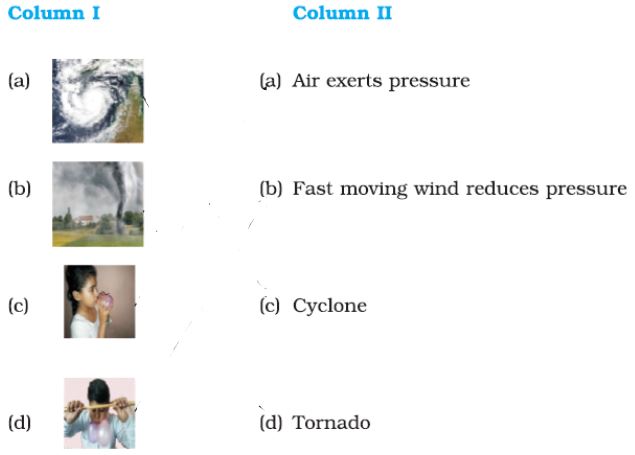
Answer : (i) - (c), (ii) - (d), (iii) - (a), (iv) - (b),
ACTIVITY- Air expands on heating.
Question. On cooling the boiling tube, the balloon expands. (True/False)
Answer : False.
Question. The air ………on heating.
Answer : Expands.
ACTIVITY- Air exerts pressure.
Question. Air exerts pressure. (True/False)
Answer : True.
Question. The can gets crushed because of the atmospheric pressure. (True/False)
Answer : True.
ACTIVITY- Hot air is lighter than Cold air.
Question. The paper cup over the burning candle comes down as it becomes heavier. (True/False)
Answer : False.
Question. Hot air is ………..than cold air.
Answer : Lighter.
ACTIVITY- High speed winds are accompanied by reduced air pressure.
Question. The fast moving wind creates …….….pressure.
Answer : Low.
Question. Both balloons should be of equal size. (True/False)
Answer : True.
Very Short Answer Type Questions.
Question. Which winds bring rain in India?
Answer : The Monsoon winds.
Question. Which property of air is described by the inflated balloon?
Answer : Air exerts pressure.
Question. Which region of earth gets maximum heat from the Sun?
Answer : Region near the equator.
Question. Name the instrument used for measuring the speed of wind.
Answer : Anemometer.
Question. Which is lighter, Cold air or Hot air?
Answer : Hot air.
Short Answer Type
Question. Why are the holes made in hanging banners and hoardings?
Answer : Holes in the banners and hoardings help air to pass through it. Hence banner can withstand the pressure of the air.
Question. What is Tornado? Give two safety measures.
Answer : A Tornado is a violent storm, with strong rotating winds in funnel shaped clouds. Safety measures:
(1) Take shelter inside a room in the house without windows.
(2) If a person is in vehicle, he should get out of it and lie in a low-lying area.
(3) Whenever you face Tornado you can save yourself by bending your knees and putting your arms around your head and neck.
Question. What is the difference between a thunderstorm and a cyclone?
Answer : A thunderstorm is a strong wind blowing with heavy rainfall along with thunder and lightning A Cyclone is a huge revolving storm, in which strong winds blow around a central area of low pressure.
Question. In which situation does the uneven heating of the earth produces winds?
Answer : (1) Uneven heating of regions near equator and Poles, (2) Uneven heating of land and water bodies.
Question. State effective measures to be taken in areas vulnerable to cyclones.
Answer : (1) Coastal areas should be thickly planted with tall and indigenous species of plants, which checks the speed of wind.
(2) Cyclone shelters should be constructed in cyclone vulnerable areas.
(3) In coastal areas, ponds should be built to absorb excess of water.
(4) An efficient forecast measure should be adopted and the warnings should be communicated in advance.
Question. Which winds blow from ocean to land in summer? What is their significance?
Answer : The Monsoon winds blow from ocean to land in summer in India. These winds cause rains in India.
Most of the agricultural activities in India are based on these winds.
Long Answer Type Questions.
Question. Explain with an activity that air expands on heating.
Answer : Fix a balloon tightly over the neck of the boiling test tube. As we place this test tube in hot water, balloon gets inflated. This proves that air expands on heating.
Question. Explain why does a tin can get crushed when water is boiled in it after closing it cold water is poured on it?
Answer : On boiling water in a tin, air gets out it as air expands on heating. So when we pour cold water on tin after closing, small air inside the tin gets contracted. Hence tin get crushed as pressure inside the tin is lower than atmospheric pressure.
Question. How is a cyclone formed? Describe how a cyclone caused widespread destruction in Odisha in 1999.
Answer : When water changes to water vapours to form clouds, it absorbs heat from the surroundings. When water vapours cool down and condense to form water drops (rain), they lose the absorbed heat. This heat warms the surrounding air. The warm air being lighter rises up, creating a low pressure area. Fast wind starts blowing around this area with thick clouds forming cyclone.
In India, Odisha was affected by a very strong cyclone in 1999. It destroyed 45000 houses making 70000 people homeless. High speed of wind accompanied by 9 meter high waves hitted the coastal area. Many people lost their lives and property worth of crores was destroyed.
Free study material for Science
Value-Based Questions (VBQs) for Class 7 Science Chapter 08 Winds Storms and Cyclones
Moral Practice Exercises: Class 7 Science Chapter 08 Winds Storms and Cyclones
Review important VBQs for Chapter 08 Winds Storms and Cyclones tailored for Class 7 learners. These structured exercises highlight core values and practical concepts essential for high-scoring exam performance.
NCERT-Aligned VBQ Solutions
Built using the official NCERT book for Class 7 Science, these solved problem sets provide reliable guidance. Cross-reference your answers with our expert-verified keys for complete conceptual clarity.
Complete Your Chapter Revision
Explore our wider library of free chapter notes, worksheets, and online mock tests to support your ongoing revision and secure top-tier academic results.
FAQs
The latest collection of Value Based Questions for Class 7 Science Chapter 08 Winds Storms and Cyclones is available for free on StudiesToday.com. These questions are as per 2026 academic session to help students develop analytical and ethical reasoning skills.
Yes, all our Science VBQs for Chapter 08 Winds Storms and Cyclones come with detailed model answers which help students to integrate factual knowledge with value-based insights to get high marks.
VBQs are important as they test student's ability to relate Science concepts to real-life situations. For Chapter 08 Winds Storms and Cyclones these questions are as per the latest competency-based education goals.
In the current CBSE pattern for Class 7 Science, Chapter 08 Winds Storms and Cyclones Value Based or Case-Based questions typically carry 3 to 5 marks.
Yes, you can download Class 7 Science Chapter 08 Winds Storms and Cyclones VBQs in a mobile-friendly PDF format for free.