

Class 7 Science Competency-Based Questions: CBSE Class 7 Science Heat VBQs
Review targeted competency-based resources with the CBSE Class 7 Science Heat VBQs. Built according to official CBSE standards for the 2026-27 academic year, these downloadable Class 7 Science VBQs support holistic learning and critical reasoning for Chapter 04 Heat.
Download Chapter 04 Heat VBQ PDF with Solutions
View or download the dedicated CBSE Class 7 Science Heat VBQs resource below. Engaging with these value-based scenarios ensures continuous academic progress and mastery of the 2026-27 exam format.
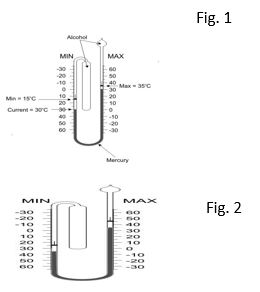
Question. A Maximum-Minimum thermometer has two stems which record the highest and lowest temperatures during a period of time. A small metallic piece in each stem indicates the temperature.
What are the MAXIMUM, MINIMUM AND CURRENT TEMPERATURES shown in this thermometer (Fig.2)
(a) 55oC, 35oC, 45oC
(b) 45oC, 25oC, 35oC
(c) 55oC, 25oC, 35oC
(d) 45oC, 25oC, 30oC
Answer : B
Question. Mercury and Alcohol are two common liquids used in thermometers. The boiling point of MERCURY is 357 oC, while its freezing point is -39 0C. For ALCOHOL, the boiling point is 78 oC and the freezing point is -80oC. It is required in a laboratory to make measurements which are in the region of -60oC. Which type of thermometer would be more suitable?
(a) A MERCURY thermometer since the freezing point of mercury is higher than -60oC.
(b) A MERCURY thermometer since the boiling point of mercury is as high as 357oC.
(c) An ALCOHOL thermometer since the boiling point of alcohol is lower at 78oC.
(d) An ALCOHOL thermometer since the freezing point of alcohol is lower than -60oC
Answer : D
Question. Which of these readings CANNOT be taken with the thermometer shown?

(a) 92oF
(b) 98.4oF
(c) 100.1oF
(d) 106oF
Answer : A
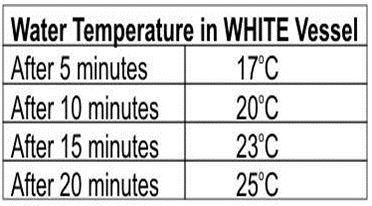
Question. The question is based on this experiment: Two identical vessels are taken and painted white and black respectively. Then the same quantity of water is poured into each one of them. Both the vessels are left in the sun, and the temperature is noted regularly.
The water temperature in the vessel painted white is recorded every five minutes as shown in the table below. What is the temperature in the vessel likely to be 30 minutes after it was left in the sun? (Select the closest temperature)
(a) 20 oC
(b) 25 oC
(c) 29 oC
(d) 35 oC
Answer : C
Question. The question is based on this experiment: Two identical vessels are taken and painted white and black respectively. Then the same quantity of water is poured into each one of them. Both the vessels are left in the sun, and the temperature is noted regularly.
The water is which vessel is likely to get hotter and why?
(a) The white vessel as white reflects more heat than black.
(b) The black vessel as black absorbs more heat than white
(c) The white vessel as white absorbs more heat than black.
(d) It will be same in both vessel as the material is the same.
Answer : B
Question. The specific heat capacity of a substance is the heat required to raise the temperature of 1kg of the substance by 1oC .The specific heat capacity of water is 4187 joules per degree celsius per kilogram. A bucket contains 4kg of water. What is the specific heat capacity of water in the bucket?
(a) 4187 J/oC/kg
(b) 16748 J/oC/kg
(c) 1047 J/oC/kg
(d) 8374 J/oC/kg
Answer : A
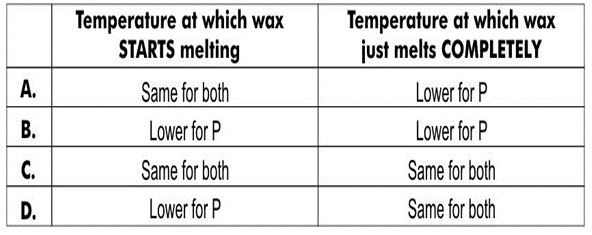
Question. Vessel P contains 150 grams of candle wax, while vessel Q contains 3 kilograms of the same material. Both are heated and start melting. Which of the following will be true about the temperature at which the wax just STARTS melting, and the temperature at which the wax melts COMPLETELY
(a) A
(b) B
(c) C
(d) D
Answer : C
Question. 3 ice cubes of similar shape and size were kept on three different surfaces - glass, copper and concrete. The first to completely melt was the cube on the copper surface, while the one on the glass surface melted last. Arrange Copper, Glass and Concrete from WORST heat conductor to BEST.
(a) glass, concrete, copper
(b) glass, concrete, copper
(c) copper, concrete, glass
(d) concrete, copper, glass
Answer : B
Question. The structure shown here is called a greenhouse. Greenhouses have glass panels that let in light but keep heat from escaping. In which regions would greenhouses of this type be used to grow plants?

(a) Regions that are very cold
(b) Regions that are very hot
(c) Regions that are very humid
(d) Regions that are very dry
Answer : A
Question. In a thermal power station coal is used to produce energy. Which of these shows the correct sequence of transformation of energy in a thermal power station?
(a) Mechanical -> Heat -> Electrical -> Chemical
(b) Chemical -> Electrical -> Heat -> Mechanical
(c) Heat -> Chemical -> Mechanical -> Electrical
(d) Chemical -> Heat -> Mechanical -> Electrical
Answer : D
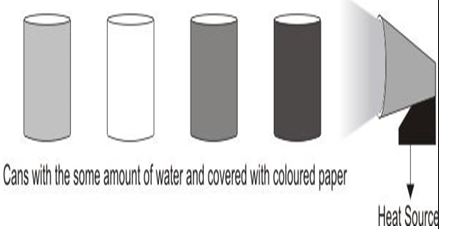
Question. Kamesh conducts the following activity to check if colour has any effect on heat absorption.He takes four identical cans with the same amount of water but covered with different coloured papers and places them near a heat source as shown in the figure. The temperature of the water in the cans is measured at regular intervals.The MISTAKE in Kamesh's experiment relates to:
(a) the amount of water being the same in each can
(b) the positioning of the cans with respect to the heat source
(c) the use of paper of different colours for covering the cans
(d) taking temperature readings at the same time in all the cans
Answer : B
Question. Which of these will definitely have a freezing point of 0 degree C and a boiling point of 100degree C?
(a) Rain water
(b) River Water
(c) Distilled water
(d) All the aboves
Answer : C
Question. The temperature inside a refrigerator (not in the freezer compartment) is likely to be around_________.
(a) -4 °Celsius
(b) 0° Fahrenheit
(c) 5°Celsius
(d) 100° Fahrenheit
Answer : C
Question. The diagram below shows a block of wood stuck in a metal container. Which of these is the best way to remove the block of wood undamaged?
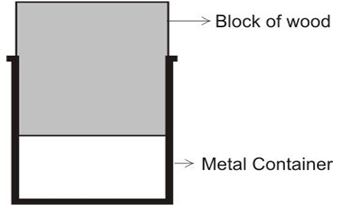
(a) Burn the wood.
(b) Drill holes in the metal container
(c) Submerge the container in water.
(d) Heat the metal container.
Answer : C
Question. In which of these following cases is energy released?
(a) when water is boiled
(b) when wood is burned
(c) when an object is dropped
(d) when a plant makes food
Answer : C
Question. One litre of water at 30ºC is mixed with one litre of water at 50ºC. Then temperature of mixture will be:
a) 80ºC
b) More than 50ºC but less than 80ºC
c) 20ºC
d) Between 30ºC and 50ºC
Answer : D
Question. Which is bad conductor of heat:
a) Aluminium
b) Iron
c) Copper
d) Wood
Answer : D
Question. Land breeze is:
a) Cool air from land to sea
b) Cool air from sea to land
c) Hot air from land to sea
d) Hot air from sea to land
Answer : A
Question. A wooden spoon is dipped in a cup of ice-cream. Its other end:
a) becomes cold by the process of conduction
b) becomes cold by the process of convection
c) becomes cold by the process of radiation
d) Does not become cold
Answer : D
Question. Temperature of human body is:
a) 100ºC
b) 0ºC
c) 37ºC
d) 98ºC
Answer : C
Fill In The Blanks.
(i). The hotness of an object is measured by its temperature.
(ii). The mode of heat transfer without any medium is called radiation.
(iii). Air is bad conductor of heat.
(iv). The normal temperature of human body is 37ºC.
Write True Or False.
Question. Metals are insulators of heat.
Answer : False
Question. We get heat from the sun by radiation.
Answer : True
Question. Wool is good conductor of heat.
Answer : False
Question. Sea breeze arises due to conduction.
Answer : False
Question. Range of clinical thermometer is 35ºC to 42ºC.
Answer : True
Match The Following :
| Column A | Column B |
| (i) Land breeze blows during | (a) winter |
| (ii) Sea breeze blows during | (b) night |
| (iii) We prefer light coloured clothes in | (c) day time |
| (iv) We prefer dark coloured clothes in | (d) summer |
Answer : (i) - (b), (ii) - (c), (iii) - (d), (iv) - (a),
ACTIVITY- To measure the temperature using clinical thermometer.
Question. The clinical thermometer can measure temperature above 45ºC. (T/F)
Answer : False.
Question. The normal temperature of our body is …………….
Answer : 37ºC.
ACTIVITY- Measurement of temperature of water by using a laboratory thermometer.
Question. The thermometer should not touch the …………….. of the beaker.
Answer : Bottom or sides.
Question. Thermometer should be held from its bulb. (True/False)
Answer : False.
ACTIVITY-Flow of heat through a metal strip.
Question. The handle of electric iron is good conductor of heat. (True/False)
Answer : False.
Question. The handle of cooking vessels are good conductor of heat. (True/False)
Answer : False.
ACTIVITY- Transfer of heat through liquids and gases.
Question. The liquids are always heated from the bottom. (True/False)
Answer : True.
Question. The ventilators in the rooms are used to expel cold air. (True/False)
Answer : False.
ACTIVITY- Dark colour objects absorb more heat.
Question. Dark coloured clothes absorb less heat. (True/False)
Answer : False.
Question. We wear light coloured clothes in winters. (True/False)
Answer : False.
Short Answer Type Questions.
Question. What is the use of kink in a clinical thermometer?
Answer : Kink prevents the level of mercury to fall down even after it is taken out of mouth.
Question. Why do we wear woolen clothes in winter?
Answer : Wool has air trapped inside; air is bad conductor of heat. So woolen clothes keep us warm in winters.
Question. What is lab thermometer? Write its range.
Answer : Laboratory thermometer is used to measure temperature of objects other than living bodies. Its range is usually from -10ºC to 110ºC.
Question. State the condition which determines the direction of flow of heat.
Answer : Heat always flows from hot body (high temperature) to cold body (low temperature).
Question. Why do we prefer dark clothes in winter and light one in summers?
Answer : Dark coloured clothes are better absorbers of heat than the light coloured clothes. So we prefer dark clothes in winter and light one in summers.
Question. What is clinical thermometer? Write its range.
Answer : Clinical thermometer is used to measure temperature of human body. Its range is from 35ºC to 42ºC.
Long Answer Type Questions.
Question. Explain the formation of sea breeze and land breeze in coastal areas.
Answer : During day time land gets heated due to sunlight. The air over the land gets heated, expands and rises upwards. The cooler air from the sea rushes towards the coast to take its place due to convection. This moving air is known as sea breeze.
During the night time, exactly the reverse happens. Due to its higher absorption capacity, the water cools down more slowly than the land, so cool air from the land move towards the sea, this moving air is known as land breeze.
Question. What are various modes of heat transfer? Explain.
Answer : (1) Conduction- The process by which heat is transferred from hotter end to the colder end of a sold body without actual movement of particles is known as conduction.
(2) Convection- The process of heat transfer due to actual movement of heated particles is called convection. Liquids and gases get heated by convection.
(3) Radiation- The process of heat transfer which does not require any medium is known as radiation.
Heat of the sun reaches earth by radiation.
Free study material for Science
VBQs with Answers for Class 7 Science Chapter 04 Heat
About Chapter 04 Heat Value-Based Questions
Review important VBQs for Chapter 04 Heat tailored for Class 7 learners. These structured exercises highlight core values and practical concepts essential for high-scoring exam performance.
How to Use These Value-Based Questions
Pair your practice with our comprehensive NCERT solutions for Class 7 Science to review detailed responses and master the underlying themes of this chapter.
Real-Life Applications in Science
Explore our wider library of free chapter notes, worksheets, and online mock tests to support your ongoing revision and secure top-tier academic results.
FAQs
The latest collection of Value Based Questions for Class 7 Science Chapter 04 Heat is available for free on StudiesToday.com. These questions are as per 2026 academic session to help students develop analytical and ethical reasoning skills.
Yes, all our Science VBQs for Chapter 04 Heat come with detailed model answers which help students to integrate factual knowledge with value-based insights to get high marks.
VBQs are important as they test student's ability to relate Science concepts to real-life situations. For Chapter 04 Heat these questions are as per the latest competency-based education goals.
In the current CBSE pattern for Class 7 Science, Chapter 04 Heat Value Based or Case-Based questions typically carry 3 to 5 marks.
Yes, you can download Class 7 Science Chapter 04 Heat VBQs in a mobile-friendly PDF format for free.