

Official CBSE VBQs for Class 7 Science
Explore authentic value-based practice materials through the CBSE Class 7 Science Soil VBQs. Tailored for Class 7 learners, utilizing these Science VBQs ensures thorough preparation and strengthens moral reasoning skills before final CBSE evaluations.
Competency-Based Practice for Science
View or download the dedicated CBSE Class 7 Science Soil VBQs resource below. Engaging with these value-based scenarios ensures continuous academic progress and mastery of the 2026-27 exam format.
Choose The Correct Answer.
Question. Which of these does not cause soil erosion:
a) Deforestation
b) Building of check dams
c) Grazing cattle
d) Mining
Answer : B
Question. Soil is polluted by:
a) Rotation of crops
b) Use of manure
c) Use of insecticides and fertilizers
d) Using green manure
Answer : C
Question. Soil is not used for:
a) Making insecticides
b) Making check dams
c) Making cement
d) Making earthen pots
Answer : A
Question. Which of the following can check soil erosion:
a) Deforestation
b) Afforestation
c) Grazing of cattle
d) Mining
Answer : B
Question. Soil is used for:
a) Making cement
b) Growing crops
c) Making dams
d) All of these
Answer : D
Fill In The Blanks.
(i) The top layer of earth up to a depth of 30-40 cm where crops can grow is called soil.
(ii) A section of earth shows horizons of soil.
(iii) Acidic nature or alkaline nature of soil can be tested by using a pH paper.
(iv) Clay has the finest particles which can even pass through muslin cloth.
(v) Sand soil has least water retention capacity.
(vi) Loamy soil is best for growing crops.
(vii) In western states of India like Gujarat and Maharashtra, the soil is of black colour.
(viii) Clay is used by potter for making earthen pots.
(ix) The soil which is used for making cement is clay
(x) Bricks are made from soil.
State True Or False.
Question. Water can easily percolate through clayey soil.
Answer : False
Question. pH paper is used to test the acidic or alkaline nature of soil.
Answer : True
Question. All crops grow better in sandy soil.
Answer : False
Question. Overgrazing of pasture lands is also responsible for soil erosion.
Answer : True
Question. Below a depth of 100 cm, the layer of earth is called soil.
Answer : False
Question. Mining can check soil erosion.
Answer : False
Match The Column ‘A’ With Column ‘B’.
| Column A | Column B |
| (i) Water can easily percolate through | (a). Pollution of soil |
| (ii) This soil is best for growing cotton | (b). Soil erosion |
| (iii) Polythene, plastic and use of insecticides cause | (c). Clay |
| (iv) Mining, Overgrazing and deforestation cause | (d). Black soil |
| (v) This soil is used in the manufacture of cement | (e). Sandy soil |
Answer : (i) - (e), (ii) - (d), (iii) - (a), (iv) - (b), (v) - (c),
ACTIVITY- To identify pH of soil.
Question. What is the chemical nature of the soil having pH 10?
Answer : Basic.
Question. What is the chemical nature of the soil having pH 3?
Answer : Acidic.
Question. Write down the pH of neutral soil.
Answer : 7 (seven).
ACTIVITY- To find the rate of percolation of water.
Question. Which soil has maximum water retention capacity?
Answer : Clay.
Question. In which type of soil rate of percolation is highest?
Answer : Sand.
ACTIVITY- To show the presence of air in the soil.
Question. What is the use of air present in soil?
Answer : Roots of plants use air present in soil.
Question. Why is soil tilled or ploughed?
Answer : The soil is tilled or ploughed to make it porous. Porous soil contains more air in it.
Very Short Answer Type Questions.
Question. Name the organic constituents of soil.
Answer : Dead and decaying leaves or plants, dead bodies of insects or other animals buried in soil, cow dung etc. make the organic constituents of soil.
Question. Define soil erosion.
Answer : The washing away of the top layer of the soil by the action of floods, winds, storms and mining etc. is called soil erosion.
Question. Name the inorganic constituents of soil.
Answer : Sand, gravel, clay, stones and minerals are the inorganic constituents of the soil.
Question. What is humus?
Answer : Dead and decaying leaves or plants, dead bodies of insects or other animals buried in soil, cow dung etc. make the organic matter known as humus.
Question. What do you mean by loamy soil?
Answer : The soil having particles size between clay and sand is known as loamy soil.
Short Answer Type Questions.
Question. Draw a labeled diagram of soil profile.
Answer :
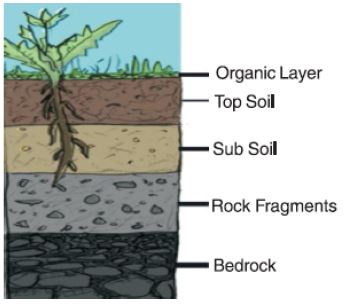
Question. What is soil profile?
Answer : Soil profile shows different layers of soil.
Question. List the difference between clay soil and sandy soil?
Answer :
| Clayey Soil | Sandy Soil |
| 1. It has very small particles. | 1. It has large particles. |
| 2. Water holding capacity is very high. | 2. Water holding capacity is very low. |
| 3. It is fertile. | 3 It is not fertile. |
| 4. Very less air is trapped between particles. | 4. Large air is trapped between particles. |
| 5. Particles are tightly packed. | 5. Particles are loosely packed. |
Question. What is check-dam? Why is it built?
Answer : In hilly areas check dams are built across small streams. This helps in preventing soil erosion.
Question. How does soil get polluted?
Answer : Soil gets polluted by –
(1) Excessive use of insecticides and chemical fertilizers,
(2) Throwing industrial waste, polythene and plastic waste in soil.
Question. Why should we plant more bamboo plants?
Answer : Growing bamboo plants are best for checking soil erosion.
Long Answer Type Questions.
Question. Explain the various factors responsible for soil erosion.
Answer : (1) Floods- floods wash away the top layer of soil.
(2) Wind or Storm- Wind or storm carry away the top layer of the soil.
(3) Deforestation- When trees are uprooted, the soil becomes loose and is easily washed away.
(4) Over Grazing- When a grassland is grazed by cattle again and again, the soil becomes bare and loose and is easily eroded.
(5) Mining- Mining for stones and minerals is also a major factor for soil erosion.
Question. Classify the soil on the basis of size of particles?
Answer : (1) Clay- Soil in which particles are very fine, can even pass through muslin cloth.
(2) Sand- The particles of sand are bigger than clay. Generally, the desert soil is sand.
(3) Gravel- This type of soil has very large size of particles which can be picked by hand.
(4) Loamy soil- Its particles are of the size between clay and sand. It is the best for soil for crops.
Question. How is soil erosion checked? Explain.
Answer : (1) Afforestation- By planting more and more trees we can check soil erosion.
(2) Controlled Mining- Mining should be done in such a way that the mining area should not become prone to soil erosion.
(3) Alternate Grazing- The cattle should not be allowed to graze in the same pasture regularly.
(4) Making check dams- In hilly areas check dams should be built across small streams. This helps in preventing soil erosion.
(5) Fields should be surrounded by soil embankments and grass should be grown on these.
(6) Banks of rivers, canals should be made with stones and concrete.
Question. Explain how is soil formed?
Answer : Soil is formed by the breaking down of rocks by the action of wind, water and climate. This process is called weathering. It takes many years for the formation of fertile soil.
Free study material for Science
Value-Based Questions (VBQs) for Class 7 Science Chapter 09 Soil
Moral Practice Exercises: Class 7 Science Chapter 09 Soil
Access targeted moral and value-driven questions for Class 7 Science Chapter 09 Soil. Designed to align with official CBSE guidelines, these problem sets test deep comprehension beyond standard textbook answers.
NCERT-Aligned VBQ Solutions
Pair your practice with our comprehensive NCERT solutions for Class 7 Science to review detailed responses and master the underlying themes of this chapter.
Complete Your Chapter Revision
Explore our wider library of free chapter notes, worksheets, and online mock tests to support your ongoing revision and secure top-tier academic results.
FAQs
The latest collection of Value Based Questions for Class 7 Science Chapter 09 Soil is available for free on StudiesToday.com. These questions are as per 2026 academic session to help students develop analytical and ethical reasoning skills.
Yes, all our Science VBQs for Chapter 09 Soil come with detailed model answers which help students to integrate factual knowledge with value-based insights to get high marks.
VBQs are important as they test student's ability to relate Science concepts to real-life situations. For Chapter 09 Soil these questions are as per the latest competency-based education goals.
In the current CBSE pattern for Class 7 Science, Chapter 09 Soil Value Based or Case-Based questions typically carry 3 to 5 marks.
Yes, you can download Class 7 Science Chapter 09 Soil VBQs in a mobile-friendly PDF format for free.