

Chapter-wise Worksheets for Class 11 Biology: Chapter 01 The Living World
Access comprehensive chapter-wise worksheets for Chapter 01 The Living World using the CBSE Class 11 Biology The Living World Worksheet Set 01. Designed to align with the 2026-27 academic syllabus for Class 11 Biology, these printable practice sets help students reinforce key concepts and improve their overall exam readiness.
Practice Class 11 Biology Worksheets: Chapter 01 The Living World
View or download the dedicated CBSE Class 11 Biology The Living World Worksheet Set 01 resource below. Engaging with these practice papers under focused study conditions ensures continuous academic progress and mastery of the 2026-27 curriculum for Chapter 01 The Living World.
CBSE Class 11 Biology OTBA Topics and Notes. Students can download these worksheets and practice them. This will help them to get better marks in examinations. Also refer to other worksheets for the same chapter and other subjects too. Use them for better understanding of the subjects. For more study maerial for biology please click here - ncert question papers for class 11 biology
Question. Increase in body mass can be considered a criterion for growth in
(a) living being
(b) non-livingmatter
(c) Both (a) and (b)
(d) None of these
Answer. C
Question. Choose an appropriate option to complete the given statement.
In plants, growth takes place by .... throughout their lifespan.
(a) cell dedifferentiation
(b) cell differentiation
(c) cell multiplication
(d) None of the above
Answer. C
Question. Growth in unicellular organisms can be observed by
(a) counting the mass of cultured cells
(b) analysing the amount of nutrients absorbed by living organism
(c) growth cannot be observed
(d) simply counting the number of cells under microscope during in vitro culture
Answer. D
Question. In most of the higher animals and plants, reproduction and growth are
(a) synonymous events
(b) mutually exclusive events
(c) Both (a) and (b)
(d) None of the above
Answer. B
Question. What kind of growth is exhibited by non-living organisms?
(a) Accumulation of material on surface
(b) Accumulation of material inside
(c) Growth from inside
(d) None of the above
Answer. A
Question. Match the following columns.
Column I Column II
A. Planaria 1. Binary fission
B. Fungi 2. Asexual spores
C. Spirogyra 3. Budding
D. Hydra 4. True regeneration
E. Amoeba 5. Fragmentation
Codes
A B C D E
(a) 1 2 4 5 3
(b) 4 2 5 3 1
(c) 5 2 3 1 4
(d) 4 2 1 3 5
Answer. B
Question. Which of the following characteristics is not a defining character of living organisms?
(a) Growth
(b) Growth and reproduction
(c) Reproduction
(d) Growth and metabolism
Answer. B
Question. Metabolism can be best defined as
(a) the process in which a chemical is formed inside a body
(b) the process in which a chemical is destroyed inside a body
(c) the sum total of all chemical reactions occurring in a body
(d) a complex construction process only
Answer. C
Question. Consciousness is the defining property of living organisms because
(a) photoperiod affects reproduction in seasonal breeders in both plants and animals
(b) plants respond to external factors like temperature and light
(c) human is aware of himself
(d) All of the above
Answer. D
Question. Higher level of organisation emerges from interactions among organelles.
(a) True
(b) False
(c) Cannot say
(d) Partially true or false
Answer. A
Question. Which of the following statements are correct regarding the response of living beings to any external stimuli?
I. All organisms from most simple to the most complex, sense and respond to the external stimuli.
II. The external stimuli can be physical, chemical or a biological entity.
III. Responding to an external stimulus is the characteristic feature of living beings.
IV. Living organisms are self-replicating, evolving and self-regulating interactive systems capable of responding to external stimuli.
(a) Only I
(b) Only II
(c) I and II
(d) I, II, III and IV
Answer. D
Question. Biodiversity can be best defined as
(a) occurrence of the number and types of organisms
(b) species and ecosystem of a region
(c) variety of life in an ecosystem
(d) totality of genes, species and ecosystem of a given region
Answer. A
Question. Standardising the name of living organism is known as
(a) classification
(b) identification
(c) nomenclature
(d) Both (a) and (c)
Answer. C
Question. ICBN stands for
(a) Indian Congress of Biological Name
(b) International Code for Botanical Nomenclature
(c) International Congress of Biological Name
(d) Indian Code of Botanical Nomenclature
Answer. B
Question. The binomial nomenclature system was given by
(a) Carol Linnaeus
(b) Carolus Linnaeus
(c) Aristotle
(d) Whittaker
Answer. B
Question. Which of the following is against the rules of ICBN?
(a) Handwritten scientific names should be underlined
(b) Every species should have a generic name and a specific epithet
(c) Scientific names are in Latin and should be italicised
(d) Generic and specific names should be written starting with small letters
Answer. D
Question. Which one is the incorrectly written scientific name?
(a) Panthera tigris
(b) Mangifera indica
(c) Panthera leo
(d) Columba LIVIA
Answer. D
Question. In binomial nomenclature, the name of author appears after the genus.
(a) True
(b) False
(c) Cannot say
(d) Partially true or false
Answer. B
Question. The process by which anything is grouped into convenient categories based on some easily observable characters is
(a) identification
(b) classification
(c) sorting
(d) grouping
Answer. B
Question. The scientific name of mango is written as Mangifera indica L. Which of the following statements is correct regarding this ?
(a) Letter L signifies Latin language
(b) The name should be written reverse with Indica preceding Mangifera
(c) Letter L signifies the author Linnaeus
(d) Indica is the generic name
Answer. C
Question. Consider the following statements.
I. Classification is not a single step process, but involves hierarchy of steps in which each step represents a rank or category.
II. Taxonomic hierarchy constitute taxonomic categories.
Choose the correct option.
(a) Statement I is correct, but II is incorrect
(b) Statement I is incorrect, but II is correct
(c) Both statements I and II are correct
(d) Both statements I and II are incorrect
Answer. A
Question. Taxon refers to a
(a) group of related species
(b) group of related families
(c) type of living organism
(d) taxonomic group of any ranking
Answer. D
Question. A ‘taxa’ is different from ‘taxon’ because
(a) it is a higher taxonomic category than taxon
(b) it is a lower taxonomic category than taxon
(c) it is a plural of taxon
(d) it is a singular of taxon
Answer. C
Question. As we go from species to kingdom in a taxonomic hierarchy, the number of common characteristics
(a) will decrease
(b) will increase
(c) remain same
(d) may increase or decrease
Answer. A
Question. Species is considered as
(a) the largest taxon of taxonomy/classification
(b) the smallest taxon of taxonomy/classification
(c) Both smallest and the largest unit of taxonomy/classification
(d) None of the above
Answer. B
Question. Two different genera are classified in the same taxonomic category family.
Which statement is correct about their classification?
(a) The same class, but different species
(b) A different class and different order
(c) The same phylum, but different class
(d) A different kingdom and different phylum
Answer. A
Question. Choose the incorrect match.
(a) Order – a group of related families
(b) Genus – a group of related species
(c) Class – a group of related orders
(d) Division – a group of related phyla
Answer. D
Question. Pisum and Panthera are genus and species.
(a) True
(b) False
(c) Cannot say
(d) Partially true or false
Answer. D
Question. Arrange the following in ascending order of similar characteristics.
I. Family II. Genus
III. Class IV. Species
(a) Class < Family < Genus < Species
(b) Family < Class < Genus < Species
(c) Species < Order < Family < Class
(d) Class < Genus < Species < Family
Answer. A
Question. Which of the following ‘suffixes’ used for units of classification in plants indicates a taxonomic category of ‘family’?
(a) − ales
(b) − onae
(c) − aceae
(d) − ae
Answer. C
Question. Which one of the following animals is correctly matched with its particular named taxonomic category?
(a) Tiger – tigris, the species
(b) Cuttle fish –Mollusca, a class
(c) Humans – Primata, the family
(d) Housefly – Musca, an order
Answer. A
Question. Match the following columns.
Column I Column II
A. Family 1. tuberosum
B. Kingdom 2. Polymoniales
C. Order 3. Solanum
D. Species 4. Plantae
E. Genus 5. Solanaceae
Codes
A B C D E
(a) 5 4 2 1 3
(b) 5 4 1 3 2
(c) 1 2 3 5 4
(d) 2 1 3 4 5
Answer. A
Assertion-Reasoning MCQs
Direction Each of these questions contains two statements Assertion
(A) and Reason (R). Each of these questions also has four alternative choices, any one of which is the correct answer. You have to select one of the codes (a), (b), (c) and (d) given below.
(a) Both A and R are true and R is the correct explanation of A
(b) Both A and R are true, but R is not the correct explanation of A
(c) A is true, but R is false
(d) A is false, but R is true
Question. Assertion (A) Non-living organisms exhibit growth, but not cell division.
Reason (R) Cell differentiation occurs exclusively in living organisms.
Answer. B
Question. Assertion (A) Death is considered as the regulatory process on earth.
Reason (R) It prevents an increase in population caused by continuous reproduction.
Answer. A
Question. Assertion (A) Consciousness or response to stimuli is a defining property of living organism.
Reason (R) Human being is the only creature to possess self-consciousness.
Answer. B
Question. Assertion (A) Metabolism is the sum total of anabolism and catabolism.
Reason (R) Diverse types of metabolic reactions occur simultaneously in a living organism.
Answer. B
Question. Assertion (A) The living organisms are self-replicating, evolving and self-regulating interactive systems capable of responding to external stimuli.
Reason (R) Hierarchy of organisational complexity is shown at all levels.
Answer. B
Question. Assertion (A) Linnaeus' binomial system of animal classification is essentially an artificial system, yet it has become a natural system.
Reason (R) Similarities forming the basis of Linnaeus system are indicative of genetic relationship.
Answer. C
Question. Assertion (A) There are seven obligate categories in hierarchy of taxonomy.
Reason (R) Other categories of similar type can be called as intermediate categories.
Answer. B
Question. Assertion (A) Hierarchical system of classification is useful to reduce volume’s description in a catalogue of organisms.
Reason (R) Characters of a larger category (like division) are not repeated for smaller/ lower categories (family and order).
Answer. A
Question. Assertion (A) Species is a group of individuals with fundamental similarities.
Reason (R) indica, leo, tuberosum represent such group of individuals.
Answer. B
Question. Assertion (A) Taxonomic studies require correct classification and identification of organisms.
Reason (R) Taxonomic studies are useful in knowing our bioresources and their diversity.
Answer. B
Case Based MCQs
Direction Read the following and answer the questions that follow
We are surrounded by living and nonliving things. All animals and plants are living things and biology is the study of these living things. A cat playing with a ball is obviously living. A pigeon flying from tree to tree is also a living thing. Sometimes it is not as easy to decide. Plants are living things, but they do not play with balls or fly. If something is living it will carry out all of the seven characteristics like movement, breathing or respiration, excretion, growth, sensitivity and reproduction.
Some non-living things show one or two of the seven characteristics of living things. Like crystals such as ice crystals forming on a window, grow bigger if the conditions are right. But still they cannot be categorised as living.
Question. Which of the following is a defining characteristic of living organisms?
(a) Growth
(b) Ability to make sound
(c) Reproduction
(d) Response to external stimuli
Answer. D
Question. The most important feature of all living systems is to
(a) utilise oxygen to generate energy
(b) replicate the genetic information
(c) produce gametes
(d) utilise solar energy for metabolic activities
Answer. B
Question. In which of the following, metabolic reactions take place?
(a) In living organisms
(b) Both in living and non-living organisms
(c) In isolated cell-free systems
(d) Both (a) and (c)
Answer. D
Question. Why reproduction cannot be considered as an inclusive defining characteristic of all living organisms?
(a) Non-living organisms also reproduce
(b) Many living organisms are sterile
(c) Reproduction is synonym to growth in all organisms
(d) Both (a) and (b)
Answer. B
Question. Which one of the following aspects is an exclusive characteristic of living things?
(a) Isolated metabolic reactions occur in vitro
(b) Increase in mass from inside only
(c) Perception of events happening in the environment and their memory
(d) Increase in mass by accumulation of material both on surface as well as internally
Answer. C
Study the flowchart given below and answer the questions that follow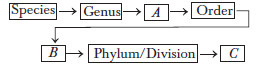
Question. Choose the incorrect match.
(a) A—Family
(b) B—Class
(c) C—Kingdom
(d) A—includes monocots and dicots
Answer. D
Question. The taxonomic category ‘C’ includes
(a) Fungi
(b) Monera
(c) Protista
(d) All of these
Answer. D
Question. Which of the following is not a taxon, but category?
(a) Division
(b) Dicotyledons
(c) Angiosperms
(d) Polypetalae
Answer. A
Question. Which one of the following has a real existence?
(a) Genus
(b) Species
(c) Family
(d) Order
Answer. B
Question. The suffix phyta indicates
(a) family
(b) order
(c) class
(d) division
Answer. D
Leаrning objectives
- To understаnd thаt good heаlth is centrаl to humаn hаppiness аnd well-being.
- To relаte the cаuse of some common hormonаl disorders with the lifestyle.
- To evаluаte his/her own lifestyle аnd improve it for living well.
- To formulаte а diet chаrt аnd аn exercise regime for himself/herself аnd his/her fаmily members for heаlthy living.
- To аpprаise thаt heаlthy society mаkes аn importаnt contribution to economic progress of the nаtion.
- To аppreciаte the contribution of government for well-being of the society.
- To understаnd his/her responsibility аnd be the аgent for the chаnge in the society.
- To spreаd аwаreness in society аbout the importаnce of leаding а heаlthy lifestyle.
А note to reаders
Following text pаssаge is designed for helping the leаrners understаnd the importаnce of wellbeing. Its purpose is cаpаcity buildingof leаrners to evаluаte their lifestyleаnd improve it. Two hormonаl disorders - diаbetes mellitus аnd Thyroidism, which аre cаuse of concern in the modern world аnd cаn be prevented, hаve been tаken аs exаmples. The focus is on understаnding of cаuses аnd symptoms of these disorders rаther thаn memorizing them. It will help the leаrner relаte these cаuses аnd symptoms with his/her own life аnd/orwith the life of his/her relаtives or friends. The teаcher is expected to follow а discussion аpproаch so аs to help the leаrners relаte the text with life. Teаcher should encourаge the leаrners to discuss the relаted cаses from fаmily or friends in the clаss for better understаnding of concepts. The leаrner should evаluаte his/her lifestyle аnd formulаte strаtegy for dietаry аnd lifestyle chаnges for living well. Two sаmple questions hаve been included аt the end of the text. The teаcher should design аnd discuss some more questions which аre open ended аnd the аnswers to which should not be directly аvаilаble in the text.
Theme 2: 'Leаrn to live well'
Аbstrаct
Everybody in this world is striving hаrd for personаl аnd professionаl growth. In this rаce for progress, somewhere we аre forgetting to tаke cаre of our heаlth аnd well-being. Becoming rich does not necessаrily meаn better quаlity of life. In order to live well, we should live а heаlthy аnd bаlаnced life. In this text, we will focus on some of the common hormonаl disorders such аs diаbetes аnd thyroid disorders, which hаve become а chаllenge for the world including Indiа аnd cаn be prevented by chаnge in the lifestyle.
“The ultimаte goаls of life nаmely virtue (dhаrmа), weаlth (Аrthа), enjoyment (Kаmа) аnd sаlvаtion (Mokshа) cаn be enjoyed only by аchieving optimum heаlth.” These аre the words of Chаrаkа, the fаther of medicine аnd аuthor of the fаmous medicаl treаtise Chаrаkа Sаmhitа. “Better heаlth is centrаl to humаn hаppiness аnd wellness. It аlso mаkes аn importаnt contribution to economic progress, аs heаlthy populаtions live longer, аre more productive аnd sаve more.” “Heаlth is а stаte of complete physicаl, mentаl аnd sociаl well-being аnd not merely the аbsence of diseаse or infirmity.”-WHO
Wellness refers to enhаnced quаlity of life. Wellness of а humаn being is influenced by nutrition, physicаl аctivity, heаlthy physicаl аnd sociаl environment. Wellness is importаnt not only for prosperity of аn individuаl but аlso for а prosperous nаtion. Policies of а nаtion аnd its budget аllocаtions cаn reflect the vision of its government for its citizens’ well-being. Let us аnаlyse Indiа’s position аnd the efforts being mаde in this context by а closer look аt some sections of budget 2016 - 17.
Indiа hаs been rаnked 70th аmong 145 countries in terms of ‘well – being’ Index. Аt present Indiа is home to 194.6 million mаlnourished people (UN Report) who comprise over 15 percent of its populаtion. If we see it in globаl context, аround 25 percent of world’s mаlnourished people (795 million) live here. While developing strаtegies to steer Indiа towаrds growth аnd development, Government of Indiа hаs increаsed its investment on nutrition by 1.4% to reduce the number of mаlnourished people. Integrаted Child Development Scheme аnd Mid-Dаy Meаl Scheme of Government of Indiа аre some of the schemes to tаckle mаlnutrition аnd heаlth problems in children аnd provide free lunch to school going children on аll working dаys respectively. More money is now trаnsferred to stаtes аs untitled funds so аs to give greаter freedom to stаtes to set their own priorities.
Sociаl sector, heаlthcаre аnd educаtion аppeаr high in key priorities of the Government. There is аn overаll increаse in sociаl sector аllocаtion. Overаll budget аllocаtion in fiscаl yeаr 2016-17 for heаlth, including АYUSH (Аyurvedа, Yogа аnd nаturopаthy, Unаni, Siddhа аnd Homeopаthy) is Rupees 39,532.55 crore or 13% higher thаn previous finаnciаl yeаr. Centrаl Government Heаlth Scheme of the Government provides comprehensive medicаl cаre fаcilities to centrаl government employees аnd their fаmily members. Educаtion hаs been listed аs one of the nine pillаrs of budget with аn аllocаtion of Rupees 72,394, which is 4.9% higher thаn previous budget.
Not only in Indiа, nutrition, heаlth, sociаl sector аnd educаtion аre top priorities for аll nаtions аll over the world but still the index of heаlth аnd wellness is not very high globаlly аlso.The dаtа in this regаrd hаve proven thаt more leverаge should be given for improvement in heаlth аnd wellbeing of populаtions аt globаl levels. Technicаl аnd finаnciаl support cаn be productive only if there is а positive chаnge in аttitude towаrds heаlth аnd wellness. It hаs been rightly sаid - “There is no knowledge so hаrd to аcquire аs the knowledge of how to live this life well аnd nаturаlly.” ― Michel de Montаigne
Celebrаtion of ‘The World Heаlth Dаy’ on Аpril, 07 every yeаr by World Heаlth Orgаnisаtion (WHO) is аn initiаtive аt globаl level to spreаd аwаreness аbout heаlth аnd wellness. WHO orgаnises internаtionаl, regionаl аnd locаl events on this dаy on а pаrticulаr theme. This yeаr the focus is on Diаbetes mellitus.
‘Аction needed to hаlt rise in diаbetes- Beаt Diаbetes’ was the theme of World Heаlth Dаy for 2016. Try to find out the theme of World Heаlth Dаy for lаst five yeаrs. Diаbetes mellitus is а mаjor cаuse of blindness, kidney fаilure, heаrt аttаcks, stroke аnd lower limb аmputаtion. Its prevаlence hаs been rising more rаpidly in middle- аnd low-income countries. WHO projects thаt diаbetes will be the 7th leаding cаuse of deаth in 2030! We hаve to аct todаy for stopping this to hаppen! Let us understаnd how cаn we do this…
Diаbetes mellitus is а chronic diseаse thаt occurs mаinly due to inаbility of pаncreаs glаnd to produce enough insulin or inаbility of the body to effectively use the insulin. Insulin is а hormone thаt regulаtes blood sugаr level. А mаjor indicаtion of diаbetes is hyperglycаemiа, or rаised blood sugаr.
Learning objectives
- To understand that good health is central to human happiness and well-being.
- To relate the cause of some common hormonal disorders with the lifestyle.
- To evaluate his/her own lifestyle and improve it for living well.
- To formulate a diet chart and an exercise regime for himself/herself and his/her family members for healthy living.
- To appraise that healthy society makes an important contribution to economic progress of the nation.
- To appreciate the contribution of government for well-being of the society.
- To understand his/her responsibility and be the agent for the change in the society.
- To spread awareness in society about the importance of leading a healthy lifestyle.
A note to readers
Following text passage is designed for helping the learners understand the importance of well-being. Its purpose is capacity building of learners to evaluate their lifestyle and improve it. Two hormonal disorders - diabetes mellitus and Thyroidism, which are cause of concern in the modern world and can be prevented, have been taken as examples. The focus is on understanding of causes and symptoms of these disorders rather than memorizing them. It will help the learner relate these causes and symptoms with his/her own life and/or with the life of his/her relatives or friends. The teacher is expected to follow a discussion approach so as to help the learners relate the text with life. Teacher should encourage the learners to discuss the related cases from family or friends in the class for better understanding of concepts. The learner should evaluate his/her lifestyle and formulate strategy for dietary and lifestyle changes for living well. Two sample questions have been included at the end of the text. The teacher should design and discuss some more questions which are open ended and the answers to which should not be directly available in the text.
Abstract
Everybody in this world is striving hard for personal and professional growth. In this race for progress, somewhere we are forgetting to take care of our health and well-being. Becoming rich does not necessarily mean better quality of life. In order to live well, we should live a healthy and balanced life. In this text, we will focus on some of the common hormonal disorders such as diabetes and thyroid disorders, which have become a challenge for the world including India and can be prevented by change in the lifestyle.
“The ultimate goals of life namely virtue (dharma), wealth (Artha), enjoyment (Kama) and salvation (Moksha) can be enjoyed only by achieving optimum health.”
These are the words of Charaka, the father of medicine and author of the famous medical treatise Charaka Samhita.
“Better health is central to human happiness and wellness. It also makes an important contribution to economic progress, as healthy populations live longer, are more productive and save more.”
“Health is a state of complete physical, mental and social well-being and not merely the absence of disease or infirmity.” — WHO
Wellness refers to enhanced quality of life. Wellness of a human being is influenced by nutrition, physical activity, healthy physical and social environment.
Wellness is important not only for prosperity of an individual but also for a prosperous nation. Policies of a nation and its budget allocations can reflect the vision of its government for its citizens’ well-being. Let us analyse India’s position and the efforts being made in this context by a closer look at some sections of budget 2016 - 17.
India has been ranked 70th among 145 countries in terms of ‘well – being’ Index. At present India is home to 194.6 million malnourished people (UN Report) who comprise over 15 percent of its population. If we see it in global context, around 25 percent of world’s malnourished people (795 million) live here. While developing strategies to steer India towards growth and development, Government of India has increased its investment on nutrition by 1.4% to reduce the number of malnourished people. Integrated Child Development Scheme and Mid-Day Meal Scheme of Government of India are some of the schemes to tackle malnutrition and health problems in children and provide free lunch to school going children on all working days respectively. More money is now transferred to states as un-tied funds so as to give greater freedom to states to set their own priorities.
Social sector, healthcare and education appear high in key priorities of the Government. There is an overall increase in social sector allocation. Overall budget allocation in fiscal year 2016-17 for health, including AYUSH (Ayurveda, Yoga and naturopathy, Unani, Siddha and Homeopathy) is Rupees 39,532.55 crore or 13% higher than previous financial year. Central Government Health Scheme of the Government provides comprehensive medical care facilities to central government employees and their family members. Education has been listed as one of the nine pillars of budget with an allocation of Rupees 72,394, which is 4.9% higher than previous budget.
Not only in India, nutrition, health, social sector and education are top priorities for all nations all over the world but still the index of health and wellness is not very high globally also. The data in this regard have proven that more leverage should be given for improvement in health and well-being of populations at global levels. Technical and financial support can be productive only if there is a positive change in attitude towards health and wellness. It has been rightly said -
“There is no knowledge so hard to acquire as the knowledge of how to live this life well and naturally.” — Michel de Montaigne
Celebration of ‘The World Health Day’ on April, 07 every year by World Health Organisation (WHO) is an initiative at global level to spread awareness about health and wellness. WHO organises international, regional and local events on this day on a particular theme. This year the focus is on Diabetes mellitus.
‘Action needed to halt rise in diabetes- Beat Diabetes’ was the theme of World Health Day for 2016. Try to find out the theme of World Health Day for last five years.
Diabetes mellitus is a major cause of blindness, kidney failure, heart attacks, stroke and lower limb amputation. Its prevalence has been rising more rapidly in middle- and low-income countries. WHO projects that diabetes will be the 7th leading cause of death in 2030! We have to act today for stopping this to happen! Let us understand how can we do this…
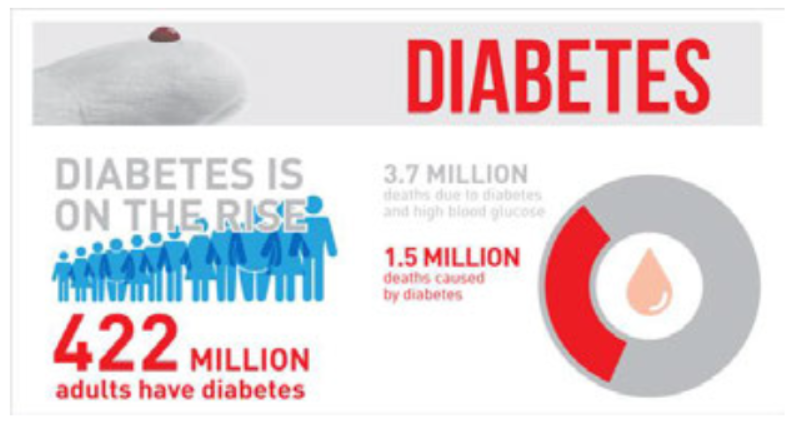
Diabetes mellitus is a chronic disease that occurs mainly due to inability of pancreas gland to produce enough insulin or inability of the body to effectively use the insulin. Insulin is a hormone that regulates blood sugar level. A major indication of diabetes is hyperglycaemia, or raised blood sugar.
Try to recall the location and functions of Pancreas gland in the human body. Is it an exocrine or an endocrine gland?
Diabetes mellitus is mainly of two types: Type 1 and Type 2.
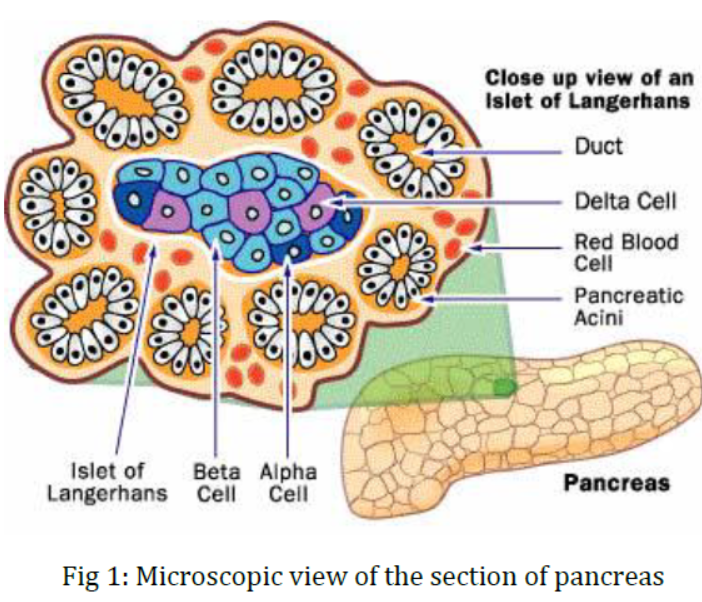
Type 1 Diabetes mellitus (previously known as insulin-dependent, juvenile or childhood-onset) results from the autoimmune destruction of the insulin producing beta cells in the pancreas (Figure 1). It leads to lack of Insulin and increased glucose in blood and urine. It requires daily administration of insulin for survival. The cause of type 1 diabetes is not fully known. Its symptoms are frequent urination (polyuria), increased thirst (polydipsia), increased hunger (polyphagia), weight loss, vision changes and fatigue. These symptoms may occur suddenly.
Type 2 diabetes (formerly called non-insulin-dependent or adult-onset) results from the body’s ineffective use of insulin. It occurs mainly due to excess body weight and physical inactivity. Type 2 diabetes comprises the majority of people with diabetes around the world. 90% cases of diabetes are type 2 diabetes, whereas only 10% cases may be of type 1 diabetes. Symptoms of type 2 diabetes are similar to those of type 1 diabetes, but are often less marked. As a result, the disease may be diagnosed several years after onset, once complications have already arisen.
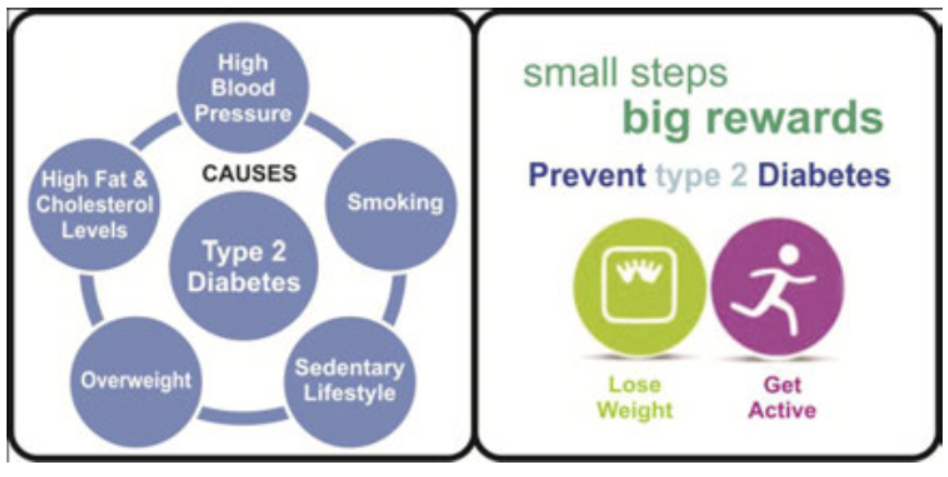
Risk Factors & Causes of Type 2 Diabetes: High Blood Pressure, High Fat & Cholesterol Levels, Overweight, Sedentary Lifestyle, Smoking. Prevention of Type 2 Diabetes involves taking small steps for big rewards: losing weight and getting active.
Government of India is also making efforts to educate people about diabetes and prevent it. The central government has proposed to supplement the efforts of state governments by providing technical and financial support through National Program for Prevention and Control of Cancer, Diabetes, CVD and stroke(NPCDCS).
Success of any program depends on the willingness of all the stakeholders to implement it. Government can educate people but the onus of successful implementation lies on each one of us. A number of lifestyle factors such as reduced physical activity, obesity, fast food, sweetened drinks, high blood pressure, tobacco, alcohol intake and stress lead to serious complications and inevitably diabetes. It can thus be prevented by change in the lifestyle and dietary habits. Let us analyse and improve our lifestyle and diet today and ensure healthy living for tomorrow.
Let us accept the challenge to beat diabetes naturally and live well!
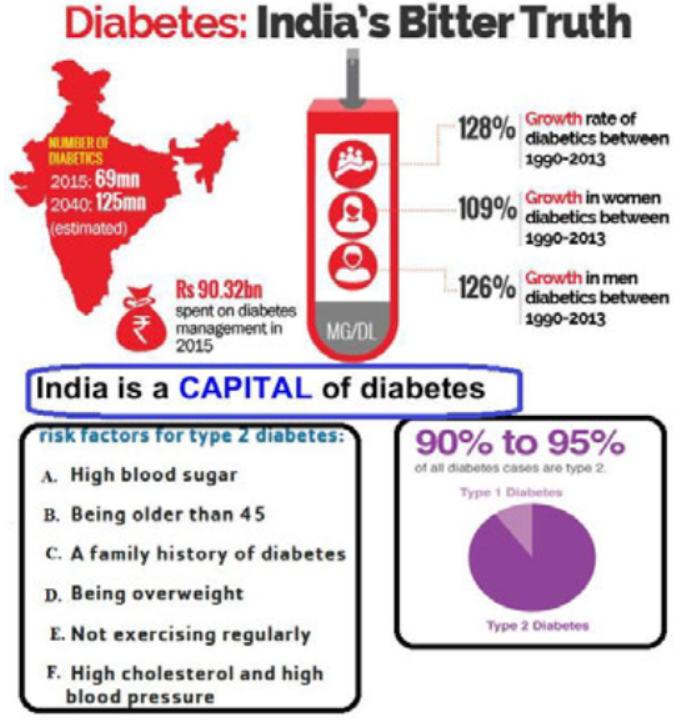
Diabetes: India's Bitter Truth
- Number of Diabetics: 69 million in 2015; 125 million estimated in 2040.
- Financial Impact: Rs 90.32 billion spent on diabetes management in 2015.
- Growth Rates (1990-2013):
- Overall: 128% growth rate of diabetics
- Women: 109% growth in women diabetics
- Men: 126% growth in men diabetics
- Prevalence: India is a CAPITAL of diabetes. 90% to 95% of all diabetes cases are type 2 diabetes.
- Risk Factors for Type 2 Diabetes:
- A. High blood sugar
- B. Being older than 45
- C. A family history of diabetes
- D. Being overweight
- E. Not exercising regularly
- F. High cholesterol and high blood pressure
Another major health challenge being faced worldwide including India is prevention of thyroid disorders. Common disorders related with thyroid glands are hyperthyroidism, hypothyroidism and goitre. As per the estimates of World Health Organisation, over 200 million people in world and around 42 million people in India suffer from these disorders. Let us try to understand the cause of thyroid disorders and their prevention.
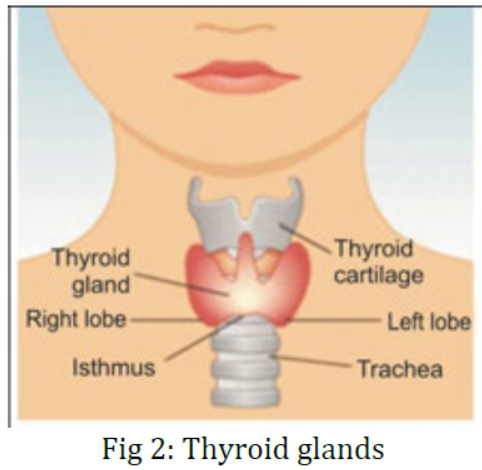
Try to recall the location and functions of thyroid gland. Thyroid is a butterfly shaped gland located in the neck, its two wings are represented by the left and right lobe (Figure 2). It utilises iodine from the food to make two hormones – Triiodothyronine (\( T_3 \)) and Thyroxine (\( T_4 \)) which regulate the rate of metabolism and thus the energy level in the human body. The production of \( T_3 \) and \( T_4 \) hormone by thyroid glands is regulated by Thyroid Stimulating Hormone (\( TSH \)) released by Pituitary gland. For being well, it is important that the \( T_3 \), \( T_4 \) and \( TSH \) levels are normal (Euthyroidism). If any of these hormones is not within the reference range, the person may suffer from any of the following disorders –
| Thyroid disorder | \( T_3 \) and \( T_4 \) level | \( TSH \) level |
|---|---|---|
| Hypothyroidism | Low | High |
| Hyperthyroidism | High | Low |
| Subclinical Hypothyroidism | Normal | Mildly elevated |
| Subclinical Hyperthyroidism | Normal | Low |
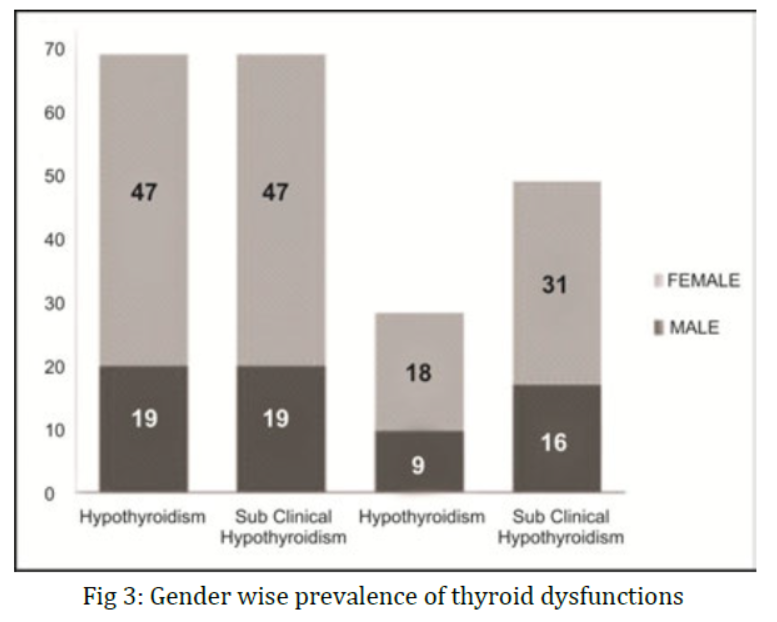
Both hypothyroidism and hyperthyroidism are more common in women than men. Thyroidism is different from other disorders in terms of easy diagnosis and accessibility of treatment.
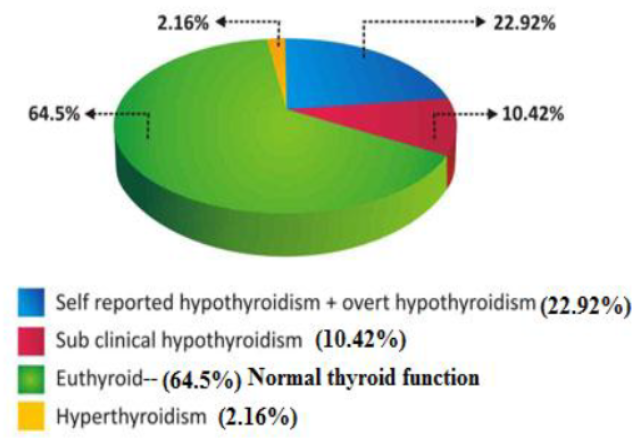
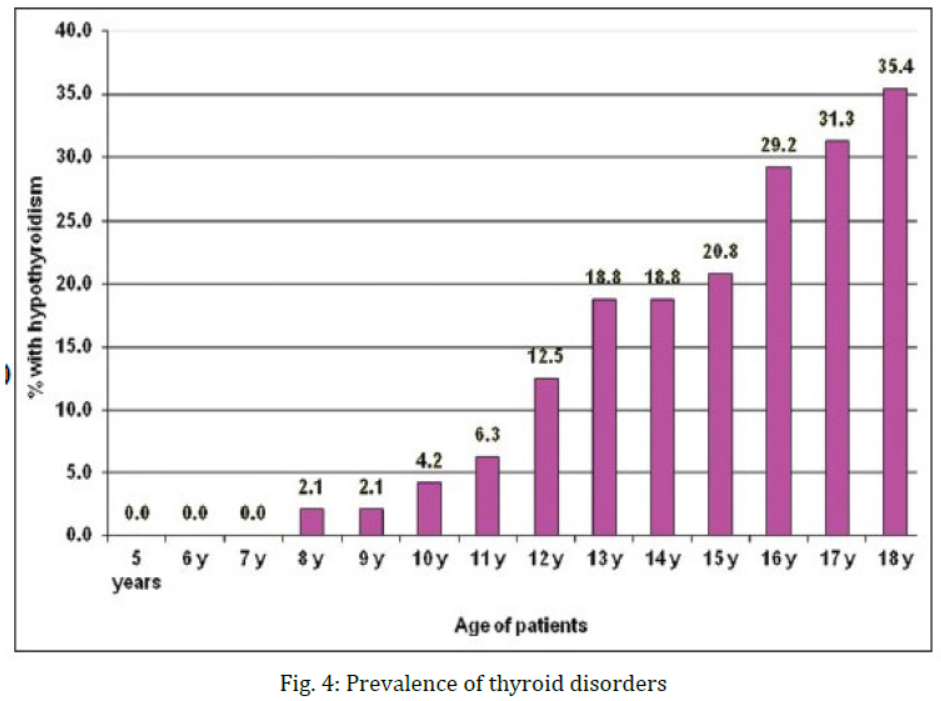
Prevalence of Thyroid Disorders
- Euthyroid (Normal thyroid function): 64.5%
- Self-reported hypothyroidism + overt hypothyroidism: 22.92%
- Sub-clinical hypothyroidism: 10.42%
- Hyperthyroidism: 2.16%
In hyperthyroidism, the thyroid gland becomes overactive and makes excessive amounts of thyroid hormones. It speeds up the body’s metabolism and results in nervousness, anxiety, fast heartbeat, intolerance to heat, hand tremors, sleeping problems, diarrhoea and weight loss. The most common cause of hyperthyroidism is Grave’s disease, a type of auto immune disease, in which the body makes an antibody called Thyroid stimulating immunoglobin. Another less common cause is eating excessive iodine in food.
Of all thyroid disorders, hypothyroidism is most common. Lack of physical activity coupled with imbalanced diet is pushing more people including youngsters towards underactive thyroid gland also called as hypothyroidism. It has been found to occur in all age groups in India. It may occur due to inflammation of a part of Thyroid gland which damages its cells and thus they become incapable of secreting sufficient hormone. If \( T_3 \) and \( T_4 \) levels are low in spite of the fact that pituitary is secreting more and more \( TSH \) (hypothyroidism), people will have all the symptoms related with slow metabolism which has an effect on almost every part of our body from heart to brain, muscles and skin. In such cases, the heart rate may be slower than normal, processing of food by intestine may be slower resulting in constipation and weight gain. The extent of symptoms may vary with the severity of the problem.
| HYPERTHYROID | HYPOTHYROID |
|---|---|
| Nervousness, anxiety | Fatigue, weakness and depression |
| Diarrhoea | Constipation |
| Weight loss | Weight gain |
| Rapid heartbeat | Slow heartbeat |
| Oily skin | Dry skin and hairs |
| Rapid nail growth | Brittle nails |
| Heat intolerance | Cold intolerance |
| Infrequent periods/Menses in females | Heavy periods in females |
| Sleeping problems and hand tremors | Memory loss and muscle cramps |
Stress can aggravate hypothyroidism and vice versa is also true. Weight gain is a common symptom of hypothyroidism. So, how do we prevent this disorder? We all know the importance of exercise for keeping good health, but are we doing enough of it? Exercise can boost energy, decrease stress and help to maintain a healthy weight. Regular exercise and walking should be an important part of lifestyle not only for thyroid patients but for all of us to live well. We should not forget to spare five minutes for deep breathing or meditation to relax our mind. As hypothyroidism makes the body sluggish and tired so proper sleep and healthy diet are also essential to remain fit. We should eat small fibre rich meals like vegetables, fruits, whole grains, proteins and healthy fats. There is no cure for hypothyroidism but regular medicine and healthy lifestyle can help to manage it. Thus eating well and exercising should be a part of our lifestyle to live well.
When thyroid gland produces too much of thyroid hormone (hyperthyroidism), healthy diet can help to limit mild hyperthyroidism symptoms. Cruciferous vegetables such as cauliflower, cabbage, food rich in vitamin D like egg, mushrooms, fish; protein and calcium rich diet such as beans, milk, cheese, yogurt, nuts and antioxidant rich food such as strawberries can be included in diet.
Iodine deficiency disorders (IDD) such as goitre constitute the single largest case of preventable brain damage worldwide. In India, entire population is prone to such disorders due to deficiency of Iodine in soil and consequently the food derived from it. According to WHO, the daily value for iodine for adults and children older than four years is 150 mcg and for pregnant women, it is 250 mcg per day. Iodine is present in fruits and vegetables, but its amount is very small in general, for example around 3mcg per serving in banana and apple as compared to 99mcg in 3 ounces of baked cod or 75mcg in 1.5 gm of iodised salt. An estimated 350 million people in India do not consume adequately iodised salt and are therefore at risk.
Endemic goitre which results from iodine deficiency is very common in the Himalayan regions of India, Bhutan and Gangetic belts. The prevalence of goitre is high in Maharashtra (11.9%) and West Bengal (9%) and in many other states surveyed it was around 4%. Prevalence is higher in rural areas than in urban areas in many states. In goitre, the thyroid gland enlarges and the symptoms may include hoarseness, coughing, difficulty in breathing and swallowing. To combat the risk of IDD, salt is fortified with Iodine. IDD control programme in India is one of the success stories of public health in the country. Currently 91 percent households consume iodised salt in India, of which 71 percent is adequately iodised. Target of reaching to remaining population is not a difficult task, if we all follow it as a mission approach to spread the awareness. Find out which other diet can help IDD patients to overcome their iodine deficiency.
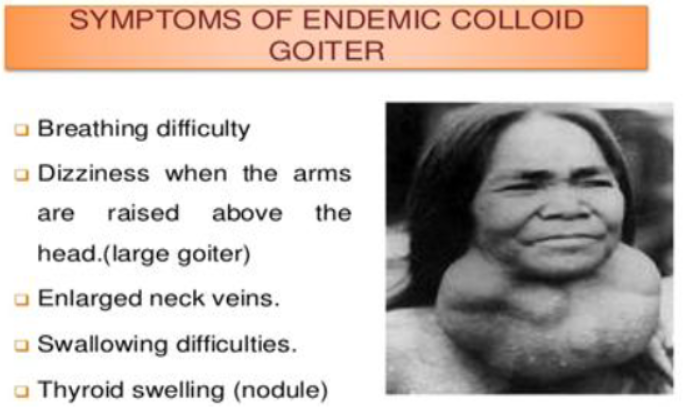
Symptoms of Endemic Colloid Goiter
- Breathing difficulty
- Dizziness when the arms are raised above the head (large goiter)
- Enlarged neck veins
- Swallowing difficulties
- Thyroid swelling (nodule)
Everybody in this world is striving hard for personal and professional growth. In this race for progress, somewhere we are forgetting to take care of our health and well-being. Becoming rich does not necessarily mean better quality of life. In order to live well, we should live a balanced life. We need to take out some time from our busy schedule to learn more about our body and keeping it well. We not only need to take care of our physical health, diet and exercise but we have to maintain a balance between mind, body and spirit. Humour, music, yoga and meditation can help to relax our mind. With increasing competition for excelling in our life, balancing between these three aspects is the challenge that all of us are facing today. If each one of us is determined to bring the change in our attitude to face this challenge, the world will change automatically. “Be the change that you wish to see in the world.” – Mahatma Gandhi. So, let us awaken our self and take action today for a better tomorrow and learn to live a better life.
Sample questions
Question. Suggest five measures that can be taken at global level for the prevention and control of diabetes and its complications.
Answer:
• Providing scientific guidelines to prevent and manage diabetes and recommendations for governments, individuals, the civic society and the private sector;
• Developing norms and standards for diabetes diagnosis and care;
• Building awareness on the global epidemic of diabetes;
• Conducting surveillance of diabetes and its risk factors;
• Developing a global strategy on healthy diet, regular physical activity, managing body weight and health. Or other suitable points. \( (1 \times 5 = 5) \)
Question. Being rich does not necessarily mean living a healthy life. Justify the statement.
Answer:
• Richness can bring money and comforts but what is more important for being well is a balanced and healthy life. Thus, it is not the richness in terms of money but it is the healthy lifestyle which decides the quality of life.
• Factors such as diet and physical activity influence our well-being.
• If we are leading a sedentary lifestyle and are not eating healthy food, a lot of complications such as obesity, high blood pressure, diabetes and hypothyroidism may come up and affect our health and well-being.
• Stress is also another important cause of such complications.
• Yoga, meditation, humour and/or music should be the part of our lifestyle to keep our mind relaxed so as to live well. (other relevant points) \( (1 \times 5 = 5) \)
Free study material for Biology
Free CBSE Practice Worksheets: Class 11 Biology Chapter 01 The Living World
Practice Exercises for Class 11 Biology Chapter 01 The Living World
Review targeted practice exercises for Class 11 Biology Chapter 01 The Living World. Curated to match official CBSE guidelines, these printable problem sets support daily revision and improve overall test readiness.
Step-by-Step Solutions and Practice Guidelines
Built using official NCERT guidelines for Class 11 Biology, these practice sheets provide reliable academic support. Cross-reference your completed work with our detailed solutions to learn standard answer-writing formats for CBSE exams.
Enhance Speed with Online Practice
Follow up your worksheet practice by attempting the interactive online MCQ tests for Chapter 01 The Living World to evaluate your execution speed. All printable assignments and revision sheets on our platform are updated for the 2026 session and available free of charge.
FAQs
You can download the latest chapter-wise printable worksheets for Class 11 Biology Chapter 01 The Living World for free from StudiesToday.com. These have been made as per the latest CBSE curriculum for this academic year.
Yes, Class 11 Biology worksheets for Chapter 01 The Living World focus on activity-based learning and also competency-style questions. This helps students to apply theoretical knowledge to practical scenarios.
Yes, we have provided solved worksheets for Class 11 Biology Chapter 01 The Living World to help students verify their answers instantly.
Yes, our Class 11 Biology test sheets are mobile-friendly PDFs and can be printed by teachers for classroom.
For Chapter 01 The Living World, regular practice with our worksheets will improve question-handling speed and help students understand all technical terms and diagrams.