

Practice Worksheets for Class 7 English: All Chapters
Review targeted practice sets for Class 7 English All Chapters. Built according to official educational guidelines for the 2026-27 academic year, these downloadable worksheets support daily revision and core concept reinforcement.
Practice All Chapters Worksheets for Class 7 English
Access the complete worksheet PDF for All Chapters below. Regular practice with these targeted questions builds familiarity with standard exam patterns and helps secure higher marks in final English evaluations.
The parts of speech explain how a word is used in a sentence.
There are eight main parts of speech:-
noun, pronoun, adjective, adverb, preposition, conjunction and interjection.
1) NOUN - (Naming words)
A noun is the name of a person, place, thing or idea.
Examples - Rohit, London, teacher, bird,
table, happiness, hope, group etc.
2) PRONOUN - (Replaces a noun )
A pronoun is used in place of a noun or nouns to avoid repetition.
Examples - I, we, you, me, they, he, she, it, them, him, her, this, those etc.
3) ADJECTIVE - ( Describing words )
An adjective describes, modifies or gives more information about a noun or pronoun.
Examples - big, little, happy, young, old, three etc.
4) VERB - ( ACTION WORDS)
A verb shows an action or state of being. It shows what someone or something is doing.
Examples - go, speak, learn, come, walk, live, eat etc.
5) ADVERB - ( Describes a verb )
An adverb describes/ modifies a verb, an adjective or another adverb. It answers how, where, when, how often or to what extent .
Examples - slowly, early, tomorrow, here, never, too etc.
6) PREPOSITION - ( Shows relationship )
A preposition shows the relationship of a noun or pronoun to another word. They can indicate time, place or relationship .
Examples - at, on, in, between, near, about, under etc.
7)CONJUNCTION - ( Joining words )
A conjunction joins two words, ideas, phrases or clauses together in a sentence and shows how they are connected.
Examples - or, and, but, because, so, unless, yet etc.
8) INTERJECTION - ( Expressive word )
An interjection is a word or phrase that expresses a strong feeling or emotion. It is a short exclamation.
Examples - Wow!, Ouch!, Help!, Oh!, Hi! etc.
Q.) Read the following sentences and choose the appropriate answer from the options given below :-
1.) She went to the market and bought some eggs. Here went is a ................................
verb
adverb
noun
2.) I want to go now. Here now is a/an ..............................
verb
adjective
adverb
3.) What are you doing there? Here there is a/an ..................................
adjective
adverb
verb
4.) There is a mouse underneath the piano. Underneath is a/an ....................................
conjunction
preposition
adverb
5.) Masons build houses. Masons is a/an .....................................
verb
adverb
noun
6.) John is my best friend. Here John is a/an ....................................
Proper noun
Collective noun
Common noun
7.) She looked up but didn’t see anything. Here up is a/an ....................................
verb
adverb
conjunction
8.) My family lives in different parts of India. Here family is a/an ....................................
common noun
abstract noun
collective noun
9.) That was a difficult question. Here difficult is a/an....................................
adjective
adverb
preposition
10.)She was very impressed with her results. Here very is a/an
adjective
adverb
noun
Words such as many, much, enough, lots of, a little, and several tell us quantity without giving an exact number. They are called Quantifying Determiners.
1) Few - means not many. It is a negative adjective.
Ex. Few people came to attend the function.
A few - means some. It is an affirmative adjective.
Ex. My parents bought a few dresses for me.
The few - means all of them, though very few. Plural noun is used after the few.
Ex. The few men present there.
2) Little - means not much. It is negative adjective.
Ex. There was little water in the pot.
A little - means some at least. It is an affirmative adjective.
Ex. I drink a little tea in the evening.
The little - means the whole, though very little.
Ex. The little food is not enough for his hunger.
3) Much - with uncountable nouns.
Ex. There is much water in a jug.
4) Many - with countable nouns.
Ex. Many flats are still vacant in this apartment.
5) Some - to indicate an unspecified number or quantity with affirmative sentence.
Ex. Some roses were still blooming.
6) Several - denotes only number.
Ex. Several people are recovering from COVID -19.
7) Enough - denotes both the number and quantity.
Ex. There are enough books in our school library.
8) Too -To talk and ask about problems of quantity. It is used in negative way.
9) Fewer - used to refers the number
Ex. There are no fewer than fifty guests in the party.
10) Both - used for two objects/ persons/ animals
Ex. - She took both the dresses from the shop.
11) All - determine number and quantity.
Ex. All work is done by students.
Q.1 Choose the correct Quantifying determiners from the brackets :-
1) There are --------------- biscuits in the packet.( a few, a little, a lot)
2) I have ------------- money than you. ( a lot, fewer, less)
3) There are------------- people in the super market. (little, a lot, fewer )
4) Meena has ---------------- friends. ( lot of , lots of, a lot)
5) We are going to be late. There is ------------- traffic. ( much, many, any )
6) Can you bring cold drinks to the party . I don't have ---------------( any, much, some )
7) Now I have ---------------- (less, several, fewer ) stress.
8) The polls say there 's---------------- support by citizens. ( Much, little, a little )
9)--------------- player will get the chance to play. ( every, any, each )
10) She took ---------------- hours to compare her work. ( enough, many, several )
NOTE Do the above mentioned exercise in a copy or on a paper.
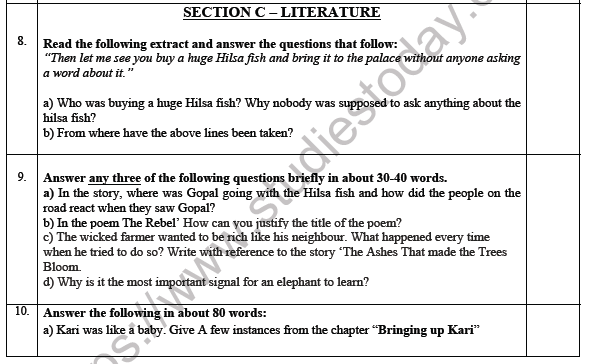
Please click on below link to download CBSE Class 7 English Woksheet Set A
Free study material for English
Exam Preparation Worksheet for Class 7 English All Chapters
All Chapters Printable Worksheet for Class 7 English
Access structured practice worksheets for All Chapters designed in alignment with the latest CBSE curriculum for Class 7 English. These printable problem sets help students build accuracy and prepare effectively for school tests.
How to Use These Practice Sheets
Cross-reference your completed exercises with comprehensive NCERT solutions for Class 7 English to ensure absolute clarity across all sub-topics in this chapter.
Enhance Speed with Online Practice
Wrap up your chapter revision by testing your knowledge against standard question formats. Everything on our platform is provided free of charge.
FAQs
You can download the teacher-verified PDF for CBSE Class 7 English Worksheet Set 01 from StudiesToday.com. These practice sheets for Class 7 English are designed as per the latest CBSE academic session.
Yes, our CBSE Class 7 English Worksheet Set 01 includes a variety of questions like Case-based studies, Assertion-Reasoning, and MCQs as per the 50% competency-based weightage in the latest curriculum for Class 7.
Yes, we have provided detailed solutions for CBSE Class 7 English Worksheet Set 01 to help Class 7 and follow the official CBSE marking scheme.
Daily practice with these English worksheets helps in identifying understanding gaps. It also improves question solving speed and ensures that Class 7 students get more marks in CBSE exams.
All our Class 7 English practice test papers and worksheets are available for free download in mobile-friendly PDF format. You can access CBSE Class 7 English Worksheet Set 01 without any registration.