

Download NCERT Solutions for Class 8 Social Science Chapter 10 Law and Social Justice
Review structured textbook solutions for Class 8 Social Science Chapter 10 Law and Social Justice. Built according to NCERT guidelines for the 2026-27 academic year, these downloadable answers support daily revision and problem-solving accuracy.
Access NCERT Solutions and Answers
Access the complete solution PDF for Class 8 Social Science below. Regular practice with these targeted textbook answers builds familiarity with standard question patterns and helps secure higher marks in final school evaluations.
NCERT Solutions for Class 8 Social Science Civics for Chapter 10 Law and Social Justice
Q2. What are the advantages to foreign companies in setting up production in India?
Ans.
The main reason why foreign companies come to India is cheap labour. Wages that the companies pay to workers in developed countries are far higher than what they have to pay to workers in poorer countries like India. For lower pay, companies can get longer hours of work. Additional expenses such as for housing facilities are also lesser. Thus, companies can save costs and earn higher profits.
Another reason is that any risk of pollution and harmful radiations is also exported to other countries. Union Carbide gas tragedy in Bhopal is an example of how Indian people became victims of the poisonous gases that leaked from the plant owned by a US company.
Q3. Do you think the victims of the Bhopal gas tragedy got justice? Discuss.
Ans.
The victims of Bhopal gas tragedy have not yet got justice. Initially, the Union Carbide had refused to accept any responsibility altogether, despite so many clear proofs. The UC got away after paying a bare minimum compensation to the survivors of this tragedy. Even after 24 years, the survivors are still fighting for justice, for safe drinking water, for health-care facilities and jobs for those affected by the tragedy. Their cases are still pending in numerous courts.
Q4. What do we mean when we speak of law enforcement? Who is responsible for the enforcement? Why is enforcement so important?
Ans.
It is the duty of the government to make laws and ensure that people abide by them. This responsibility of the government as law maker and law enforcer is referred to as law enforcement. Enforcement is important to maintain the democratic status of India; if foreign companies are allowed to maintain low working conditions, then this interferes with the Fundamental Right of the Right to Life, of a worker. Hence, enforcement is necessary to protect the people.
Q5.How can laws ensure that markets work in a manner that is fair? Give two examples to support your answer.
Ans.
Laws can ensure that markets work in a fair manner in the following ways-
Frequently upgraded Minimum Wages Law ensures that workers are not exploited and over-worked by companies that hire them.
Law keeps checks on the quality of production. This makes sure that sub-standard goods do not enter the market.
Q7. Write a paragraph on the various roles of the government that you have read about in this unit.
Ans.
The legislature is supposed to frame laws to protect people from any type of exploitation. Government appoints different types of employees and officials to enforce its laws and regulations. Those found guilty of violating these laws are arrested by the police or other departments. They are taken to courts (court of laws or consumers courts etc.). Punishment is awarded to law-breakers by the judiciary. It is the duty of the government to ensure that workers get payment in accordance with Minimum Wages Law. The government also has to see that children below 14 years are not exploited. The government also has to ensure that women workers are paid equally as men. Finally, the government has to keep revising the Minimum Wages Law from time to time.
Q8. What are the sources of environmental pollution in your area? Discuss with respect to (a) air; (b) water and (c) soil. What are the steps being taken to reduce the pollution? Can you suggest some other measures?
Ans.
Sources of environmental pollution with respect to:
(a) Air-
1.Vehicles
11.Factory chimneys
(b) Water-
1.Disposal of dead bodies
11.Factory waste
(c) Soil-
1.Pesticides
11.Chemical fertilizers
Awareness regarding environmental issues has been increased in recent times. Courts in our country have also come up with several orders over environmental issue. The Delhi government had recently introduced the odd-even numbers car policy to reduce vehicular movement on the road. Many river cleaning projects are also going on.
Here are some suggestions that may improve the environment further:
Every company or factory that seeks registration/license to open its unit should be required to plant a certain number of trees as a condition of getting the registration/license.
To reduce vehicular movement, the odd-even policy should be introduced in the entire country.
Stricter safety norms should be followed by factories to reduce pollution and avert Bhopal type of tragedies.
Q9. How was environment treated earlier? What has been the change in perception? Discuss.
Ans.
Earlier, there was very little or no awareness about environmental issues. There was indiscriminate cutting of forests, killing of wildlife, disposal of wastes into rivers and so on. Factory owners bothered the least about the environment.
Today the perception regarding environmental issues has totally changed. People have understood the importance of a clean environment. They have understood that this planet has to be conducive for our future generation to survive. Industrial development cannot be at the cost of human lives. The Bhopal gas tragedy has been an eye opener. The courts also gave a number of judgments upholding the right to a healthy environment as intrinsic to the Fundamental Right to life.
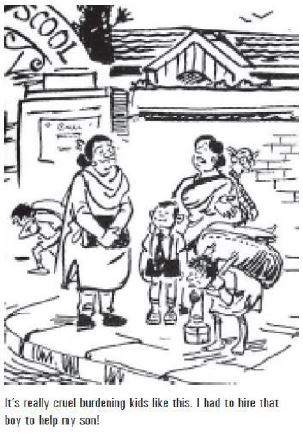
Q10. What do you think the famous cartoonist R.K.Laxman is trying to convey in this cartoon? How does it relate to the 2006 law that you read about on page 125?
Ans.
In this cartoon, we can see a woman condemning the 'cruel burdening of kids', but at the same time she herself is burdening another child. This cartoon conveys the message that mere making of laws is not enough until and unless each one of us understands our responsibility and acts accordingly.
In October 2006, the government amended the Child Labour Prevention Act, banning children under the age of 14 years from working as domestic helps, or as workers in dhabas, restaurants, tea shops, etc. It made employing these children as a punishable offence. This cartoon clearly depicts the violation of this Act.
Free study material for Social Science
NCERT Solutions for Class 8 Social Science Chapter 10 Law and Social Justice
Official NCERT Solutions for Chapter 10 Law and Social Justice
Explore reliable textbook solutions for Chapter 10 Law and Social Justice tailored for Class 8 learners. Utilizing these complete exercise answers ensures your preparation aligns exactly with official NCERT standards for Social Science.
Step-by-Step Explanations for Chapter 10 Law and Social Justice
Beyond providing final answers, these guides offer step-by-step breakdowns for complex queries in the Class 8 Social Science module. This approach helps students balance theoretical depth with practical problem-solving skills required for NCERT exams.
Next Steps in Your Social Science Revision
Frequent review of these structured answers builds strong analytical capabilities and response efficiency. Maximize your academic readiness by combining these textbook solutions with our curated study materials and mock evaluations for Class 8 Social Science.
FAQs
The complete and updated NCERT Solutions Class 8 Social Science Chapter 10 Law and Social Justice is available for free on StudiesToday.com. These solutions for Class 8 Social Science are as per latest NCERT curriculum.
Yes, our experts have revised the NCERT Solutions Class 8 Social Science Chapter 10 Law and Social Justice as per 2026 exam pattern. All textbook exercises have been solved and have added explanation about how the Social Science concepts are applied in case-study and assertion-reasoning questions.
Toppers recommend using NCERT language because NCERT marking schemes are strictly based on textbook definitions. Our NCERT Solutions Class 8 Social Science Chapter 10 Law and Social Justice will help students to get full marks in the theory paper.
Yes, we provide bilingual support for Class 8 Social Science. You can access NCERT Solutions Class 8 Social Science Chapter 10 Law and Social Justice in both English and Hindi medium.
Yes, you can download the entire NCERT Solutions Class 8 Social Science Chapter 10 Law and Social Justice in printable PDF format for offline study on any device.