

NCERT Solutions for Class 8 Social Science: Chapter 10 The Changing World of Visual Arts
Explore reliable textbook solutions for Chapter 10 The Changing World of Visual Arts tailored for Class 8 learners. Utilizing these Social Science answers ensures thorough preparation and strengthens foundational knowledge before final NCERT evaluations.
Practice Class 8 Social Science Solutions: Chapter 10 The Changing World of Visual Arts
Navigate directly to the solved Social Science textbook exercises using the digital viewer below. Each solution includes detailed step-by-step explanations, allowing students to instantly cross-check their work and identify areas requiring further revision.
NCERT Solutions for Class 8 Social Science History for Chapter 10 The Changing World of Visual Arts
Let’s recall
1. Fill in the blanks:
(a) The art form which observed carefully and tried to capture exactly what the eye saw is called realism.
(b) The style of painting which showed Indian landscape as a quaint, unexplored land is called picturesque.
(c) Paintings which showed the social lives of Europeans in India are called Company paintings.
(d) Paintings which depicted scenes from British imperial history and their victories are called “history painting”.
2. Point out which of the following were brought in with British art:
(a) oil painting (b) miniatures (c) life-size portrait painting (d) use of perspective (e) mural art
Answer:
(a) Oil painting, (c) life-size portrait painting and (d) use of perspective.
3. Describe in your own words one painting from this chapter which suggests that the British were more powerful than Indians. How does the artist depict this?
Answer:
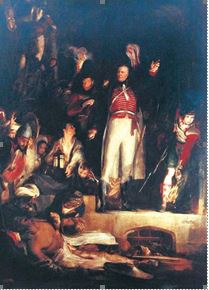
(i)The oil painting titled The discovery of the body of Sultan Tipu by General Sir David Baird, 4 May 1799, painted by David Wilkie in 1839 suggests that the British were more powerful than Indians.
(ii)In this painting, General Baird, who led the British army that stormed Tipu’s fort, is shown victorious in the middle.
(iii)The lantern lights up Baird, making him visible to the spectator.
(iv)Tipu lies dead (left corner), his body hidden in semi- darkness. His forces are defeated, his royal clothes torn and stripped off.
(v)The painting seems to announce: this is the fate of those who dare to oppose the British.
4. Why did the scroll painters and potters come to Kalighat? Why did they begin to paint new themes? Answer:
(i)In Bengal, around the temple of Kalighat in Calcutta, local village scroll painters (called patuas) and potters (called kumors in eastern India and kumhars in north India) developed a new style of art.
(ii) In the early nineteenth century, the city was emerging as a vibrant commercial and administrative centre.
(iii)Colonial offices, new buildings, roads and markets were being established; the city offered many opportunities for people.
(iv)Village artists too came and settled in the city in the hope of new patrons and new buyers of their art.
(v)Before the nineteenth century, the village patuas and kumors painted mythological themes and images of gods and goddesses. After the 1840s, a new trend within the Kalighat Artists emerged.
(vi)Their paintings depicted rapid changes in the society’s values, tastes, social norms and customs; they produced paintings on social and political themes.
(vii)Many of the late-nineteenth-century Kalighat paintings depicted social life under British rule.
(viii)Often the artists mocked at the social changes and ridiculed the new tastes of those who spoke in English and adopted Western habits, dressed like sahibs, smoked cigarettes, or sat on chairs.
(ix)They made fun of the westernised baboo, criticised the corrupt priests, and warned against women moving out of their homes.
(x)They often expressed the anger of common people against the rich, and the fear many people had about dramatic changes of social norms.
5. Why can we think of Raja Ravi Varma’s paintings as national?
Answer:
(i)Raja Ravi Varma was one of the first artists who tried to create a style that was both modern and national.
(ii)He was an expert in the Western art of oil painting and realistic life study, but painted themes from Indian mythology.
(iii)He dramatised on canvas, scene after scene from the Ramayana and the Mahabharata, drawing on the theatrical performances of mythological stories.
(iv)From the 1880s, his mythological paintings became the rage among Indian princes and art collectors, who filled their palace galleries with his works.
(v) His paintings which dealt with the themes of the ancient Indian culture can be considered as national in expression.
Let’s discuss
6. In what way did the British history paintings in India reflect the attitudes of imperial conquerors? Answer:
(i)The category of imperial art, called “history painting” sought to dramatise and recreate various episodes of British imperial history.
(ii)It also enjoyed great prestige and popularity during the late eighteenth and early nineteenth centuries.
(iii)British victories in India served as rich material for history painters in Britain.
(iv)These painters drew on firsthand sketches and accounts of travellers to depict for the British public a favourable image of British actions in India.
(v)These paintings once again celebrated the British: their power, their victories, and their supremacy.
7. Why do you think some artists wanted to develop a national style of art?
Answer:
(i)In Bengal, a new group of nationalist artists inspired by Abanindranath Tagore rejected the art of Ravi Varma as imitative and westernised.
(ii)They declared that such a style was unsuitable for depicting the nation’s ancient myths and legends.
(iii)They felt that a genuine Indian style of painting had to draw inspiration from non-Western art traditions, and try to capture the spiritual essence of the East.
(iv)So they broke away from the convention of oil painting and the realistic style, and turned for inspiration to medieval Indian traditions of miniature painting and the ancient art of mural painting in the Ajanta caves.
8. Why did some artists produce cheap popular prints? What influence would such prints have on the minds of people who looked at them?
Answer:
(i)By the late-nineteenth century, mechanical printing presses were set up in different parts of India, which allowed prints to be produced in even larger numbers.
(ii)These prints could therefore be sold cheap in the market; even the poor could buy them.
(iii)Such cheap prints helped in spreading certain ideas among the masses. For example, with the spread of nationalism, popular prints of paintings depicted the Bharat Mata as a Goddess carrying the national flag and helped in instilling a sense of nationhood among the Indians.
Free study material for Social Science
Free NCERT Textbook Explanations: Class 8 Social Science Chapter 10 The Changing World of Visual Arts
Chapter Exercise Answers for Class 8 Social Science
Review comprehensive exercise answers for Class 8 Social Science Chapter 10 The Changing World of Visual Arts. Fully updated to match current NCERT syllabus guidelines, these textbook solutions help students verify their work and maintain accurate study notes.
Detailed Answer Guides for Chapter 10 The Changing World of Visual Arts
Clear, methodical explanations accompany every challenging problem within the Class 8 Social Science text. Engaging with these detailed answers lays a solid foundation for advanced learning and improves foundational clarity for upcoming assessments.
Complete Preparation Kit for Class 8 Exams
Consistent practice with these solution guides cultivates faster problem-solving habits and clearer logical structuring. For a complete preparation experience, pair these textbook answers with our dedicated revision notes and sample papers for Class 8 Social Science.
FAQs
The complete and updated NCERT Solutions Class 8 Social Science Chapter 10 The Changing World of Visual Arts is available for free on StudiesToday.com. These solutions for Class 8 Social Science are as per latest NCERT curriculum.
Yes, our experts have revised the NCERT Solutions Class 8 Social Science Chapter 10 The Changing World of Visual Arts as per 2026 exam pattern. All textbook exercises have been solved and have added explanation about how the Social Science concepts are applied in case-study and assertion-reasoning questions.
Toppers recommend using NCERT language because NCERT marking schemes are strictly based on textbook definitions. Our NCERT Solutions Class 8 Social Science Chapter 10 The Changing World of Visual Arts will help students to get full marks in the theory paper.
Yes, we provide bilingual support for Class 8 Social Science. You can access NCERT Solutions Class 8 Social Science Chapter 10 The Changing World of Visual Arts in both English and Hindi medium.
Yes, you can download the entire NCERT Solutions Class 8 Social Science Chapter 10 The Changing World of Visual Arts in printable PDF format for offline study on any device.