

Official NCERT Solutions for Class 4 Mathematics: Chapter 14 Smart Charts
Explore reliable textbook solutions for Chapter 14 Smart Charts tailored for Class 4 learners. Utilizing these Mathematics answers ensures thorough preparation and strengthens foundational knowledge before final NCERT evaluations.
Chapter-wise Solutions for Mathematics: Chapter 14 Smart Charts
View or download the dedicated Chapter 14 Smart Charts solution resource below. Engaging with these textbook answers under focused study conditions ensures continuous academic progress and mastery of the 2026-27 curriculum for Mathematics.
NCERT Solutions for Class 4 Mathematics Math Magic for Chapter 14 Smart Charts
1. How many Hours?
(a) How much time do we spend in this?
Ans. We spend about one hour per day watching television (TV) or listening to the radio.
(b) Note the time you spend in front of a TV or radio everyday. Do this for one week. The time spent in a week is 11 hours. So in a month you spend 30 x 11 = 330 hours.
Find out from the friends the time they spend in a week.
Ans. The given table is completed after asking my friends as under:
| How many hours they watch
TV or listen to the radio? |
Number of children |
| More than 6 hours | 8 |
| Six hours | 10 |
| Five hours | 12 |
| Four hours | 17 |
| Three hours | 13 |
| Two hours | 8 |
| One hours | 5 |
| Zero hour (do not watch) | 2 |
(c). From your table:
Watch TV/ listening to the radio.
Ans. (i)8 children spend more than 6 hours in a weak.
(ii)2 children spend no time at all.
(iii)Most children spend four hours in a week.
(iv)47 children spend more than 3 hours.
2. Ask people in your family to name one programme they like and one programme they dislike. Make a table.
Ans. The required table is as follows:
| Family Member | Programme they like | Programme they dislike |
| Mother | Movie | Sports |
| Father | Sports | Serials |
| Grandmother | Religious | Serials |
| Grandfather | Religious | Sports |
| Uncle | Religious | Plays |
| Brother | Cartoons | Plays |
| Sister | Serials | Sports |
Most of the family member like religious programme. Most of the family members dislike sports.
3. Find out from friends the programmes they like and dislike, and write in a table.
Ans. The required table is as under:
| Kind of Programme | Number of children liking it | Number of children disliking it |
| News | 3 | 17 |
| Serials | 5 | 15 |
| Cartoons | 19 | 1 |
| Comedy | 14 | 6 |
| Sports | 18 | 2 |
(a) Which kind of programme is liked by most children?
Ans. Cartoons is liked by most of the children.
(b) Which kind of programme is disliked by the least number of children?
Ans. Cartoons is disliked by the least number of children.
(c) How many children like sports programme?
Ans. 18 children like sports programmes.
(d) Is there any kind of programme not liked by anyone? Yes/No. If yes, which one?
Ans. There is no such programme which is not liked by anyone.
4. Who is my friend?
Read the poem carefully and answer these questions:
(a) Which word comes most often in the poem?
Ans. Let us prepare the following table to answer the questions:
| Letter | Tally Marks | No. of letters | Letter | Tally Marks | No. of letters |
| A | IIIIIIIII | 10 | N | IIIIIIIIIIIII | 13 |
| B | I | 1 | O | IIIIII | 6 |
| C | II | 2 | P | – | |
| D | IIIIIII | 7 | Q | – | |
| E | IIIIIIIIII | 20 | R | IIIIII | 6 |
| IIIIIIIIII | |||||
| F | II | 2 | S | IIIIIIIIII | 10 |
| G | II | 2 | T | IIIIIIIIII | 10 |
| H | IIIIIIIIIIIIIII | 15 | U | IIII | 4 |
| I | IIIIIIIIIIIIII | 14 | V | I | 1 |
| J | – | W | IIIIIII | 7 | |
| K | II | 2 | X | – | |
| L | II | 2 | Y | III | 3 |
| M | IIIIIII | 7 | Z | – |
The word ‘I’ is used most often in the poem.
(b) Which letter has been used most?
Ans. ‘E’ has been used most.
(c) Which comes the least?
Ans. ‘B’ and ‘V’ comes the least apart from P, Q, J, X and Z which never come.
5. Take a paragraph you like from your language textbook. Read carefully and find out:
(a) Which word comes most often? How many times?
Ans. Consider the paragraph:
“He picked up a large bag and filled it with the most beautiful jewels. At least, when the bag was full, he went back to the cave door.”
The word ‘the’ comes most often in the paragraph. It comes three times.
(b) Which word comes least often?
Ans. Picked up, large, filled .. are some of the many words which come only once in the paragraph.
(c) The letter used more often is …
Ans. The letter ‘E’ is used more often.
(d) The letter used more often is ..
Ans. The letter ‘J, M, V’ are used least often.
6. Find out from your classmates and fill the table:
Ans. The table is filled as under:
| Main food | Number of persons |
| Rice | 15 |
| Wheat | 20 |
| Maize | 10 |
| Barely | 5 |
| Ragi | 8 |
7. Look at the table and tell:
| Main food | Number of persons |
| Rice | 15 |
| Wheat | 20 |
| Maize | 10 |
| Barely | 5 |
| Ragi | 8 |
(a) Most children eat food more from …
Ans. Most children eat wheat.
(b) Compared to children who eat rice, those who eat wheat are more/less equal.
Ans. The children who eat rice are less than those who eat wheat.
(c) Compared to those eat wheat, children who eat ragi are more/less.
Ans. The children who eat wheat are more than those eating ragi.
8. Preparing for the Class Drama:
(a) How many children are acting in a drama?
Ans. The number of children acting in a drama are 3 x 3= 9.
(b) Which are more children making the sets or those acting?
Ans. Number of children making the sets are 2 x 3 = 6 and, those who are acting= 3 x 3 = 9. Clearly, 9 > 6. Thus, the number of children acting are more than those making the sets.
(c) What is being done by most of the children?
Ans. Most of the children are playing music.
(d) How many children are collecting dresses?
Ans. Number of children collecting dresses are 2 x 3 = 6.
9. From the picture (given in the book) we can see that:
(a) Half of the children in the class take part in Games Club.
(b) One fourth of the children are members of the Garden Club.
(c) The Drawing Club has one-fourth children of the class.
If there are 200 students in the school, look at the above Chapati Chart and tell the number of members in each club:
(A) The Games Club has ____ members.
Ans. Number of students in the school = 200
Half of the children are in the Games Club.
So, the Games Club has (200 X 1/2) = 100 children.
The Games Club has 100 members.
(B) The Garden Club has ___ members.
Ans. One-fourth of the children are in the Garden Club.
So, the Garden Club has (200 X 1/4) = 50 children. The Garden Club has 50 members.
(C) There are __ members in the Drawing Club.
Ans. One-fourth of the children are in the Drawing Club.
So, the Drawing Club has (200 X 1/4) = 50 children.
There are 50 members in the Drawing Club.
10. Getting Wet in the Rain:
See the Chapati (in the book) chart and tell:
(a) How many children like to get wet in the rain?
(i) Half(ii) One-fourth (iii) three-fourth
Ans. Three-fourth of children like to get wet in the rain. Thus (iii) is the answer.
(b) How many children do not like to get wet in the rain?
(i) Half(ii) one-fourth (iii) three-fourth
Ans. One-fourth of children do not like to get wet in the rain. Thus, (ii) is the answer.
11. If the children in the class is 28 then tell the number of children.
(a) Who like to get wet in the rain.
Ans. Number of children in the class is 28.
Who like to get wet in the rain = 28 x 3/4 = 7 x 3 = 21
(b) Who do not like to wet in the rain.
Ans. Who do not like to wet in the rain = 28 x 1/4 = 7
12. Some children were asked which of these they like the most – Tea, Coffee and Milk.
| The drink they like | Number of children |
| Milk | 20 |
| Coffee | 10 |
| Tea | 10 |
| Total Number of children | 40 |
Find out from the children:
(a) Children who like milk are (1/2) / (1/4) of the total children.
Ans. Children who like milk are = 1/2 of the total children.
(b) Children who like coffee are (1/2) / (1/4) of the total children.
Ans. Children who like coffee are (10/40) = (1/4) of the total children.
Question. The boy who planted four saplings more than Zahir is
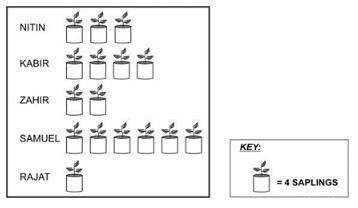
(a) Nitin
(b) Kabir
(c) Samuel
(d) Rajat
Answer : A
Question. There were 25 children in a class. Out of which 16 children could read first, second, third, fourth and fifth lines. How many children in the class could NOT read the last line?
25 children of a class went to the doctor for an eye check-up and were asked to read the letters from this chart:
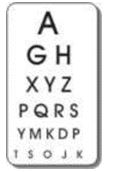
(a) 11
(b) 9
(c) 6
(d) 2
Answer : B
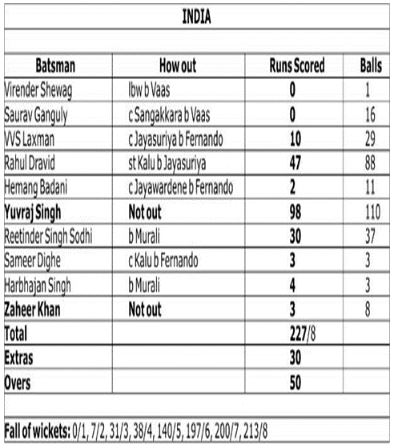
Question. The batsman who scored more than a fifty runs was:
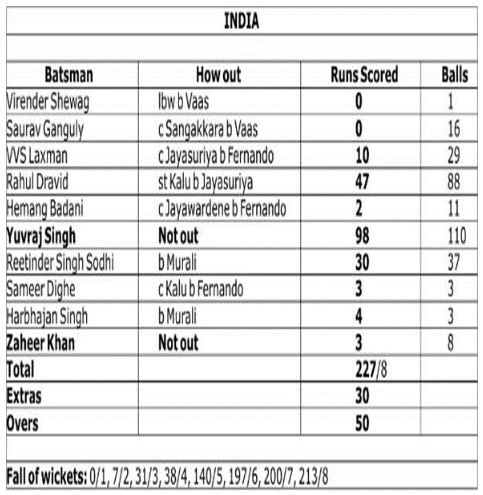
(a) Yuvraj Singh
(b) Rahul Dravid
(c) Reetinder Sodhi
(d) Saurav Ganguly
Answer : A
Question. The total runs scored by the first 4 batsmen was:
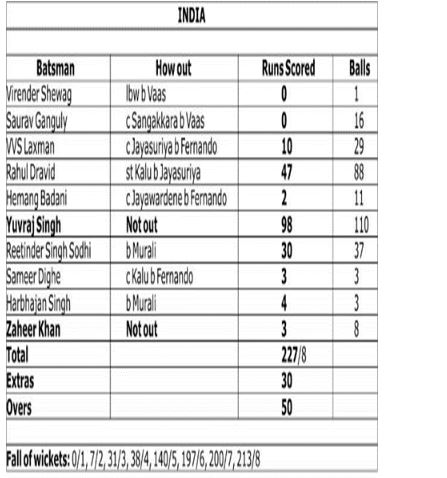
(a) 49
(b) 59
(c) 57
(d) 145
Answer : C
Question. How many batsmen scored more than 10 runs but less than 50 runs ?
(a) 7
(b) 4
(c) 2
(d) None of the above
Answer : C
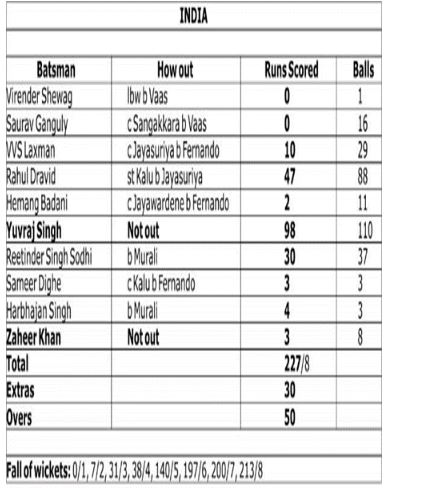
Question. What was the score when the fourth wicket fell ?
(a) 7
(b) 38
(c) 57
(d) 102
Answer : B
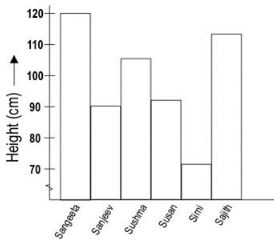
Question. The heights of 6 children are shown in this graph. Which two of them are nearly of the same height?
(a) Sangeeta and Sajith
(b) Sanjeev and Susan
(c) Sajith and Sushma
(d) Sangeeta and Simi
Answer : B
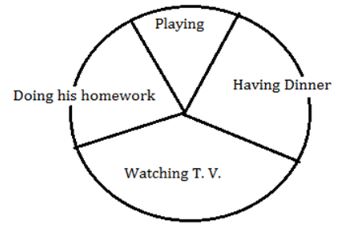
Question. On which activity does Shankar spend maximum time after school?
(a) Doing his homework
(b) Playing
(c) Having Dinner
(d) Watching T. V.
Answer : D
Question. This is the score-card of a recent World Cup match between India and England. Study it carefully and answer the question. Who was the top scorer in the Indian batting line up?
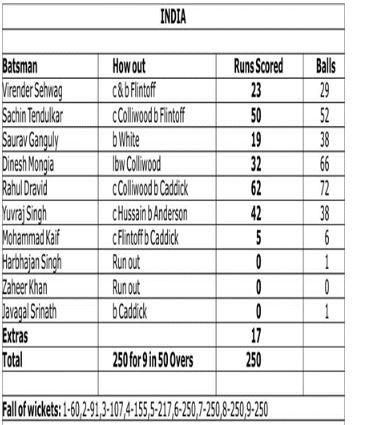
(a) Sachin Tendulkar
(b) Rahul Dravid
(c) Saurav Ganguly
(d) Yuvraj Singh
Answer : B
Question. This is the score-card of a recent World Cup match between India and England. Study it carefully and answer the question. How many batsmen failed to score?
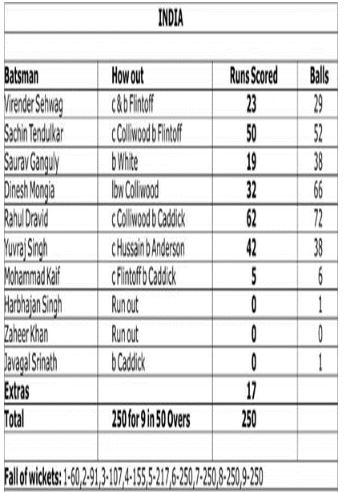
(a) 2
(b) 3
(c) 4
(d) 5
Answer : B
Question. The heights of 6 children are shown in this graph. Which of them is the tallest one ?
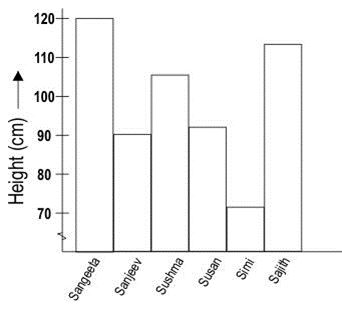
(a) Sangeeta
(b) Sanjeev
(c) Sushma
(d) Simi
Answer : A
Question. Mrs. Mathur keeps weekly records of absent students in her class. The list for a certain week looks like this (no new students joined that week). On which day of the week was the number of students PRESENT the LEAST?
| Mon | Tue | Wed | Thu | Fri | Sat | |
| Number of Students absent | 2 | 0 | 1 | 3 | 1 | 5 |
(a) Monday
(b) Tuesday
(c) Friday
(d) Saturday
d
Question. What kind of toothbrush does Mitu use?
| Colour | Type | Size | |
| Mr. Sen | Blue | Hard | Full-Size |
| Mrs. Sen | Yellow | Soft | Full-Size |
| Joy | Yellow | Soft | Jonior |
| Mitu | Pink | Soft | Boby |
(a) a soft, yellow, junior-size toothbrush
(b) a soft, pink, baby-size toothbrush
(c) a soft, yellow, baby-size toothbrush
(d) a soft, pink, junior-size toothbrush
Answer : B
Question. Both Mrs Sen and Joy use toothbrushes that are
| Colour | Type | Size | |
| Mr. Sen | Blue | Hard | Full-Size |
| Mrs. Sen | Yellow | Soft | Full-Size |
| Joy | Yellow | Soft | Jonior |
| Mitu | Pink | Soft | Boby |
(a) full-size and yellow
(b) soft and blue
(c) soft and yellow
(d) full-size and soft
Answer : C
Question. These are the marks of Juhi and 4 of her classmates in a Maths exam.
Anindita-73 , Bulbul-65 , Harsh -72 ,
Juhi -70 and Saira - 69 .
Whose marks are the closest to that of Juhi?
(a) Anindita
(b) Bulbul
(c) Harsh
(d) Saira
Answer : D
Question. This is a notice put up on the gate of Nirmala School on the day of the 'Diwali Mela'. Amal a class 4 student of Nirmala school, goes to the Diwali Mela with her father. How much will they have to pay for entry?
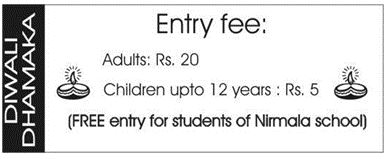
(a) Rs. 5
(b) Rs. 20
(c) Rs. 25
(d) Rs. 40
Answer : B
Free study material for Mathematics
Step-by-Step Textbook Answers: Class 4 Mathematics Chapter 14 Smart Charts
Chapter Exercise Answers for Class 4 Mathematics
Review comprehensive exercise answers for Class 4 Mathematics Chapter 14 Smart Charts. Fully updated to match current NCERT syllabus guidelines, these textbook solutions help students verify their work and maintain accurate study notes.
Detailed Answer Guides for Chapter 14 Smart Charts
Clear, methodical explanations accompany every challenging problem within the Class 4 Mathematics text. Engaging with these detailed answers lays a solid foundation for advanced learning and improves foundational clarity for upcoming assessments.
Complete Preparation Kit for Class 4 Exams
These resources act as an effective roadmap for daily homework tasks and independent study. Supplement your review of Chapter 14 Smart Charts with official sample papers and interactive practice tests available on our platform free of charge.
FAQs
The complete and updated NCERT Solutions Class 4 Mathematics Chapter 14 Smart Charts is available for free on StudiesToday.com. These solutions for Class 4 Mathematics are as per latest NCERT curriculum.
Yes, our experts have revised the NCERT Solutions Class 4 Mathematics Chapter 14 Smart Charts as per 2026 exam pattern. All textbook exercises have been solved and have added explanation about how the Mathematics concepts are applied in case-study and assertion-reasoning questions.
Toppers recommend using NCERT language because NCERT marking schemes are strictly based on textbook definitions. Our NCERT Solutions Class 4 Mathematics Chapter 14 Smart Charts will help students to get full marks in the theory paper.
Yes, we provide bilingual support for Class 4 Mathematics. You can access NCERT Solutions Class 4 Mathematics Chapter 14 Smart Charts in both English and Hindi medium.
Yes, you can download the entire NCERT Solutions Class 4 Mathematics Chapter 14 Smart Charts in printable PDF format for offline study on any device.