

Download NCERT Solutions for Class 6 Mathematics Chapter 07 Fractions
Review structured textbook solutions for Class 6 Mathematics Chapter 07 Fractions. Built according to NCERT guidelines for the 2026-27 academic year, these downloadable answers support daily revision and problem-solving accuracy.
Access NCERT Solutions and Answers
View or download the dedicated Chapter 07 Fractions solution resource below. Engaging with these textbook answers under focused study conditions ensures continuous academic progress and mastery of the 2026-27 curriculum for Mathematics.
EXERCISE 7.1
Q.1) Write the fraction representing the shaded portion.
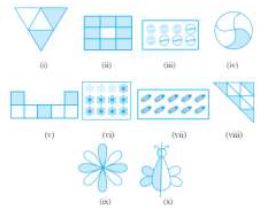
Sol.1) i) 2/4 [There are four equal parts out of which 2 parts are shaded.]
ii) 8/9 [There are 9 equal parts out of which 8 parts are shaded.]
iii) 4/8 [There are 8 equal parts out of which 4 parts are shaded.]
iv) 1/4 [There are 4 equal parts out of which 1 part is shaded.]
v) 3/ 7 [There are 7 equal parts out of which 3 parts are shaded.]
vi) 3/12 [There are 12 flowers of the same kind out of which 3 are shaded.]
vii) 10/10 [There are 10 pencils out of which 10 are shaded.]
viii) 4/9 [There are 9 equal parts out of which 4 parts are shaded.]
ix) 4/8 [There are 8 equal parts out of which 4 parts are shaded.]
x) 1/2 [There is a shape divided into 2 equal parts, out of which one part is haded.]
Q.2) Colour the part according to the given fraction.
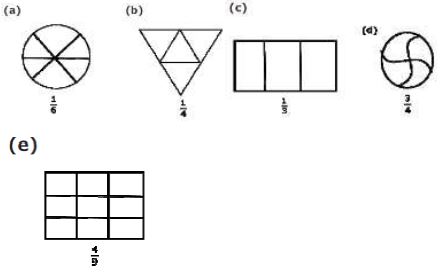
Sol.2)
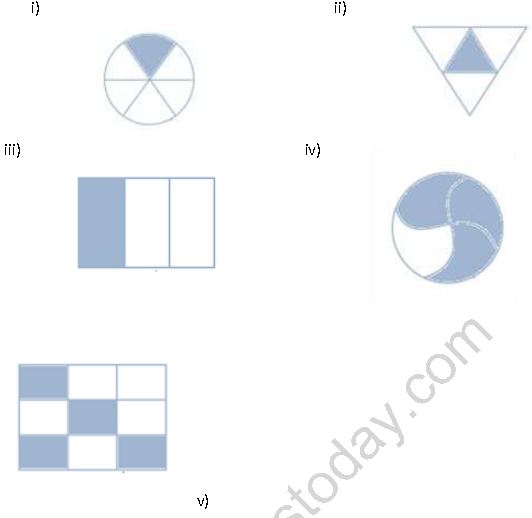
Q.3) Identify the error, if any
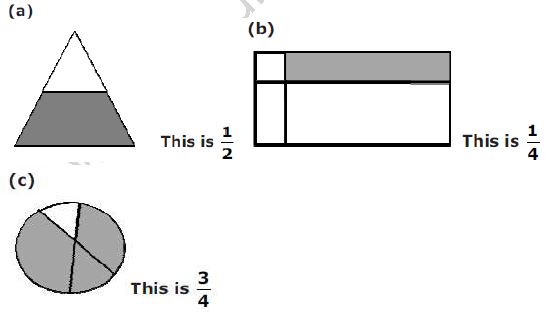
Sol.3) The shaded portions do not represent the given fractions as each shape is not divided into equal parts.
Q.4) What fraction of a day is 8 hours?
Sol.4) In a day there are 24 hours. So, 8 hours in a 24 hour day is represented as 8/24
Q.5) What fraction of an hour is 40 minutes?
Sol.5) One hour is 60 minutes. So, 40 minutes as a fraction of an hour is represented as 40/60
Q.6) Arya, Abhimanyu, and Vivek shared lunch. Arya has brought two sandwiches, one made of vegetable and one of jam. The other two boys forgot to bring their lunch. Arya agreed to share his sandwiches so that each person will have an equal share of each sandwich.
(a) How can Arya divide his sandwiches so that each person has an equal share?
(b) What part of a sandwich will each boy receive?
Sol.6) a) Arya should divide his sandwiches into 3 equal parts and give 1 part of each sandwich so that each person has an equal share.
b) Each boy will receive 1/3 of a sandwich.
Q.7) Kanchan dyes dresses. She had to dye 30 dresses. She has so far finished 20 dresses.
What fraction of dresses has she finished?
Sol.7) She has finished 20 dresses out of 30.
So, fraction of dresses she has finished = 20/30`
Q.8) Write the natural numbers from 2 to 12. What fraction of them are prime numbers?
Sol.8) Natural numbers from 2 to 12 are 2, 3, 4, 5, 6, 7, 8, 9, 10, 11 and 12
Prime numbers – 2, 3, 5, 7, 11
There are 11 natural numbers from 2 to 12 out of which 5 are prime numbers.
Fraction of numbers that are prime is 5/11
Q.9) Write the natural numbers from 102 to 113. What fraction of them are prime numbers?
Sol.9) Natural numbers from 102 to 113 are 102, 103, 104, 105, 106, 107, 108, 109, 110, 111, 112 and 113
Prime numbers – 103, 107, 109, 113
There are 12 natural numbers from 102 to 113 out of which 4 are prime numbers.
So, fraction of numbers that are prime is 4/12
Q.10) What fraction of these circles have X’s in them?

Sol.10) There are 8 circles out of which 4 have X’s in them.
So, fraction of circles having X’s is 4/8
Q.11) Kristin received a CD player for her birthday. She bought 3 CDs and received 5 others as gifts. What fraction of her total CDs did she buy and what fraction did she receive as gifts
Sol.11) Number of CDs Kristin purchased = 3
Number of CDs she received as gifts = 5
So, total number of CDs = 8
Kristin purchased 3 CDs out of a total number of 8 CDs.
Fraction of CDs she purchased = 3/8
Kristin received 5 CDs out of a total number of 8 CDs.
Fraction of CDs she received as gifts = 5/8
Exercise 7.2
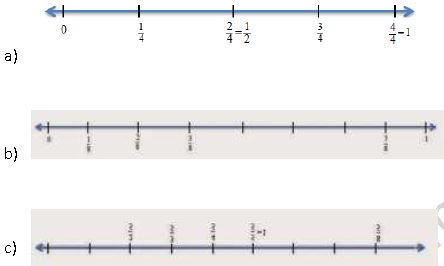
Q.1) Draw number lines and locate the points on them
a) 1/2, 1/4, 3/4, 4/4
b) 1/8, 2/8, 3/8, 7/8
c) 2/5, 3/5, 8/5, 4/5
Sol.1)
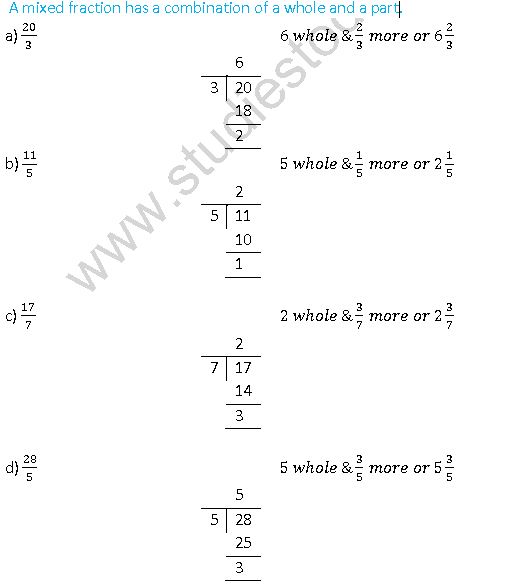
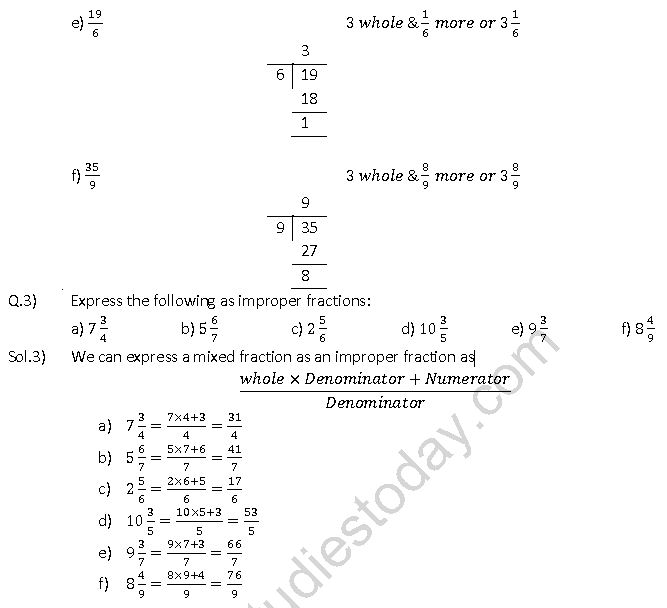
Q.2) Express the following as mixed fractions:
a) 20/3 b) 11/5 c) 17/7 d) 28/5 e) 19/6 f) 35/9
Sol.2)
Exercise 7.3
Q.1) Write the fractions. Are all these fractions equivalent?
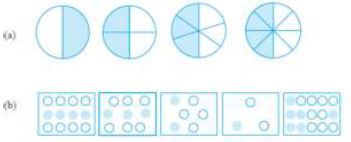
Sol.1) a) 1/2, 2/4, 3/6, 4/8 yes, the fraction are equivalent
b) 4/8, 3/9, 2/6, 1/3, 6/15 No, the fraction are not equivalent
Q.2) Write the fractions and pair up the equivalent fractions from each row.
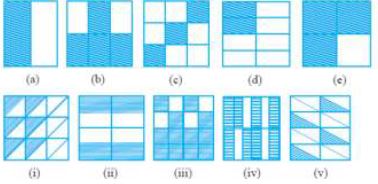
Sol.2) The fractions are as follows:
The pairs are as follows:
a) ii)
b) iv)
c) i)
d) v)
e) iii)
Q.3) Replace in each of the following by the correct number :
a) 2/7 = 8/
b) 5/8 = 10/
c) 3/5 = /20
d) 45/60 = 15/
e) 18/24 = /4
Sol.3) To find an equivalent fraction, we may divide both the numerator and the denominator by the same number.
a) 2×4/7×4 = 8/32
b) 5×2/8×2 = 10/16
c) 3×4/5×4 = 12/20
d) 45×3/60×3 = 15/90
e) 18÷6/24÷6 = 3/4
Q.4) Find the equivalent fraction of 3/5 having
(a) denominator 20 (b) numerator 9
(c) denominator 30 (d) numerator 27
Sol.4) a) We have the fraction.
Numerator is 3 and denominator is 5.
We know that 5 × 4 = 20. So, we have multiply both the numerator and denominator by 4 to find the equivalent fraction having denominator 20.
So, 3/5 = 3×4/5×4 = 12/20
b) We have the fraction 3/5.
Numerator is 3 and denominator is 5.
As the numerator should be 9 and 3 × 3 = 9, we have to multiply both the numerator and denominator by 3 to find the equivalent fraction having numerator 9.
So, 3/5 = 3×3/5×3 = 9/15
c) We have the fraction 3/5.
Numerator is 3 and denominator is 5.
As the denominator should be 30 and 5 × 6 = 30, we have to multiply both the numerator and denominator by 6 to find the equivalent fraction having denominator 30.
So, 3/5 = 3×6/5×6 = 18/30
d) We have the fraction 3/5.
Numerator is 3 and denominator is 5.
As the numerator should be 27 and 3 × 9 = 27, we have to multiply both the numerator and denominator by 9 to find the equivalent fraction having numerator 27.
So, 3/5 = 3×9/5×9 = 27/45
Q.5) Find the equivalent fraction of 36/48 having
(a) numerator 9 (b) denominator 4
Sol.5) a) We have the fraction 36/48.
Numerator is 36 and denominator is 48.
As the numerator should be 9 and 36 ÷ 4 = 9, we have to divide both the numerator and denominator by 4 to find the equivalent fraction having numerator 9.
So, 36/48 = 36÷4/48÷4 = 9/12
b) We have the fraction 36/48.
Numerator is 36 and denominator is 48.
As the denominator should be 4 and 48 ÷ 12 = 4, we have to divide both the numerator and denominator by 12 to find the equivalent fraction having denominator 4.
So, 36/48 = 36÷12/48÷12 = 3/4
Q.6) Check whether the given fractions are equivalent:
a) 5/9, 30/54
b) 3/10, 12/50
c) 7/13, 5/11
Sol.6) a) 5/9 = 5×6/9×6 = 30/54
We see that the numerator and the denominator are multiplied by the same number 6.
Hence the fractions are equivalent.
b) If we multiply the numerator and denominator by 4, we get
3/10 = 3 × 4/10 × 4 = 12/40
If we multiply the numerator and denominator by 5, we get
3/10 = 3 × 5/10 × 5 = 15/50
So, we see that the fractions are not equivalent.
c) The numerators 7 and 5, and the denominators 13 and 11 are all prime numbers and hence they cannot be equivalent fractions.
Q.7) Reduce the following fractions to simplest form :
a) 48/60
b) 150/60
c) 84/98
d) 12/52
e) 7 28
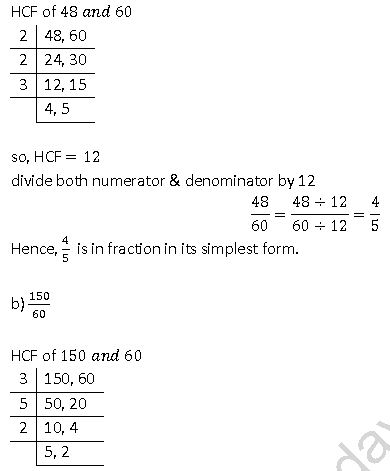
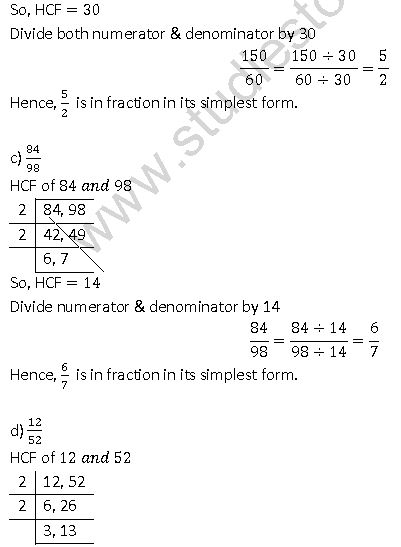
Sol.7) To reduce a fraction into its simplest form, find the HCF of the numerator and the denominator and divide both by the HCF.
a) 48/60

Q.8) Ramesh had 20 pencils, Sheelu had 50 pencils and Jamaal had 80 pencils. After 4 months, Ramesh used up 10 pencils, Sheelu used up 25 pencils and Jamaal used up 40 pencils.
What fraction did each use up? Check if each has used up an equal fraction of her/his pencils ?
Sol.8) Fraction of pencils used by Ramesh = 10/20 = 1/2
Fraction of pencils used by Sheelu = 28/20 = 1/2
Fractions of pencils used by Jamaal = 40/80 = 1/2
Yes, they have all used up an equal fraction of his/her pencils.
Q.9) Match the equivalent fractions and write two more for each :
i) 250/400 a) 2/3
ii) 180/200 b) 2/5
iii) 660/990 c) 1/2
iv) 180/360 d) 5/8
v) 220/550 e) 9/10
Sol.9) i) 250/400 = 250÷50/400÷50 = 5/8 d)
ii) 180/200 = 180÷20/200÷20 = 9/10 e)
iii) 660/990 = 660÷110/990÷110 = 2/3 a)
iv) 180/360 = 180÷180/360÷180 = 1/2 c)
v) 220/550 = 220÷110/500÷110 = 2/5 b)
Exercise 7.4
Q.1) Write shaded portions as fraction. Arrange them in ascending or descending order using the correct sign ‘<’ ‘=’ ‘>’ between the fractions.

Sol.1) The fractions represented by the shaded portions are as follows:
a) 3/8, 6/8, 4/8, 1/8
b) 8/9, 4/9, 3/9, 6/9
The above fractions in a) and b) are like fractions as they have the same denominator. When comparing fractions with same denominator, the fraction with the greater numerator is greater.
So, arranging the fractions in ascending order, we have:
a) 1/8 < 3/8 < 4/8 < 6/8
b) 3/9 < 4/9 < 6/9 < 8/9
c) Let us represent the fractions
c) Let us represent the fractions 2/6, 4/6, 8/6 & 6/6 on the number line.

5/6 > 2/6 ; 3/6 > 0 ; 1/6 < 6/6 ; 8/6 > 5/6'
Q.2) Compare the fractions and put an appropriate sign.
a) 3/6 5/6
b) 1/7 1/4
c) 4/5 5/5
d) 3/5 3/7
Sol.2) a) When the denominators are the same, the fraction with the greater numerator is a greater fraction.
As 3 < 5, 3/6 < 5/6
b) When we compare two unlike fractions, we first get their equivalent fractions with a denominator which is the L.C.M of the denominators of both the fractions.
1/7, 1/4
L.C.M. of 7 & 4 is 28
1/7 = 1×7/7×7 = 4/28 and 1/4 = 1×7/4×7 = 7/28
1/7 < 1/4
c) The denominators are the same. So, the fraction with the greater numerator is a greater fraction.
4/5 < 5/5
d) When we compare two unlike fractions, we first get their equivalent fractions with a denominator which is the L.C.M of the denominators of both the fractions.
3/5, 3/7
L.C.M. of 5 & 7 is 35
3/5 = 3×7/5×7 = 21/35 and 3/7 = 3×5/7×5 = 15/35
21/35 > 15/35
3/5 > 3/7
Q.3) Make five more such pairs and put appropriate signs.
Sol.3) 4/5 < 4/6, 2/9 < 7/13, 7/9 > 5/8, 12/13 > 9/13, 12/5 > 11/6
Q.4) Look at the figures and write ‘ < ’ 𝑜𝑟 ‘ > ’, ‘ = ’between the given pairs of fractions.
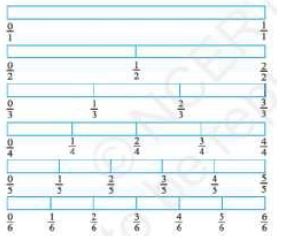
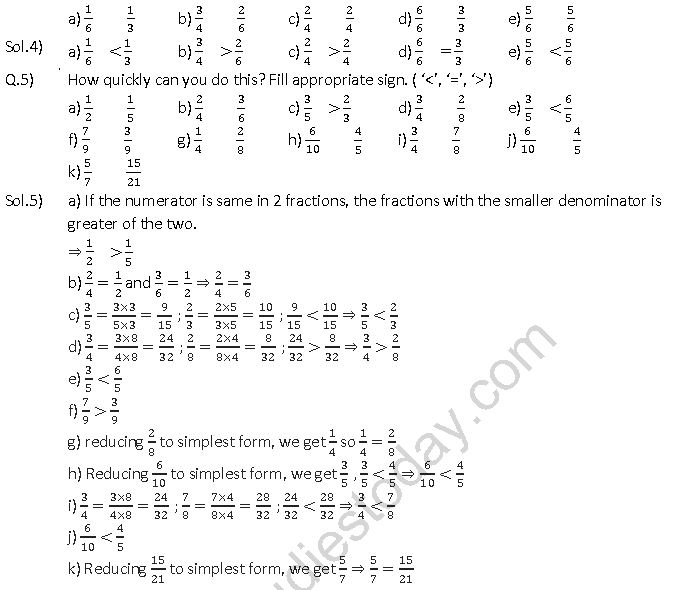
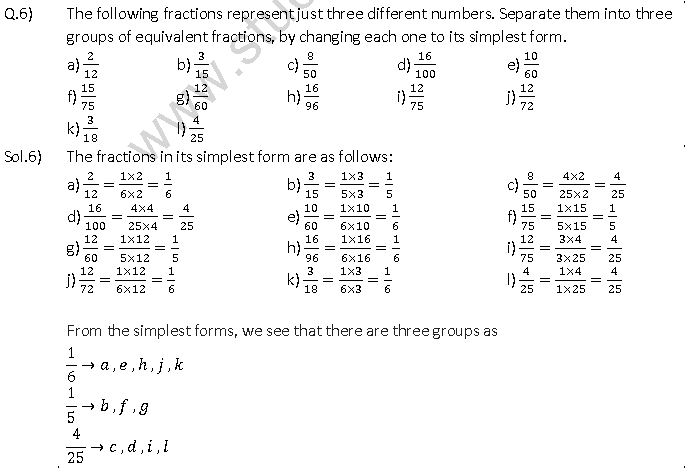
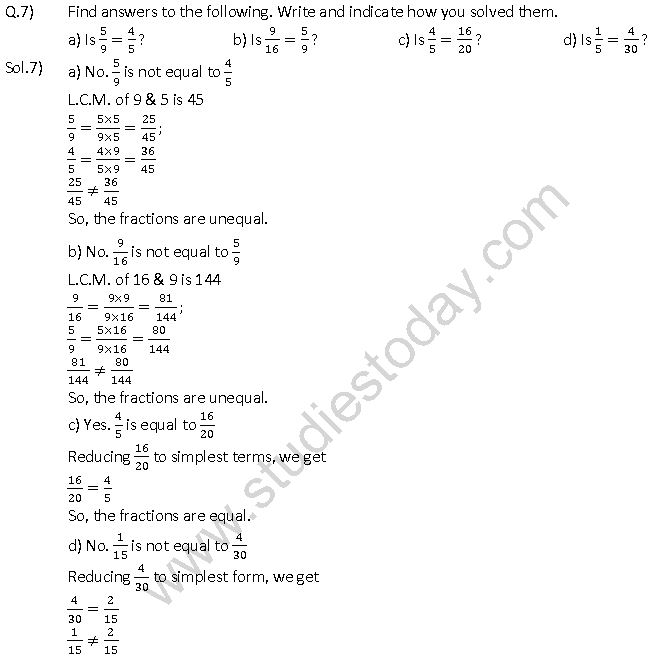
So, the fractions are unequal.
Q.8) Ila read 25 pages of a book containing 100 pages. Lalita read 2/5 of the same book. Who read less?
Sol.8) Total number of pages in the book = 100 𝑝𝑎𝑔𝑒𝑠
Number of pages read by Ila = 25 𝑝𝑎𝑔𝑒𝑠
Fraction of pages read by Ila = 25/100 = 1/4
Fraction of pages read by Lalita = 2/5
Comparing the two fractions, we have
LCM of 4 & 5 is 20
1/4 = 1×5/4×5 = 5/20
2/5 = 2×4/4×5 = 8/20
5/20 < 8/20 ⇒ 1/4 < 2/5
So, Ila read lesser number of pages than Lalita.
Q.9) Rafiq exercised for 3/6 of an hour, while Rohit exercised for 3/4 of an hour. Who exercised for a longer time?
Sol.9) Rafiq exercised for 3/6 of an hour Rohit exercised for 3/4 of an hour
Comparing both the fractions :
LCM of 6 & 4 is 12
3/6 = 3×2/6×2 = 6/12
3/4 = 3×3/4×3 = 9/12
6/12 < 9/12 ⇒ 3/6 < 3/4
Rohit exercised for a longer time than Rafiq.
Q.10) In a class A of 25 students, 20 passed in first class. In another class B of 30 students, 24 passes in first class. In which class was a greater fraction of students getting first class?
Sol.10) Total number of students in class A = 25
Number of students passed in first class = 20.
Fraction of students of class A who passed in first class = 20/25 = 4/5
Total number of students in class B = 30
Number of students passed in first class = 24.
Fraction of students of class B who passed in first class = 24/30 = 4/5
Both class A and B have the same fraction of students who passed in first class.
Exercise 7.5
Q.1) Write these fractions appropriately as additions or subtractions :
Sol.1) a) The first shaded portion represents the fraction = 1/5
The second shaded portion represents = 2/5
and the third portion represents 3/5
So, we see that 1/5 + 2/5 = 3/5
Hence ‘+’ is the operation involved.
b) The first shaded portion represents the fraction = 5/5
The second shaded portion represents = 2/5
and the third portion represents = 3/5
So, we see that 5/5 − 3/5 = 2/5
Hence ‘-’ is the operation involved.
c) The first shaded portion represents the fraction = 2/6
The second shaded portion represents = 3/6
and the third portion represents = 5/6
So, we see that 2/6 + 3/6 = 5/6
Hence ‘+’ is the operation involved.
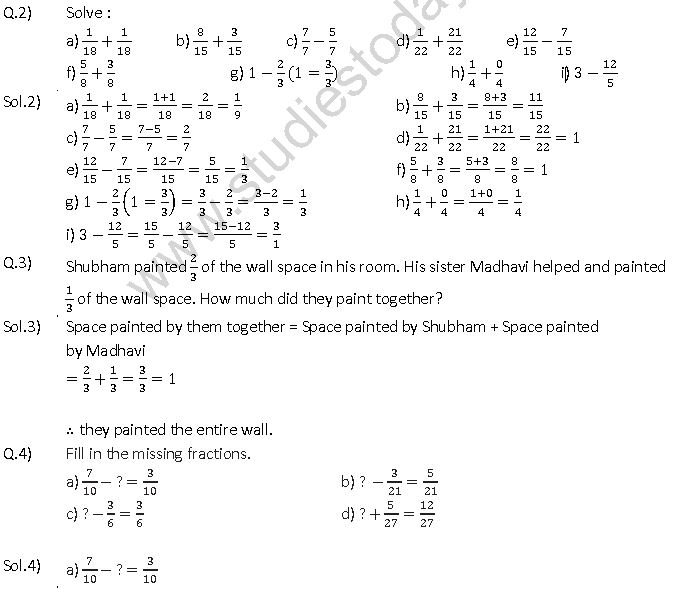
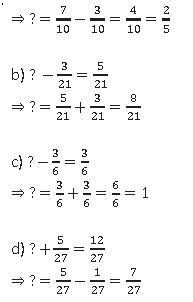
Q.5) aved was given 5/7 of a basket of oranges. What fraction of oranges was left in the basket?
Sol.5) Fraction of oranges given to Javed = 5/7
Fraction of oranges left in the basket = 1 − 5/7 = 2/7'
Exercise 7.6
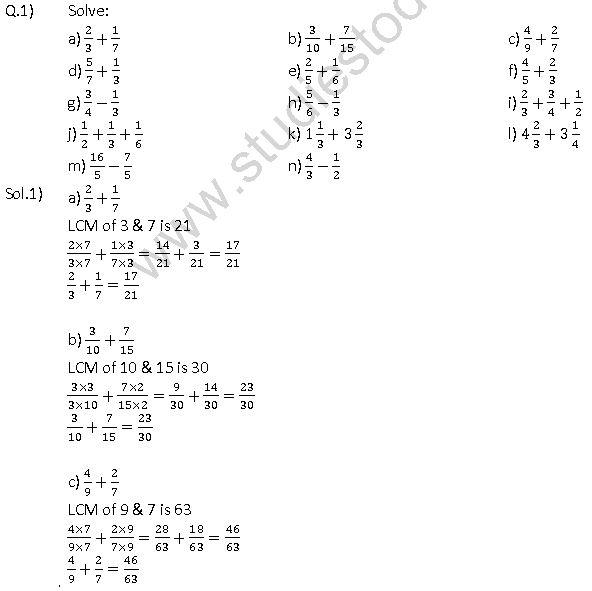
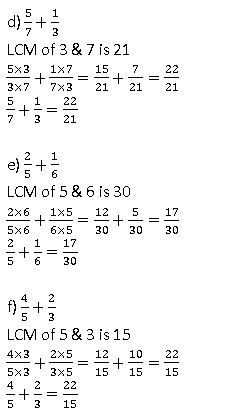
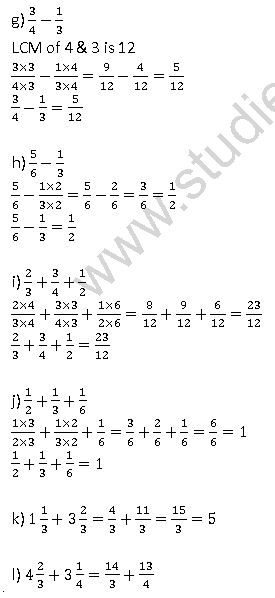
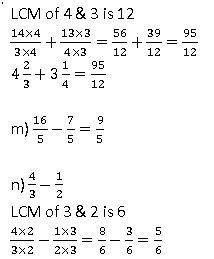
Q.2) Sarita bought 2/5 metre of ribbon and Lalita 3/4 metre of ribbon. What is the total length of the ribbon they bought?
Sol.2) Length of ribbon Sarita bought = 2/5 𝑚𝑒𝑡𝑒𝑟
Length of ribbon Lalita bought = 3/4 𝑚𝑒𝑡𝑒𝑟
Total length of ribbon = 2/5 + 3/4
LCM of 5 & 4 is 20/4×2/5×4 + 3×5/4×5 = 8/20 + 15/20 = 23/20
They bought 23/20
meters of ribbon together
Q.3) Naina was given 1(1/2) piece of cake and Najma was given 1(1/3) piece of cake. Find the total amount of cake was given to both of them
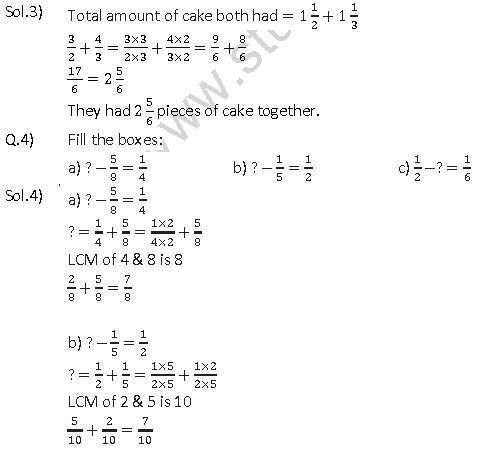
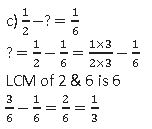
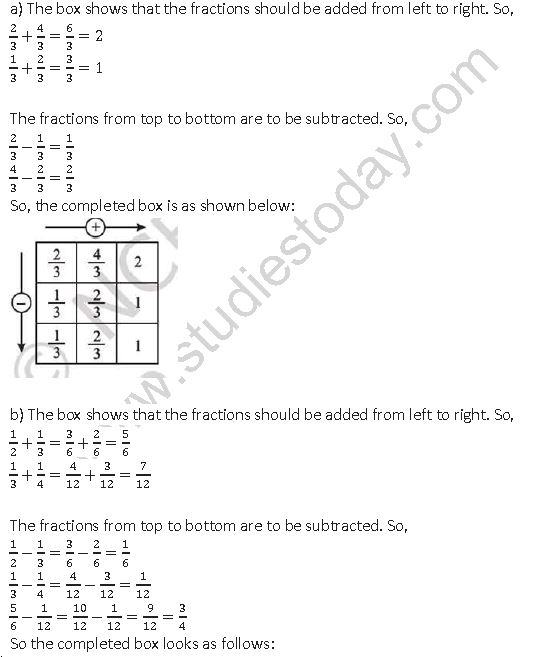
Q.5) Complete the addition subtraction boxes:

Sol.5) a) The box shows that the fractions should be added from left to right. So,
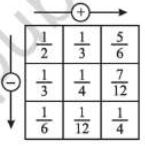
Q.6) A piece of wire 7/8
metre long broke into two pieces. One piece was 1/4
metre long. How
long is the other piece ?
Sol.6) Length of the piece of wire is = 7/8 𝑚𝑒𝑡𝑟𝑒
Length of one broken piece is = 1/4 𝑚𝑒𝑡𝑟𝑒
Length of the other broken piece = total length of the wire – length of one broken piece
= 7/8 − 1/4 = 7/8 − 1×2/4×2 = 7/8 − 2/8 = 5/8
Length of the piece of wire is = 5/8 𝑚𝑒𝑡𝑟𝑒
Q.7) Nandini’s house is 9/10
km from her school. She walked some distance and then took a bus for 1/2 𝑘𝑚 to reach the school. How far did she walk?
Sol.7) Distance from Nandini’s house to school = 9/10 𝑘𝑚
Distance covered by bus = 1/2 𝑘𝑚
Distance she walked = distance from house to school – distance she covered by bus.
= 9/10 − 1/2 = 9/10 − 5/10 = 4/10 = 2/5
Distance walked by Nandini = 2/5 𝑘𝑚
Q.8) Asha and Samuel have bookshelves of the same size partly filled with books. Asha’s shelf is 5/6 th full and Samuel’s shelf is 2/5𝑡ℎ full. Whose bookshelf is more full? By what fraction.
Sol.8) Fraction of books in Asha’s shelf = 5/6
Fraction of books in Samuel’s shelf = 2/5
We compare the fractions to find whose shelf is more full.
LCM of 5 & 6 is 30

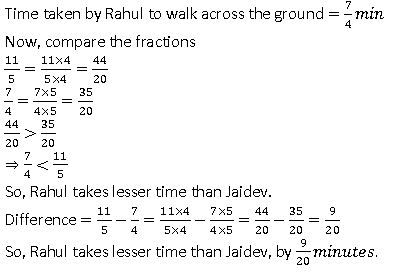
Q.9) Jaidev takes 2(1/5) minutes to walk across the school ground. Rahul takes 7/4 minutes to do the same. Who takes less time and by what fraction?
Sol.9) Time taken by Jaidev to walk = 2(1/5) 𝑚𝑖𝑛 = 11/5𝑚𝑖𝑛
Free study material for Mathematics
Free NCERT Textbook Explanations: Class 6 Mathematics Chapter 07 Fractions
Official NCERT Solutions for Chapter 07 Fractions
Review comprehensive exercise answers for Class 6 Mathematics Chapter 07 Fractions. Fully updated to match current NCERT syllabus guidelines, these textbook solutions help students verify their work and maintain accurate study notes.
Step-by-Step Explanations for Chapter 07 Fractions
Each solution includes detailed reasoning to foster genuine comprehension of Chapter 07 Fractions concepts. Reviewing these step-by-step breakdowns allows learners to master both analytical and descriptive questions expected in school evaluations.
Next Steps in Your Mathematics Revision
Frequent review of these structured answers builds strong analytical capabilities and response efficiency. Maximize your academic readiness by combining these textbook solutions with our curated study materials and mock evaluations for Class 6 Mathematics.
FAQs
The complete and updated NCERT Solutions Class 6 Mathematics Chapter 7 Fractions is available for free on StudiesToday.com. These solutions for Class 6 Mathematics are as per latest NCERT curriculum.
Yes, our experts have revised the NCERT Solutions Class 6 Mathematics Chapter 7 Fractions as per 2026 exam pattern. All textbook exercises have been solved and have added explanation about how the Mathematics concepts are applied in case-study and assertion-reasoning questions.
Toppers recommend using NCERT language because NCERT marking schemes are strictly based on textbook definitions. Our NCERT Solutions Class 6 Mathematics Chapter 7 Fractions will help students to get full marks in the theory paper.
Yes, we provide bilingual support for Class 6 Mathematics. You can access NCERT Solutions Class 6 Mathematics Chapter 7 Fractions in both English and Hindi medium.
Yes, you can download the entire NCERT Solutions Class 6 Mathematics Chapter 7 Fractions in printable PDF format for offline study on any device.