

NCERT Solutions for Class 6 Mathematics: Chapter 04 Basic Geometrical Ideas
Review structured textbook solutions for Class 6 Mathematics Chapter 04 Basic Geometrical Ideas. Built according to NCERT guidelines for the 2026-27 academic year, these downloadable answers support daily revision and problem-solving accuracy.
Practice Class 6 Mathematics Solutions: Chapter 04 Basic Geometrical Ideas
Navigate directly to the solved Mathematics textbook exercises using the digital viewer below. Each solution includes detailed step-by-step explanations, allowing students to instantly cross-check their work and identify areas requiring further revision.
EXERCISE 4.1
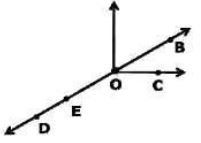
Q.1) Use the figure to name
(a) Five points (b) A line
(c) Four rays (d) Five line segments
Sol.1) Point:
A point is used to represent any specified location or position. Dots are used to the present points.
Line:
Two points determine a line. Line is breadth less & has length only. Line extend indefinitely in both directions.
Line segment:
The definite length between 2 points.it is the shortest distance between 2 points. A line segment has 2 end points .
Ray:
A ray is a portion of line. It starts at one point & goes endlessly in one direction.
a) 5 points : O, B, C, D,E
b) A line: BD
c) 4 rays: OD, OE, OC , OB
d) 4 line segments: DE, OE, OC, OB,
Q.2) Name the line given in all possible (twelve) ways, choosing only two letters at a time from the four given.
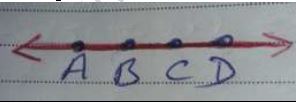
Sol.2) A line is a line segment which extends on both side infinitely.
A line does not have a definite length.
By taking point A
AB , AC, AD
By taking point B
BC, BD, BA
By taking point C
CD, CA,CB
By taking point D
DA, DB, DC
Hence the line given in all possible (12) ways are:
AB , AC, AD, BC, BD, BA, CD, CA,CB, DA, DB, DC
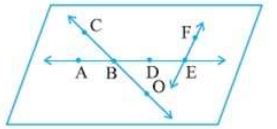
Q.3) Use the figure to name:
(a) Line containing point E.
(b) Line passing through A.
(c) Line on which O lies
(d) Two pairs of intersecting lines
Sol.3) A line segment which extend on both sides infinitely is called the line.
We cannot draw a line but can represent it by putting two opposite arrows on both ends of a segment of the line.
Intersecting lines:
If two lines pass through a point then the two lines are called intersecting lines.
If two lines have one point in common than they are called intersecting lines.
a) In this figure two lines contain point E, one of them is AE.
b) in this figure 1 line is passing through A i.e AE.
c) In this figure, Line on which Is lies is CO.
d) In this figure, two pairs of intersecting lines are CO, AE & AE ,EF.
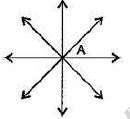
Q.4) How many lines can pass through?
(a) one given point? (b) two given points?
Sol.4) a) If we try to imagine a point in plane and pass a point through it, we can pass many lines coming from different direction and there's no end to it. From a point on a plane, we can pass infinitely many lines
(b) For two given points, we can't say so that in case of one given point, because here due to two points the line must pass from between the two points in a straight line. Which means that only one line can pass through two given points.
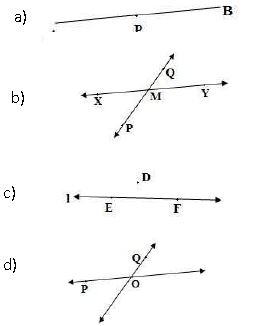
Q.5) Draw a rough figure and label suitably in each of the following cases:
(a) Point P lies on AB.
(b) XY and PQ intersect at M.
(c) Line contains E and F but not D.
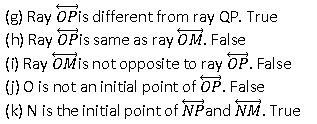
(d) OP and OQ meet at O.
Sol.5)

Exercise 4.2
Classify the following curves as (i) Open or (ii) Closed.
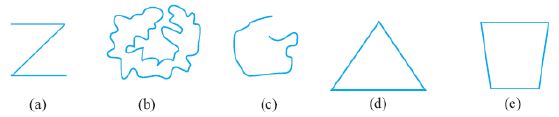
Sol.1) (a) Open curve
(b) Closed curve
(c) Open curve
(d) Closed curve
(e) Closed curve
∴ Curves (a) and (c) are open curves and Curves (b), (d) and (e) are closed curves.
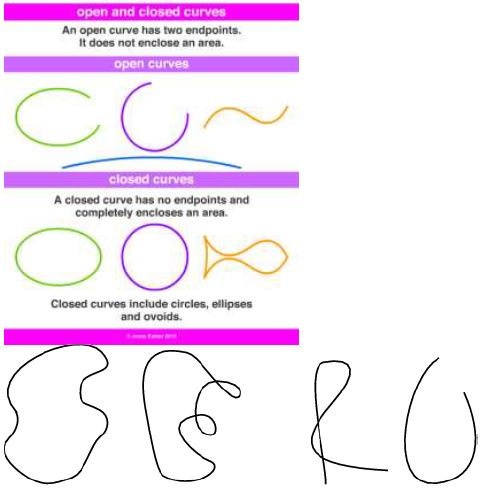
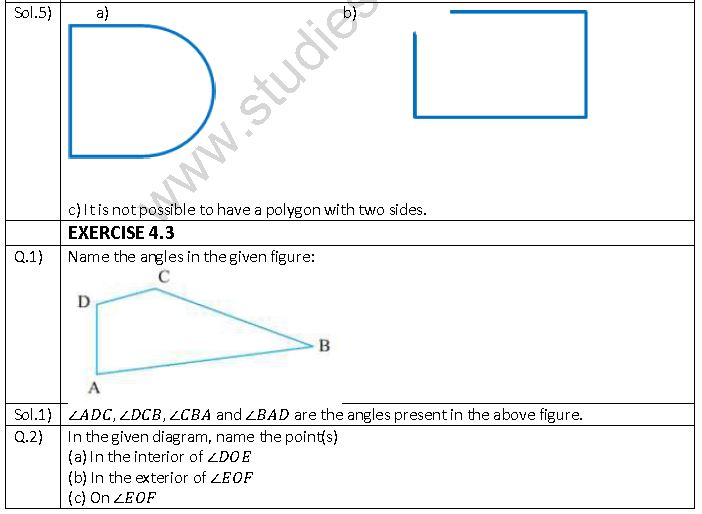
Q.2) Draw rough diagrams to illustrate the following:
(a) Open curve (b) Closed curve
Sol.2) Here are some expamles of Open & Closed Curves
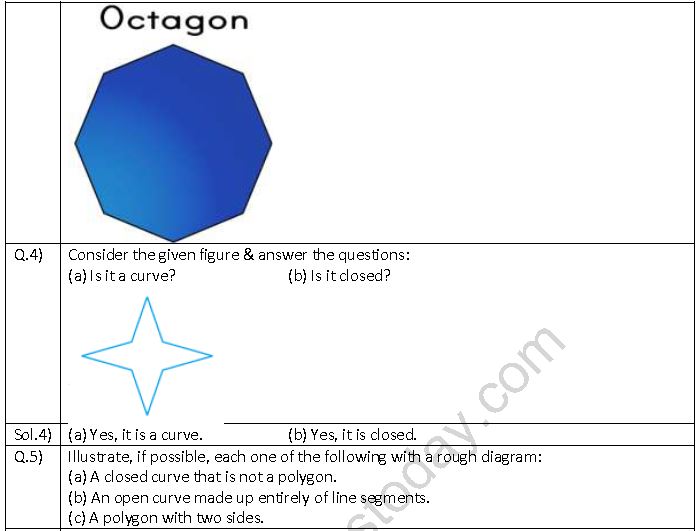
Q.3) Draw any polygon and shade its interior.
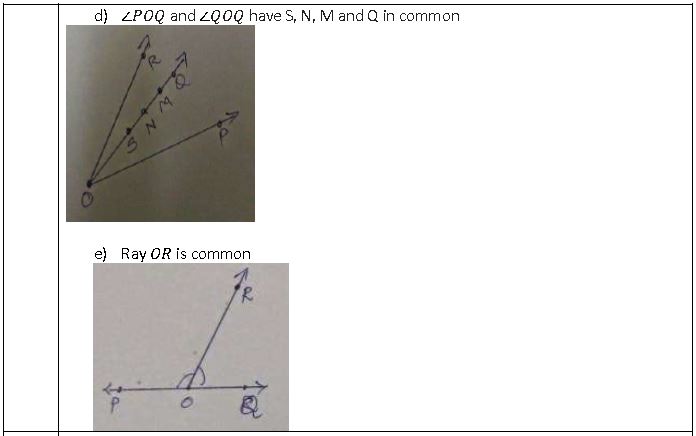
Sol.3) Diagram of a Octagon polygon is given below:
Exercise 4.4
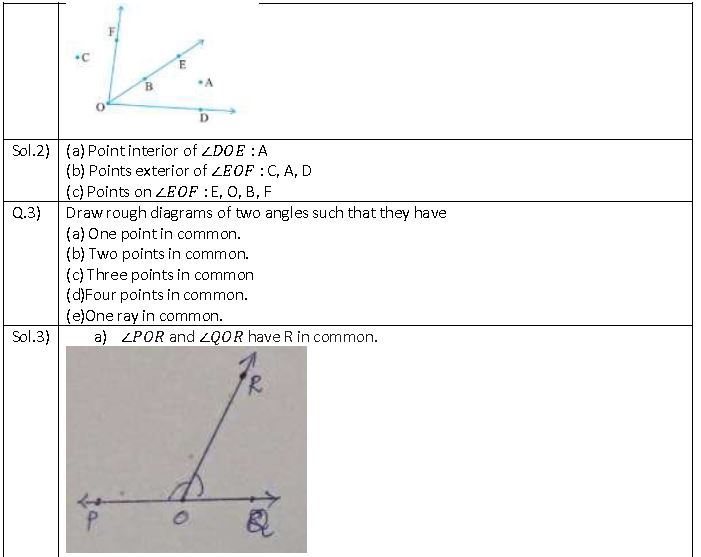
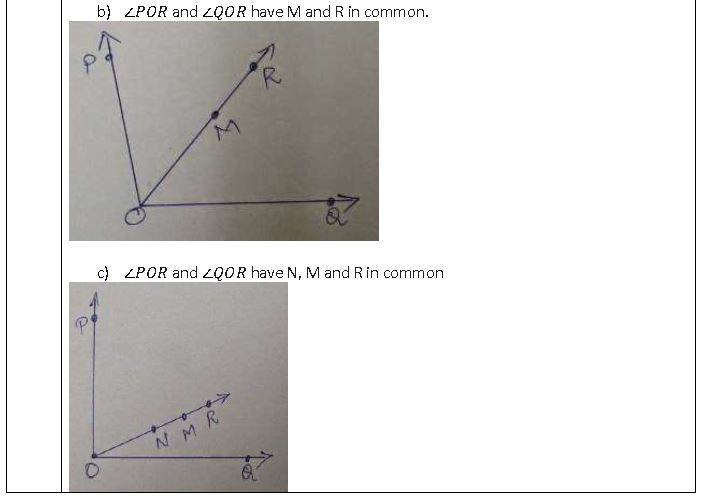
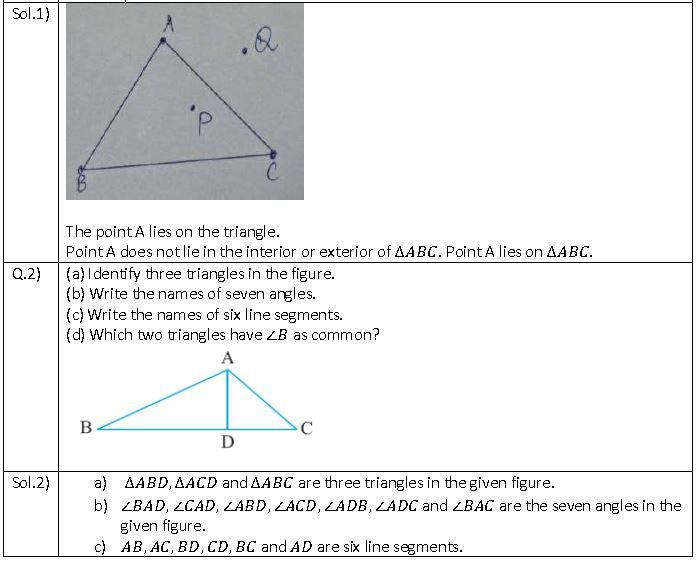
Q.1) Draw a rough sketch of a triangle ABC. Mark a point P in its exterior. Is the point A interior?
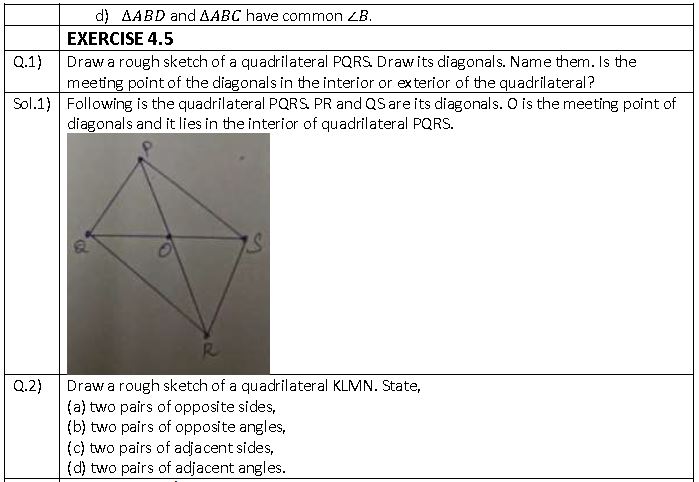
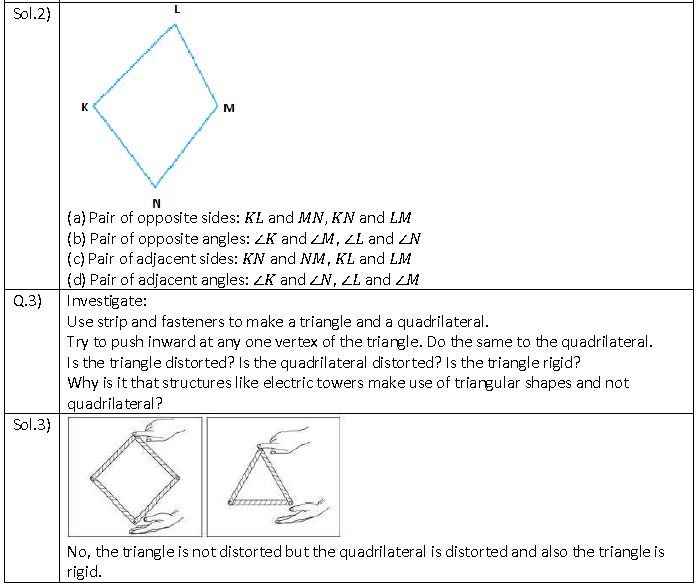
Structures like electric towers make use of triangular shape so that they could not be distorted and they could be rigid.
Exercise 4.6
Q.1) From the figure, identify:
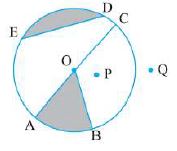
a) the centre of circle
b) three radii
c) a diameter
d) a chord
e) two points in the interior
f) a point in the exterior
g) a sector
h) a segment
Sol.1) a) 𝑂 is the centre.
(b) Three radii: 𝑂𝐴, 𝑂𝐵 and 𝑂𝐶
(c) A diameter: 𝐴𝐶
(d) A chord: 𝐸𝐷
(e) Interior points: 𝑂, 𝑃
(f) Exterior point: 𝑄
(g) A sector: 𝑂𝐴𝐵
(h) A segment: 𝐸𝐷
Q.2) (a) Is every diameter of a circle also a chord?
(b) Is every chord of a circle also a diameter?
Sol.2) (a) Is every diameter of a circle also a chord?
Yes
(b) Is every chord of a circle also a diameter?
No
Q.3) Draw any circle and mark
(a) its centre
(b) a radius
(c) a diameter
(d) a sector
(e) a segment
(f) a point in its interior
(g) a point in its exterior
(h) an arc
Sol.3)
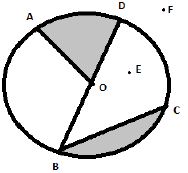
a) 𝑂 is the centre of the circle
b) 𝐴𝑂, 𝑂𝐵 and 𝑂𝐷 are radii of the circle.
c) 𝐵𝐷 is the diameter of the circle.
d) 𝐴𝑂𝐷 is the sector of the circle shaded in grey colour.
e) 𝐵𝐶 is the segment of the circle shaded in grey colour.
f) 𝐸 is the point in the interior of the circle. 𝑂 is also the point in the interior.
g) 𝐹 is the point in the exterior of the circle.
h) 𝐴𝐵 is one of the many arcs present in the circle.
Q.4) Say true or false
(a) Two diameters of a circle will necessarily intersect.
(b) The centre of a circle is always in its interior.
Sol.4) (a) Two diameters of a circle will necessarily intersect.
True, Diameters always intersect at the centre of the circle.
(b) The centre of a circle is always in its interior.
True
Question. 10 matchsticks can be arranged to form rectangles in exactly 2 DIFFERENT ways. Look at the figures below to see how.(No matchstick can be bent or broken) Similarly, in how many different ways can 14 matchsticks be arranged to form rectangles?

(a) 2
(b) 3
(c) 4
(d) 7
Answer : B
Question. The mirror reflection of a regular clock seems to show the time as 1:30. What time is the clock ACTUALLY showing?
(a) 01:30
(b) 09:30
(c) 10:30
(d) 11:30
Answer : C
Question. See the railway route map and time table below and answer the question. Which of the following is NOT on the direct route between Ahmedabad and Delhi?
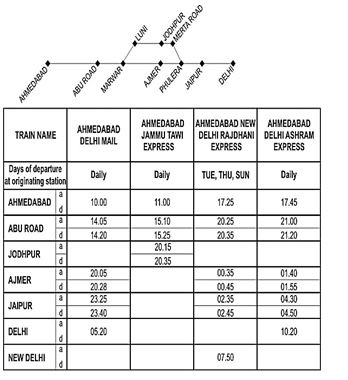
(a) Ajmer
(b) Jodhpur
(c) Phulera
(d) Abu Road
Answer : B
Question. The figure below has to be drawn in ONE CONTINUOUS MOTION without lifting pencil from paper and without going over any part twice. (A corner can be crossed more than once)Which of the following should be the starting point to make this possible?

(a) P
(b) T
(c) R
(d) S
Answer : A
Question. Which 3 line segments would you erase to get exactly 3 squares (with no extra line segments)?

(a) UV, VW and WZ
(b) PU, UT and UV
(c) UV, VW and SX
(d) PU, PQ and SX
Answer : D
Question. Which of the following figures is a polygon?

Answer : D
Question. A network of roads in a city leading to the City Centre is shown here. How many possible paths can a person at point Q follow to reach the City Centre such that he is always going towards it and never away from it?
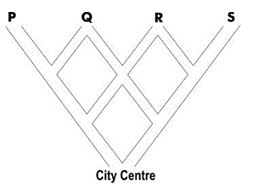
(a) 2
(b) 3
(c) 4
(d) 5
Answer : B
Question. In the figure, which of the following is a chord but NOT a diameter of the circle with O as its centre?
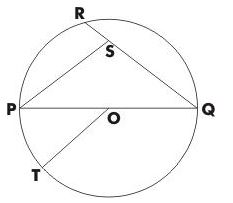
(a) OT
(b) RQ
(c) PS
(d) PQ
Answer : B
Question. On the surface of which of these shapes will you find it impossible to draw a straight line?
(a) A circular disc
(b) A cylinder
(c) A cone
(d) A sphere
Answer : D
Question. Which of the following shapes has NO corners?

Answer : D
Question. Abdul is playing a game on the computer where he has to fit together pieces to complete a rectangle. He has just one more piece to fit in the rectangle shown below. Which of the pieces below should he choose to complete his rectangle?

Answer : D
Question. On this map of part of a city, 1 cm = 0.5 km. Which place is likely to be 4 km from the Rose garden?
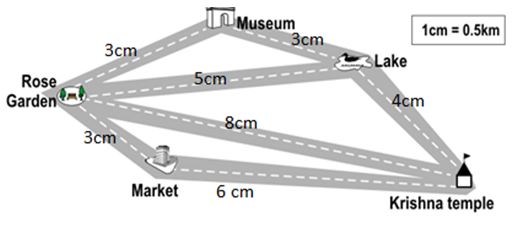
(a) The museum
(b) The lake
(c) The market
(d) The Krishna temple
Answer : D
Question. An ant starts from a point P and walks 20 cm towards the East. Next it walks 10 cm towards the North, then 10 cm towards the West and finally 15 cm towards the South to stop at point Q. Which of these figures best shows the path traced by the ant from start to finish?
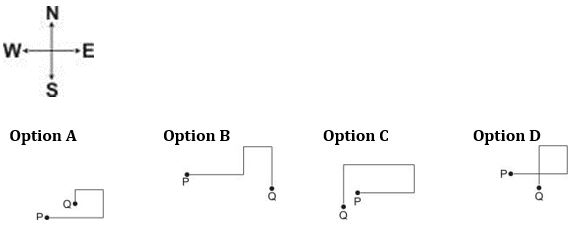
Answer : D
Question. This is the logo of a TV channel. Which of these will it look like when it is magnified?
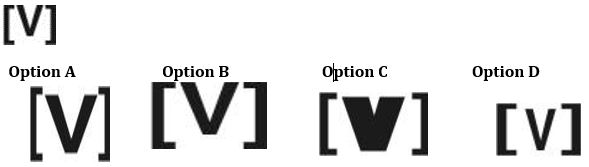
Answer : B
Free study material for Mathematics
Mathematics Class 6 Curriculum Solutions: Chapter 04 Basic Geometrical Ideas
Official NCERT Solutions for Chapter 04 Basic Geometrical Ideas
Review comprehensive exercise answers for Class 6 Mathematics Chapter 04 Basic Geometrical Ideas. Fully updated to match current NCERT syllabus guidelines, these textbook solutions help students verify their work and maintain accurate study notes.
Step-by-Step Explanations for Chapter 04 Basic Geometrical Ideas
Clear, methodical explanations accompany every challenging problem within the Class 6 Mathematics text. Engaging with these detailed answers lays a solid foundation for advanced learning and improves foundational clarity for upcoming assessments.
Next Steps in Your Mathematics Revision
Consistent practice with these solution guides cultivates faster problem-solving habits and clearer logical structuring. For a complete preparation experience, pair these textbook answers with our dedicated revision notes and sample papers for Class 6 Mathematics.
FAQs
The complete and updated NCERT Solutions Class 6 Mathematics Chapter 4 Basic Geometrical Ideas is available for free on StudiesToday.com. These solutions for Class 6 Mathematics are as per latest NCERT curriculum.
Yes, our experts have revised the NCERT Solutions Class 6 Mathematics Chapter 4 Basic Geometrical Ideas as per 2026 exam pattern. All textbook exercises have been solved and have added explanation about how the Mathematics concepts are applied in case-study and assertion-reasoning questions.
Toppers recommend using NCERT language because NCERT marking schemes are strictly based on textbook definitions. Our NCERT Solutions Class 6 Mathematics Chapter 4 Basic Geometrical Ideas will help students to get full marks in the theory paper.
Yes, we provide bilingual support for Class 6 Mathematics. You can access NCERT Solutions Class 6 Mathematics Chapter 4 Basic Geometrical Ideas in both English and Hindi medium.
Yes, you can download the entire NCERT Solutions Class 6 Mathematics Chapter 4 Basic Geometrical Ideas in printable PDF format for offline study on any device.