

Here is CBSE Class 8 Maths Factorization HOTs for your advanced practice. Find detailed High Order Thinking Skills (HOTS) questions and solutions for Class 8 Mathematics Chapter 13 Factorisation. Built for the 2026-27 exam session, these expert-tested questions sharpen your problem-solving skills according to standard CBSE, NCERT, and KVS rules.
Class 8 Mathematics Chapter 13 Factorisation HOTS Questions & Answers
Want to boost your grades in Mathematics? Solving Class 8 Mathematics HOTS Questions is a great way to build strong logic. Review the step-by-step answers below to increase your speed and feel fully ready for your Class 8 exams.
HOTS Questions and Answers for Class 8 Mathematics Chapter 13 Factorisation
HOTS
Question. Find all the factors of 14xy2.
Answer : 2 × 7 × x × y × y
Question. Factorize : x2 – 30x – 216.
Answer : (x – 36) (x + 6)
Question. Complete the brackets –
(x + a) (x + b) = x2 + ( ) x + ( )
Answer : a + b, ab
Question. Complete it : x2 – x – 156 = (_______) × (x + 12).
Answer : (x – 13)
Question. Give the factors which are common in 6xyz and 9yz2
Answer : 3yz
Question. Find dividend, when
Divisor = x + 3, Quotient = x + 2, Remainder = 0.
Answer : x2 + 5x + 6
Question. Find two numbers ‘a’ and ‘b’ so that ab = 36 and (a – b) = 5
Answer : a = 9, b = 4
Question. Factorize : (x + y)2 – (x – y)2.
Answer : 4xy
Question. Simplify : x2 – 10x – 96.
Answer : (x – 16) (x + 6)
Question. Simplify : x2 - 12x - 45 / x2 + 4x + 3
Answer : x - 15 / x + 1
Question. Find x2 – y2 if x = 5, y = 7.
Answer : –24
Question. Which is the factor common in all terms? 3xy + 15x2y + 9xy2 + 21y3
Answer : 3y
Question. Simplify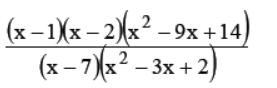
Answer: (x–2)
Question. Find the value of ‘a’ and ‘b’ so that x4+x3+8x2+ax+b is divisible by (x2+1).
Answer: a=1, b=7
Question. If both (p+1) and (p–1) are factors of ap3+p2–2p+b; find the value of ‘a’ and ‘b’.
Answer: a=2, b=–1
Question. Factorize :
a. 5 √5x 2 + 30x + 8 √5 b. 9a3b+41a2b2+20ab3 c. x8+x4+1
Answer: a. √5(√5 x +4) (√5x + 2)
b. ab(9a+5b)(a+4b)
c. (x2+1+x)(x2+1–x)(x4–x2+1)
CHALLENGES
1. Factorise the following :
a. x2+6x+9 b. 1–8x+16x2 c. 4x2–81y2
d. 4a2+4ab+b2 e. a2b2+c2d2–a2c2–b2d2
2. Factorise the following:
a. x2+7x+12 b. x2+x–12 c. x2–3x–18
d. x2+4x–21 e. x2–4x–192 f. x4–5x2+4
g. x4–13x2y2+36y4
3. Factorise the following:
a. 2x2+7x+6 b. 3x2–17x+20 c. 6x2–5x–14
d. 4x2+12xy+5y2 e. 4x4–5x2+1
4. Factorise the following:
a. x8–y8 b. a12x4–a4x12
c. x4+x2+1 d. x4+5x2+9
5. Factorise x4+4y4. Use this to prove that 20114+64 is a composite number.
6. Prove the identity (x+y+ z)2= x2+y2+z2+2xy+2yz+2zx. Use this to factorise the expression x8+4x2+4.
7. Prove that 41×61 can be written as the sum of two perfect squares.
8. Factorise: b2–12ac–4a2–9c2.
9. Factorise: 4a–3+16a2+64a3.
10. Factorise : a4–5a3–12a2–5a+1.
SUMMARY
1. The process of writing an expression as the product of two or more expressions is called factorization.
2. There are four ways to factorize
a. Common factor method
b. Grouping method
c. Using identities
d. Splitting the middle term
3. Basic identities are
(a+b)2=a2+2ab+b2
(a–b)2=a2–2ab+b2
(a+b)(a–b)=a2–b2
(x+a)(x+b)=x2+(a+b)x+ab
4. Factorization is the inverse of multiplication. Division is the inverse of multiplication. So, factorization makes division easy.
5. For dividing an algebraic expression by a monomial, there are two ways
a. Term by term
b. Common factor method
6. For dividing an algebraic expression by a polynomial, there are two ways
a. Factorization and cancelling the common factors
b. Long division method.
ERROR ANALYSIS
1. Students make mistakes while copying down an expression.
2. Students fail to identify which identity is to be applied in a particular question.
3. While performing long division, they miss on arranging the dividend in the standard form.
ACTIVITY I
To verify the identity (a+b)2=a2+2ab+b2
Material required
a. White chart paper b. Cardboard
c. Geometry box d. Pair of scissors
e. Fevistick f. Colour box
Steps
1 On a white chart paper, draw and cut a square of side 8cm (= a), another square of side 3cm (=b) and two rectangles each of length 8 cm and breadth 3 cm (as shown in fig. (i)).
2. Colour the bigger square red, the smaller square light red and each rectangle grey.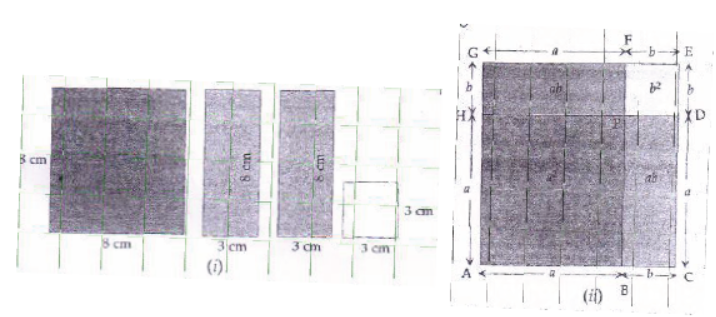
3. Paste the red square on the card board.
4. Arrange the other cut outs on the cardboard (as shown in fig. (ii))•
5. Name the figure (as shown in fig. (ii)).
Demonstration
AC = AB + BC = a + b
CE = CD + DE = a + b
∴ ACEG is a square of side a + b.
Now, the area of square ACEG = area of square ABPH + area of rectangle BCDP
+ area of rectangle PFGH + area of square DEFP
⇒ (a + b)(a + b) = (a × a) + a × b + a x b + (b × b)
⇒ (a + b)2 = a2 + ab + ab + b2
⇒ (a + b)2 = a2 + 2ab + b2.
ACTIVITY II
To verify the identity (a - b)2 = a2 – 2ab + b2
Material required
a. White chart paper b. Cardboard
c. Geometry box d. Pair of scissors
e. Fevistick f. Colour box
Steps
1. On a white chart paper, draw and cut a square of side 5 cm, another square of side 3 cm and two rectangles of dimensions 5 cm x 3 cm and 8 cm x 3 cm (as shown in fig- (i)).
2. Colour the bigger square red, smaller square as light red, bigger rectangle grey and smaller rectangle dark grey. 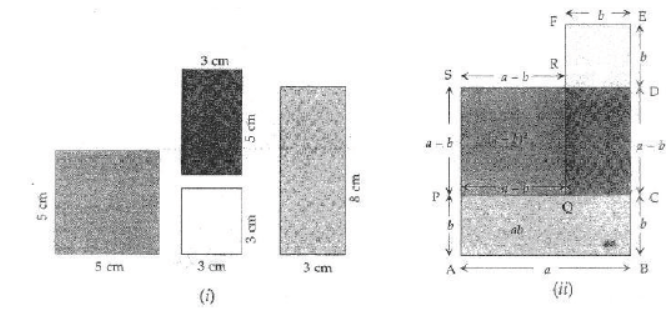
3. Paste the red square on the cardboard.
4. Arrange the other cut outs on the cardboard (as shown in fig. (ii)).
5. Name the figure (as shown in fig. (ii)).
Demonstration
Suppose AB = 8 cm = a, DE = 3 cm = b
∴ PQ = PC – QC = 8 cm – 3 cm = 5 cm = a –b
and BD = BC + CD = 3 cm + 5 cm = 8 cm = a
∴ PQRS is a square of side a-b and ABDS is a square of side a.
CEFQ is a rectangle whose length = a – b + b = a and breadth = b.
Now, the area of square PQRS = area of square ABDS + area of square DEFR
– area of rectangle ABCP – area of rectangle CEFQ
⇒ (a – b)(a – b) = a × a + b × b – a × b – a × b
⇒ (a – b)2 = a2 + b2 – ab – ab
⇒ (a – b)2 = a2 – 2ab + b2.
Free study material for Mathematics
CBSE Class 8 Mathematics Chapter 13 Factorisation HOTS Questions and Answers
Class 8 Mathematics Chapter Chapter 13 Factorisation Advanced Problem Sets
Strengthen your preparation for Class 8 Mathematics examinations with specialized Chapter 13 Factorisation HOTS worksheets. These structured problems are curated to match official CBSE guidelines and help tackle difficult board-level questions.
How to Use These Class 8 Mathematics HOTS
All analytical exercises for Chapter 13 Factorisation are structured around standard CBSE textbooks. Cross-reference your answers with our professional step-by-step guides to ensure complete conceptual accuracy.
More Study Resources for Class 8 Mathematics
Wrap up your chapter revision by testing your speed with our interactive Mathematics quizzes. Access all curriculum-aligned study resources online without any restrictions.
FAQs
You can download the teacher-verified PDF for CBSE Class 8 Maths Factorization HOTs from StudiesToday.com. These questions have been prepared for Class 8 Mathematics to help students learn high-level application and analytical skills required for the 2026-27 exams.
In the 2026 pattern, 50% of the marks are for competency-based questions. Our CBSE Class 8 Maths Factorization HOTs are to apply basic theory to real-world to help Class 8 students to solve case studies and assertion-reasoning questions in Mathematics.
Unlike direct questions that test memory, CBSE Class 8 Maths Factorization HOTs require out-of-the-box thinking as Class 8 Mathematics HOTS questions focus on understanding data and identifying logical errors.
After reading all conceots in Mathematics, practice CBSE Class 8 Maths Factorization HOTs by breaking down the problem into smaller logical steps.
Yes, we provide detailed, step-by-step solutions for CBSE Class 8 Maths Factorization HOTs. These solutions highlight the analytical reasoning and logical steps to help students prepare as per CBSE marking scheme.