NEET Physics Surface Tension Revision Notes

Download the latest NEET Physics Surface Tension Revision Notes in PDF format. These Full Course Surface Tension revision notes are carefully designed by expert teachers to align with the 2025-26 syllabus. These notes are great daily learning and last minute exam preparation and they simplify complex topics and highlight important definitions for Full Course students.

Chapter-wise Revision Notes for Full Course Surface Tension Surface Tension

To secure a higher rank, students should use these Full Course Surface Tension Surface Tension notes for quick learning of important concepts. These exam-oriented summaries focus on difficult topics and high-weightage sections helpful in school tests and final examinations.

Surface Tension Revision Notes for Full Course Surface Tension


• Force of cohesion:- It is force between two molecules of similar nature.
 
• Force of adhesion:- It is the force between two molecules of different nature.
 
• Molecular range:- The maximum distance between two molecules so that the force of attraction between them remains effective is called molecular range.
 
• Sphere of influence:- Sphere of influence of any molecule is the sphere with molecule as its center and having a radius equal to molecular range (=10-7 cm).
 
• Surface film:- Surface film of a liquid is defined as the portion of liquid lying on the surface and caught between two parallel planes situated molecular range apart.
 
• Surface tension:-
Surface tension is the property of a liquid by virtue of which its free surface behaves like a stretched membrane and supports, comparatively heavier objects placed over it. It is measured
in terms of force of surface tension.
 
• Force of surface tension:- It is defined as the amount of force acting per unit length on either side of an imaginary line drawn over the liquid surface.
 
side of an imaginary line drawn over the liquid surface.
(a) T = Force/length = F/l
(b) T = Surface energy/Surface area = W/A
Units:- S.I – Nm-1
C.G.S- dyne cm-1
 
 Additional force:-
(a) For a cylindrical rod:- F = T×2πr (Here r is the radius of cylindrical rod)
(b) For a rectangular block:- F = T×2(l+d) (Here l is the length and d is the thickness of the rectangular block)
 
(c) For a ring:- F = T×2×2πr (Here r is the radius of cylindrical rod)
 
 Surface energy:-
Potential energy per unit area of the surface is called surface energy.
(a) Expansion under isothermal condition:-
To do work against forces of surface tension:-
    W= T×A (Here A is the total increase in surface area)
 
To supply energy for maintaining the temperature of the film:-
    E = T+H
 
(b) Expansion under adiabatic conditions:-
    E = T
Force of surface tension is numerically equal to the surface energy under adiabatic conditions.
 
• Drops and Bubbles:-
(a) Drop:- Area of surface film of a spherical drop of radius R is given by, A = 4πR2
(b) Bubble:- The surface area of the surface films of a bubble of radius R is, A = 2×4πR2
 
 Combination of n drops into one big drop:-
 
(a) R = n1/3r
 
(b) Ei = n (4πr2T), Ef =4πR2T
 
(c) Ef/ Ei = n -1/3
 
(d) ΔE/Ei = [1-(1/n1/3)]
 
(e) ΔE = 4πR2T (n1/3-1) = 4πR3T (1/r – 1/R)
 
 Angle of contact:- Angle of contact, for a pair of solid and liquid, is defined as the angle between tangent to the liquid surface drawn at the point of contact and the solid surface inside the liquid.
 
(a) When θ < 90º (acute):-
     Fa >Fc/√2
 
(i) Force of cohesion between two molecules of liquid is less than the force of adhesion between molecules of solid and liquid.
(ii) Liquid molecules will stick with the solid, thus making solid wet.
(iii) Such liquid is put in the solid tube; it will have meniscus concave upwards
 
(b) When θ > 90º (obtuse):-Fa
 
(i) Force of cohesion between two molecules of liquid is less than the force of adhesion between molecules of solid and liquid.
(ii) In this case, liquids do not wet the solids.
(iii) Such liquids when put in the solid tube will have a meniscus convex upwards.
 
(c) When θ = 90º:-?
     Fa=Fc/√2
The surface of liquid at the point of contact is plane. In this case force of cohesion and adhesion are comparable to each other.
 
(d) cosθc = Tsa – Tsl/Tla
Here, Tsa,Tsl and Tla represent solid-air, solid-liquid and liquid-air surface tension respectively). Here θc is acute if Tsl < Tsa while θc is obtuse if Tsl >Tsa
 
 
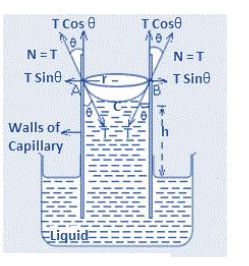
 Capillarity:-
 
Capillarity is the phenomenon, by virtue of which the level of liquid in a capillary tube is different from that outside it, is called capillarity.
Weight of liquid, W = Vρg = πr2[h+(r/3)]ρg (Here r is the radius meniscus)
If weight of meniscus is taken into account, the force of surface tension will be,
T = [r(h+(r/3)) ρg]/2 cosθ
 
For fine capillary, force of surface tension, T = rhρg/2 cosθ
So height, h = 2T cosθ/ rρg
 
This signifies, height of liquid risen (or depressed) in a capillary tube varies inversely as the radius of tube. Smaller the diameter of capillary tube, greater is the rise of liquid in it.
NEET-Physics-Surface-Tension-Revision-Notes 1
 
• Tube of insufficient length:
Rh = 2T/ρg
As, T, ρ and g are all constant, Rh = Constant
Smaller the value of h, greater will be the value of R. But liquid will never flow.


• Effect of temperature affecting surface tension of liquids:-
Surface tension of a liquid decreases with an increase in its temperature.
Tθ = K (θc-θ)
Here Tθ is the surface tension at a particular temperature θ while θc is the critical temperature of the liquid and K is constant.
 
• General formula for excess pressure:-
Pexcess =T[1/R1 + 1/R2]
 
• Excess pressure in liquid drop:-
Pexcess = 2T/R, Here R is the radius of liquid drop.
 
• Excess pressure for an air bubble in liquid drop:-
Pexcess = 2T/R
 
• Excess pressure in soap bubble:-
Pexcess = 4T/R, Here R is the radius of soap bubble.
 
 Pressure inside an air bubble at a depth h in a liquid:- Pin = Patm+ hdg + (2T/R)
 
• Forces between two plates with thin water film separating them:-
(a) ΔP = T (1/r – 1/R)
(b) F = AT (1/r – 1/R)
(c) If separation between plate is d, then ΔP = 2T/d and F = 2AT/d
 
 Radius of curvature of common film:- Rcomon = rR/R-r
 
 Capillary depression, h = 2T cos (π-θ)/rdg
 
•Shape of liquid surface:-
(a) Plane surface (as for water – silver) if Fadhesive > Fcohesive/√2
(b) Concave surface (as for water – glass) if Fadhesive > Fcohesive/√2
(c) Convex surface (as for mercury-glass) if Fadhesive < Fcohesive/√2
 
 Increase in temperature:-
Δθ = 3T/ρs (1/r – 1/R) or Δθ = 3T/ρsJ (1/r – 1/R)


Please click the link below to download pdf file of NEET Physics Surface Tension Revision Notes
 

NEET Full Course Surface Tension Surface Tension Notes

Students can use these Revision Notes for Surface Tension to quickly understand all the main concepts. This study material has been prepared as per the latest NEET syllabus for Full Course. Our teachers always suggest that Full Course students read these notes regularly as they are focused on the most important topics that usually appear in school tests and final exams.

NCERT Based Surface Tension Summary

Our expert team has used the official NCERT book for Full Course Surface Tension to design these notes. These are the notes that definitely you for your current academic year. After reading the chapter summary, you should also refer to our NCERT solutions for Full Course. Always compare your understanding with our teacher prepared answers as they will help you build a very strong base in Surface Tension.

Surface Tension Complete Revision and Practice

To prepare very well for y our exams, students should also solve the MCQ questions and practice worksheets provided on this page. These extra solved questions will help you to check if you have understood all the concepts of Surface Tension. All study material on studiestoday.com is free and updated according to the latest Surface Tension exam patterns. Using these revision notes daily will help you feel more confident and get better marks in your exams.

Where can I download latest NEET Full Course Surface Tension Surface Tension notes

You can download notes for Full Course Surface Tension Surface Tension for latest academic session from StudiesToday.com

Are the revision notes available for Surface Tension Full Course Surface Tension for the latest NEET academic session

Yes, the notes issued for Full Course Surface Tension Surface Tension have been made available here for latest NEET session

Is there any charge for the Full Course Surface Tension Surface Tension notes

There is no charge for the notes for NEET Full Course Surface Tension Surface Tension, you can download everything free of charge

Which is the best online platform to find notes for Surface Tension Full Course Surface Tension

www.studiestoday.com is the best website from which you can download latest notes for Surface Tension Surface Tension Full Course

Where can I find topic-wise notes for Full Course Surface Tension Surface Tension

Come to StudiesToday.com to get best quality topic wise notes for Full Course Surface Tension Surface Tension