Reflection:-
• Light:- it is an agent which produces in us the sensation of sight. It is a form of energy.
• Transparent medium:- It is a medium through which light can be propagated easily.(e.g., sun, candle, electric arc)
• Translucent medium:- It is a medium through which light is propagated partially.(e.g., paper, ground, glass)
• Opaque:- It is a medium through which light can be propagated. (e.g., wood, iron)
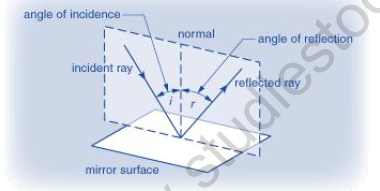
• Reflection:- It is the property of light by virtue of which, light is sent back into the same medium from which it is coming after being obstructed by a surface.
• Laws of reflection:-
(a) The incident ray, the reflected ray and normal to the reflecting surface at the point of incidence, all lie in one plane and that plane is perpendicular to the reflecting surface.
(b) The angle of incidence is equal to the angle of reflection.
So, ∠i = ∠r
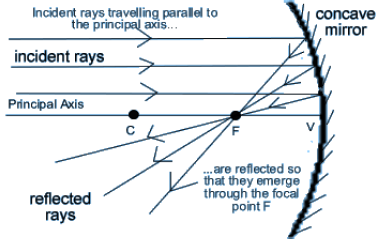
• Concave Mirror:- It is a spherical mirror which when looked from the reflecting side is depressed at the center and bulging at the edges.
• Convex mirror:-
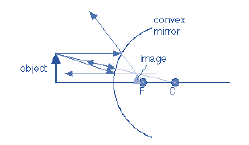
?It is a spherical mirror which when looked from the reflecting side bulges at the center and is depressed at the edges.
• Radius of curvature(R):-
Radius curvature of a mirror is defined as the radius of that sphere of which the mirror forms a part.
• Principal focus:-
Principal focus is a point, situated on the principal axis, at which a beam coming parallel to
principal axis meets or appears to meet after reflection from the mirror.
• Focal plane:-
It is a vertical plane passing through the principal focus and perpendicular to the principal axis.
• Focal length (f):-
Focal length, of a spherical mirror is the distance of its principal focus from its pole.
• Relation between focal length and radius of curvature:-
f = R/2
This signifies, the focal length of a spherical mirror is half of its radius of curvature.
• Mirror formula:-
?1/f = 1/v + 1/u = 2/r
• Relative positions, size and nature of image as object is brought from infinity to the pole of a concave mirror:-
(a) If the object is at infinity, u = ∞
v = -f , m = 0
Thus, image is obtained at the focus of a focal plane and very small in dimensions.
(b) If object lies beyond center of curvature,
2f > v >f
(c) If object is at center of curvature,
v = -2f , m =1
Thus, a real and inverted image of same size as that of object is formed at center of curvature.
(e) Object is in between a distance f and 2f , i.e., in between focus and center of curvature
(f < u < 2f):-
v < ∞ and m = (v/u) >1
Thus, a real, inverted and magnified image is formed in between center of curvature and infinity.
(e) Object is kept at focus (u = -f):-
v = -∞
The rays after reflection are rendered into a parallel beam meeting in infinity.
(f) Object is kept within focus (u < -f):-
v is positive.
Thus, a virtual, erect and magnified image is formed on the other side of mirror.
• Some important points:-
(a) In case of spherical mirrors, focal length is half its radius of curvature image.
(b) In case of concave mirror areal object produces a real and inverted if its distance from pole is greater than the focal length while its virtual and erect if its distance from pole is less than focal length.
(c) In case of convex mirror a real object always produces a virtual and erect image.
(d) All real images are inverted and virtual images are erect.
Refraction:-
• Refraction:- Refraction is the phenomenon by virtue of which a ray of light going from one medium to the other undergoes a change in its velocity.
• Incident ray:-The ray which approaches the interface is called incident ray.
• Refracted ray:- Ray which goes into the second medium is called angle of incidence.
• Laws of refraction:-
(a) Snell’s law:- The sine of the angle of incidence bears a constant ratio with the sine of the angle of refraction.
sin i/sin r = constant
(b) The incident ray, the refracted ray and the normal to the interface at the point of incidence all lie in one plane and that plane is perpendicular to the interface separating the two media.
• Refractive Index:-
? (a) Refractive index of a medium with respect to another is defined as the ratio between sine of the angle of incidence to the sine of angle of refraction.
sin i/sin r = constant = 1μ2
(b) Refractive index of medium 2 with respect to1 is also defind as the ratio between velocity of light in medium 1 to the velocity of light in medium 2.
(c) 1μ2 = v1/v2
(d) μ = c/v
(e) Refractive index of a second medium with respect to first is defined as the ratio between absolute refractive index of second medium to the abdsolute refractive index of first medium.
(f) 1μ2 = μ2/μ1?
• Total internal reflection:-
(a) Critical angle:- Critical angle is the angle of incidence of a ray of light in denser medium such that its angle of refraction in the rarer medium is 90º.
(b) Total internal reflection:- It is the phenomenon by virtue of which, a ray of light travelling from a denser to a rarer medium is sent back in the same medium provided, it is incident on the interface at an angle greater than critical angle.
(c) μ = 1/sin C
• Refraction at a single spherical surface when light travelling from medium of refractive index μ1 (rarer) to that of refractive index μ2 (denser):-
(a) Refraction at a convex surface producing real image:-
μ2/v – μ1/u = μ2 - μ1/R
(b) Refraction at a convex surface producing virtual image:-
μ2/v – μ1/u = μ2 - μ1/R
(c) Refraction at a concave surface:-
μ2/v – μ1/u = μ2 - μ1/R
• Refraction at a single spherical surface when light travelling from medium of refractive index μ2 (denser) to that of refractive index μ1(rarer) :-
Convex surface producing a real image of a real object:-
μ2/u – μ1/v = μ2 - μ1/R
Please click the link below to download pdf file of NEET Physics Ray Optics Revision Notes