NEET Physics Sound And Light Waves Revision Notes

Revision Notes for Full Course Sound and Light Waves: Sound And Light Waves

Explore reliable concept summaries and revision materials through the NEET Physics Sound And Light Waves Revision Notes. Tailored for Full Course learners, utilizing these notes for Sound and Light Waves Sound And Light Waves ensures thorough preparation and strengthens core academic definitions before final evaluations.

Review Sound And Light Waves for Full Course Sound and Light Waves

Access the complete concept summary PDF for Sound And Light Waves below. Regular review of these targeted notes builds familiarity with complex Full Course Sound and Light Waves themes and helps secure higher marks in final school evaluations.
Sound Waves:-
 
It is the form of energy which produces, in us, the sensation of hearing.
 
• Properties:-
 
(a) Longitudinal in nature.
(b) It requires a material medium for its propagation.
(c) Sound waves can be reflected.
(d) Sound waves suffer refraction.
(e) Sound waves show the phenomenon of interference
(f) Sound waves shows diffraction
(g) Sound propagates with a velocity much smaller than that of light.
(h) Sound gets absorbed in the medium through which it passes.
 
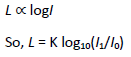
• Loudness (L)or Intensity (I):-
 
NEET Physics Sound and Light Waves Revision Notes
Unit of intensity of sound is bel.
 
• Intensity (I) and Amplitude (A):-
NEET Physics Sound and Light Waves Revision Notes-1
 
 Intensity(I) and distance from the source (r):-
NEET Physics Sound and Light Waves Revision Notes-2
 
  Pitch or Shrillness:-Pitch is a sensation which determines the shrillness of sound. It is subjective and cannot be measured quantitatively. It depends up on frequency and relative motion
between the sources and the listener.
  Quality or Timber:- It is that characteristic of a musical sound which enables us to distinguish between two notes of the same pitch and loudness produced by two different sources.
 
•  Velocity u of longitudinal wave (sound) [Newton’s Formula]:-
u = √E/ρ
Here E is the coefficient of elasticity and ρ is the density of medium.
 
•  Velocity of sound in solids:-
u = √Y/ρ
Here Y is the young’s modulus of elasticity and ρ is the density.
 
• Velocity of sound in liquids:-
u = √B/ρ
Here B is the Bulk modulus of elasticity and ρ is the density.
 
 Velocity of sound in gases:-
u = √γP
Here, γ (=cP/cV) is the adiabatic ratio, P is the pressure and ρ is the density.
 
 Various factors affecting velocity of sound:-
(a) Effect of density:- The velocity of sound in a gas varies inversely as the square root of its
density. u1/ u2 = √*ρ21]
 
(b) Effect of moisture:-um/ud= √*ρd/ ρm]
Since, ρm<ρd, then, um>ud
This signifies sound travels faster in moist air.
 
(c) Effect of pressure:- u=√γP/ρ=√γk = constant
This signifies, change of pressure has no effect on the velocity of sound.
 
(d) Effect of temperature:- ut/u0 =√ρ0/ρt= √T/T0
Thus, velocity of sound varies directly as the square root temperature on Kelvin’s scale.
 
(e) Temperature coefficient of velocity of sound (α):- α = u0/546 = (ut-u0)/t
 
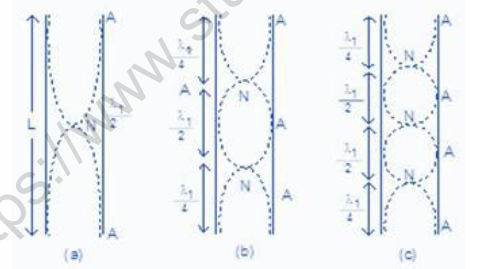
 Overtones in open pipe:-An open pipeis open at both ends. Since air is free to vibrate at an open end, we must get an antinode at the open end
NEET-Physics-Sound-and-Light-Waves-Revision-Notes-unlocked 1
(a) Fundamental frequency:-
Wavelength, λ=2l
Frequency, f=u/2l = (1/2l)√(γP/ρ)
Here l is the length of the pipe and u is the velocity of sound.
 
(b) First overtone (Second Harmonic):-
Wavelength, λ1=l
Frequency, f1=2f
c) Second overtone (Third Harmonic):-
Wavelength, λ2=2l/3
Wavelength, f2=3f
 
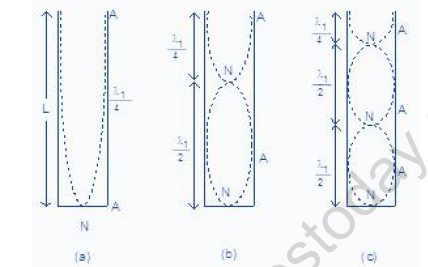
 Overtones in closed pipe:-Since air, at a closed end, is not free to vibrate, there must be a node at a closed end always.
NEET-Physics-Sound-and-Light-Waves-Revision-Notes-unlocked 2
(a) Fundamental frequency:-
Wavelength, λ=4l
Frequency, F=u/4l = (1/4l)√(γP/ρ)
Here l is the length of the pipe and u is the velocity of sound.
 
(b) First overtone (Third Harmonic):-
Wavelength, λ1=(4/3)l
Frequency, F1=3F
 
(c) Second overtone (Fifth Harmonic):-
λ2 = 4l/5
F2 = 5F
 Comparison of fundamental frequencies of a closed end of an open pipe:- f = 2F
 Doppler’s Effect:-Theapparent change in pitch of a note, due to the relative motion between the source and the listener is called Doppler’s effect.
 
(a) Source in motion, listener at rest:-
 
(i) Source approaching the listener:-
Modifying wave length, λ' = V-a/f
Apparent frequency, f' = [V/V-a]f
Change in frequency, ?f = (a/V-a)f
 
Here V is the velocity of sound in air and a is the velocity of source when it moves towards the listener.
 
(ii) Source going away from the listener:-
Apparent frequency, f' = [V/V+a]f
Change in frequency, ?f = -(a/V+a)f
 
(iii) Source crossing the listener:-
Apparent frequency of the source before crossing = (V/V-a) f
Apparent frequency of the source after crossing = (V/V+a) f
Change in frequency, ?f = -(2aV/V2-a2)f
 
(b) Source at rest, listener in motion:-
 
(i) Listener moving away from source:-
Apparent frequency, f'= [V-b/V]f
Change in frequency, ?f = (-b/V)f
Here b is the velocity of listener.
 
(ii) Listener moving towards the source:-
Apparent frequency:-f'= [V+b/V]f
Change in frequency, ?f = (+b/V)f
 
(iii) Listener crossing the source:-
Apparent frequency of the source before crossing = (V+b/V) f
Apparent frequency of the source after crossing = (V-b/V) f
Change in frequency, ?f =-2fb/V
 
 
Please click the link below to download pdf file of NEET Physics Semiconductors Revision Notes
 

Revision Notes and Key Concepts for Full Course Sound and Light Waves Sound And Light Waves

Quick Revision Notes: Sound And Light Waves (NEET)

Review targeted chapter notes for Full Course Sound and Light Waves Sound And Light Waves. Built according to official NEET guidelines, these summaries highlight high-yield topics frequently tested in school evaluations.

Expert Study Material for Full Course Sound and Light Waves

Each chapter summary is structured around standard NEET textbooks, allowing students to check their understanding and clarify complex ideas early in their revision.

Complete Your Chapter Revision

Explore our broader library of printable assignments, chapter notes, and mock tests designed to support continuous revision and secure higher marks in NEET assessments.

FAQs

Where can I download the latest PDF for NEET Physics Sound And Light Waves Revision Notes?

You can download the teacher prepared revision notes for NEET Physics Sound And Light Waves Revision Notes from StudiesToday.com. These notes are designed as per 2026-27 academic session to help Full Course students get the best study material for Sound and Light Waves.

Are these Sound and Light Waves notes for Full Course based on the 2026 board exam pattern?

Yes, our NEET Physics Sound And Light Waves Revision Notes include 50% competency-based questions with focus on core logic, keyword definitions, and the practical application of Sound and Light Waves principles which is important for getting more marks in 2026 NEET exams.

Do these Full Course notes cover all topic-wise concepts for Sound and Light Waves?

Yes, our NEET Physics Sound And Light Waves Revision Notes provide a detailed, topic wise breakdown of the chapter. Fundamental definitions, complex numerical formulas and all topics of NEET syllabus in Full Course is covered.

How can I use NEET Physics Sound And Light Waves Revision Notes for quick last-minute revision?

These notes for Sound and Light Waves are organized into bullet points and easy-to-read charts. By using NEET Physics Sound And Light Waves Revision Notes, Full Course students fast revise formulas, key definitions before the exams.

Is there any registration required to download Full Course Sound and Light Waves notes?

No, all study resources on StudiesToday, including NEET Physics Sound And Light Waves Revision Notes, are available for immediate free download. Full Course Sound and Light Waves study material is available in PDF and can be downloaded on mobile.