

Official Class 6 Mathematics Revision Material: CBSE Class 6 Mathematics Ratio And Proportion Chapter Notes
Explore reliable concept summaries and revision materials through the CBSE Class 6 Mathematics Ratio And Proportion Chapter Notes. Tailored for Class 6 learners, utilizing these notes for Mathematics Chapter 12 Ratio and Proportion ensures thorough preparation and strengthens core academic definitions before final evaluations.
Chapter-wise Concept Summaries: Chapter 12 Ratio and Proportion
Access the complete concept summary PDF for Chapter 12 Ratio and Proportion below. Regular review of these targeted notes builds familiarity with complex Class 6 Mathematics themes and helps secure higher marks in final school evaluations.
CBSE Class 6 Ratio and Proportion Chapter Concepts. Learning the important concepts is very important for every student to get better marks in examinations. The concepts should be clear which will help in faster learning. The attached concepts made as per NCERT and CBSE pattern will help the student to understand the chapter and score better marks in the examinations.
Ratio and Proportion
12.1 Ratio
A ratio is a pair of numbers used to describe a relationship or make a comparison between two quantities. A ratio can be written three ways. Like fractions, ratios should be reduced. Notice that each form has been reduced.
1. Using the word “to” 48 to 8 = 6 to 1
2. Using a “colon” 48:8 = 6:1
3. Expressed in “fraction form” 48/8 = 6/1
Note: Given ratio a: b. Here a is called the “Antecedent” of the ratio and b is called “Consequent” of the ratio.
12.2 Proportion
A part considered in relation to the whole. The relationship between things or parts of things with respect to the total magnitude or quantity. Or it can be defined as “A statement that two ratios are the same.” Sign of Proportion: The Sign of Proportion is denoted as “:” For example, the ratios 1:4 and 4:16 are equal which means both the ratios are in proportion. It can be written as 1:4::4:16.
In a proportion 1st term and 4th term are known as extremes while 2nd and 3rd terms are known as means.
Note: If a:b=c:d then ad=bc i.e., Product of extremes = Product of means
Continued Proportions: If three quantities of the same kind are said to be in continued proportion, then the ratio of the first and second is equal to the ratio of the second and the third.
For example, If a:b=b:c, then a, b, c are in continue proportion and b2 = ac.
Here b is called the mean proportional and the mean proportional
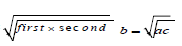
Note:
1. Suppose it is given that A:B, B:C, C:D then A:D can be easily find out using the following relation:
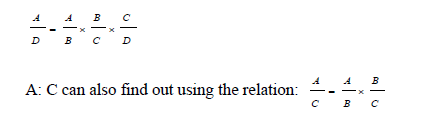
2. If a and b are two quantities then
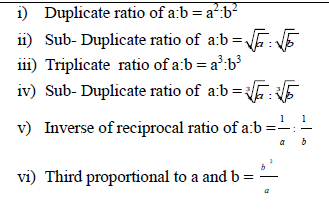
Example 1: What do we mean by the ratio of two natural numbers?
Solution: It is their relationship with respect to relative size that we can express verbally in a sentence. Specifically, one number is a multiple of the other (so many times it), a part of it, or parts of it.
Example 2: What ratio has 15 to 5?
Solution:. 15 is three times 5. That is the ratio -- the relationship -- of 15 to 5.
Example 3. What ratio has 5 to 15?
Solution: 5 is the third part of 15. That is called the inverse ratio of 15 to 5
Example 4: What ratio has 10 to 15?
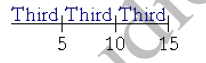
Solution: 10 is two thirds of 15.
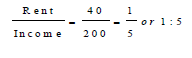
Example 5: Let’s suppose you earn Rs.200 a week. Your house rent is Rs.40 weekly. What is the ratio of your rent to your income?
Solution: Make a ratio with the rent on top (numerator) and the weekly income on the bottom (denominator). Then reduce.
Example 6: Simplify the ratio 1/3:1/2.
Solution: Ratio is a comparison of numbers by division. Rewrite the above example as a division problem and solve.1/3:1/2 = 1/3 ¸ 1/2 = 1/3 ´ 2/1 = 2/3 or 2:3
Example7: On a workplace mathematics test of 20 questions, you missed 2 questions. What is the ratio of the number you answered correctly to the number you missed?
Step 1: Subtract the number of questions you missed from the total number of questions.
Total questions - 20
Number missed - 2
Number correct - 18
Step 2: Make a ratio with the number you answered correctly on top (numerator) and the number you missed on the bottom (denominator). Then reduce if necessary.
N u m b e r c o r r e c t = 18 = 9 = 1
N u m b e r m i s s e d 2 1
Example 8: In a ratio which is equal to 8:9 if the antecedent is 64, What is the consequent?
Solution: If the antecedent is 8 then consequent is 9. If the antecedent is 64, then consequent is Proportions
Example 1: 5 is to 15 as 8 is to 24. Is this a proportion?
This is a proportion because
5 : 15 = 5/15 = 1/3
8:24 =1/3
Example 2: Why is this a proportion? 16 is to 2 as 80 is to 10.
Solution: This is a proportion because 16: 2 =16/2= 8
80:10 = 80/10 =8
Example 3: Why is this a proportion? 10 is to 15 as 2 is to 3.
Solution: This is a proportion because 10 : 15 = 10/15= 2/3
Example 4: Complete this proportion: 8 is to 32 as 9 is to ?
Solution: Let the missing number be x 8:32:: 9:x
USE: Product of extremes = Product of means
⇒ 8 x = 3 2 x 9
x = 32 x 9 / 8
288/8 = 36
Example 5: Complete this proportion: 27 is to 3 as ? is to 5
Solution: Let the missing number be x 27:3:: x :5
USE: Product of extremes = Product of means
⇒ 27 x 5 = 3 x x
x = 27 x 5 / 3
= 135/3 45
Example 6: In each item below, what ratio has a to b?
Solution: a) Since 1 is the sixth part of 6, then a is the sixth part of b.
b) Since 10 is ten times 1, then a is ten times b.
(a simply means the first term; b means the second.)
a) a is to b as 1 is to 6.
b) a is to b as 10 is to 1.
Example 7: Read this proportion, and complete it:
8/2 = 20/?
Solution: Let the missing number be x
8/2 = 20/ x
⇒ 8 * x = 20 * 2
x = 20*2/8 = 40/8 = 5
Example 8: Complete this proportion
7/21 = 4/? :
Solution: Let the missing number be x
7/21 = 4/x
⇒ 7 * x = 21 * 4
x = 21*4/7 = 84/7 = 12
Example 9: Complete this proportion:
2/3 = ?/12
Solution: Let the missing number be x
2/3 = x/12
⇒ 2 * 12 = x * 3
x = 2*12/3 = 24/3 = 8
Please click on below link to download pdf file for CBSE Class 6 Ratio and Proportion Chapter Concepts.
Free study material for Mathematics
Study Material and Revision Notes for Class 6 Mathematics Chapter 12 Ratio and Proportion
Quick Revision Notes: Chapter 12 Ratio and Proportion (CBSE)
Review targeted chapter notes for Class 6 Mathematics Chapter 12 Ratio and Proportion. Built according to official CBSE guidelines, these summaries highlight high-yield topics frequently tested in school evaluations.
Expert Study Material for Class 6 Mathematics
Each chapter summary is structured around standard CBSE textbooks, allowing students to check their understanding and clarify complex ideas early in their revision.
Complete Your Chapter Revision
Follow up your revision by attempting the interactive online Mathematics MCQ test and practice worksheets for this chapter to verify your mastery. All platform resources are free to access.
FAQs
You can download the teacher prepared revision notes for CBSE Class 6 Mathematics Ratio And Proportion Chapter Notes from StudiesToday.com. These notes are designed as per 2026-27 academic session to help Class 6 students get the best study material for Mathematics.
Yes, our CBSE Class 6 Mathematics Ratio And Proportion Chapter Notes include 50% competency-based questions with focus on core logic, keyword definitions, and the practical application of Mathematics principles which is important for getting more marks in 2026 CBSE exams.
Yes, our CBSE Class 6 Mathematics Ratio And Proportion Chapter Notes provide a detailed, topic wise breakdown of the chapter. Fundamental definitions, complex numerical formulas and all topics of CBSE syllabus in Class 6 is covered.
These notes for Mathematics are organized into bullet points and easy-to-read charts. By using CBSE Class 6 Mathematics Ratio And Proportion Chapter Notes, Class 6 students fast revise formulas, key definitions before the exams.
No, all study resources on StudiesToday, including CBSE Class 6 Mathematics Ratio And Proportion Chapter Notes, are available for immediate free download. Class 6 Mathematics study material is available in PDF and can be downloaded on mobile.