

Official Class 6 Mathematics Revision Material: CBSE Class 6 Mathematics Basic Geometrical Ideas Chapter Notes
Explore reliable concept summaries and revision materials through the CBSE Class 6 Mathematics Basic Geometrical Ideas Chapter Notes. Tailored for Class 6 learners, utilizing these notes for Mathematics Chapter 04 Basic Geometrical Ideas ensures thorough preparation and strengthens core academic definitions before final evaluations.
Chapter-wise Concept Summaries: Chapter 04 Basic Geometrical Ideas
Navigate directly to the revision notes for Chapter 04 Basic Geometrical Ideas using the digital viewer below. Each summary is structured to highlight high-weightage sections, allowing students to instantly access critical definitions and focus on core exam topics.
CBSE Class 6 Basic Geometrical Ideas Chapter Concepts. Learning the important concepts is very important for every student to get better marks in examinations. The concepts should be clear which will help in faster learning. The attached concepts made as per NCERT and CBSE pattern will help the student to understand the chapter and score better marks in the examinations.
1. Point
In geometry, points are zero-dimensional; i.e., they do not have volume, area, length, or any other higher-dimensional analogue. A point could also be defined as a sphere which has a diameter of zero.

2. Line Segment
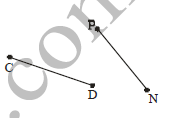
In geometry, a line segment is a part of a line that is bounded by two end points, and contains every point on the line between its end points. Examples of line segments include the sides of a triangle or square.
3. Line
The notion of line or straight line was introduced by the ancient mathematicians to represent straight objects with negligible width and depth. until seventeenth century, lines were defined like this: "The line is the first species of quantity, which has only one dimension, namely length, without any width nor depth, and is nothing else than the flow or run of the point which [...] will leave from its imaginary moving some vestige in length, exempt of any width. [...] The straight line is that which is equally extended between its points" Euclid described a line as "breadthless length", and introduced several postulates.
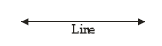
In modern mathematics, A line is defined as a collection of points along a straight path that goes on and on in opposite directions. A line has no endpoints.
4. Intersecting Lines
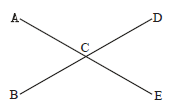
Lines that have one and only one point in common are known as intersecting lines.
Note:
1. A minimum of two lines are required for intersection. B
2. The common point where all the intersecting lines meet is called the Point of Intersection.
3. All the intersecting lines form angles at the point of intersection.
5. Parallel Lines
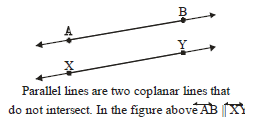
Two lines in a plane that do not intersect or meet are called parallel lines. The parallel symbol is || For example, AB || CD indicates that line AB is parallel to line CD.
6. Curves
A curve is defined as a line that deviates from straightness in a smooth, continuous fashion.
Types of Curves
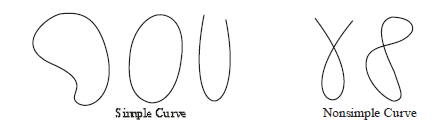
i) Simple Curve: A curve is simple if it does not cross itself.
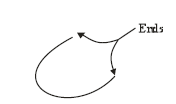
ii) Open Curve: A curve with end points (in other words, the ends don't join up) is called an open curve.
iii) Closed Curve: A curve that joins up so there are no end points is called a closed curve.
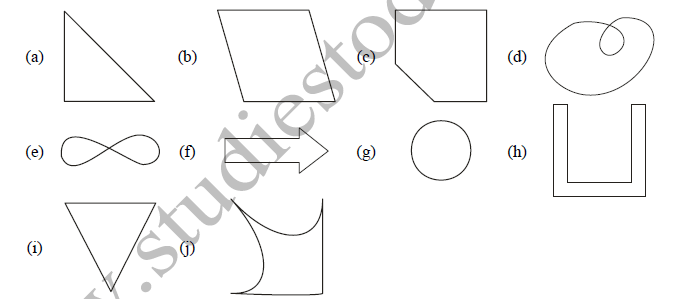
iv) Jordan Curve: A Simple closed curve is called a Jordan Curve:

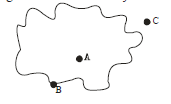
Position In Various Regions: In a closed curve, thus, there are three parts.
i) interior (‘inside’) of the curve
ii) boundary (‘on’) of the curve and
iii) exterior (‘outside’) of the curve.
In the adjacent figure 4.12, A is in the interior, C is in the exterior and B is on the curve. The interior of a curve together with its boundary is called its “region”.
7. Polygon
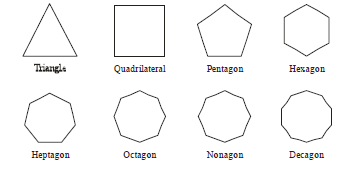
In geometry a polygon is traditionally a plane figure that is bounded by a closed path or circuit, composed of a finite sequence of straight line segments (i.e., by a closed polygonal chain). These segments are called its edges or sides, and the points where two edges meet are the polygon's vertices (singular: vertex) or corners.
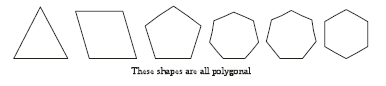
Regular Polygon: A regular polygon is a polygon that is equiangular (all angles are equal in measure) and equilateral (all sides have the same length). Regular polygons may be convex or star
8. Angles
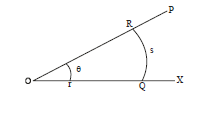
An angle is the figure formed by two rays sharing a common endpoint. This common point is called the vertex. The magnitude of the angle is the amount of rotation that separates the two rays. It may also be understood as measurement of rotation of one straight line from the other straight line. This is measured in terms of ratio in lengths of arc and radius of arc when arc is drawn taking vertex as the center.
If s is the length of arc and r is the length of the radius, then value of angle θ is s/r. Here we notice that for two given lines, if we increase radius of arc r, length of arc s also increases in the same proportion and finally ratio s/r remains the same. Thus ratio θ is constant for two given lines.
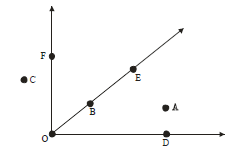
Position In Various Regions: In a closed curve, thus, there are three parts.
i) Interior (‘inside’) of the angle
ii) Boundary (‘on’) of the angle and
iii) Exterior (‘outside’) of the angle.
In the adjacent figure, A is in the interior, C is in the exterior and B is on the angle. The interior of an angle together with its boundary is called its “region”.
9. Triangle
A triangle is one of the basic shapes of geometry: a polygon with three corners or vertices and three sides or edges which are line segments. A triangle with vertices A, B, and C is denoted Δ ABC. Triangle is the smallest polygon.
The three sides of the triangle are AB, BC and CA . The three angles are
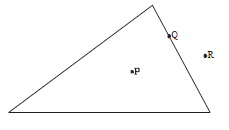
∠ BAC, ∠ BCA and ∠ ABC. The points A, B and C are called the vertices of the triangle. Being a polygon, a triangle has an exterior and an interior. P is in the interior of the triangle, R is in the exterior and Q on the triangle.
10. Quadrilateral
A quadrilateral is a four sided polygon and it has four vertices.

A quadrilateral has four angles, four sides and four vertices.
In quadrilateral ABCD
i) AB and BC; BC and CD ; CD and DA; DA and AB are adjacent sides (adjacent sides are sides with common vertex)
ii) AB and CD; BC and DA are opposite sides. (opposite sides are sides with no common vertex)
iii) ∠ A and ∠ B; ∠ B and ∠ C; ∠ C and ∠ D; ∠ D and ∠ A are adjacent angles. (adjacent angles are angles with common side)
iv) ∠ A and ∠ C; ∠ B and ∠ D are opposite angles. (opposite angles are angles with no common side)
11. Circle
A circle is a simple shape of Euclidean geometry consisting of the set of points in a plane that are a given distance from a given point, the centre. The distance between any of the points and the centre is called the radius.
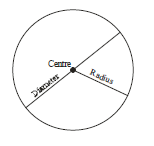
Circles are simple closed curves which divide the plane into two regions: an interior and an exterior. In everyday use, the term "circle" may be used interchangeably to refer to either the boundary of the figure, or to the whole figure including its interior; in strict technical usage, the circle is the former and the latter is called a disk.
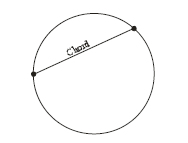
A chord of a circle is a geometric line segment whose endpoints both lie on the circumference of the circle.
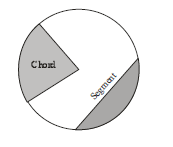
A circular segment is an area of a circle informally defined as an area which is "cut off" from the rest of the circle by a chord. A circular sector or circle sector, is the portion of a disk enclosed by two radii
Please click on below link to download pdf file for CBSE Class 6 Basic Geometrical Ideas Chapter Concepts.
Free study material for Mathematics
Study Material and Revision Notes for Class 6 Mathematics Chapter 04 Basic Geometrical Ideas
Download Chapter Summary: Class 6 Mathematics Chapter 04 Basic Geometrical Ideas
Access structured revision notes for Chapter 04 Basic Geometrical Ideas designed in alignment with the latest CBSE curriculum for Class 6 Mathematics. These summaries help clarify core themes and support effective daily study.
Concept Clarification for Chapter 04 Basic Geometrical Ideas
Each chapter summary is structured around standard CBSE textbooks, allowing students to check their understanding and clarify complex ideas early in their revision.
Additional Study Resources for Class 6 Mathematics
Wrap up your chapter revision by testing your knowledge against standard question formats. Everything on our platform is provided free of charge.
FAQs
You can download the teacher prepared revision notes for CBSE Class 6 Mathematics Basic Geometrical Ideas Chapter Notes from StudiesToday.com. These notes are designed as per 2026-27 academic session to help Class 6 students get the best study material for Mathematics.
Yes, our CBSE Class 6 Mathematics Basic Geometrical Ideas Chapter Notes include 50% competency-based questions with focus on core logic, keyword definitions, and the practical application of Mathematics principles which is important for getting more marks in 2026 CBSE exams.
Yes, our CBSE Class 6 Mathematics Basic Geometrical Ideas Chapter Notes provide a detailed, topic wise breakdown of the chapter. Fundamental definitions, complex numerical formulas and all topics of CBSE syllabus in Class 6 is covered.
These notes for Mathematics are organized into bullet points and easy-to-read charts. By using CBSE Class 6 Mathematics Basic Geometrical Ideas Chapter Notes, Class 6 students fast revise formulas, key definitions before the exams.
No, all study resources on StudiesToday, including CBSE Class 6 Mathematics Basic Geometrical Ideas Chapter Notes, are available for immediate free download. Class 6 Mathematics study material is available in PDF and can be downloaded on mobile.