

Download Class 6 Mathematics Concept Summaries: CBSE Class 6 Mathematics Decimals Chapter Notes
Explore reliable concept summaries and revision materials through the CBSE Class 6 Mathematics Decimals Chapter Notes. Tailored for Class 6 learners, utilizing these notes for Mathematics Chapter 08 Decimals ensures thorough preparation and strengthens core academic definitions before final evaluations.
Access Chapter 08 Decimals Notes and Study Material
Access the complete concept summary PDF for Chapter 08 Decimals below. Regular review of these targeted notes builds familiarity with complex Class 6 Mathematics themes and helps secure higher marks in final school evaluations.
CBSE Class 6 Decimals Chapter Concepts. Learning the important concepts is very important for every student to get better marks in examinations. The concepts should be clear which will help in faster learning. The attached concepts made as per NCERT and CBSE pattern will help the student to understand the chapter and score better marks in the examinations.
Decimals
8.1 Decimals
The decimal numeral system (also called base ten or occasionally denary) has ten as its base. It contains a decimal point. It is the numerical base most widely used by modern civilizations. Decimal notation often refers to a base-10 positional notation such as the Hindu-Arabic numeral system; however, it can also be used more generally to refer to non-positional systems such as Roman or Chinese numerals which are also based on powers of ten.
Ex: 3.14159265358979323846264338327950288419716939937510
8.2 History
Many ancient cultures calculated from early on with numerals based on ten: Egyptian hieroglyphs, in evidence since around 3000 BC, used a purely decimal system, just as the Cretan hieroglyphs (ca. 1625−1500 BC) of the Minoans whose numerals are closely based on the Egyptian model. The decimal system was handed down to the consecutive Bronze Age cultures of Greece, including Linear A (ca. 18th century BC−1450 BC) and Linear B (ca. 1375−1200 BC) —
the number system of classical Greece also used powers of ten, including, like the Roman numerals did, an intermediate base of 5. Notably, the polymath Archimedes (c. 287–212 BC) invented a decimal positional system in his Sand Reckoner which was based on 108 and later led the German mathematician Carl Friedrich Gauss to lament what heights science would have already reached in his days if Archimedes had fully realized the potential of his ingenious discovery. The Hittites hieroglyphs (since 15th century BC), just like the Egyptian and early numerals in Greece, was strictly decimal.
The Egyptian herratic numerals, the Greek alphabet numerals, the Roman numerals, the Chinese numerals and early Indian Kharoshi numerals, Indian Brahmi numerals are all non-positional decimal systems, hence required large numbers of symbols. For instance, Egyptian numerals used different symbols for 10, 20, through 90, 100, 200, through 900, 1000,2000, 3000, 4000, to 100,1000. Greek numerals, Indian Kharoshi and Brahmi numerals all have similar characteristics.
History Of Decimal Fractions: According to Joseph Needham, decimal fractions were first developed and used by the Chinese in the 1st century BC, and then spread to the Middle East and from there to Europe. The written Chinese decimal fractions were non-positional.[ However, counting rod fractions were positional.
Qin Jiushao in his book Mathematical Treatise in Nine Sections (1247) denoted 0.96644 by 寸

Immanuel Bonfils invented decimal fractions around 1350, anticipating Simon Stevin, but did not develop any notation to represent them. The Persian mathematician Jamshīd al-Kāshī claimed to have discovered decimal fractions himself in the 15th century, though J. Lennart Berggren notes that positional decimal fractions were used five centuries before him by Arab mathematician Abu'l-Hasan al-Uqlidisi as early as the 10th century.
Khwarizmi introduced fractions to Islamic countries in the early 9th century. His representation of fractions was taken from traditional Chinese mathematical fractions. This form of fraction with the numerator on top and the denominator on the bottom, without a horizontal bar, was also used in the 10th century by Abu'l-Hasan al-Uqlidisi and again in the 15th century work "Arithmetic Key" by Jamshīd al-Kāshī. A forerunner of modern European decimal notation was introduced by Simon Stevin in the 16th century.
8.3 Place Value
For place value of all digits before decimal point International number system for whole numbers can be followed.
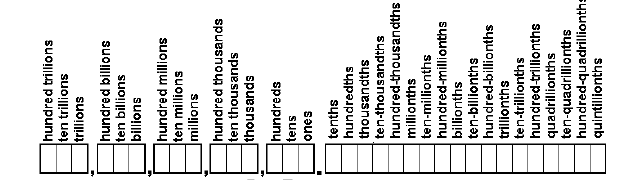
The place value of the first digit after the decimal point is tenth place. The place value of the second digit after the decimal point is hundredth place and so on. The place value chart is given as below:
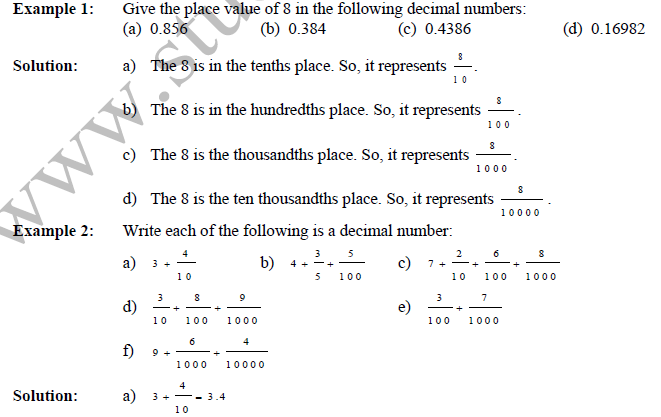
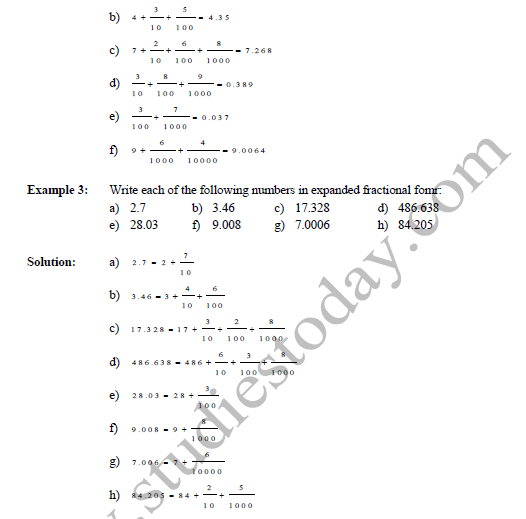
Example 4: Write each of the following decimal numbers in words:
a) 7.3 b) 84.6 c) 3.189 d) 18.3478
e) 0.008 f) 0.000043
Solution: a) 7.3 represents seven units and three tenths.
b) 84.6 represents eight tens, four units and six tenths.
c) 3.189 represents three units, one tenth, eight hundredths and nine thousandths.
d) 18.3478 represents one ten, eight units, three tenths, four hundredths, seven thousandths and eight ten-thousandths.
e) 0.008 represents eight thousandths.
f) 0.000 043 represents four hundred-thousandths and three millionths.
8.4. Representation of Decimals on a Number Line
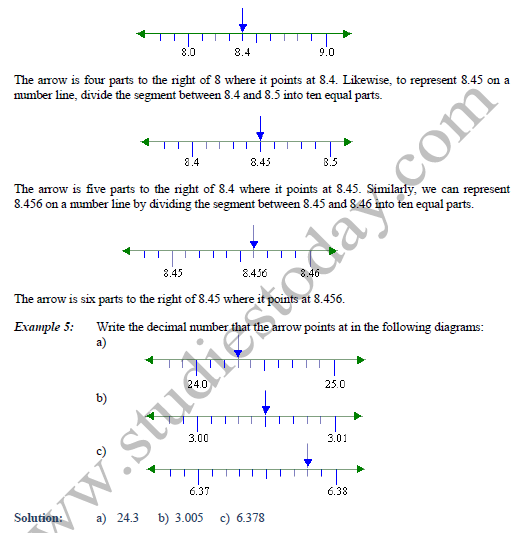
To represent a decimal on a number line, divide each segment of the number line into ten equal parts. E.g. To represent 8.4 on a number line, divide the segment between 8 and 9 into ten equal parts.
8.5 Expressing Decimals into Fractions
Step 1: Write down the decimal divided by 1, like this: decimal/1
Step 2: Multiply both top and bottom by 10 for every number after the decimal point. (For example, if there are two numbers after the decimal point, then use 100, if there are three then use 1000, etc.)
Step 3: Simplify (or reduce) the fraction
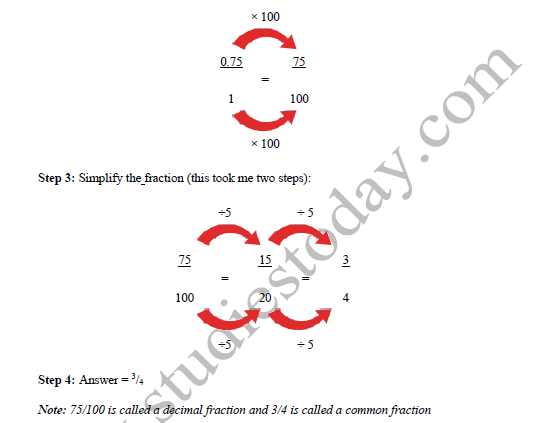
Example: Express 0.75 as a fraction
Step 1: Write down 0.75 divided by 1 : 0 .7 5 / 1
Step 2: Multiply both top and bottom by 100 (there were 2 digits after the decimal point so that is 10×10=100):
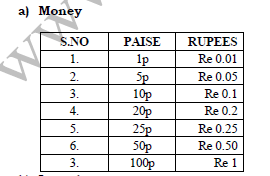
8.5 Application of Decimals in Money, Length and Weight
Please click on below link to download pdf file for CBSE Class 6 Decimals Chapter Concepts.
Free study material for Mathematics
Revision Notes and Key Concepts for Class 6 Mathematics Chapter 08 Decimals
Download Chapter Summary: Class 6 Mathematics Chapter 08 Decimals
Explore reliable chapter overviews for Chapter 08 Decimals tailored for Class 6 learners. Use these structured points to grasp difficult themes and ensure solid preparation for upcoming assessments.
Concept Clarification for Chapter 08 Decimals
Cross-reference your comprehension with comprehensive NCERT solutions for Class 6 to ensure absolute clarity across all sub-topics in this chapter.
Additional Study Resources for Class 6 Mathematics
Wrap up your chapter revision by testing your knowledge against standard question formats. Everything on our platform is provided free of charge.
FAQs
You can download the teacher prepared revision notes for CBSE Class 6 Mathematics Decimals Chapter Notes from StudiesToday.com. These notes are designed as per 2026-27 academic session to help Class 6 students get the best study material for Mathematics.
Yes, our CBSE Class 6 Mathematics Decimals Chapter Notes include 50% competency-based questions with focus on core logic, keyword definitions, and the practical application of Mathematics principles which is important for getting more marks in 2026 CBSE exams.
Yes, our CBSE Class 6 Mathematics Decimals Chapter Notes provide a detailed, topic wise breakdown of the chapter. Fundamental definitions, complex numerical formulas and all topics of CBSE syllabus in Class 6 is covered.
These notes for Mathematics are organized into bullet points and easy-to-read charts. By using CBSE Class 6 Mathematics Decimals Chapter Notes, Class 6 students fast revise formulas, key definitions before the exams.
No, all study resources on StudiesToday, including CBSE Class 6 Mathematics Decimals Chapter Notes, are available for immediate free download. Class 6 Mathematics study material is available in PDF and can be downloaded on mobile.