

Official Class 9 Other Subjects Revision Material: CBSE Class 9 Fundamentals of Business Activities Notes
Explore reliable concept summaries and revision materials through the CBSE Class 9 Fundamentals of Business Activities Notes. Tailored for Class 9 learners, utilizing these notes for Other Subjects Fundamentals of Business Activities ensures thorough preparation and strengthens core academic definitions before final evaluations.
Chapter-wise Concept Summaries: Fundamentals of Business Activities
Navigate directly to the revision notes for Fundamentals of Business Activities using the digital viewer below. Each summary is structured to highlight high-weightage sections, allowing students to instantly access critical definitions and focus on core exam topics.
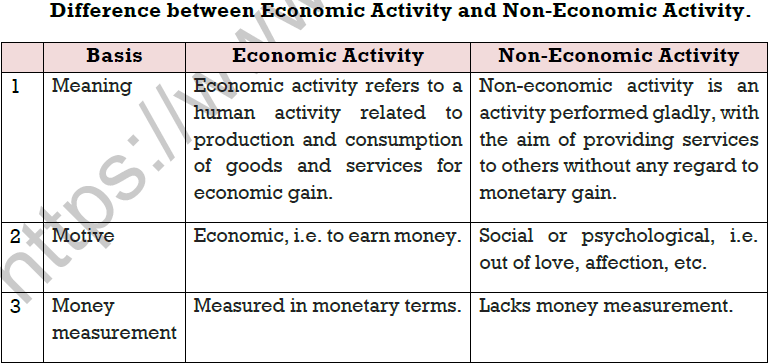
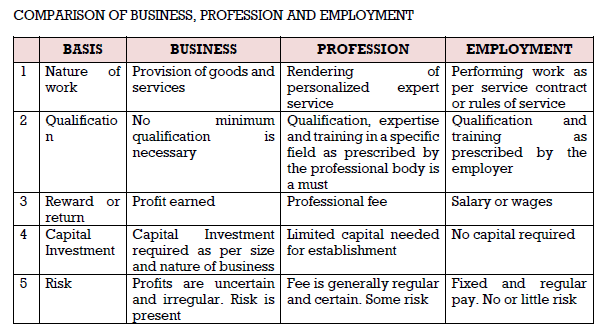
Various business activities may be classified into two broad categories — industry and commerce.
INDUSTRY is concerned with the production or processing of goods and materials.
Commerce includes all those activities which are necessary for facilitating the exchange of goods and services.
On the basis of these two categories, we may classify business firms into industrial and commercial enterprises.
COMMERCE
Commerce includes two types of activities, viz., (i) trade and (ii) auxiliaries to trade.
(i) Buying and selling of goods is termed as trade.
(ii) But there are a lot of activities that are required to facilitate the purchase and sale of goods. These are called services or auxiliaries to trade and include transport, banking, insurance, communication, advertisement, packaging and warehousing.
Factors Affecting Business
1. Economic - Interest rates, inflation rates, changes in disposable income of people, stock market indices and the value of rupee are some of the economic factors that can affect management practices in a business enterpris
2. Social –The social environment of business include the social forces like customs and traditions, values, social trends, society’s expectations from business, etc. Traditions define social practices that have lasted for decades or even centuries.
3. Political - Political environment includes political conditions such as general stability and peace in the country and specific attitudes that elected government representatives hold towards business. The significance of political conditions in business success lies in the predictability of business activities under stable political conditions.
Profit Orientation of Business
Profit may be regarded as an essential objective of business for various reasons:
(i) It is a source of income for business persons,
(ii) It can be a source of finance for meeting expansion requirements of business,
(iii) It indicates the efficient working of business,
(iv) It can be taken as society’s approval of the utility of business, and
(v) It builds up the reputation of a business enterprise.
Vocation
Vocation is a strong feeling of suitability for a particular career or occupation.
Features of Vocation
(i) Training consists of units of Competency – A training qualification has a specific set of units of competency which together make up the overall set of skills and knowledge required for qualification.
(ii) Competence Based – Training is provided to meet a set of performance criteria. Each individual must be able to demonstrate competence to a satisfactory level in order to be determined as competent. Hence there is no ‘pass’ or ‘fail’. Competence based outcome is either ‘satisfactory or not yet satisfactory’ or on completion of all unit requirements ‘competent or not yet competent’.
(iii) Job Ready – Training provided includes practical and hands-on training which is relevant to the industry of work hence making an individual job- ready upon successful completion of the training.
(iv) Customised Training –One can choose units of competency relevant to one’s job functions. Training assessment can be customized to industry specific tasks.
Revision Notes and Key Concepts for Class 9 Other Subjects Fundamentals of Business Activities
Key Concepts and Summary for Class 9 Other Subjects Fundamentals of Business Activities
Access structured revision notes for Fundamentals of Business Activities designed in alignment with the latest CBSE curriculum for Class 9 Other Subjects. These summaries help clarify core themes and support effective daily study.
NCERT-Aligned Chapter Summary and Notes
Built using the official NCERT book for Class 9 Other Subjects, these notes provide reliable academic guidance. Pair your summary review with our recommended NCERT solutions to master optimal problem-solving approaches.
Next Steps in Your Exam Preparation
Explore our broader library of printable assignments, chapter notes, and mock tests designed to support continuous revision and secure higher marks in CBSE assessments.
FAQs
You can download the teacher prepared revision notes for CBSE Class 9 Fundamentals of Business Activities Notes from StudiesToday.com. These notes are designed as per 2026-27 academic session to help Class 9 students get the best study material for Other Subjects.
Yes, our CBSE Class 9 Fundamentals of Business Activities Notes include 50% competency-based questions with focus on core logic, keyword definitions, and the practical application of Other Subjects principles which is important for getting more marks in 2026 CBSE exams.
Yes, our CBSE Class 9 Fundamentals of Business Activities Notes provide a detailed, topic wise breakdown of the chapter. Fundamental definitions, complex numerical formulas and all topics of CBSE syllabus in Class 9 is covered.
These notes for Other Subjects are organized into bullet points and easy-to-read charts. By using CBSE Class 9 Fundamentals of Business Activities Notes, Class 9 students fast revise formulas, key definitions before the exams.
No, all study resources on StudiesToday, including CBSE Class 9 Fundamentals of Business Activities Notes, are available for immediate free download. Class 9 Other Subjects study material is available in PDF and can be downloaded on mobile.