

Download CBSE Class 11 Physics Assignments
Access comprehensive school assignments for Chapter 01 Physical World using the CBSE Class 11 Physics Physical World and Measurement Assignment. Designed to align with the 2026-27 CBSE academic guidelines, these practice sets help Class 11 Physics students reinforce core concepts and improve their problem-solving accuracy.
Access CBSE School Assignments and Answers
Navigate directly to the solved Physics assignments using the digital viewer below. Each practice set includes detailed step-by-step solutions, allowing students to instantly cross-check their work and identify areas requiring further revision.
There are four fundamental forces which govern both macroscopic and microscopic phenomena. There are
(i) Gravitational force (iii) Electromagnetic force
(ii) Nuclear force (iv) Weak force
The relative strengths of these forces are
Fg :Fw:Fe:Fs=1:1025:1036:1038 .
All those quantities which can be measured directly or indirectly and in terms of which the laws of physics can be expressed are called physical quantities.
(a) Fundamental quantities (b) Derived quantities.
The units of the fundamental quantities called fundamental units , and the units of derived quantities called derived units.
System of units:-
(a) MKS (b) CGS (c) FPS (d) SI
• The dimensions of a physical quantity are the powers to which the fundamental quantities are raised to represent that physical quantity.
• The equation which expresses a physical quantity in terms of the fundamental units of mass, length and time, is called dimensional equation.
• According to this principle of homogeneity a physical equation will be dimensionally correct if the dimensions of all the terms in the all the terms occurring on both sides of the equation are the same.
• If any equation is dimensionally correct it is not necessary that must be mathematically correct too.
• There are three main uses of the dimensional analysis-
(a) To convert a unit of given physical quantities from one system of units to another system for which we use
n2 = n1[M1/M2]a[L1/L2]b[T1/T2]c
(b) To check the correctness of a given physical relation.
(c) To derive a relationship between different physical quantities.
• Significant figures: - The significant figures are normally those digits in a measured quantity which are known reliably plus one additional digit that is uncertain.
For counting of the significant figure rule are as:
(i) All non- zero digits are significant figure.
(ii) All zero between two non-zero digits are significant figure.
(iii) All zeros to the right of a non-zero digit but to the left of an understood decimal point are not significant. But such zeros are significant if they come from a measurement.
(iv) All zeros to the right of a non-zero digit but to the left of a decimal point are significant.
(v) All zeros to the right of a decimal point are significant.
(vi) All zeros to the right of a decimal point but to the left of a non-zero digit are not significant. Single zero conventionally placed to the left of the decimal point is not significant.
(vii) The number of significant figures does not depend on the system of units.
• In addition or subtraction, the result should be reported to the same number of decimal places as that of the number with minimum number of decimal places.
• In multiplication or division, the result should be reported to the same number of significant figures as that of the number with minimum of significant figures.
• Accuracy refers to the closeness of a measurement to the true value of the physical quantity and precision refers to the resolution or the limit to which the quantity is measured.
• Difference between measured value and true value of a quantity represents error of measurement.
It gives an indication of the limits within which the true value may lie.
Mean of n measurements
amean = a1 + a2 + a3 + ....... + an
Absolute error ( Δa ) = amean - ai Where ai = measured value
It may be - positive, negative or zero.
(i) Mean absolute error
(ii) Relative error - it is the ratio of the mean absolute error to the true value.
δa = I Δa I/ amean
(iii) The relative error expressed in percent is called percentage error.
The error is communicated in different mathematical operations as detailed below:
(i) For x = (a ± b), Δx = ± ( Δa + Δb)
(ii) For x = a x b , Δx/x = ± ( Δa/a + Δb/b)
(iii) For x = a/b , Δx/x = ± ( Δa/a + Δb/b)
(iv) For x= anbm /cp Δx/x = ± ( nΔa/a +m Δb/b + pΔc/c
HOTs
Question. What are the dimensions of 1/u0ϵ0, where symbols have their usual meaning.
Answer : [ M0 L2 T-2]
Question. What is the dimensions of (1/2 )ϵ0E2 , Where E electric field and ϵ0 permittivity of free space.
Answer : [ M1 L-1 T-2 ]
Question. The pairs of physical quantities that have the same dimensions are:
(a) Reynolds’s number and coefficient of friction,
(b) Curie and frequency of a light wave
(c) Latent heat and gravitational potential
(d) Planck’s constant and torque.
Answer : (a), (b).
Question. If L,C,R represent inductance , capacitance and resistance respectively, the combinations having dimensions of frequency are
(a) 1/√CL
(b) L/C
(c) R/L
(d) R/C
Answer : (a) and (c).
Question. If the error in radius is 3%, what is error in volume of sphere?
(a) 3 %
(b) 27 %
(c) 9 %
(d) 6 %
Answer : (c) 9%.
Very short answer type questions, (1 mark question)
Question. State one law that holds good in all natural processes.
Answer : One such laws is the Newton’s gravitation law, According to this law everybody in this nature are attracts with other body with a force of attraction which is directly proportional to the product of their masses and inversely proportionally To the square of the distance between them.
Question. Among which type of elementary particles does the electromagnetic force act?
Answer : Electromagnetic force acts between on all electrically charged particles.
Question. Name the forces having the longest and shortest range of operation.
Answer : longest range force is gravitational force and nuclear force is shortest range force.
Question. If ‘slap’ times speed equals power, what will be the dimensional equation for ‘slap’?
Answer : Slap x speed = power
Or slap = power/speed = [MLT-2]
Question. If the units of force and length each are doubled, then how many times the unit of energy would be affected?
Answer : Energy = Work done = Force x length
So when the units are doubled, then the unit of energy will increase four times.
Question. Can a quantity has dimensions but still has no units?
Answer : No, a quantity having dimension must have some units of its measurement.
Question. Justify L +L = L and L – L = L.
Answer : When we add or subtract a length from length we get length, So L +L =L AND L
– L =L, justify.
Question. Can there be a physical quantity that has no unit and no dimensions?
Answer : yes, like strain.
Question. Given relative error in the measurement of length is 0.02, what is the percentage error?
Answer : percentage error = 2 %
Question. If g is the acceleration due to gravity and λ is wavelength, then which physical quantity does represented by √gλ.
Answer : Speed or velocity.
Short answer type questions (2 marks)
Question. If heat dissipated in a resistance can be determined from the relation:
H = I2Rt joule , If the maximum error in the measurement of current, resistance and time are 2% ,1% , and 1% respectively, What would be the maximum error in the dissipated heat?
Answer : % error in heat dissipated is ±6 %.
Question. Name any three physical quantities having the same dimensions and also give their dimensions.
Answer : Any group of physical quantities, like work , energy and torque and their dimensions [ ML2 T-2].
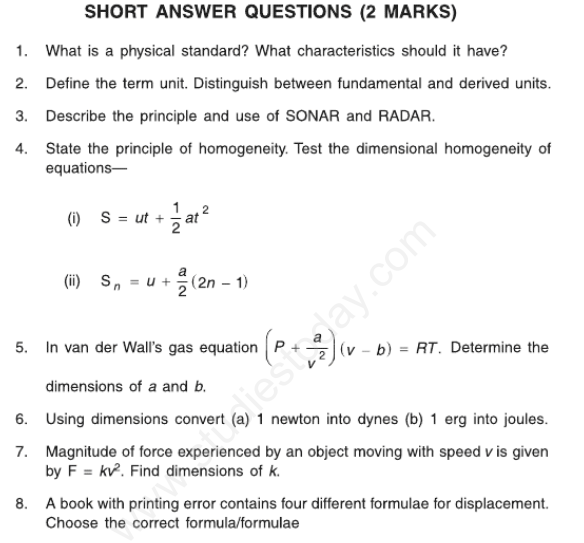
Question. In Van der Wall’s equation ( P + a/V2)( V – b ) = RT, Determine the dimensions of a and b.
Answer : [a] = [ML5 T-2] and [b] = [ M0L3T0].
Question. If X= a+ bt2 , where X is in meter and t is in second . find the unit of a and b?
Answer : unit of a is meter and unit of b is m/sec2.
Question. Show that the maximum error in the quotient of two quantities is equal to the sum of their individual relative errors.
Answer : For x = a/b , Δx/x = ± ( Δa/a + Δb/b)
Question. Deduce the dimensional formulae for the following physical quantities.
A) Gravitational constant.
B) Power
C) coefficient of viscosity
D) Surface tension.
Answer : (A) gravitational constant = [M-1 L3 T-2],
B) Power = [ML2T-3]
C) Coefficient of viscosity = [ ML-1 T-1]
D) Surface tension = [ ML0T-2]
Question. Name the four basic forces in nature. Arrange them in the order of their increasing strengths.
Answer : (i) Gravitational force (ii) Electromagnetic force
(iii) nuclear force (iv) Weak force
The relative strengths of these forces are
Fg :Fw:Fe:Fs = 1:1025:1036:1038 .
Question. Convert 1 Newton force in to Dyne.
Answer : 1N = 105 Dyne.
Short answer type questions (3marks)
Q1. If E,M,J and G respectively denote energy, mass, angular momentum and gravitational constant, Calculate the dimensions of EJ2 /M5G2
Q2. The frequency of vibration of stretched string depends on its length L its mass per unit length m and the tension T in the string obtain dimensionally an expression for frequency.
Q3. What is meant by significant figures .State the rules for counting the number of significant figures in a measured quantity?
Q4. A physical quantity X is given by X = A2B3/C√D , If the percentage errors of measurement in A,B,C and D are 4%,2%,3% and 1% respectively, then calculate the % error in X.
Q5. If two resistors of resistance R1 = (4 ± 0.5) Ω and R2 = (16 ± 0.5) Ω are connected
(1) In series and (2) Parallel . Find the equivalent resistance in each case with limits of % error.
Q6. The length of a rod measured in an experiment was found to be 2.48m, 2.46, 2.50m and 2.48m and 2.49m, Find the average length , the absolute error in each observation and % error.
Q7. A famous relation in physics relates moving mass m to the rest mass m0 of a particle in terms of its speed v and the speed of the light c. A boy recalls the relation almost correctly but forgets where to put the constant c. He writes:
m = mo / (1 – v2)1/2
Guess where to put the missing c.
Q8. A calorie is a unit of heat energy and it equals about 4.2 J, where 1 J = 4.2 kgm2s-2. Suppose we employ a system of units in which the unit of mass equals α kg, the unit of length equals β m, the units of time is ϒ sec. show that a calorie has a magnitude 4.2 α-1 β-2 ϒ2 in terms of the new units.
Q9. In the formula X = 3YZ2, X and Z have dimensions of capacitance and magnetic induction respectively, what are the dimensions of Y in MKS system?
Q10. In an experiment, on the measurement of g using a simple pendulum the time period was measured with an accuracy of 0.2 % while the length was measured with accuracy of 0.5%. Calculate the percentage error in the value of g.
Long answer question ( 5 marks )
Q1. Explain:
(i) Absolute error (iii) Mean absolute error
(ii) Relative error (iv) percentage error
(v) Random error
Q2. Convert:
(i) Gravitational constant (G) = 6.67 x 10⁻¹¹ Nm2 kg-2 to cm3 g-1 s-2 (ii) The escape velocity v of a body depends on, the acceleration due to gravity ‘g’ of the planet and the radius R of the planet, Establish dimensionally for relation for the escape velocity.
Q3. Name the four basic forces in nature. Write a brief note of each, hence compare their strengths and ranges.
Free study material for Physics
Chapter 01 Physical World Printable Assignments & Solutions for Class 11 Physics
Class 11 Physics Chapter 01 Physical World Printable Assignments
Access structured practice assignments for Chapter 01 Physical World designed in alignment with the latest CBSE curriculum for Class 11 Physics. These printable sets cover objective and descriptive problem types to support thorough revision.
Why Practice Class 11 Physics Assignments?
- Exam Alignment: Questions strictly follow contemporary CBSE sample papers and grading schemes.
- Comprehensive Coverage: Features objective drills, case studies, and structured descriptive problems for Chapter 01 Physical World.
- Pacing & Precision: Regular problem-solving builds critical calculation speed and test-taking accuracy.
Steps to Complete Chapter 01 Physical World Assignments Successfully
- Concept Foundation: Review the NCERT book for Class 11 Physics thoroughly before diving into assignment tasks.
- Self-Evaluation: Solve exercises independently before inspecting professional answer guides.
- Progress Monitoring: Note down complex formulas or concepts, clearing them up using available online practice aids.
FAQs
You can download free PDF assignments for Class 11 Physics Chapter 01 Physical World from StudiesToday.com. These practice sheets have been updated for the 2026-27 session covering all concepts from latest NCERT textbook.
Yes, our teachers have given solutions for all questions in the Class 11 Physics Chapter 01 Physical World assignments. This will help you to understand step-by-step methodology to get full marks in school tests and exams.
Yes. These assignments are designed as per the latest CBSE syllabus for 2026. We have included huge variety of question formats such as MCQs, Case-study based questions and important diagram-based problems found in Chapter 01 Physical World.
Practicing topicw wise assignments will help Class 11 students understand every sub-topic of Chapter 01 Physical World. Daily practice will improve speed, accuracy and answering competency-based questions.
Yes, all printable assignments for Class 11 Physics Chapter 01 Physical World are available for free download in mobile-friendly PDF format.