

Official CBSE Assignments for Class 11 Physics
Explore structured practice materials through the CBSE Class 11 Physics Gravitation Assignment. Tailored for Class 11 learners, utilizing these Physics assignments ensures thorough preparation and strengthens foundational knowledge before final CBSE evaluations.
Solved Practice Assignments for Physics
Navigate directly to the solved Physics assignments using the digital viewer below. Each practice set includes detailed step-by-step solutions, allowing students to instantly cross-check their work and identify areas requiring further revision.
Question. If the distance between two masses is doubled, the gravitational attraction between them:
a. Is doubled
b. Becomes four times
c. Is reduced to half
d. Is reduced to a quarter
Answer : D
Question. The earth (mass = 6×1240 kg) revolves round the sun with angular velocity 2 x 10⁻⁷ rad/s in a circular orbit of radius 1.5×10⁸ km.The force exerted by the sun on the earth in newtons, is:
a. 18 ×1025
b. Zero
c. 27 ×1039
d. 36 ×1021
Answer : D
Question. The moon's radius is 1/4 that of the earth and its mass is 1/80 times that of the earth. If g represents the acceleration due to gravity on the surface of the earth that on the surface of the moon is:
a. g / 4
b. g / 5
c. g / 6
d. g / g
Answer : B
Question. The mass and diameter of a planet have twice the value of the corresponding parameters of earth. Acceleration due to gravity on the surface of the planet is:
a. 9.8m / sec2
b. 4.9 m / sec2
c. 980 m / sec2
d. 19.6 m / sec2
Answer : B
Question. If the radius of the earth were to shrink by 1% its mass remaining the same, the acceleration due to gravity on the earth's surface would:
a. Decrease by 2%
b. Remain unchanged
c. Increase by 2%
d. Increase by 1%
Answer : C
Question. The radii of two planets are respectively R1 and R2 and their densities are respectively ρ1 and ρ2 . The ratio of the accelerations due to gravity at their surfaces is:
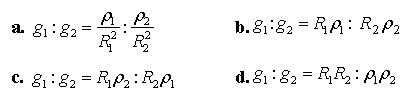
Answer : D
Question. Where will it be profitable to purchase 1 kg sugar: (by spring balance)
a. At poles
b. At equator
c. At 45° latitude
d. At 40° latitude
Answer : B
Question. Four particles of masses m, 2m, 3m and 4m are kept in sequence at the corners of a square of side a. The magnitude of gravitational force acting on a particle of mass m placed at the centre of the square will be:
a. 24m2G /a2
b. 6m2G/a2
c. 4√2Gm2/a2
d. Zero
Answer : C
Question. If the change in the value of ‘g’ at a height h above the surface of the earth is the same as at a depth x below it, then: (both x and h being much smaller than the radius of the earth)
a. x = h
b. x = 2h
c.x = h/2
d. 2 x = h
Answer : B
Question. Weight of a body of mass m decreases by 1% when it is raised to height h above the earth's surface. If the body is taken to a depth h in a mine, change in its weight is:
a. 2% decrease
b. 0.5% decrease
c. 1% increase
d. 0.5% increase
Answer : B
Question. The depth d at which the value of acceleration due to gravity becomes 1/n times the value at the surface, is: [R = radius of the earth]
a. R/n
b. R(n − 1 / n)
c. R/n2
d. R(n/n+1)
Answer : B
Question. If the angular speed of earth is increased so much that the objects start flying from the equator, then the length of the day will be nearly:
a. 1.5 hours
b. 8 hours
c. 18 hours
d. 24 hours
Answer : A
Question. Knowing that mass of Moon is M/81 where M is the mass of Earth, find the distance of the point where gravitational field due to Earth and Moon cancel each other, from the Moon. Given that distance between Earth and Moon is 60 R. Where R is the radius of Earth:
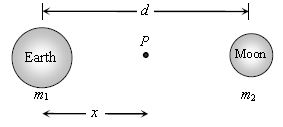
a. 2 R
b. 4 R
c. 6 R
d. 8 R
Answer : C
Question. The intensity of gravitational field at a point situated at a distance of 8000 km from the centre of the earth is 6N/kg. The gravitational potential at that point is: (in Joule/ kg)
a. 8×10⁵
b. 2.4×10³
c. 4.8×10⁷
d. 6.4×10¹⁴
Answer : C
Question. The gravitational potential due to the earth at infinite distance from it is zero. Let the gravitational potential at a point P be −5J / kg . Suppose, we arbitrarily assume the gravitational potential at infinity to be + 10 J / kg , then the gravitational potential at P will be:
a. −5 J / kg
b. +5 J / kg
c. −15 J / kg
d. +15 J / kg
Answer : B
Question. Two bodies of masses m and M are placed a distance d apart. The gravitational potential at the position where the gravitational field due to them is zero is V, then:
a.V = - G/d (m + M)
b. V = - Gm/d
c. V = - GM/d
d. V = - G/d √(m + √M)
Answer : D
Question. If the earth suddenly shrinks (without changing mass) to half of its present radius, the acceleration due to gravity will be:
a. g/2
b. 4g
c. g/4
d. 2g
Answer : B
Question. Infinite bodies, each of mass 3kg are situated at distances 1m, 2m, 4m, 8m… respectively on x-axis. The resultant intensity of gravitational field at the origin will be:
a. G
b. 2 G
c. 3 G
d. 4 G
Answer : D
Question. If the distance between centres of earth and moon is D and the mass of earth is 81 times the mass of moon, then at what distance from centre of earth the gravitational force will be zero:
a. D/2
b. 2D/3
c. 4D/3
d. 9D/10
Answer : D
Question. Two concentric shells of mass M1 and M2 are having radii r1 and r2. Which of the following is the correct expression for the gravitational field on a mass m.
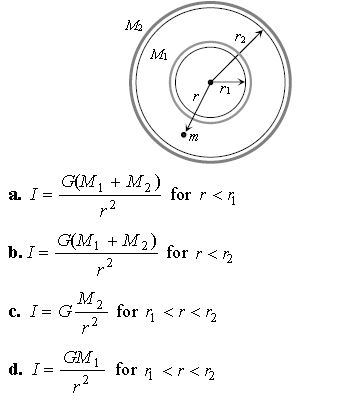
Answer : D
Question. At surface of earth weight of a person is 72 N then his weight at height R/2 from surface of earth is: (R = radius of earth)
a. 28 N
b. 16 N
c. 32 N
d. 72 N
Answer : C
Question. A uniform ring of mass m is lying at a distance 1.73 a from the centre of a sphere of mass M just over the sphere where a is the small radius of the ring as well as that of the sphere. Then gravitational force exerted is:
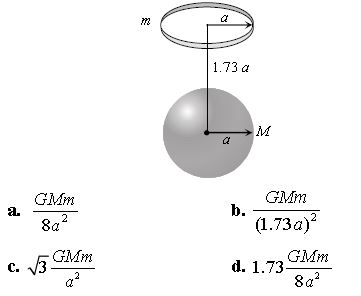
Answer : D
Question. The change in potential energy, when a body of mass m is raised to a height nR from the earth's surface is: (R = Radius of earth)
a. mgR (n / n - 1)
b. nmgR
c. mgR (n2 / n2 - 1)
d. mgR (n / n + 1)
Answer : D
VERY SHORT ANSWER TYPE QUESTIONS (1 MARK EACH)
Question 1. The mass of moon is nearly 10% of the mass of the earth. What will be the gravitational force of the earth on the moon, in comparison to the gravitational force of the moon on the earth?
Answer: According to Newton's third law of motion and the law of gravitation, the gravitational force exerted by the earth on the moon is equal in magnitude and opposite in direction to the gravitational force exerted by the moon on the earth.
In simple words: Both forces are equal because gravitational force is a mutual interaction between two bodies.
Exam Tip: Remember that gravitational force is always mutual, obeying Newton's Third Law, irrespective of the masses of the interacting bodies.
Question 2. Why does one feel giddy while moving on a merry go round?
Answer: When moving on a merry-go-round, the body experiences continuous changes in direction, leading to a centripetal acceleration. This rapid change affects the fluids in the inner ear (vestibular system) which are responsible for balance, causing a sensation of dizziness or giddiness.
In simple words: Rapid circular motion disturbs the balancing mechanism in our ears, causing giddiness.
Exam Tip: Relate the feeling of giddiness to vestibular system disturbance caused by non-inertial frame effects or changing centripetal acceleration.
Question 3. Name two factors which determine whether a planet would have atmosphere or not.
Answer: The two main factors are:
1. Acceleration due to gravity (or escape velocity) on the surface of the planet.
2. Surface temperature of the planet.
In simple words: A planet needs strong gravity and low temperature to hold onto gas molecules so they do not escape into space.
Exam Tip: Mention escape speed and thermal velocity of gas molecules for a complete and precise physics answer.
Question 4. The force of gravity due to earth on a body is proportional to its mass, then why does a heavy body not fall faster than a lighter body?
Answer: The gravitational force on a body of mass \(m\) is given by \(F = \frac{GMm}{R^2} = mg\).
The acceleration of the body is \(a = \frac{F}{m} = \frac{mg}{m} = g\).
Since acceleration due to gravity (\(g\)) is independent of the mass of the falling body, all bodies fall with the same acceleration in vacuum.
In simple words: Although the gravitational pull is larger on a heavier body, its inertia is also correspondingly larger, making the acceleration the same for both.
Exam Tip: Always use the relation \(a = \frac{F}{m}\) to explain why mass cancels out in free fall acceleration.
Question 5. The force of attraction due to a hollow spherical shell of uniform density on a point mass situated inside is zero, so can a body be shielded from gravitational influence?
Answer: No, a body cannot be shielded from gravitational influence because gravitational force is independent of the intervening medium.
In simple words: Unlike electric or magnetic fields, gravitational fields cannot be blocked or shielded by any material.
Exam Tip: Highlight that gravitational shielding is physically impossible with known materials.
Question 6. The gravitational force between two bodies is 1 N if the distance between them is doubled, what will be the force between them?
Answer: According to Newton's law of gravitation, force is inversely proportional to the square of the distance: \(F \propto \frac{1}{r^2}\).
When distance is doubled (\(r' = 2r\)), the new force becomes:
\(F' = \frac{F}{(2)^2} = \frac{1}{4}\text{ N} = 0.25\text{ N}\).
In simple words: Doubling the distance reduces the gravitational force to one-fourth of its original value.
Exam Tip: Use the inverse-square proportionality ratio method directly to save time in numerical questions.
Question 7. A body of mass 5 kg is taken to the centre of the earth. What will be its (i) mass (ii) weight there?
Answer: (i) Mass remains constant everywhere, so mass = 5 kg.
(ii) Weight \(W = mg'\). At the centre of the earth, acceleration due to gravity \(g' = 0\), so weight = 0.
In simple words: Mass never changes, but weight becomes zero at the earth's centre because gravity becomes zero.
Exam Tip: Clearly distinguish between intrinsic mass (constant) and weight (depends on local \(g\)).
Question 8. Why is gravitational potential energy negative?
Answer: Gravitational potential energy is negative because it is defined by taking reference potential energy as zero at infinity, and work is done by the gravitational field in bringing a body from infinity to a finite distance.
In simple words: It is negative because an attractive force binds the system together, and energy must be supplied to separate the bodies to infinity.
Exam Tip: Mention the reference point (infinity where potential energy is zero) to justify the negative sign.
Question 9. A satellite revolves close to the surface of a planet. How is its orbital velocity related with escape velocity of that planet?
Answer: Orbital velocity near the surface is given by \(v_o = \sqrt{GR}\) and escape velocity is \(v_e = \sqrt{2GR}\).
Therefore, \(v_e = \sqrt{2} v_o\), or \(v_o = \frac{v_e}{\sqrt{2}}\).
In simple words: The orbital velocity is smaller than the escape velocity by a factor of the square root of 2.
Exam Tip: Memorize the standard ratio \(v_e = \sqrt{2} v_o\) for quick application in exams.
Question 10. Does the escape velocity of a body from the earth depend on (i) mass of the body (ii) direction of projection?
Answer: (i) No, escape velocity is independent of the mass of the body (\(v_e = \sqrt{\frac{2GM}{R}}\)).
(ii) No, it is independent of the direction of projection as long as the body is projected upwards away from the gravitational pull.
In simple words: Escape speed depends only on the mass and radius of the planet, not on the object's mass or direction.
Exam Tip: Quote the formula \(v_e = \sqrt{2gR}\) to prove it has no mass or angle terms.
Question 11. Identify the position of sun in the following diagram if the linear speed of the planet is greater at C than at D.
Answer: The Sun should be at position B because according to Kepler's second law, the linear speed of a planet is greater when it is closer to the Sun.
In simple words: Planets move faster when they are closer to the Sun, so the Sun is located at point B.
Exam Tip: Link linear speed directly to proximity with the Sun using conservation of angular momentum.
Question 12. A satellite does not require any fuel to orbit the earth. Why?
Answer: The gravitational force between the earth and the satellite provides the necessary centripetal force required for circular motion around the earth.
In simple words: Gravity acts as the natural pulling force that keeps the satellite moving in a circle without needing engines.
Exam Tip: State clearly that gravitational force equals required centripetal force (\(\frac{mv^2}{r} = \frac{GMm}{r^2}\)).
Question 13. A satellite of small mass burns during its descent and not during ascent. Why?
Answer: During descent, the satellite enters the denser layers of the atmosphere at very high speeds, producing large amounts of frictional heat. During ascent, it starts from rest and accelerates gradually where the atmosphere is initially dense near the ground but thinning out rapidly.
In simple words: High-speed atmospheric friction during downward re-entry produces intense heat that burns small objects.
Exam Tip: Emphasize atmospheric friction and high re-entry speed during descent.
Question 14. Is it possible to place an artificial satellite in an orbit so that it is always visible over New Delhi?
Answer: No. An artificial satellite can only remain stationary relative to the earth if it is placed in an equatorial orbit directly above the equator. Since New Delhi does not lie on the equator, a geostationary satellite cannot stay directly above it.
In simple words: Stationary satellites only work directly above the equator, and New Delhi is not on the equator.
Exam Tip: Mention the equatorial plane condition required for geostationary orbits.
Question 15. If the density of a planet is doubled without any change in its radius, how does 'g' change on the planet?
Answer: Acceleration due to gravity is given by \(g = \frac{GM}{R^2} = \frac{G(\frac{4}{3}\pi R^3 \rho)}{R^2} = \frac{4}{3}\pi G R \rho\).
Since \(g \propto \rho\) for a constant radius, doubling the density doubles the value of \(g\).
In simple words: If density is doubled while keeping size the same, gravity becomes twice as strong.
Exam Tip: Substitute mass \(M = \frac{4}{3}\pi R^3 \rho\) into the gravity formula for density-based problems.
Question 16. Mark the direction of gravitational intensity at (i) centre of a hemispherical shell of uniform mass density (ii) any arbitrary point on the upper surface of hemisphere.
Answer: (i) At the centre of a hemispherical shell, the gravitational intensity is directed downwards along the axis of symmetry towards the base.
(ii) At any arbitrary point on the upper surface, the gravitational intensity is directed towards the centre of mass of the hemisphere.
In simple words: The gravitational pull points towards the bulk mass concentration in both cases.
Exam Tip: Visualize symmetry lines to determine the net direction of vector fields.
Question 17. Why an astronaut in an orbiting space craft is not in zero gravity although weight less?
Answer: The astronaut is in the gravitational field of the earth and experiences gravity. However, this gravitational force provides the necessary centripetal force for orbital motion, putting both the spacecraft and the astronaut in a state of free fall towards the earth.
In simple words: Gravity is still acting, but because everything is falling together in orbit, there is no normal reaction force, causing weightlessness.
Exam Tip: Clarify the difference between feeling weightless (due to free fall) and absolute absence of gravity.
Question 18. Write one important use of (i) geostationary satellite (ii) polar satellite.
Answer: (i) Geostationary satellite: Used for telecommunication and weather forecasting.
(ii) Polar satellite: Used for remote sensing, environmental monitoring, and mapping.
In simple words: Geostationary satellites handle communication, while polar satellites scan and monitor the whole earth.
Exam Tip: Memorize one distinct application for each type of satellite.
Question 19. A binary star system consists of two stars A and B which have time periods \(T_A\) and \(T_B\), radius \(R_A\) and \(R_B\) and masses \(m_A\) and \(m_B\) which of the three quantities are same for the stars. Justify.
Answer: The time periods (\(T_A = T_B\)) of the two stars are the same because they revolve around their common centre of mass with the same angular velocity.
In simple words: Both stars complete one full rotation around their shared center in the exact same time, so their time periods are equal.
Exam Tip: In binary star systems, angular velocity and time period are always identical for both components.
Question 20. The time period of the satellite of the earth is 5 hr. If the separation between earth and satellite is increased to 4 times the previous value, then what will be the new time period of satellite?
Answer: According to Kepler's third law, \(T^2 \propto R^3\).
\(\frac{T_2}{T_1} = \left(\frac{R_2}{R_1}\right)^{3/2}\)
Given \(T_1 = 5\text{ hr}\) and \(R_2 = 4R_1\):
\(T_2 = 5 \times (4)^{3/2} = 5 \times 8 = 40\text{ hr}\).
In simple words: Using Kepler's law of periods, quadrupling the radius increases the time period by a factor of 8.
Exam Tip: Apply the power \(\frac{3}{2}\) directly when radius ratio is given to find the new time period.
Question 21. The distance of Pluto from the sun is 40 times the distance of earth if the masses of earth and Pluto he equal, what will be ratio of gravitational forces of sun on these planets?
Answer: Gravitational force is \(F = \frac{GMm}{r^2}\).
Since mass of Sun (\(M\)) and masses of planets (\(m\)) are equal, \(F \propto \frac{1}{r^2}\).
\(\frac{F_{\text{earth}}}{F_{\text{Pluto}}} = \left(\frac{r_{\text{Pluto}}}{r_{\text{earth}}}\right)^2 = (40)^2 = 1600:1\).
In simple words: The force on Earth is 1600 times greater because it is 40 times closer to the Sun.
Exam Tip: Square the distance ratio when calculating inverse-square forces.
Question 22. If suddenly the gravitational force of attraction between earth and satellite become zero, what would happen to the satellite?
Answer: The satellite will move tangentially to its original orbit with the linear velocity it possessed at that instant, flying off into space along a straight line.
In simple words: Without gravity pulling it inward, the satellite will fly off in a straight line tangent to its path due to inertia.
Exam Tip: Mention Newton's first law and tangential velocity for a complete explanation.
SHORT ANSWER TYPE QUESTIONS (2 MARKS)
Question 1. If the radius of the earth were to decrease by 1%, keeping its mass same, how will the acceleration due to gravity change?
Answer: Acceleration due to gravity is \(g = \frac{GM}{R^2}\).
Taking natural logarithms and differentiating: \(\frac{\Delta g}{g} = -2\frac{\Delta R}{R}\).
Given \(\frac{\Delta R}{R} = -1\% = -0.01\):
\(\frac{\Delta g}{g} = -2(-1\%) = +2\%\).
In simple words: Decreasing the earth's radius by 1% increases gravity by 2%.
Exam Tip: Use percentage error differentiation formulas for quick fractional change calculations.
Question 2. If 'g' be the acceleration due to gravity on earth's surface. Calculate the gain in potential energy of an object of mass m raised from the surface of earth to a height equal to the radius of earth in term of 'g'.
Answer: Potential energy at surface \(U_i = -\frac{GMm}{R}\).
Potential energy at height \(h = R\) (i.e., distance \(r = 2R\)): \(U_f = -\frac{GMm}{2R}\).
Gain in potential energy \(\Delta U = U_f - U_i = -\frac{GMm}{2R} - \left(-\frac{GMm}{R}\right) = \frac{GMm}{2R}\).
Since \(GM = gR^2\), substituting this gives:
\(\Delta U = \frac{gR^2 m}{2R} = \frac{1}{2} mgR\).
In simple words: The potential energy increases by half of \(mgR\) when lifted to a height equal to the earth's radius.
Exam Tip: Substitute \(GM = gR^2\) to express final answers in terms of \(g\), \(m\), and \(R\).
Question 3. A satellite is moving round the earth with velocity \(v_o\) what should be the minimum percentage increase in its velocity so that the satellite escapes.
Answer: Orbital velocity near the surface is \(v_o = \sqrt{gR}\) and escape velocity is \(v_e = \sqrt{2}v_o = 1.414 v_o\).
Percentage increase required = \(\frac{v_e - v_o}{v_o} \times 100 = (1.414 - 1) \times 100 = 41.4\%\).
In simple words: The satellite's speed must be increased by 41.4% to break free from earth's gravity.
Exam Tip: Remember \(v_e = \sqrt{2}v_o \approx 1.414 v_o\) for orbital escape problems.
Question 4. Two planets of radii \(r_1\) and \(r_2\) are made from the same material. Calculate the ratio of the acceleration due to gravity on the surface of the planets.
Answer: Acceleration due to gravity in terms of density is \(g = \frac{4}{3}\pi G \rho r\).
Since density \(\rho\) and \(G\) are the same for both planets, \(g \propto r\).
Therefore, \(\frac{g_1}{g_2} = \frac{r_1}{r_2}\).
In simple words: For planets made of the same material, gravity is directly proportional to their radii.
Exam Tip: Express mass in terms of volume and density when comparing planets of the same material.
Question 5. If earth has a mass 9 times and radius 4 times than that of a planet 'P'. Calculate the escape velocity at the planet 'P' if its value on earth is 11.2 kms\({-1}\).
Answer: Escape velocity is \(v_e = \sqrt{\frac{2GM}{R}}\).
Given \(M_e = 9M_p\) and \(R_e = 4R_p\), so \(M_p = \frac{M_e}{9}\) and \(R_p = \frac{R_e}{4}\).
\(v_{ep} = \sqrt{\frac{2G M_p}{R_p}} = \sqrt{\frac{2G (M_e/9)}{R_e/4}} = \sqrt{\frac{4}{9}} \times v_{ee} = \frac{2}{3} \times 11.2\text{ km s}^{-1} = \frac{22.4}{3} = 7.47\text{ km s}^{-1}\).
In simple words: The escape velocity on planet P is 7.47 km/s based on its mass and radius ratios.
Exam Tip: Use ratio methods to cancel out constants like \(2\) and \(G\) quickly.
Question 6. At what height from the surface of the earth will the value of 'g' be reduced by 36% of its value at the surface of earth.
Answer: If \(g'\) is reduced by 36%, then \(g' = g - 0.36g = 0.64g = \frac{64}{100}g\).
Using the altitude formula: \(g' = g \frac{R^2}{(R+h)^2}\)
\(\frac{64}{100} = \frac{R^2}{(R+h)^2} \implies \frac{8}{10} = \frac{R}{R+h}\)
\(8R + 8h = 10R \implies 8h = 2R \implies h = \frac{R}{4} = \frac{6400}{4} = 1600\text{ km}\).
In simple words: At a height of 1600 km, gravity drops to 64% of its surface value.
Exam Tip: Take square roots on both sides early to simplify fractional altitude equations.
Question 7. At what depth is the value of 'g' same as at a height of 40 km from the surface of earth.
Answer: For small heights and depths (\(h, d \ll R\)):
\(g_h \approx g\left(1 - \frac{2h}{R}\right)\) and \(g_d = g\left(1 - \frac{d}{R}\right)\).
Given \(g_h = g_d\), so \(1 - \frac{2h}{R} = 1 - \frac{d}{R} \implies d = 2h\).
Given \(h = 40\text{ km}\), therefore \(d = 2 \times 40 = 80\text{ km}\).
In simple words: The decrease in gravity at a depth is twice the decrease at the same height, so depth is 80 km.
Exam Tip: Remember the approximation \(d = 2h\) for small heights and depths.
Question 8. The mean orbital radius of the earth around the sun is \(1.5 \times 10^8\text{ km}\). Calculate mass of the sun if \(G = 6.67 \times 10^{-11}\text{ N m}^2\text{kg}^{-2}\)?
Answer: Given \(R = 1.5 \times 10^{11}\text{ m}\), \(T = 365\text{ days} = 3.153 \times 10^7\text{ s}\).
Equating gravitational force to centripetal force: \(\frac{GM_s m}{R^2} = m \frac{4\pi^2 R}{T^2}\).
\(M_s = \frac{4\pi^2 R^3}{G T^2} = \frac{4 \times (3.14)^2 \times (1.5 \times 10^{11})^3}{6.67 \times 10^{-11} \times (3.153 \times 10^7)^2} \approx 2.01 \times 10^{30}\text{ kg}\).
In simple words: Using Earth's orbital radius and period, the mass of the Sun is calculated to be about \(2 \times 10^{30}\) kg.
Exam Tip: Convert all units to SI (meters and seconds) before substituting into Kepler's mass formula.
Question 9. Draw graphs showing the variation of acceleration due to gravity with (i) height (ii) depth from the surface of earth.
Answer: 1. Inside the earth (depth \(d\)), \(g \propto (R-d)\), showing a linear increase from the centre to the surface.
2. Outside the earth (height \(h\)), \(g \propto \frac{1}{(R+h)^2}\), showing an inverse-square decrease.
In simple words: Gravity increases linearly from the centre to the surface, and then decreases as an inverse square curve outside the earth.
Exam Tip: Peak value of \(g\) occurs precisely at the surface (\(r = R\)).
Question 10. Which planet of the solar system has the greatest gravitational field strength? What is the gravitational field strength of a planet where the weight of a 60 kg astronaut is 300 N.
Answer: Jupiter has the greatest gravitational field strength among the planets in our solar system.
Field strength \(E = \frac{W}{m} = \frac{300\text{ N}}{60\text{ kg}} = 5\text{ N kg}^{-1}\).
In simple words: Jupiter has the strongest gravity, and the calculated field strength for the astronaut is 5 N/kg.
Exam Tip: Gravitational field strength equals weight divided by mass (\(E = \frac{W}{m} = g\)).
Question 11. Two satellites are at different heights from the surface of earth which would have greater velocity. Compare the speeds of two satellites of masses m and 4m and radii 2R and R respectively.
Answer: Orbital velocity is \(v = \sqrt{\frac{GM}{R+h}}\). The satellite closer to the earth's surface has a greater velocity.
Comparing speeds for satellite 1 (radius \(2R\)) and satellite 2 (radius \(R\)):
\(v_1 = \sqrt{\frac{GM}{2R}}\) and \(v_2 = \sqrt{\frac{GM}{R}}\).
\(\frac{v_1}{v_2} = \frac{1}{\sqrt{2}}\).
In simple words: The satellite closer to Earth moves faster, and their speed ratio is 1 to root 2.
Exam Tip: Orbital speed is independent of the satellite's own mass, depending only on orbit radius.
Question 12. What is (i) inertial mass, (ii) gravitational mass. Are the two different?
Answer: (i) Inertial mass is the measure of a body's resistance to acceleration, given by \(m_i = \frac{F}{a}\).
(ii) Gravitational mass determines the gravitational pull experienced by a body in a gravitational field, given by \(m_g = \frac{FR^2}{GM}\).
No, experimentally both inertial and gravitational masses are found to be equal.
In simple words: Inertial mass resists acceleration while gravitational mass feels gravity, but both quantities are equal in value.
Exam Tip: State that although their definitions differ conceptually, their numerical values are identical.
Question 13. Why the space rockets are generally launched west to East?
Answer: Since the earth rotates from west to east, launching rockets in the same direction adds the earth's rotational speed to the rocket's orbital speed, helping it achieve orbit with less fuel consumption.
In simple words: Launching eastward gives the rocket a free boost from the earth's rotation.
Exam Tip: Mention earth's rotational velocity addition for fuel efficiency.
Question 14. Explain why a tennis ball bounces higher on hills than in plane?
Answer: The value of 'g' is smaller on hills than on plains because altitude is greater. Since weight and downward pull are smaller on hills, the ball experiences less resistance to upward rebound, causing it to bounce higher.
In simple words: Gravity is weaker on mountains, so the ball bounces higher than it would at sea level.
Exam Tip: Relate bounce height inversely to local acceleration due to gravity \(g\).
Question 15. The gravitational force on the earth due to the sun is greater than moon. However tidal effect due to the moon's pull is greater than due to sun. Why?
Answer: Tidal force depends on the gradient of gravitational field across the earth's diameter, which is inversely proportional to the cube of the distance (\(\frac{1}{r^3}\)), whereas gravitational force is inversely proportional to the square of the distance (\(\frac{1}{r^2}\)). Although the Sun is much more massive, the Moon is much closer, making its tidal effect stronger.
In simple words: Tides depend on how much gravity changes from one side of Earth to the other, making the nearby Moon more influential than the distant Sun.
Exam Tip: Emphasize that tidal force depends on distance cubed (\(r^3\)), making proximity more important than total mass.
Question 16. The mass of moon is \(\frac{M}{81}\) (where M is mass of earth). Find the distance of the point where the gravitational field due to earth and moon cancel each other. Given distance of moon from earth is 60 R, where R is radius of earth.
Answer: Let the neutral point be at distance \(x\) from the moon, so its distance from the earth is \((60R - x)\).
Equating gravitational fields: \(\frac{GM_e}{(60R-x)^2} = \frac{GM_m}{x^2}\)
Given \(M_e = 81 M_m\):
\(\frac{81}{(60R-x)^2} = \frac{1}{x^2} \implies \frac{9}{60R-x} = \frac{1}{x}\)
\(9x = 60R - x \implies 10x = 60R \implies x = 6R\).
In simple words: The point where Earth and Moon gravity cancel out is located 6 radii away from the Moon.
Exam Tip: Take square roots on both sides to solve distance ratio problems easily.
Question 17. The figure shows elliptical orbit of a planet m about the sun S. The shaded area of SCD is twice the shaded area SAB. If \(t_1\) is the time for the planet to move from D to C and \(t_2\) is time to move from A to B, what is the relation between \(t_1\) and \(t_2\)?
Answer: According to Kepler's second law (law of areal velocities), areal velocity is constant: \(\frac{A_1}{t_1} = \frac{A_2}{t_2}\).
Given \(A_1 = 2A_2\):
\(\frac{2A_2}{t_1} = \frac{A_2}{t_2} \implies t_1 = 2t_2\).
In simple words: Since area SCD is twice area SAB, it takes twice as much time to cover that region.
Exam Tip: Use constant areal velocity (\(\frac{\Delta A}{\Delta t} = \text{constant}\)) for Kepler's second law problems.
Question 18. Calculate the energy required to move a body of mass m from an orbit of radius 2R to 3R.
Answer: Total energy in an orbit of radius \(r\) is \(E = -\frac{GMm}{2r}\).
Initial energy at \(r_1 = 2R\) is \(E_i = -\frac{GMm}{4R}\).
Final energy at \(r_2 = 3R\) is \(E_f = -\frac{GMm}{6R}\).
Energy required \(\Delta E = E_f - E_i = -\frac{GMm}{6R} - \left(-\frac{GMm}{4R}\right) = GMm \left(\frac{1}{4R} - \frac{1}{6R}\right) = \frac{GMm}{12R}\).
In simple words: The energy needed to shift the orbit is equal to the difference in total mechanical energy between the two orbits.
Exam Tip: Total energy in orbit is always negative half of potential energy (\(E = -\frac{GMm}{2r}\)).
Question 19. A man can jump 1.5 m high on earth. Calculate the height he may be able to jump on a planet whose density is one fourth that of the earth and whose radius is one third of the earth.
Answer: Jump height is inversely proportional to gravity (\(h \propto \frac{1}{g}\)).
Gravity is given by \(g = \frac{4}{3}\pi G \rho R\).
For the planet: \(\rho' = \frac{\rho}{4}\) and \(R' = \frac{R}{3}\), so \(g' = \frac{4}{3}\pi G \left(\frac{\rho}{4}\right) \left(\frac{R}{3}\right) = \frac{g}{12}\).
Height on planet \(h' = \frac{g}{g'} h = 12 \times 1.5\text{ m} = 18\text{ m}\).
In simple words: Because gravity is much weaker on that planet, the man can jump 18 meters high.
Exam Tip: Relate jump height to surface gravity ratio (\(h' = h \frac{g}{g'}\)).
SHORT ANSWER TYPE QUESTIONS (3 MARKS)
Question 1. Define gravitational potential at a point in the gravitational field. Obtain a relation for it. What is the position at which it is (i) maximum (ii) minimum.
Answer: Gravitational potential at a point is defined as the work done in bringing a unit mass from infinity to that point without acceleration.
Relation: \(V = -\frac{GM}{r}\).
(i) Maximum at infinity where \(V = 0\).
(ii) Minimum at the surface of the body where \(r = R\).
In simple words: Gravitational potential is negative work per unit mass, reaching its maximum value of zero at infinity.
Exam Tip: Remember potential is maximum at infinity because it approaches zero from negative values.
Question 2. Find the potential energy of a system of four particles, each of mass m, placed at the vertices of a square of side l. Also obtain the potential at the centre of the square.
Answer: Potential energy of the system is the sum of potential energies of all unique pairs:
\(U = -G \left(\frac{m^2}{l} + \frac{m^2}{l} + \frac{m^2}{l} + \frac{m^2}{l} + \frac{m^2}{\sqrt{2}l} + \frac{m^2}{\sqrt{2}l}\right) = -\frac{Gm^2}{l}\left(4 + \frac{2}{\sqrt{2}}\right) = -\frac{Gm^2}{l}(4 + \sqrt{2})\).
Distance of centre from each vertex is \(r = \frac{l}{\sqrt{2}}\).
Potential at the centre \(V = 4 \times \left(-\frac{GM}{l/\sqrt{2}}\right) = -\frac{4\sqrt{2}GM}{l}\).
In simple words: Total potential energy is the sum of interactions between all 4 side pairs and 2 diagonal pairs.
Exam Tip: Count all particle pairs carefully (\(\frac{n(n-1)}{2}\) pairs for \(n\) particles).
Question 3. Three mass points each of mass m are placed at the vertices of an equilateral triangle of side l. What is the gravitational field and potential at the centroid of the triangle due to the three masses?
Answer: By symmetry, the gravitational field vectors at the centroid due to the three equal masses are inclined at 120 degrees to each other and cancel out completely, making the net gravitational field equal to zero.
Potential at centroid \(V = 3 \times \left(-\frac{GM}{r}\right)\), where distance from vertex to centroid is \(r = \frac{l}{\sqrt{3}}\).
\(V = -\frac{3GM}{l/\sqrt{3}} = -\frac{3\sqrt{3}GM}{l}\).
In simple words: The gravitational fields cancel out due to triangular symmetry, but potentials add up algebraically to give a net negative value.
Exam Tip: Use vector cancellation for symmetric fields and scalar addition for potentials.
Question 4. Briefly explain the principle of launching an artificial satellite. Explain the use of multistage rockets in launching a satellite.
Answer: A satellite is launched by projecting it horizontally at a very high speed from a high tower or via rocket so that the curvature of its trajectory matches the curvature of the earth.
Multistage rockets are used because dropping empty fuel tanks (stages) reduces the dead weight of the rocket, allowing it to achieve extremely high orbital velocities efficiently.
In simple words: Rockets shed empty fuel tanks in stages to gain speed and reach orbit efficiently.
Exam Tip: Mention horizontal projection speed and staging for weight reduction.
Question 5. In a two stage launch of a satellite, the first stage brings the satellite to a height of 150 km and the 2nd stage gives it the necessary critical speed to put it in a circular orbit. Which stage requires more expenditure of fuel? Given mass of earth = \(6.0 \times 10^{24}\text{ kg}\), radius of earth = 6400 km.
Answer: Work done in the first stage (\(W_1\) = change in potential energy):
\(W_1 = \frac{GMmh}{R(R+h)}\).
Work done in the second stage (\(W_2\) = kinetic energy for orbital speed):
\(W_2 = \frac{1}{2}mv_o^2 = \frac{GMm}{2(R+h)}\).
Ratio \(\frac{W_1}{W_2} = \frac{2h}{R} = \frac{2 \times 150}{6400} = \frac{300}{6400} = \frac{3}{64} < 1\).
Since \(W_2 > W_1\), the second stage requires more energy and fuel expenditure.
In simple words: Giving the satellite its high orbital speed requires much more energy than lifting it to that height.
Exam Tip: Compare energy equations for lifting vs. orbital acceleration to determine fuel consumption.
Question 6. The escape velocity of a projectile on earth's surface is 11.2 km s\({-1}\) A body is projected out with thrice this speed. What is the speed of the body far away from the earth? Ignore the presence of the sun and other planets.
Answer: Given initial projection velocity \(v = 3v_e\).
By conservation of energy, total initial energy equals total final energy far away:
\(\frac{1}{2}mv^2 - \frac{GMm}{R} = \frac{1}{2}mv_o^2 + 0\), where \(\frac{GM}{R} = \frac{1}{2}v_e^2\).
\(\frac{1}{2}m(3v_e)^2 - \frac{1}{2}mv_e^2 = \frac{1}{2}mv_o^2\)
\(9v_e^2 - v_e^2 = v_o^2 \implies v_o^2 = 8v_e^2 \implies v_o = \sqrt{8} v_e = 2\sqrt{2}v_e = 2\sqrt{2} \times 11.2 \approx 31.68\text{ km s}^{-1}\).
In simple words: Using energy conservation, the remaining speed of the body far in space is calculated as 31.68 km/s.
Exam Tip: Set initial kinetic minus gravitational potential energy equal to final residual kinetic energy at infinity.
Question 7. A satellite orbits the earth at a height 'R' from the surface. How much energy must be expended to rocket the satellite out of earth's gravitational influence?
Answer: For a satellite at height \(h = R\), the orbital radius is \(r = R + R = 2R\).
Total energy in orbit \(E = -\frac{GMm}{2r} = -\frac{GMm}{4R}\).
To escape to infinity, final total energy must be zero.
Energy required = \(0 - E = +\frac{GMm}{4R}\).
In simple words: The energy needed to remove the satellite is equal to the negative of its total orbital energy.
Exam Tip: Binding energy is always equal in magnitude and opposite in sign to the total orbital energy.
Question 9. Deduce the law of gravitation from Kepler's laws of planetary motion.
Answer: Consider a planet of mass \(m\) moving in a circular orbit of radius \(r\) with velocity \(v\).
Centripetal force \(F = \frac{mv^2}{r}\). Since \(v = \frac{2\pi r}{T}\), we get \(F = \frac{4\pi^2 m r}{T^2}\).
According to Kepler's third law, \(T^2 = kr^3\). Substituting this gives \(F = \frac{4\pi^2 m}{k r^2}\).
By Newton's third law, the force must be proportional to the mass of the sun (\(M\)), leading to \(F = \frac{GMm}{r^2}\).
In simple words: Combining centripetal force equations with Kepler's third law yields the inverse-square gravitational force law.
Exam Tip: Substitute \(T^2 = kr^3\) into the centripetal force formula to derive Newton's law of gravitation.
Question 10. Mention at least three conditions under which weight of a person can become zero.
Answer: The three conditions are:
1. When the person is at the centre of the earth.
2. When the person is at a neutral point in space where gravitational forces cancel out.
3. When the person is inside a freely falling lift or an orbiting spacecraft.
In simple words: Weight becomes zero at the earth's centre, at gravitational neutral points, and during free fall in space.
Exam Tip: List free fall, center of earth, and neutral points as standard zero-weight scenarios.
LONG ANSWER TYPE QUESTIONS (5 MARKS)
Question 1. What is acceleration due to gravity? Obtain relations to show how the value of 'g' changes with (i) altitude (ii) depth.
Answer: Acceleration due to gravity is the acceleration produced in a body falling freely under the sole influence of earth's gravity, given by \(g = \frac{GM}{R^2}\).
(i) Effect of altitude (\(h\)): \(g' = \frac{GM}{(R+h)^2} = g\left(1 - \frac{2h}{R}\right)\) (for \(h \ll R\)).
(ii) Effect of depth (\(d\)): \(g' = g\left(1 - \frac{d}{R}\right)\).
In simple words: Gravity decreases both when you go high up into the atmosphere and when you go deep down inside the earth.
Exam Tip: Derive both binomial approximations for altitude and density-based depth formulas clearly.
Question 2. Define escape velocity obtain an expression for escape velocity of a body from the surface of earth? Does the escape velocity depend on (i) location from where it is projected (ii) the height of the location from where the body is launched.
Answer: Escape velocity is the minimum velocity required for a body to project vertically upwards so that it just crosses the gravitational field of the earth and never returns.
Derivation: Using conservation of energy, Initial Energy = Final Energy at infinity (\(\frac{1}{2}mv_e^2 - \frac{GMm}{R} = 0\)).
\(v_e = \sqrt{\frac{2GM}{R}} = \sqrt{2gR}\).
(i) Yes, it depends slightly on the location (poles vs. equator) due to the earth's rotation and equatorial bulge.
(ii) Yes, escape velocity decreases as the launch height increases because it is inversely proportional to the square root of the distance from the centre.\(\left(v_e \propto \frac{1}{\sqrt{r}}\right)\).
In simple words: Escape speed is the speed needed to break free from gravity, and it depends on launch location and height.
Exam Tip: Always equate total mechanical energy to zero at infinity to derive the escape velocity formula.
Question 3. State Kepler's three laws of planetary motion. Prove the second and third law.
Answer: 1. Law of orbits: Every planet moves in an elliptical orbit with the Sun at one of the foci.
2. Law of areas: The line joining the planet to the Sun sweeps out equal areas in equal intervals of time.
3. Law of periods: The square of the time period of revolution of a planet is directly proportional to the cube of the semi-major axis of its elliptical orbit (\(T^2 \propto R^3\)).
Proof of second law: Based on conservation of angular momentum (\(\frac{dA}{dt} = \frac{L}{2m} = \text{constant}\)).
Proof of third law: Equating gravitational force to centripetal force for a circular orbit gives \(\frac{GMm}{r^2} = m\omega^2 r = m\left(\frac{2\pi}{T}\right)^2 r\), leading to \(T^2 = \left(\frac{4\pi^2}{GM}\right)r^3\).
In simple words: Kepler's laws describe planetary orbits, constant areal speeds, and the period-radius cube relationship.
Exam Tip: Connect areal velocity directly to angular momentum for the second law proof.
Question 4. Derive expression for the orbital velocity of a satellite and its time period. What is a geostationary satellite. Obtain the expression for the height of the geostationary satellite.
Answer: Orbital velocity: Equating gravitational force to centripetal force: \(\frac{GMm}{(R+h)^2} = \frac{mv_o^2}{R+h} \implies v_o = \sqrt{\frac{GM}{R+h}}\).
Time period: \(T = \frac{2\pi(R+h)}{v_o} = 2\pi \sqrt{\frac{(R+h)^3}{GM}}\).
Geostationary satellite: A satellite that rotates in the equatorial plane with a 24-hour period, appearing stationary relative to earth.
Height expression: Substituting \(T = 86400\text{ s}\) into the period formula gives \(h \approx 36,000\text{ km}\).
In simple words: Orbital speed and period are derived using centripetal force balance, giving geostationary satellites a 36,000 km altitude.
Exam Tip: Remember the 36,000 km height value and 24-hour period for geostationary calculations.
Question 5. State universal law of gravitation. Explain briefly how Newton discovered the universal law of gravitation.
Answer: Universal law of gravitation states that every particle in the universe attracts every other particle with a force directly proportional to the product of their masses and inversely proportional to the square of the distance between them (\(F = G\frac{m_1 m_2}{r^2}\)).
Newton discovered it by analyzing the moon's centripetal acceleration in comparison with acceleration due to gravity on earth, deducing that the gravitational force follows an inverse-square law extending across the solar system.
In simple words: Newton realized that the same force pulling an apple down also keeps the moon in orbit around the earth.
Exam Tip: Mention the apple-moon apple-tree analogy and inverse-square verification in your explanation.
Question 6. Define the term gravitational potential energy. Is it a scalar or vector? Derive an expression for the gravitational potential energy at a point in the gravitational field of earth.
Answer: Gravitational potential energy is the energy possessed by a body due to its position in a gravitational field, equal to the work done in bringing it from infinity to that point.
It is a scalar quantity.
Derivation: Work done by gravitational force from infinity to distance \(r\) is \(W = \int_{\infty}^{r} \frac{GMm}{x^2} dx = -\frac{GMm}{r}\).
Therefore, \(U = -\frac{GMm}{r}\).
In simple words: Potential energy is scalar and represents the stored work of bringing a mass from infinity.
Exam Tip: Integrate the gravitational force vector with respect to displacement from infinity to \(r\) to show the derivation.
NUMERICALS
Question 1. The mass of planet Jupiter is \(1.9 \times 10^{27}\text{ kg}\) and that of the sun is \(1.99 \times 10^{30}\text{ kg}\). The mean distance of Jupiter from the Sun is \(7.8 \times 10^{11}\text{ m}\). Calculate gravitational force which sun exerts on Jupiter, and the speed of Jupiter.
Answer: Gravitational force \(F = \frac{GM_{\text{sun}}M_{\text{jupiter}}}{r^2}\):
\(F = \frac{6.67 \times 10^{-11} \times 1.99 \times 10^{30} \times 1.9 \times 10^{27}}{(7.8 \times 10^{11})^2} = 4.1 \times 10^{23}\text{ N}\).
Orbital speed \(v = \sqrt{\frac{GM_{\text{sun}}}{r}} = \sqrt{\frac{6.67 \times 10^{-11} \times 1.99 \times 10^{30}}{7.8 \times 10^{11}}} = 1.3 \times 10^4\text{ m s}^{-1}\).
In simple words: Using Newton's law and orbital speed formulas, the Sun's gravitational pull and Jupiter's speed are calculated.
Exam Tip: Substitute large exponents carefully and verify units before finalizing numerical answers.
Question 2. A mass 'M' is broken into two parts of masses \(m_1\) and \(m_2\). How are \(m_1\) and \(m_2\) related so that force of gravitational attraction between the two parts is maximum.
Answer: Let \(m_1 = m\), then \(m_2 = M - m\).
Force \(F = \frac{Gm(M-m)}{r^2}\).
For \(F\) to be maximum, differentiating with respect to \(m\) and equating to zero:
\(\frac{dF}{dm} = \frac{G}{r^2}(M - 2m) = 0 \implies M = 2m \implies m = \frac{M}{2}\).
Therefore, \(m_1 = m_2 = \frac{M}{2}\).
In simple words: The gravitational attraction is maximum when the mass is split into two equal halves.
Exam Tip: Use calculus (first derivative equal to zero) for maximization problems.
Question 3. If the radius of earth shrinks by 2%, mass remaining constant. How would the value of acceleration due to gravity change?
Answer: Using percentage variation: \(\frac{\Delta g}{g} = -2\frac{\Delta R}{R}\).
Given \(\frac{\Delta R}{R} = -2\% = -0.02\):
\(\frac{\Delta g}{g} = -2(-2\%) = +4\%\).
In simple words: Shrinking the earth's radius by 2% increases gravity by 4%.
Exam Tip: Multiply the percentage reduction in radius by 2 to get the percentage increase in gravity.
Question 4. A body hanging from a spring stretches it by 1 cm at the earth's surface. How much will the same body stretch at a place 1600 km above the earth's surface? Radius of earth 6400 km.
Answer: Spring stretch \(x \propto g\).
At surface \(mg = kx\), at height \(h\) (\(h = 1600\text{ km}\)), \(mg' = kx'\).
\(\frac{x'}{x} = \frac{g'}{g} = \frac{R^2}{(R+h)^2} = \left(\frac{6400}{6400 + 1600}\right)^2 = \left(\frac{6400}{8000}\right)^2 = \left(\frac{4}{5}\right)^2 = \frac{16}{25}\).
\(x' = \frac{16}{25} \times 1\text{ cm} = 0.64\text{ cm}\).
In simple words: At 1600 km high, the spring stretches less (0.64 cm) because gravity is weaker.
Exam Tip: Set spring extension proportional to local acceleration due to gravity \(g\).
Question 5. Imagine a tunnel dug along a diameter of the earth. Show that a particle dropped from one end of the tunnel executes simple harmonic motion. What is the time period of this motion?
Answer: The gravitational force at a distance \(y\) from the centre inside the earth is \(F = -\frac{GMm}{R^3} y = -my\).
Since acceleration \(a = -\left(\frac{g}{R}\right)y\), acceleration is proportional to displacement and directed towards the centre, proving Simple Harmonic Motion.
Time period \(T = 2\pi \sqrt{\frac{\text{displacement}}{\text{acceleration}}} = 2\pi \sqrt{\frac{R}{g}}\) \(\approx 84.6\text{ minutes}\).
In simple words: A particle dropped through a diametric tunnel oscillates back and forth in SHM with a period of about 84.6 minutes.
Exam Tip: Remember the standard SHM time period formula for earth tunnels: \(T = 2\pi\sqrt{\frac{R}{g}}\).
Question 6. The gravitational field intensity at a point 10,000 km from the centre of the earth is \(4.8\text{ N kg}^{-1}\). Calculate gravitational potential at that point.
Answer: Given gravitational intensity \(E = 4.8\text{ N kg}^{-1}\) at \(r = 10,000\text{ km} = 10,000 \times 10^3\text{ m} = 10^7\text{ m}\).
We know \(E = \frac{GM}{r^2}\) and \(V = -\frac{GM}{r}\).
Therefore, \(V = -E \times r = -4.8 \times 10^7 = -4.8 \times 10^7\text{ J kg}^{-1}\).
In simple words: Gravitational potential equals intensity multiplied by distance with a negative sign.
Exam Tip: Use the direct relation \(V = -E \cdot r\) to avoid recalculating \(GM\).
Question 7. A geostationary satellite orbits the earth at a height of nearly 36000 km. What is the potential due to earth's gravity at the site of this satellite (take the potential energy at \(\infty\) to be zero). Mass of earth is \(6 \times 10^{24}\text{ kg}\), radius of earth is 6400 km.
Answer: Distance from centre \(r = R + h = 6400 + 36000 = 42400\text{ km} = 4.24 \times 10^7\text{ m}\).
Potential \(V = -\frac{GM}{r} = -\frac{6.67 \times 10^{-11} \times 6 \times 10^{24}}{4.24 \times 10^7} \approx -9.44 \times 10^6\text{ J kg}^{-1}\).
In simple words: The gravitational potential at geostationary orbit height is calculated using the standard potential formula.
Exam Tip: Add Earth radius \(R\) to orbital height \(h\) to get the total radial distance from the centre.
Question 8. How much faster than the present speed should the earth rotate so that bodies lying on the equator may fly off into space.
Answer: For bodies to fly off at the equator, centrifugal force must equal gravitational force: \(mg = m\omega'^2 R\).
New angular velocity \(\omega' = \sqrt{\frac{g}{R}}\). Present angular velocity \(\omega = \frac{2\pi}{T}\).
Calculating the ratio gives \(\frac{\omega'}{\omega} \approx 17\).\br /> In simple words: Earth would need to rotate 17 times faster for objects at the equator to experience zero effective gravity and float off.
Exam Tip: Equate weight (\(mg\)) to centrifugal force (\(m\omega^2 R\)) to find the critical rotational speed.
Question 9. The distance of Neptune and Saturn from the sun is nearly \(10^{13}\text{ m}\) and \(10^{12}\text{ m}\) respectively. Assuming that they move in circular orbits, then what will be the ratio of their periods.
Answer: Using Kepler's third law \(T^2 \propto R^3\):
\(\frac{T_n}{T_s} = \left(\frac{R_n}{R_s}\right)^{3/2} = \left(\frac{10^{13}}{10^{12}}\right)^{3/2} = (10)^{3/2} = 10\sqrt{10} = 31.6\).
Ratio \(T_n : T_s = 31.6 : 1\).
In simple words: Using Kepler's period-radius law, the ratio of Neptune's period to Saturn's is calculated as 31.6 to 1.
Exam Tip: Simplify powers of 10 carefully when evaluating fractional exponents like \(\frac{3}{2}\).
Question 10. Let the speed of the planet at perihelion P in fig be \(v_p\) and Sun planet distance SP be \(r_p\). Relate (\(r_p, v_p\)) to the corresponding quantities at the aphelion (\(r_A, v_A\)). Will the planet take equal times to traverse BAC and CPB?
Answer: By conservation of angular momentum at perihelion and aphelion: \(m r_p v_p = m r_A v_A \implies r_p v_p = r_A v_A\).
Since the area bounded by SB and SC is greater than the area of the other segment, and by Kepler's second law equal areas are swept in equal intervals of time, the planet takes more time to traverse BAC than CPB.
In simple words: Angular momentum is conserved at all points in orbit, and more distant orbital arcs take longer to traverse.
Exam Tip: Apply conservation of angular momentum (\(rv = \text{constant}\)) for planet velocities at extreme points.
Free study material for Physics
Chapter Assignment & Practice Material for Class 11 Physics Chapter 07 Gravitation
Download Assignment: Chapter 07 Gravitation (Class 11 Physics)
Review targeted chapter assignments for Class 11 Physics Chapter 07 Gravitation. Built according to official CBSE guidelines, these downloadable problem sets help students build accuracy and prepare effectively for school tests.
Why Practice Class 11 Physics Assignments?
- Syllabus Compliance: Sets reflect current CBSE evaluation criteria and official marking frameworks.
- Multi-Format Practice: Includes varied problem types designed to deepen comprehension across all sub-topics.
- Time Management: Routine practice optimizes pacing to finish school examinations comfortably within schedule.
How to Approach Physics Chapter 07 Gravitation Assignments
- Concept Foundation: Review the NCERT book for Class 11 Physics thoroughly before diving into assignment tasks.
- Self-Evaluation: Solve exercises independently before inspecting professional answer guides.
- Progress Monitoring: Note down complex formulas or concepts, clearing them up using available online practice aids.
FAQs
You can download free PDF assignments for Class 11 Physics Chapter 07 Gravitation from StudiesToday.com. These practice sheets have been updated for the 2026-27 session covering all concepts from latest NCERT textbook.
Yes, our teachers have given solutions for all questions in the Class 11 Physics Chapter 07 Gravitation assignments. This will help you to understand step-by-step methodology to get full marks in school tests and exams.
Yes. These assignments are designed as per the latest CBSE syllabus for 2026. We have included huge variety of question formats such as MCQs, Case-study based questions and important diagram-based problems found in Chapter 07 Gravitation.
Practicing topicw wise assignments will help Class 11 students understand every sub-topic of Chapter 07 Gravitation. Daily practice will improve speed, accuracy and answering competency-based questions.
Yes, all printable assignments for Class 11 Physics Chapter 07 Gravitation are available for free download in mobile-friendly PDF format.