

Official CBSE Assignments for Class 7 All subjects
Review targeted academic assignments with the CBSE Class 7 Revision Assignment Set 06. Built according to official CBSE standards for the 2026-27 term, these downloadable Class 7 All subjects worksheets support effective daily practice for All topics.
Solved Practice Assignments for All subjects
View or download the dedicated CBSE Class 7 Revision Assignment Set 06 resource below. Engaging with these assignments under focused study conditions ensures continuous academic progress and mastery of the 2026-27 curriculum.
MATHS
MATHS
Activity 1: FIND FISHY TAIL
Question 1. 8 fishes are drawn with some integers on their body and tail. Match the correct tail with correct fish after solving the problem on it. Do cut the fish and paste them in project file with correct fish tail on the plain side. On the ruled side, write the complete activity. Note - Don't use any colours or sketch pen. Where to do: Project file. Assessment Criteria: Accuracy in solving, Presentation, Creativity
Answer: Let us solve the integer expression on each fish body and match it with the correct tail value:
1. Fish body expression: \(-3 + 10 = 7\). Matching tail value: \(7\)
2. Fish body expression: \(-30 - 24 = -54\). Matching tail value: \(-54\)
3. Fish body expression: \(-7 - (-1) = -7 + 1 = -6\). Matching tail value: \(-6\)
4. Fish body expression: \(-100 + 98 = -2\). Matching tail value: \(-2\)
5. Fish body expression: \(-9 + (-8) = -17\). Matching tail value: \(-17\)
6. Fish body expression: \(-94 + 93 = -1\). Matching tail value: \(-1\)
7. Fish body expression: \(10 + (-4) = 6\). Matching tail value: \(6\)
8. Fish body expression: \(-5 + (-100) = -105\). Matching tail value: \(-105\)
In simple words: Simplify each integer expression on the fish body to find its correct matching tail value.
Exam Tip: Remember that subtracting a negative integer is the same as adding its positive counterpart, as seen in \(-7 - (-1) = -7 + 1 = -6\).
Activity 2: TUMBLER OF RULES OF ADDITION OF INTEGERS
Question 1. Draw a tumbler for each question given below in Project file (on the plain side) a) \(-3 + 5\) b) \(-7 + 4\) c) \(10 - 6\) d) \(-8 - 2\)
Answer: To represent each addition of integers using a tumbler model:
a) For \(-3 + 5\): Draw 3 red markers (representing negative integers) and 5 green markers (representing positive integers) in the tumbler. Pairing and cancelling 3 red markers with 3 green markers leaves 2 green markers, so the result is \(2\).
b) For \(-7 + 4\): Draw 7 red markers and 4 green markers. Cancelling 4 pairs leaves 3 red markers, so the result is \(-3\).
c) For \(10 - 6\): Draw 10 green markers and 6 red markers. Cancelling 6 pairs leaves 4 green markers, so the result is \(4\).
d) For \(-8 - 2\): Draw 8 red markers and 2 red markers. Since all are red, no cancellation occurs, leaving 10 red markers, so the result is \(-10\).
In simple words: Use green counters for positive numbers and red counters for negative numbers, then cancel out opposite pairs to find the final remaining value.
Exam Tip: Opposite signs cancel each other out in equal numbers, while same signs accumulate together.
Question 2. Paste a green bindi for a positive integer and a negative integer in the tumbler or (coloured paper in place of bindi)
Answer: Follow the instruction by using green bindis or coloured paper to represent positive integers and red bindis for negative integers inside the drawn tumbler diagram.
In simple words: Use bindis to physically model positive and negative numbers.
Exam Tip: Ensure a clear colour distinction is maintained between positive and negative markers.
Question 3. Cancel each pair formed of a red and green bindi using pencil.
Answer: Draw neat strike-through lines using a pencil across every matched pair of red and green bindis to demonstrate additive inverse cancellation.
In simple words: Cross out matching positive-negative pairs since they sum up to zero.
Exam Tip: Only cancel one red bindi for every one green bindi.
Question 4. Count the remaining bindi and represent it with integer.
Answer: Count the leftover uncancelled bindis. If green bindis remain, represent with a positive sign (or natural number); if red bindis remain, represent with a negative sign.
In simple words: Count what is left after cancellation to get the final answer.
Question 5. Write all the steps on the ruled side
Answer: Document all the mathematical steps, observations, and conclusions clearly on the ruled side of the project file corresponding to the tumbler diagrams.
In simple words: Write down your working steps neatly on the lined paper.
Exam Tip: Keep your explanations structured step-by-step for maximum clarity.
Question 3. PROBLEM SOLVING ASSESSMENT (PSA) : Do Ex 1 (Arithmetic) of Pg 3 and Ex 5 (Mathematical Reasoning) of Pg 25 in the book of PSA on Mathematics. Note - Prepare both the topics for test after vacation.
Answer: Complete the assigned exercises from the Problem Solving Assessment textbook as directed for vacation preparation.
In simple words: Solve the designated arithmetic and reasoning practice pages from your PSA book.
Exam Tip: Revise fundamental arithmetic rules and logical reasoning patterns thoroughly before tests.
Question 4. From Maths plus book: Do Ex Q8 to 13 of Ex 1.1, complete experiment 1.2 and formative assessment test of Pg 19
Answer: Solve questions 8 through 13 of Exercise 1.1, perform experiment 1.2, and complete the formative assessment test on page 19 from the Maths Plus textbook.
In simple words: Finish the assigned textbook questions and practical activity.
Exam Tip: Show all intermediate calculation steps clearly while solving textbook problems.
SCIENCE
Activity 1: Science Kit
Question 1. Make simple pendulum using bob given in Science Kit of different length and calculate the time period. Record your observation in your project file in the format given below. Where to do: Project File. Assessment Criteria: Conclusion, Calculation, Observation
Answer: Conduct the pendulum experiment for lengths 20 cm, 15 cm, 10 cm, and 5 cm. Record the time taken for 10 oscillations, calculate the time period for 1 oscillation (\(\text{Time Period} = \frac{\text{Time taken for 10 oscillations}}{10}\)), and find the average.
| LENGTH | TIME TAKEN IN 10 OSCILLATION | TIME PERIOD | AVERAGE |
|---|---|---|---|
| 20 cm | 18.0 s | 1.8 s | 1.8 s |
| 15 cm | 15.6 s | 1.56 s | 1.56 s |
| 10 cm | 12.8 s | 1.28 s | 1.28 s |
| 5 cm | 9.0 s | 0.9 s | 0.9 s |
Exam Tip: Shorter pendulums have a shorter time period because frequency increases as length decreases.
Activity 2: Observatory Work
Question 1. Collect the solution sample mentioned below and check with litmus paper (given in Sci Kit) whether its acid or base. Record your observation in your project file and paste the litmus paper after testing the solution. Where to do: Project File. Assessment Criteria: Neatness, Presentation, Accuracy
Answer: Test each solution sample using litmus paper and record whether it is acidic, basic, or neutral:
| SOLUTION | ACID / BASE | LITMUS PAPER (AFTER TESTING) |
|---|---|---|
| a) Soap Solution | Base | Red litmus turns blue |
| b) Lemon Juice | Acid | Blue litmus turns red |
| c) Milk | Mild Acid | Blue litmus turns faint red |
| d) Shampoo | Base | Red litmus turns blue |
| e) Curd | Acid | Blue litmus turns red |
| f) Vinegar | Acid | Blue litmus turns red |
| g) Sugar Solution | Neutral | No change |
| h) Salt Solution | Neutral | No change |
Exam Tip: Acids turn blue litmus red, while bases turn red litmus blue.
Activity 3: MAGIC TRICK : Make a pepper star
Question 1. Pour water in a bowl. Sprinkle some powdered pepper from a salt cellar. Touch the centre with finger. Nothing happens. Rub your wet finger on a soap cake. Now touch the centre of the pepper film. A star will form. Note down the activity in the Project file in the following format:- Aim -, Materials Required -, Procedure -, Observation -, Conclusion -. Where to do: Project File. Assessment Criteria: Observation, Conclusion, Presentation
Answer: Complete scientific report format for the magic pepper star activity:
- Aim - To observe the effect of surface tension reduction using soap on suspended pepper particles in water.
- Materials Required - A bowl of water, powdered black pepper, a bar of soap, and a clean finger.
- Procedure - Pour water into a bowl, sprinkle black pepper evenly on the surface, touch the center with a clean finger, then rub your finger on soap and touch the center again.
- Observation - When touched with a clean finger, nothing happens to the pepper. When touched with a soapy finger, the pepper instantly rushes outward toward the edges of the bowl, forming a clear star-like pattern in the center.
- Conclusion - Soap reduces the surface tension of water at the point of contact. The surrounding water with higher surface tension pulls outward, carrying the floating pepper particles along with it.
In simple words: Soap breaks water surface tension, causing floating pepper to rapidly pull away to the edges.
Exam Tip: Surface tension is the elastic tendency of a fluid surface which makes it acquire the least surface area possible.
SOCIAL SCIENCE
Question 1. Activity 1: Power point Presentation on the topic "Kingdom of the South". (A.D 700-1200 A.D) Areas to be Cover: a) Various Kingdom of South b) Major temples (monuments) c) Art & Architecture d) No. of Slides (8-10). Assessment Criteria: Presentation, Creativity, Content
Answer: Prepare a digital presentation covering the Cholas, Chalukyas, and Pallavas, highlighting major rock-cut and structural temples like Brihadeshwara Temple, Pallava art, and architectural excellence with 8 to 10 structured slides.
In simple words: Create an 8-10 slide PowerPoint presentation about southern Indian kingdoms and their magnificent temples.
Exam Tip: Include high-quality images of ancient temples and bullet points highlighting key historical facts.
Question 2. Activity 2: Scrapbook Making ( Topic: "Powerful Delhi Sultans") (Students will make a Scrap file on power of Delhi Sultans during medieval period) Areas to be Cover: a) Delhi Sultans- their time period b) Delhi Sultan's Achievement. Where to do: Project File (word limit is 200-300 words). Assessment Criteria: Illustrations, Creativity, Presentation
Answer: Compile a scrapbook detailing the dynasties of the Delhi Sultanate (Slave, Khilji, Tughlaq, Sayyid, and Lodi), their reigning time periods, administrative reforms, military conquests, and architectural contributions within 200 to 300 words.
In simple words: Make a creative scrapbook with illustrations and descriptions about the rulers of the Delhi Sultanate.
Exam Tip: Use timelines and maps to clearly represent the chronological order of the Delhi Sultans.
INTEGRATED PROJECT
Question 1. Topic :- Gender Sensitivity. NOTE : Integrated project is one of the assessment activities for Formative Assessment. It carries 10 marks and will be done in the class after vacation. Material Required : Survey Report of 10 families regarding no. of boys & girls in the following format -
| Name of Family | No.of Children | No.of Boys | No. of Girls |
|---|---|---|---|
| Sample Family 1 | 2 | 1 | 1 |
| Sample Family 2 | 3 | 2 | 1 |
- Information on various govt. schemes & laws for women.
- Any Story or Poem depicting gender discrimination.
- Collect pictures depicting gender discrimination.
Answer: Complete the comprehensive integrated project by conducting the family survey, collecting health charts, documenting government women welfare schemes (like Beti Bachao Beti Padhao), and compiling literary excerpts and pictures highlighting gender equality and sensitivity.
In simple words: Conduct a family survey and compile research on gender equality, government laws, and health charts.
Exam Tip: Emphasize equal opportunities and gender parity throughout your project documentation.
Activity 1: FIND FISHY TAIL
8 fishes are drawn with some integers on their body and tail. Match the correct tail with correct fish after solving the problem on it. Do cut the fish and paste them in project file with correct fish tail on the plain side. On the ruled side, write the complete activity.
Note – Don’t use any colours or sketch pen
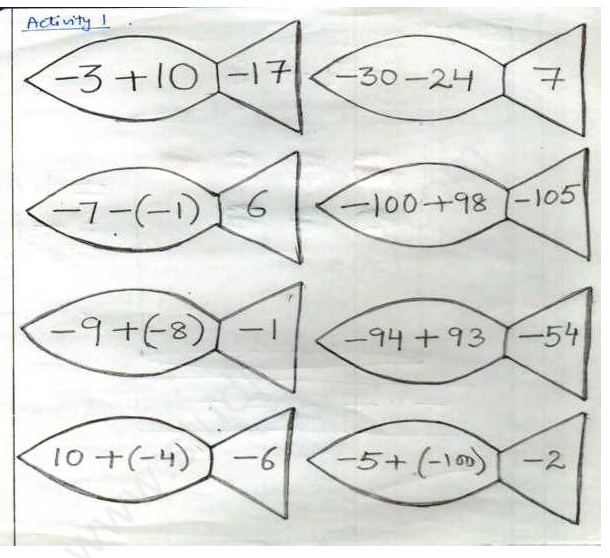
Where to do: Project file
Assessment Criteria: Accuracy in solving, Presentation, Creativity
Activity 2: TUMBLER OF RULES OF ADDITION OF INTEGERS
1. Draw a tumbler for each question given below in Project file (on the plain side)
a) – 3 + 5 b) – 7 + 4 c) 10 – 6 d) – 8 – 2
2. Paste a green bindi for a positive integer and a negative integer in the tumbler or (coloured paper in place of bindi)
3. Cancel each pair formed of a red and green bindi using pencil.
4. Count the remaining bindi and represent it with integer.
5. Write all the steps on the ruled side.
Click on link below to download CBSE Class 7 Revision Assignment Set F
Free study material for Class VII
Download Practice Assignments: Class 7 All subjects All topics
Chapter Practice Questions for Class 7 All subjects
Explore reliable practice questions for All topics tailored for Class 7 learners. Use these structured worksheets to evaluate preparedness and strengthen core problem-solving skills.
Maximize Exam Scores with Chapter Practice Sets
- Exam Alignment: Questions strictly follow contemporary CBSE sample papers and grading schemes.
- Comprehensive Coverage: Features objective drills, case studies, and structured descriptive problems for All topics.
- Pacing & Precision: Regular problem-solving builds critical calculation speed and test-taking accuracy.
Steps to Complete All topics Assignments Successfully
- Initial Reading: Begin by reading the NCERT book for Class 7 All subjects to build a baseline understanding.
- Independent Testing: Attempt assignment questions unassisted, then verify work using provided answer keys.
- Supplementary Aids: Leverage revision notes and worksheets whenever you encounter difficult topics.
FAQs
You can download free PDF assignments for Class 7 All subjects All topics from StudiesToday.com. These practice sheets have been updated for the 2026-27 session covering all concepts from latest NCERT textbook.
Yes, our teachers have given solutions for all questions in the Class 7 All subjects All topics assignments. This will help you to understand step-by-step methodology to get full marks in school tests and exams.
Yes. These assignments are designed as per the latest CBSE syllabus for 2026. We have included huge variety of question formats such as MCQs, Case-study based questions and important diagram-based problems found in All topics.
Practicing topicw wise assignments will help Class 7 students understand every sub-topic of All topics. Daily practice will improve speed, accuracy and answering competency-based questions.
Yes, all printable assignments for Class 7 All subjects All topics are available for free download in mobile-friendly PDF format.