

Value Based Questions (VBQs) for Class 10 Science
Access comprehensive Value Based Questions (VBQs) for All Chapters using the CBSE Class 10 Science VBQs . Designed to align with the 2026-27 CBSE academic guidelines, these competency-based resources help Class 10 Science students apply theoretical knowledge to real-world scenarios.
Practice Class 10 Science VBQs: All Chapters
View or download the dedicated CBSE Class 10 Science VBQs resource below. Engaging with these value-based scenarios ensures continuous academic progress and mastery of the 2026-27 exam format.
(a) Thickening of the ankles, wrists and knees, bowed legs
(b) Soft skull bones and, bending of the spine
(c) Pain or tenderness in the bones of the arms, legs, or spine
(d) All of the above
Answer : D
Question. Selects the disadvantages of fast/junk food
(a) The carbs and sugar in fast foods can lead to dental cavities
(b) Eating excessive amounts of junk food may increase your risk of depression.
(c) Higher risk of obesity, depression, type 2 diabetes
(d) All of the above
Answer : D
Question. The deficiency of which vitamin leads to the cause of ricket disease
(a) Vitamin A
(b) Vitamin D
(c) Vitamin C
(d) Vitamin B
Answer : B
Question. Select the options which help in getting the vitamin D
(a) Sunlight Exposure
(b) Fortified foods
(c) Cod Liver Oil
(d) All of the above
Answer : D
Question. Which of the following are energy foods?
(a) Vitamins and minerals
(b) Proteins and mineral salts
(c) Carbohydrates and fats
(d) Water and roughage
Answer : C
A student investigated the number of stomata pores on the upper and lower surface of a leaf. Stomata are tiny pores present on the surface of leaves. Massive amounts of gaseous exchange takes place in the leaves through these pores for the purpose of photosynthesis. But it is important to note here that exchange of gases occurs across the surface of stems, roots and leaves as well. The guard cells swell when water flows into them, causing the stomatal pore to open.
Question. Name the pores in a leaf through which respi-ratory exchange of gases takes place.
(a) Xylem
(b) Stomata
(c) Lenticels
(d) Vacuoles
Answer : B
Question. Stomata guard cells perform all functions but
(a) Chloroplast storage
(b) Regulating the amount of water lost
(c) Producing sugars
(d) Protecting the inner regions of leaf
Answer : D
Question. Opening and closing of pores is a function performed by
(a) Stomata
(b) Chlorophyll
(c) Guard cells
(d) Chloroplast
Answer : C
Question. Guard cells of Stoma are
(a) Long and cylindrical in shape
(b) Kidney Shaped
(c) Irregular in shape
(d) Convex in shape
Answer : B
Question. Select the correct option which causes the loss of water from plant cells, causes flowers and leaves to wilt.
(a) Looses it turgor pressure
(c) Exposed to strong wind
(b) Looses its central vacuoles
(d) Looses its central nucleus
Answer : A
The leaf is the main photosynthesis organ in a plant. It controls gas exchange in plants, controls the amount of water loss in plants. Upper epidermis cells contain no chloroplasts – which is not true for the guard cells. They form layers on the upper and lower surfaces of the leaf. Their function is to prevent water from getting out and stopping unwanted substances/ organisms getting in. The palisade mesophyll layer is where most of the photosynthesis occurs in the leaf. The palisade cells contain a lot of chloroplasts to help them perform this photosynthesis. Lower epidermis is the bottom layer of the leaf, and is one cell thick. They may not contain a cuticle within the lower epidermis, there are some holes found in leaves called stoma. These holes allow gases to diffuse in and out of the leaves. The stoma are formed by two highly specialised epidermis cells, called guard cells. Guard cells are the only epidermis cells that contain chloroplasts. 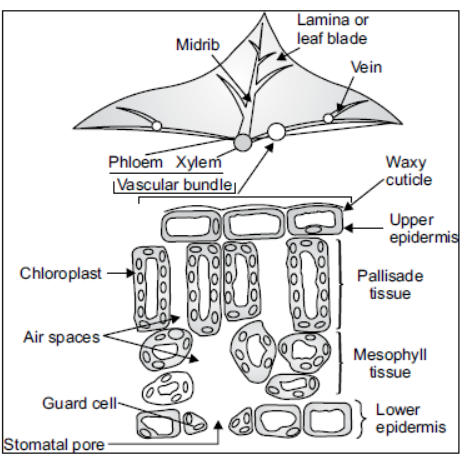
Question. Where are chloroplasts present in the leaf?
(a) Upper epidermis
(b) Guard cells and Palisade cells
(c) Inner membrane
(d) Outer membrane
Answer : B
Question. Select the statement which is not correct regarding upper epidermis
(a) Upper epidermis contains large number of stomata.
(b) This is a single layer of cells containing few or no chloroplasts
(c) The upper surface is covered with a waxy, waterproof cuticle
(d) None of the above
Answer : A
Question. The small pores present of leaf’s surface are called
(a) Guard cells
(b) Chlorophyll
(c) Stomata
(d) None of these
Answer : C
Question. Name the cell organelle in which photosynthesis occur
(a) Mitochondria
(b) Cytoplasm
(c) Chloroplast
(d) Protoplasm
Answer : C
Question. Select the function/s of lower epidermis
(a) Allow carbon dioxide and oxygen to move in and out of the plant
(b) A protective layer of cells
(c) The lower epidermis possesses a cuticle layer
(d) Both (a) & (b)
Answer : D
Question numbers (a) to (d) are based on the two tables given below. Study these tables related to blood pressure and answer the questions that follow:
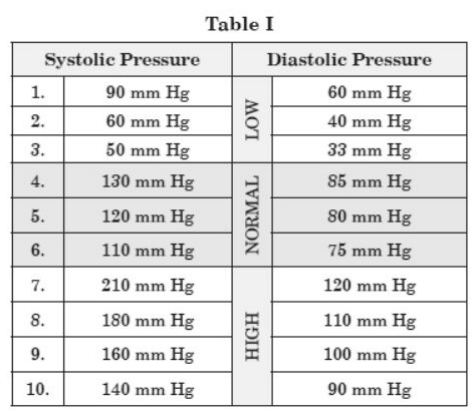
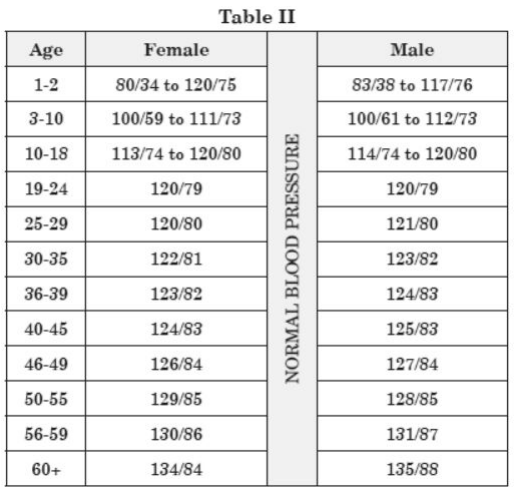
Question. Refer to the Table I and suggest the value of mean blood pressure level beyond which doctor’s advice is necessary for your father with age 45?
(a) 130/85
(b) 120/80
(c) 110/75
(d) 160/100
Answer : D
Question. Normal range of systolic pressure is
(a) 120-140 mm Hg
(b) 110-120 mm Hg
(c) 110-130 mm Hg
(d) 120-150 mm Hg
Answer : C
Question. Which one of the following diets would you recommend to patient of high blood pressure?
(a) High sugar, low fat, low salt
(b) Low sugar, low fat, low salt
(c) High sugar, high fat, low salt
(d) High sugar, low fat, high salt
Answer : B
Question. Which instrument is used to measure blood pressure and what is its normal range in general?
(a) Sphygmomanometer, 80/100
(b) Manometer, 80/140
(c) Sphygmomanometer, 120/80
(d) Barometer, 120/80
Answer : C
Question. If you are 15 years female and your blood pressure is 140/90, what will you infer?
(a) Hypertension
(b) Anaemia
(c) Low blood pressure
(d) None of these.
Answer : A
Free study material for Science
Moral and Ethical Questions: Class 10 Science All Chapters
Chapter VBQs with Solutions (CBSE)
Access targeted moral and value-driven questions for Class 10 Science All Chapters. Designed to align with official CBSE guidelines, these problem sets test deep comprehension beyond standard textbook answers.
Verified Answers for Class 10 Science All Chapters
Pair your practice with our comprehensive NCERT solutions for Class 10 Science to review detailed responses and master the underlying themes of this chapter.
More Study Resources for All Chapters
Wrap up your preparation by testing your critical thinking against standard Science question formats. All resources on our platform are free to access.
FAQs
The latest collection of Value Based Questions for Class 10 Science All Chapters is available for free on StudiesToday.com. These questions are as per 2026 academic session to help students develop analytical and ethical reasoning skills.
Yes, all our Science VBQs for All Chapters come with detailed model answers which help students to integrate factual knowledge with value-based insights to get high marks.
VBQs are important as they test student's ability to relate Science concepts to real-life situations. For All Chapters these questions are as per the latest competency-based education goals.
In the current CBSE pattern for Class 10 Science, All Chapters Value Based or Case-Based questions typically carry 3 to 5 marks.
Yes, you can download Class 10 Science All Chapters VBQs in a mobile-friendly PDF format for free.