Class 8 Social Science Why do we need a Parliament Exam Notes. Please refer to the examination notes which you can use for preparing and revising for exams. These notes will help you to revise the concepts quickly and get good marks.
Covers the following topics:
- Why should people Decide
- People and their Representatives
- Composition of Parliament
- Lok Sabha
- Rajya Sabha
- The Role of Parliament
- Who are the people in Parliament ?
Introduction
The term Parliament is derived from the French word 'Parley' which means speech, talk, debate and conversation, and the suffix 'ment' denotes result, product or means of actions. Parliament is the supreme representative authority of the people. It is the national forum for public opinion. The ideas of participation in decision-making and the need for all democratic governments to have the consent of their citizens are the elements which make us a democracy and this is best expressed in the institution of the Parliament. The Parliament enables citizens of India to participate in decision making and control the government, thus making it the most important symbol of Indian democracy and a key feature of the Constitution.
Why Should People Decide
Under colonial rule, the people had lived in fear of the British government and did not agree with many of the decisions that they took. But they faced grave danger if they tried to criticise these decisions. The freedom movement changed this situation. The nationalists began to openly criticise the British government and make demands. The formation of the Indian National Congress in 1885 gave a platform to discuss various issues such as demand for elected members in the legislature with a right to discuss the budget and ask questions, The Government of India Act 1909, allowed for some elected representation, The British did not allow for all adults to vote nor could people participate in decision making.The participation of different people in the struggle for freedom left little doubt in the minds of the nationalists that all persons in independent India would be able to participate in making decisions, With the coming of independence, the dreams and aspirations of the freedom struggle were made concrete in the Constitution of independent India that laid down the principle of universal adult franchise, i.e., that all adult citizens of the country have the right to vote
People And Their Representatives
The base of democracy is the idea of consent, i.e. the desire, approval and participation of people. The basic idea is that the individual or the citizen is the most important person and that in principle the government as well as other public institutions needs to have the trust of the citizens.
Election is the way by which the individual give approval to the government. People elect their representatives to the Parliament, then, one group from among these elected representatives forms the government. The Parliament controls and guides the government In this sense people, through their chosen representatives. form the government and also control it
→ COMPOSITION OF PARLIAMENT
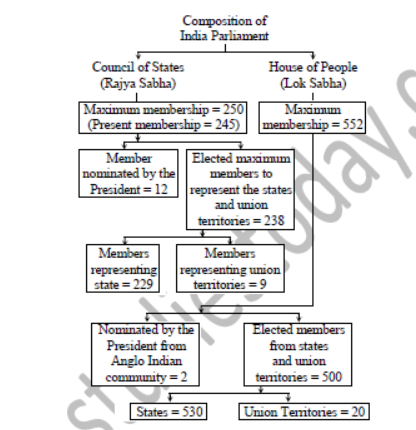
The Parliament consists of the President, the House of the people (Lok Sabha) and the council of states (Rajya Sabha)
LOK SABHA
The Lok Sabha is also called the House of People. It is the lower house of Parliament and is elected directly by the people on the basis of Universal Adult Franchise and secret ballot. The speaker is the presiding composition
officer of the house. They even elect a Deputy Speaker who presides in case a speaker is not there.
♦ Composition
The Lok Sabha consists of 550 members out of which 530 are elected from states while 20 are elected from Union Territories. Seats are allocated to each state on the basis of population. The president even nominates two Anglo Indian members to Lok Sabha to give the community adequate representation. At present, Lok Sabha has 545 members.
♦ Qualifications for becoming a member of Lok Sabha
♦ He should be a citizen of India.
♦ He should not to be less than 25 years of age
♦ He should not hold office of profit under the Government of India.
♦ He should not be bankrupt or of unsound mind
♦ Term
The Lok Sabha is elected for a term of five years. However, its tenure can be extended in case of an emergency.
It can be dissolved even earlier if the tenure of Lok Sabha ends and no party is in a majority to form the government.
→ RAJYA SABHA
The Rajya Sabha is also called Council of States. It is the upper house of Parliament and is elected indirectly by MLAs of State Legislative Assemblies on the basis of proportional representation. The Vice- President is the presiding officer or chairman of the House and the members elect a Deputy Chairman who presides over in case of the absence of the Chairman.
♦ Composition
The Rajya Sabha consists of 250 members out of whom 238 are elected from state and Union territories while
12 members are nominated by the President from among people who have distinguished themselves in the fields of education, literature, science, technology, etc
♦ Qualifications for becoming a member of Rajya Sabha
♦ He must be a citizen of India
♦ He must not be less than 30 years of age.
♦ He must not hold any office of profit under the government of any state
♦ He must not be bankrupt and must not be of unsound mind Term
The Rajya Sabha is the permanent house which is never dissolved. Its members are elected for a term of 6 years and 1/3rd of its members retire after 2 years.
→ THE ROLE OF THE PARLIAMENT
Created after 1947, the Indian Parliament is an expression of the faith that the people of India have in principles of democracy i.e. participation by people in the decision-making process and government by consent. The Parliament in our system has immense powers because it is the representative of the people. Elections are held in a similar manner as they are for the state legislature The Lok Sabha is usually elected once every five years.
The country is divided into numerous constituencies. Each of these constituencies elects one person to the Parliament. The candidates who contest elections usually belong to different political parties. Once elections to the parliament have taken place the parliament mainly needs to perform three functions.
(A) To select the National Government
(B) To control guide and inform the government
(C) Framing of laws
♦ To select the National Government
For a political party to form the government. they must have a majority of elected MPs. Since there are 543 elected (Plus 2 nominated) members In Lok Sabha to have a majority a party should have at least half the number i.e. 272 members or more.
♦ The Opposition : The Opposition in Parliament is formed by all the political parties that oppose the majority party/coalition formed. The largest amongst these parties is called the opposition party. The opposition is constituted by parties other than the ruling party. The opposition parties play a crucial role In the healthy functioning of a democracy. They highlight drawbacks in various policies and programmes of the government nd mobilise popular support for their own policies.
♦ Selection of the Executive : Executive is a group of persons who work together to implement the laws made by the Parliament. The Prime Minister of India is the leader of the ruling party in the Lok Sabha. From the MPs who belong to that party, the Prime Minister selects ministers to work with her/him to implement decisions These ministers then take charge of different areas of government functioning like health, education, finance etc
♦ Coalition government : When no single party gets the majority that is required to form the government. they then join together with different political parties who are interested in similar concerns to form what is known as a coalition government. Coalition governments of 13, 15, 18, 19 and 14 parties were formed in the year, 1996 (Devgoda), 1997 (I. K. Gujral), 1998 (A.B. Bajpai), 1999 (A B. Bajpai) and 2004 (Dr. Manmohan Singh) respectively.
♦ Rajya Sabha : It functions primarily as the representative of the states of India in the Parliament. It can also initiate legislation and a bill is required to pass through the Rajya Sabha in order to become a law. It has an important role of reviewing and altering the laws initiated by the Lok Sabha. Members are elected by the elected members of the Legislative Assemblies of various states. It has 245 members, of which 233 are elected members plus 12 members nominated by the President.
♦ To control guide and inform the government
♦ Question Hour : The question hour is an important mechanism through which MPs can elicit information about the working of the government. This is very in important way through which the Parliament controls the executive. By asking questions the government is alerted to its shortcomings and also comes to know the opinion of the people through their representatives in the Parliament, i.e., the MPs. Asking questions to the government gets valuable feedback and is kept on its toes by the questions asked by the MPs A member who desires an oral answer to the question is required to mark it with a star. Such questions are known as starred question. Through these questions the member can seek from the minister some other relevant information connected with the reply already given on the floor of house. These are called supplementary questions. Some questions without stars are also asked. These are meant for written answers. The answers to all the questions and the supplementary questions given by ministers make the government responsive to Parliament This is one of the several ways in which the Parliament controls, guides and Informs the government
♦ Making of a law : Whenever a bill is moved, members get an opportunity to discuss the merits and demerits of the government policies The Parliament is the highest place where government policies can be discussed.
♦ 'No Confidence Motion' : The Opposition party or parties may move a motion that the Lok Sabha does not have confidence in the Council of Minister. If the majority in the house votes. against the motion, the Council of Ministers continues to be in the power. However, if the majority votes for the motion the Council of Minister has to resign. Normally in both the cases the members of the government and opposition parties get the opportunity to appreciate or criticise the government
♦ Other ways : There are other ways also in which members can keep control over the government. some of these are calling attention notice, adjournment motion, etc. In these cases members can request the Speaker to have a pointed discussion on a particular issue.
♦ Law Making :
Framing of laws and amendment in previous laws is the important function of the legislature. The proposal for a law is called a bill. It is of two kinds - ordinary bill and money bill. Until a bill passed through a proper procedure, it can not be a law or an act.
→WHO ARE THE PEOPLE IN PARLIAMENT
(i) The Parliament now has more and more people from different backgrounds. For example, there are more rural members as also members from many regional parties, Groups and peoples that were till now unrepresented are beginning to get elected to the Parliament.
(ii) There has also been an increase in political participation from the Dalit and backward castes and the minorities.
(iii) Some seats are reserved in the Parliament for SCs and STs. This has been done so that the MPs elected from these constituencies will be familiar with and can represent Dalit and Adivasi interests in Parliament.
(iv) There should be reservation of seats for woman. This issue is still being debated. Sixty years ago, only four percent of MPs were women and today it is just above nine percent. This is a small share when you consider the fact that half the population are women.
Please click on below link to download pdf file for Class 8 Social Science Why do we need a Parliament Exam Notes.