

Download Class 11 Geography Practice Worksheets
Access comprehensive chapter-wise worksheets for Manufacturing Industries using the CBSE Class 11 Geography Manufacturing Industries Worksheet. Designed to align with the 2026-27 academic syllabus for Class 11 Geography, these printable practice sets help students reinforce key concepts and improve their overall exam readiness.
Access Manufacturing Industries Practice Papers and Solutions
View or download the dedicated CBSE Class 11 Geography Manufacturing Industries Worksheet resource below. Engaging with these practice papers under focused study conditions ensures continuous academic progress and mastery of the 2026-27 curriculum for Manufacturing Industries.
CBSE Class 11 Geography
Manufacturing Industries
Important Questions for NCERT Class 10 Social Science Manufacturing Industries
Question. Which is the key factor in the location of an industry?
Answer: The key factor in the location of an industry is availability of raw material.
Question. Mention some of the manufactured products that you use in your daily life.
Answer: The manufactured products that we use in our daily life are electric bulbs, vegetable oil, petrol, glassware, cement, etc.
Question. What are the different ways in which the industries are classified?
Answer: The different ways in which industries are classified:
(i) On the basis of source of raw materials are classified:
• Agro based industries
• Mineral based industries
(ii) On the basis of their main role
• Basic or key industries
• Consumer industries
(iii) On the basis of capital investment
• Small scale industries
• Large scale industries
(iv) On the basis of ownership
• Public sector
• Private sector
• Joint sector
• Cooperative sector
(v) Based on the bulk and weight of raw material and finished products
• Heavy industries
• Light industries
Question. How do industries pollute air and water? Explain with examples.
Answer: Undoubtedly the rapid growth in industries has led to considerable economic growth but it has also led to the increase in pollution of land, water, air, noise eventually resulting in degradation of environment.
Air and water pollution is prominent of them all.
(a) Air Pollution: Presence of high proportion of undesirable gases, such as sulphur dioxide and carbon monoxide in the air is very dangerous. Smoke is emitted by chemical and paper factories, brick kilns, refineries and smelting plants, and burning of fossil fuels in big and small factories that ignore pollution norms. Toxic gas leaks can be very hazardous with long-term effects. Air pollution adversely affects human health, animals, plants, buildings and the atmosphere as a whole.
(b) Water Pollution: Organic and inorganic industrial wastes and effluents are discharged into rivers. They make the river water polluted. The main industries that are responsible for it includes paper, pulp, chemical, textile and dyeing, petroleum refineries, tanneries and electroplating industries that let out dyes, detergents, acids, salts and heavy metals like lead and mercury pesticides, fertilisers, synthetic chemicals with carbon, plastics and rubber, etc. into the water bodies. Rainwater takes the pollutants deep to the ground thus contaminating the ground water also.
Question. Distinguish between the large-scale and small-scale industries.
Answer: 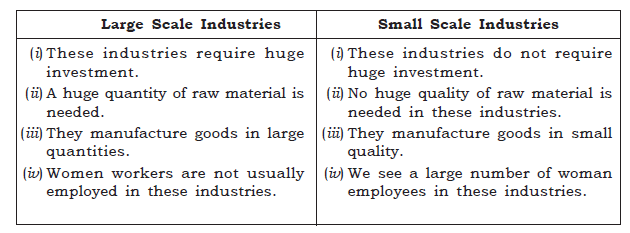
Question. How much is the contribution of manufacturing sector to the national income of the country?
Answer: Over the last two decades, the share of manufacturing sector has stagnated at 17% of GDP. Out of a total of 27 per cent for the industry which includes 10 per cent for mining, quarrying, electricity and gas. This is much lower in comparison to some East Asian economies, where it is 25-30%. The trend of growth rate in manufacturing over the last decade has been around 7 per cent per annum. The desired growth rate over the next decade is 12%. Since 2003, manufacturing is once again growing at the rate of 9 to 10 per cent per annum. With appropriate policy intervention by the government, manufacturing can achieve its target over the next decade.
Question. How can the industrial pollution of fresh water be reduced? Suggest some ways.
Answer: The waste water discharged by our industry pollutes fresh water. Hence, it is essential to save the stock of fresh water from being polluted.
Some ways that can be followed in this direction are:
(i) Water should be re-used and re-cycled to minimise the use of water.
(ii) Hot water and effluents should be treated before releasing them in rivers and ponds.
(iii) Rainwater harvesting should be encouraged to meet water requirements.
Question. What do you mean by agglomeration economics?
Answer: Cities provide markets and also provide services such as banking insurance, transport, etc. to the industry. Many industries tend to come together to make use of the advantages offered by the urban centers known as agglomeration economics.
Question. What are the major challenges of the sugar industry in India?
Answer: The major challenges of the sugar industry in India are given below:
(i) The sugar industry is seasonal in nature.
(ii) The methods of production are old and inefficient.
(iii) Transport delay in reaching came to factories.
(iv) There is a need to maximise the use of baggase.
Q1: What is manufacturing? Name any three physical and three human factors for the location of the industries.
Q2: What are basic industries? Give an example.
Q3: Agriculture and industry move hand in hand. Explain.
Q4: How do industries pollute the environment?
Q5: What are challenges before the jute industries today in India? Explain the steps of the government for its remedies.
Q6: Explain the factors responsible for the centralization of iron and steel industries in peninsular India.
Q7: What are the contributions of industry to National Economy?
Q8: Why is it important for our country to keep the mill sector loomage lower than power loom and handloom?
Q9: Discuss the steps to be taken to minimize environmental degradation by industry.
Q10: What efforts were made by NTPC to control environmental degradation without affecting the production?
Q11: Why do you feel that there are plans to shift sugar mills in South India?
Q12: How industrialization and organization go hand in hand?
Q13: What are the important ingredients of modern industry?
Q14: Locate the following on the outline map of India-
(a) Software technological parks.
(b) Iron and Steel plants.
(c) Textile industries(Cotton, Woolen and Silk)
Download Class 11 Geography Manufacturing Industries Practice Worksheets
Daily Practice Questions for Class 11 Geography
Review targeted practice exercises for Class 11 Geography Manufacturing Industries. Curated to match official CBSE guidelines, these printable problem sets support daily revision and improve overall test readiness.
Detailed Answers for Class 11 Geography Manufacturing Industries
Each worksheet draws directly from authorized standard textbooks to maintain academic accuracy. Evaluating your finished exercises against expert-verified solutions helps master the formal presentation standards expected in school evaluations.
Complete Your Chapter Revision
Consistent engagement with these exercises builds familiarity with recurring exam themes. If specific areas within Manufacturing Industries cause trouble, utilize our dedicated NCERT solutions for Class 11 Geography to clear up doubts immediately.
FAQs
You can download the latest chapter-wise printable worksheets for Class 11 Geography Manufacturing Industries for free from StudiesToday.com. These have been made as per the latest CBSE curriculum for this academic year.
Yes, Class 11 Geography worksheets for Manufacturing Industries focus on activity-based learning and also competency-style questions. This helps students to apply theoretical knowledge to practical scenarios.
Yes, we have provided solved worksheets for Class 11 Geography Manufacturing Industries to help students verify their answers instantly.
Yes, our Class 11 Geography test sheets are mobile-friendly PDFs and can be printed by teachers for classroom.
For Manufacturing Industries, regular practice with our worksheets will improve question-handling speed and help students understand all technical terms and diagrams.