

Download Class 9 English Practice Worksheets
Access comprehensive chapter-wise worksheets for Parts of Speech using the CBSE Class 9 English Parts of Speech Worksheet. Designed to align with the 2026-27 academic syllabus for Class 9 English, these printable practice sets help students reinforce key concepts and improve their overall exam readiness.
Access Parts of Speech Practice Papers and Solutions
Access the complete worksheet PDF for Class 9 English below. Regular practice with these targeted academic tasks builds familiarity with standard question patterns and helps secure higher marks in final school examinations.
Parts of Speech
The parts of speech explain how a word is used in a sentence.
There are eight main parts of speech : nouns, pronouns, adjectives, verbs, adverbs, prepositions, conjunctions and interjections. Most parts of speech can be divided into sub-classes. Prepositions can be divided into prepositions of time, prepositions of place etc. Nouns can be divided into proper nouns, common nouns, concrete nouns etc. It is important to know that a word can sometimes be in more than one part of speech. HERE we will study about all the parts of speech in general.
The eight main parts of speech are:
NOUN - (Naming word)
A noun is the name of a person, place, thing or idea. Examples of nouns: Daniel, London, table, dog, teacher,pen, city, happiness, hope Example sentences: Sam lives in Agra. Daisy uses pen and paper to write letters.
PRONOUN - (Replaces a Noun)
A pronoun is used in place of a noun or noun phrase to avoid repetition. Examples of pronouns: I, you, we, they, he, she, it, me, us, them, him, her, this, those Example sentences: Mary is tired. She wants to sleep. I want her to dance with me.
ADJECTIVE - (Describing word)
An adjective describes, modifies or gives more information about a noun or pronoun. Examples: big, happy, green, young, fun, crazy, three Example sentences: The little girl had a pink hat.
VERB - (Action Word)
A verb shows an action or state of being. A verb shows what someone or something is doing. Examples: go,speak, run, eat, play, live, walk, have, like, are, is Example sentences: I like watching English news. I watch sports sometimes.
ADVERB - (Describes a verb)
An adverb describes/modifies a verb, an adjective or another adverb. It tells how, where, when, how often or to what extent. Many adverbs end in -LY Examples: slowly, quietly, very, always, never, too, well, tomorrow, here Example sentences: I am usually busy. Yesterday, I ate my lunch quickly.
PREPOSITION - (Shows relationship)
A preposition shows the relationship of a noun or pronoun to another word. They can indicate time, place, or relationship. Examples: at, on, in, from, with, near, between, about, under Example sentences: I left my keys on the table for you.
CONJUNCTION - (Joining word)
A conjunction joins two words, ideas, phrases or clauses together in a sentence and shows how they are connected. Examples: and, or, but, because, so, yet, unless, since, if. Example sentences: I was very tired and exhausted but I still finished the marathon.
INTERJECTION - (Expressive word)
An interjection is a word or phrase that expresses a strong feeling or emotion. It is a short exclamation.
Examples: Ouch! Wow! Great! Help! Oh! Hey! Hi! Example sentences: Wow! I passed my Maths test.
ARTICLE - (Defining word)
An article is used before a noun. These are divided into definite (the) and indefinite (a, an). Articles help define nouns. Examples: a, an, the Example sentences: I need a dictionary. The dictionary needs to be in English.
PARTS OF SPEECH WITH FUNCTIONS

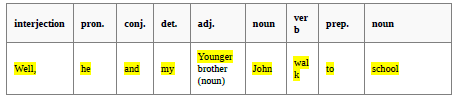
Determiners may be treated as adjectives, instead of being a separate parts of speech. Here is a sentence that contains every part of speech:
Parts of Speech Class 9 English Worksheet
Question. A receptionist should have ................... manners.
(a) please
(b) pleasure
(c) pleasant
Answer : C
Question. The government has taken several .................... to uplift the marginal sections of the society.
(a) initiatives
(b) initiate
(c) initiation
Answer : A
Question. Dogs rarely attack without ....................
(a) provoke
provocation
(b) provocative
Answer : B
Question. It was ................... for the woman to watch the sufferings of her child.
(a) agony
(b) agonizing
Answer : B
Question. The minister gave a ................... reply to the charges leveled by the opposition.
(a) befit
(b) befitting
Answer : B
Question. He pays us ................... visits.
(a) occasion
(b) occasional
Answer : B
Question. He will always remain a source of ................... for us.
(a) inspire
(b) inspiring
(c) inspiration
(d) inspirational
Answer : C
Question. The singers were given a thunderous ....................
(a) applaud
(b) applause
Answer : B
Question. She stared at the skyscrapers in ......................
(a) bewilder
(b) bewilderment
Answer : B
Question. This is a minor surgical .................... that can be carried out under local anesthetic.
(a) proceed
(b) procedure
(c) proceeding
Answer : B
Question. The goons tried to ..................... the shopkeepers.
(a) threat
(b) threaten
Answer : B
Question. The audience began to ...................... the performance of the band.
(a) applaud
(b) applause
Answer : A
HOME ASSIGNMENT
Question-1 For each of the following questions, write the name of the part of speech (noun, verb, pronoun, adjective, adverb, preposition, conjunction, article) of the coloured word:
eg: That is the biggest house I've ever seen.
noun
1. We went to the mall last night.
2. He asked me to go to the party with him.
3. The school will be closed on Monday.
4. My sisters will be here next week.
5. She will be here soon.
6. By this time tomorrow I will have read the book.
7. I'll see you in three hours.
8. He is the fastest runner in the school.
9. She is crying because she could not do the given work.
10. He has a beautiful watch.
ACTIVITY-WRITE SOME MORE SENTENCES, UNDERLINE AND NAME THE PARTS OF SPEECH USED THERE.
Free study material for English
CBSE Class 9 English Worksheets for Parts of Speech
Download Chapter Worksheets: Class 9 English
Review targeted practice exercises for Class 9 English Parts of Speech. Curated to match official CBSE guidelines, these printable problem sets support daily revision and improve overall test readiness.
Concept Clarification for Parts of Speech
Designed around the official curriculum for Class 9 English, these practice sheets guarantee standard compliance. Reviewing step-by-step solutions after completion sharpens your accuracy and clarifies complex sub-topics within Parts of Speech.
Effective Revision Strategies for School Exams
Wrap up your chapter revision by testing your knowledge against standard objective question formats. Explore our full library of free, up-to-date printable assignments to maximize your academic results in upcoming CBSE evaluations.
FAQs
You can download the latest chapter-wise printable worksheets for Class 9 English Parts of Speech for free from StudiesToday.com. These have been made as per the latest CBSE curriculum for this academic year.
Yes, Class 9 English worksheets for Parts of Speech focus on activity-based learning and also competency-style questions. This helps students to apply theoretical knowledge to practical scenarios.
Yes, we have provided solved worksheets for Class 9 English Parts of Speech to help students verify their answers instantly.
Yes, our Class 9 English test sheets are mobile-friendly PDFs and can be printed by teachers for classroom.
For Parts of Speech, regular practice with our worksheets will improve question-handling speed and help students understand all technical terms and diagrams.