

Chapter-wise Worksheets for Class 11 Biology: Chapter 12 Mineral Nutrition
Access comprehensive chapter-wise worksheets for Chapter 12 Mineral Nutrition using the CBSE Class 11 Biology Morphology Of Plants Worksheet. Designed to align with the 2026-27 academic syllabus for Class 11 Biology, these printable practice sets help students reinforce key concepts and improve their overall exam readiness.
Practice Class 11 Biology Worksheets: Chapter 12 Mineral Nutrition
Navigate directly to the solved Biology worksheets using the digital viewer below. Each practice set includes detailed step-by-step solutions, allowing students to instantly cross-check their work and identify areas requiring further revision.
Multiple Choice Questions
Question. A flower is a modified shoot because
(a) certain flowers have well-developed nodes and internodes
(b) it arises in the axile of plants
(c) the growing point of thalamus may give rise to shoots
(d) All of the above
Answer. D
Question. When a shoot tip transforms into a flower, it is always
(a) solitary
(b) axillary
(c) racemose
(d) cymose
Answer. A
Question. Inflorescence is the arrangement of
(a) leaves on the floral axis
(b) buds on the floral axis
(c) flowers on the floral axis
(d) petioles on the floral axis
Answer. C
Question. Depending on whether the apex gets converted into a flower or continues to grow, how many major types of inflorescences are defined?
(a) Two
(b) Three
(c) Four
(d) Five
Answer. A
Question. In racemose inflorescence,
I. the main axis continues to grow into a flower.
II. flowers are borne in acropetal manner.
III. young flowers are present towards the base and older at the apex.
Choose the correct option to complete the statement.
(a) Only I
(b) II and III
(c) Only III
(d) I and II
Answer. D
Question. Identify the given diagram and choose the incorrect option.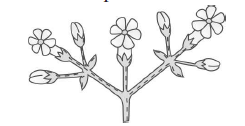
(a) The main axis terminates into a flower
(b) Flowers are basipetally arranged
(c) Growth of the peduncle is determined
(d) Older flowers are towards the base and younger at the apex
Answer. D
Question. In an inflorescence, where flowers are borne laterally in an acropetal succession, the position of the youngest floral bud shall be (NCERT Exemplar)
(a) proximal
(b) distal
(c) intercalary
(d) any where
Answer. B
Question. A typical flower has four different kinds of whorls arranged on end of the stalk or pedicel called
(a) peduncle
(b) thalamus
(c) receptacle
(d) Both (b) and (c)
Answer. D
Question. Perianth is the condition in which
(a) calyx and corolla are not distinct
(b) calyx is present, but corolla is absent
(c) corolla is present, but calyx is absent
(d) calyx and corolla are not present
Answer. A
Question. I. When flower has both an androecium and gynoecium, it is called ... A.... .
II. When flower has either stamens or only carpel, it is called ... B.... .
Fill up the blanks by choosing appropriate options for A and B.
(a) A–bisexual, B–unisexual
(b) A–unisexual, B–bisexual
(c) A–bisexual, B–hermaphrodite
(d) A–hermaphrodite, B–bisexual
Answer. A
Question. Choose the incorrect match.
(a) Actinomorphic flower — Mustard
(b) Zygomorphic flower — Gulmohar
(c) Asymmetrical flower — Bean
(d) All of the above
Answer. C
Question. Which of the following statement is correct?
(a) Actinomorphic are bilaterally symmetrical flowers
(b) Zygomorphic are radially symmetrical flowers
(c) Asymmetric are irregularly symmetrical flowers
(d) All of the above
Answer. C
Question. Which of the following represents hypogynous condition?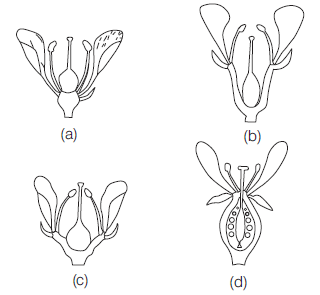
Answer. A
Question. Select the correct match with respect to the position of floral parts on thalamus.
(a) Hypogynous — Half inferior — Guava
(b) Epigynous — Superior — Cucumber
(c) Perigynous — Inferior — Ray florets of sunflower
(d) Hypogynous — Superior — China rose
Answer. D
Question. All statements are correct with respect to the figure given below, except.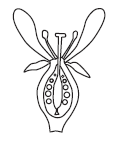
(a) the margin of thalamus grows upwards enclosing
(b) ovary is said to be inferior
(c) the flower is said to be perigynous
(d) it is seen in the flowers of guava and cucumber
Answer. C
Question. Match the following columns.
Column I Column II
(Parts of flower) (Description)
A. Calyx 1. Female reproductive part
B. Corolla 2. Male reproductive part
C. Androecium 3. Outermost whorl of flower
D. Gynoecium 4. Composed of petals
Codes
A B C D
(a) 4 1 3 2
(b) 3 2 1 4
(c) 3 4 2 1
(d) 2 1 3 4
Answer. C
Question. Read the following statements and choose the option with correct statements.
I. Generally sepals are green, leaf like and protect the flower in the bud stage.
II. Petals are usually bright coloured to attract insect pollinators.
III. The shape and colour of corolla vary greatly in plants.
IV. Corolla may be tubular, bell-shaped, funnel-shaped or wheel-shaped.
(a) I and II
(b) III and IV
(c) I, III and IV
(d) I, II, III and IV
Answer. D
Question. Match the following columns.
Column I Column II
A. Sepals free 1. Gamopetalous
B. Petals united 2. Gamosepalous
C. Petals free 3. Polysepalous
D. Sepals united 4. Polypetalous
Codes
A B C D
(a) 3 1 2 4
(b) 3 4 1 2
(c) 2 1 4 3
(d) 3 1 4 2
Answer. D
Question. The mode of arrangement of sepals or petals in a floral bud with respect to the other members of same whorl is known as
(a) aestivation
(b) cohesion
(c) placentation
(d) adhesion
Answer. A
Question. Which type of aestivation occurs when sepals or petals in a whorl just touch one another at the margin without overlapping?
(a) Imbricate aestivation
(b) Valvate aestivation
(c) Twisted aestivation
(d) Vexillary aestivation
Answer. B
Question. Arrange in correct order according to the given figures.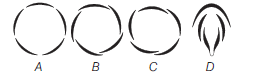
(a) A – Imbricate, B – Vexillary, C – Valvate,D – Twisted
(b) A – Vexillary, B – Valvate, C – Twisted,D – Imbricate
(c) A – Valvate, B – Twisted, C – VexillaryD – Imbricate
(d) A – Valvate, B – Twisted, C – Imbricate,D – Vexillary
Answer. D
Question. Aestivation of petals in the flower of cotton is correctly shown in
Answer. D
Question. Find out the pairs, which are correctly matched with respect to aestivation of petals.
I. Valvate – Calotropis
II. Twisted – Bean
III. Imbricate – Cassia
IV. Vexillary – China rose
(a) II and IV
(b) I and II
(c) I and III
(d) III and IV
Answer. C
Question. Staminode is a fertile stamen.
(a) True
(b) False
(c) Cannot say
(d) Partially true or false
Answer. B
Question. The technical term used for the androecium in a flower of China rose (Hibiscus rosa-sinensis) is
(a) monadelphous
(b) diadelphous
(c) polyandrous
(d) polyadelphous
Answer. A
Question. Match the following columns.
Column I Column II
A. When stamens unite into more 1. Epipetalous
than two bundles
B. When stamens 2. Epiphyllous
are attached to the petals
C. When stamens are attached 3. Diadelphous
with perianth 4. Polyadelphous
Codes
A B C
(a) 3 1 2
(b) 4 1 2
(c) 3 2 1
(d) 4 2 1
Answer. B
Question. Select the incorrect pair out of the following.
(a) Epipetalous – Brinjal
(b) Diadelphous – Cucurbita
(c) Polyadelphous – Citrus
(d) Epiphyllous – Lily
Answer. B
Question. In a carpel, …A… is the enlarged basal part, on which lies the elongated tube,…B… . The …C… is the tip of carpel,which is receptive for pollen grains.
(a) A–stigma, B–style, C–ovary
(b) A–ovary, B–style, C–stigma
(c) A–style, B–stigma, C–ovary
(d) A–stigma, B–ovary, C–style
Answer. B
Question. The expression ‘gynoecium is apocarpous’ implies that the
(a) gynoecium comprises only one pistil which is fused with the stamen
(b) gynoecium comprises more than one carpel, all of which are free
(c) gynoecium comprises only one carpel which is free
(d) gynoecium comprises more than one carpel which are fused
Answer. B
Question. Gynoecium with fused carpels is called
(a) syncarpous
(b) apocarpous
(c) syngenesious
(d) None of these
Answer. A
Question. Gynoecium with fused carpels is called
(a) syncarpous
(b) apocarpous
(c) syngenesious
(d) None of these
Answer. A
Question. Placentation can be defined as an arrangement of
(a) ovules within the ovary
(b) synergids within the ovary
(c) carpels in a flower
(d) pistils in a flower
Answer. B
Question. In marginal placentation, the ovules are arranged
(a) along the inner wall of carpel in a syncarpous ovary
(b) along the margin of single carpel
(c) in the middle of the ovary
(d) to the base of the ovary
Answer. C
Question. Axile placentation is found in syncarpous ovaries. In this placentation, the ovules are arranged along the
(a) base of the ovary
(b) margin of the ovary
(c) axis in the centre of the ovary
(d) None of the above
Answer. C
Question. Match the following columns.
Column I Column II
(Placentations) (Examples)
A. Basal 1. Mustard
B. Axile 2. China rose
C. Parietal 3. Dianthus
D. Free-central 4. Sunflower
Codes
A B C D
(a) 2 3 4 1
(b) 1 2 3 4
(c) 4 2 1 3
(d) 3 4 1 2
Answer. C
Question. In a multicarpellary syncarpous unilocular ovary, if the ovules are borne on the central axis and septa are absent this is defined as
(a) marginal placentation
(b) parietal placentation
(c) axile placentation
(d) free-central placentation
Answer. D
Question. In the diagram of types of placentation given below, A, B, C and D, respectively represent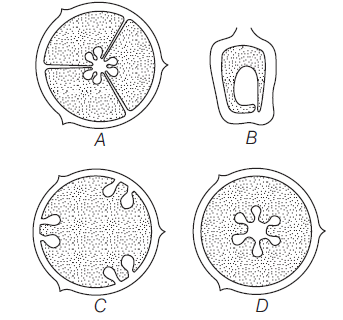
(a) A–Basal, B–Axile, C–Parietal, D–Free-central
(b) A–Free-central, B–Parietal, C–Basal, D–Axile
(c) A–Axile, B–Basal, C–Parietal, D–Free-central
(d) A–Parietal, B–Axile, C–Free-central, D–Basal
Answer. C
Question. What would we interpret if % is given for a flower in its floral formula?
(a) Any vertical section passing through its centre divides it into two equal vertical halves
(b) Only one vertical section divides it into equal vertical halves
(c) Cannot be divided into equal vertical halves by any vertical section
(d) Only one vertical section passing through its centre divides it into two equal vertical halves
Answer. D
Question. Give the symbol of bicarpellary syncarpous, inferior ovary
(a) G(2)
(b) G0
(c) G2
(d) G(2)
Answer. D
Question. Which of the following statements is correct with reference to the flowers of family–Solanaceae?
(a) Pentamerous, actinomorphic, unisexual, hypogynous
(b) Pentamerous, zygomorphic, bisexual, epigynous
(c) Pentamerous, bisexual, actinomorphic, hypogynous
(d) Trimerous, actinomorphic, bisexual, hypogynous
Answer. C
Question. Brinjal, datura and tobacco belong to family
(a) Liliaceae
(b) Fabaceae
(c) Solanaceae
(d) Leguminosae
Answer. C
Question. The correct floral formula of chilli is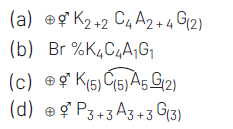
Answer. C
Question. I. Plants belonging to the family…A… possesses a persistent calyx.
II. The family …B… mainly contains monocotyledonous plants.
Choose the correct option to fill in the blanks ‘A’ and‘B’.
A B
(a) Fabaceae Poaceae
(b) Solanaceae Fabaceae
(c) Solanaceae Liliaceae
(d) Asteraceae Solanaceae
Answer. C
Question. Bicarpellary obligated placed syncarpous ovary with axile placentation is found in
(a) potato family
(b) lily family
(c) pea family
(d) mustard family
Answer. A
Question. Given are two floral diagrams A and B.
The correct floral diagram of the family to which tulip and tomato belongs are
…… and ……, respectively.
(a) A, B
(b) B, B
(c) B, A
(d) A, A
Answer. A
Question. Tricarpellary, syncarpous gynoecium is found in flowers of Solanaceae.
(a) True
(b) False
(c) Cannot say
(d) Partially true or false
Answer. B
Question. Familiar examples of family-Liliaceae are
(a) Allium cepa, Aloe vera and Tamarindus indica
(b) Saraca indica, Allium cepa and Aloe vera
(c) Allium sativum, Allium cepa and Aloe vera
(d) Tamarindus indica, Allium cepa and Allium sativum
Answer. C
Question. Gynoecium having three fused carpels with a single ovule containing chamber is
(a) Tricarpellary, syncarpous, unilocular
(b) Tricarpellary, apocarpous, unilocular
(c) Tricarpellary, syncarpous, trilocular
(d) Tricarpellary, apocarpous, trilocular
Answer. A
Question. Perianth occurs in family-Liliaceae.
(a) True
(b) False
(c) Cannot say
(d) Partially true or false
Answer. A
Question. The floral characters of Liliaceae are
(a) Six tepals, zygomorphic, six stamens, bilocular ovary, axile placentation
(b) Tetramerous, actinomorphic, polyphyllous, unilocular ovary, axile placentation
(c) Bisexual, actinomorphic, polyandrous, superior ovary, axile placentation
(d) Bisexual, zygomorphic, gamophyllous, inferior ovary, marginal placentation
Answer. C
Assertion-Reasoning MCQs
Direction- Each of these questions contains two statements
Assertion (A) and Reason (R). Each of these questions also has four alternative choices, any one of which is the correct answer. You have to select one of the codes
(a), (b), (c) and (d) given below.
(a) Both A and R are true and R is the correct explanation of A
(b) Both A and R are true, but R is not the correct explanation of A
(c) A is true, but R is false
(d) A is false, but R is true
Question. Assertion (A) Type of inflorescence in Sphaeranthus is cyathium.
Reason (R) In cyathium type inflorescence, the flowers are achlamydeous.
Answer. D
Question. Assertion (A) In racemose type of inflorescence, the main axis grows indefinitely.
Reason (R) Main axis is not terminated by flower.
Answer. A
Question. Assertion (A) Monadelphous stamens are found in China rose.
Reason (R) When the stamens are united into one bunch or bundle the condition is said to be monadelphous.
Answer. A
Question. Assertion (A) In some flowers like lily, perianth is a term used when calyx and corolla are not distinct.
Reason (R) Calyx and corolla are the reproductive organs.
Answer. C
Question. Assertion (A) Monadelphous stamens are found in pea.
Reason (R) In pea, stamens are united into two bunch or bundles.
Answer. D
Question. Assertion (A) Epiphyllous condition is found in the flowers of lily.
Reason (R) In lily, stamens are attached to the perianth.
Answer. A
Question. Assertion (R) Parietal placentation is observed in pea plant.
Reason (R) In pea plant, the placenta forms a ridge along the ventral suture of ovary and ovules are borne on this ridge forming two rows.
Answer. D
Question. Assertion (A) G2 is the symbol for inferior ovary.
Reason (R) Fusion is indicated by enclosing the number within bracket.
Answer. D
Question. Assertion (A) The floral formula of family–Solanaceae is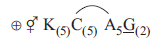
Reason (R) This floral formula tells that flower is bisexual, sepals five, petals five, stamens five and gynoecium tricarpellary, trilocular with many ovules.
Answer. C
Question. Assertion (A) Seeds of most of the members of Solanaceae are endospermic.
Reason (R) Endosperm is found in mature seeds.
Answer. A
Q1. What is the origin of root in plants? Write 4 functions of roots.
Q2. What type of roots are found Monstera and banyan tree?
Q3. What are the two types of roots in plants? Why do we call roots of monocots as fibrous roots?
Q4. Draw diagrams of Tap & fibrous roots, regions of root tip.
Q5. Explain how the roots grow is length?
Q6. Give examples of plants having prop roots, still roots and pneumatophores.
Q7. What is the function of above categories of roots?
Q8. In some plants stem does not perform the main function of photosynthesis. Give examples of such plants.
Q9. How does chrysanthemum & pineapple grow?
Q10. Draw structure of a typical simple leaf.
Q11. Define the following terms: - (a) Rachis (b) Tendrils (c) Spines (d) Petiole (e) Pulvinus
Q12. How is a pinnately compound leaf different from a palmate compound leaf?
Q13. What type of succession is seen is racemose inflorescence?
Q14. What happens to the terminal end of inflorescence in cymose inflorescence? Draw to explain.
Q15. A flower is said to be zygomorphic, tetramerous, bracteates, bisexual, hypogenous. What do you understand by these terms?
Q16. What type of ovary is present in guava & cucumber? Draw a diagram.
Q17. Androecium is composed of stamens, how are the stamens of flower arranged in different flowers.
Q18. Enumerate various types of placentation in flowers.
Q19. Differentiate between seed of gram & maize. Also draw well labeled diagrams.
Q20. Taking a flower of potato & pea, explain the floral structures (description) and the floral formula
Free study material for Biology
Chapter 12 Mineral Nutrition Printable Worksheets and Exercises for Class 11 Biology
Daily Practice Questions for Class 11 Biology
Review targeted practice exercises for Class 11 Biology Chapter 12 Mineral Nutrition. Curated to match official CBSE guidelines, these printable problem sets support daily revision and improve overall test readiness.
Detailed Answers for Class 11 Biology Chapter 12 Mineral Nutrition
Designed around the official curriculum for Class 11 Biology, these practice sheets guarantee standard compliance. Reviewing step-by-step solutions after completion sharpens your accuracy and clarifies complex sub-topics within Chapter 12 Mineral Nutrition.
Complete Your Chapter Revision
Follow up your worksheet practice by attempting the interactive online MCQ tests for Chapter 12 Mineral Nutrition to evaluate your execution speed. All printable assignments and revision sheets on our platform are updated for the 2026 session and available free of charge.
FAQs
You can download the latest chapter-wise printable worksheets for Class 11 Biology Chapter 12 Mineral Nutrition for free from StudiesToday.com. These have been made as per the latest CBSE curriculum for this academic year.
Yes, Class 11 Biology worksheets for Chapter 12 Mineral Nutrition focus on activity-based learning and also competency-style questions. This helps students to apply theoretical knowledge to practical scenarios.
Yes, we have provided solved worksheets for Class 11 Biology Chapter 12 Mineral Nutrition to help students verify their answers instantly.
Yes, our Class 11 Biology test sheets are mobile-friendly PDFs and can be printed by teachers for classroom.
For Chapter 12 Mineral Nutrition, regular practice with our worksheets will improve question-handling speed and help students understand all technical terms and diagrams.