

Class 8 Mathematics Practice Set: Chapter 16 Playing with Numbers
Review targeted practice sets for Class 8 Mathematics Chapter 16 Playing with Numbers. Built according to official educational guidelines for the 2026-27 academic year, these downloadable worksheets support daily revision and core concept reinforcement.
Download Chapter 16 Playing with Numbers Worksheet PDF
View or download the dedicated Chapter 16 Playing with Numbers practice resource below. Engaging with these objective and subjective questions daily ensures continuous academic progress and mastery of the 2026-27 curriculum.
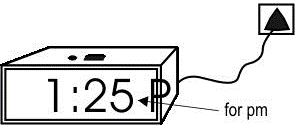
Question. Answer the question based on the given information. The digital clock shown below displays the time from 12:00 to 11:59.
At any time, the SUM OF THE DIGITS displayed can be calculated. For example, the sum of the digits at 1:25 is 1+2+5 = 8. At 10:25, it is 1+0+2+5 = 8. At what time will the sum of the digits in the time displayed be MAXIMUM?
(a) 12:00:00
(b) 11:59:00 AM
(c) 10:59:00 AM
(d) 9:59:00 AM
Answer : D
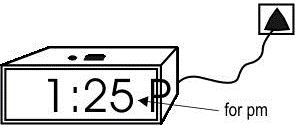
Question. Answer the question based on the given information. The digital clock shown below displays the time from 12:00 to 11:59.
At 1:01, 2:22, 3:53, etc. the time reads the same FORWARDS as well as BACKWARDS. From 12:00 noon to 11:59 pm, how many times will the clock show a time reading the same backwards and forwards? The clock does not display a zero before hours that do not require it, hence 1:01 should be counted, while 1:10 should not.
(a) 12
(b) 24
(c) 57
(d) 71
Answer : C
Question. Latif's Maths teacher asks him to think of any whole number from 1 to 10. She then asks him to do the following:
1. Double this number.
2. Add 4 to the result.
3. Multiply the sum by 5.
If we call the number Latif thinks of N, the number he gets at the end will be
(a) (N + 2) × 10
(b) N + 4 × 2 × 5
(c) (N × 2) + (4 × 5)
(d) 10N + 4
Answer : A
Question. A few drops of water fell on Pratik's phone diary and wiped out most of the digits of his friend's phone number. This is what remains:
The only other thing Pratik remembers is that the sum of any three consecutive digits in the number was 17.Which of these is the digit in the thousand's place in the number?

(a) 3
(b) 6
(c) 7
(d) 8
Answer : B
Question. lf the above pattern of faces continues, what will the 1001st face be?

Answer : D
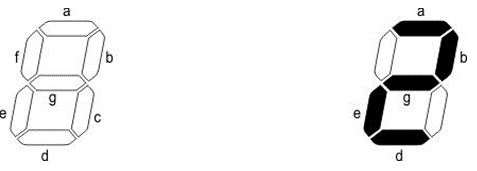
Question. Digital displays are often made using 7-segment Light Emitting Diodes (LEDs)like the one shown below:
Depending on which of the seven segments called a, b, c.. g gets power, different numbers or letters are displayed. For example, if segments a, b, d, e and g are lit, the number 2 is displayed (shown above, right side figure). Study the above figures carefully and answer the question.
Which segments must receive power if the letter F is to be displayed?
(a) a, b, d, f
(b) a, e, f, g
(c) c, d, e, g
(d) b, c, d
Answer : B
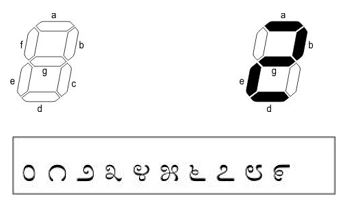
Question. Digital displays are often made using 7-segment Light Emitting Diodes (LEDs)like the one shown below:
Depending on which of the seven segments called a, b, c .. g gets power, different numbers or letters are displayed. For example, if segments a, b, d, e and g are lit, the number 2 is displayed (shown above, right side figure). Study the above figures carefully and answer the question.
The number of LIT segments in 1 is 2. In 2, the number of lit segments is 5. Thus the INCREASE in the number of lit segments is 3. Between which two numbers does the number of lit segments INCREASE THE MOST?
(a) 0 and 1
(b) 1 and 2
(c) 7 and 8
(d) 7 and 8
Answer : D
Question. Ananth ran a 4 km stretch at an average speed of 10 km an hour. If he started his run at 5:00 AM, at what time did he finish?
(a) 5:24 AM
(b) 5:40 AM
(c) 7:25 AM
(d) 7:30 AM
Answer : A
Question. The sum of three numbers is even. If the first number is odd, what can be said about the other two?
(a) Both of them are odd
(b) One of them is even and the other odd
(c) Both of them are even
(d) We can't say for sure
Answer : B
Question. 7.32 x 10⁻² is nearly equal to
(a) -140
(b) 700
(c) 0.007
(d) 0.07
Answer : D
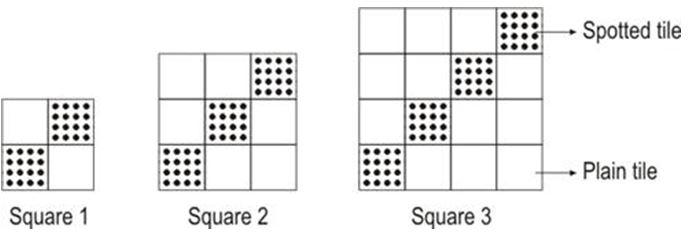
Question. See the pattern of plain tiles and spotted tiles in the squares below to answer question.
What will be the TOTAL number of spotted tiles needed to complete the patterns up to the sixth square? (including the first three)
(a) 20
(b) 27
(c) 30
(d) 36
Answer : B
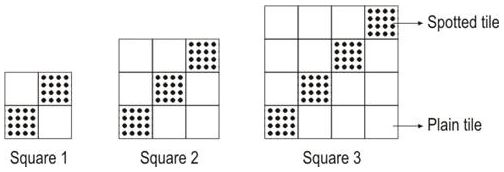
Question. See the pattern of plain tiles and spotted tiles in the squares below to answer the question.
How many PLAIN tiles will be needed for the twentieth square?
(a) 21
(b) 400
(c) 420
(d) 441
Answer : C
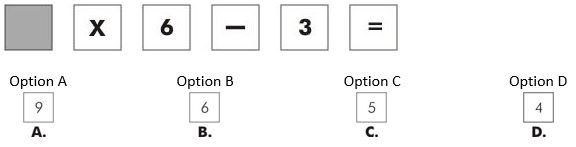
Question. Abdul pressed 6 buttons on his calculator and got the result as 27. The buttons that he pressed are shown below (in order). The first button is hidden:
Which button did Abdul press first?
Answer : C
Question. Sleeper Class coaches of the Indian Railways have a seat numbering arrangement as shown below.
Each 'cubicle' seats 8 people as shown.
Ramesh and his parents have 3 tickets and their seat numbers are 29, 30 and 31. What are their seats?

(a) One aisle, one window, one middle seat.
(b) One middle, one aisle and one side seat.
(c) One aisle and two side seats.
(d) Two side seats and one window seat.
Answer : B
Question. The question is based on the following:
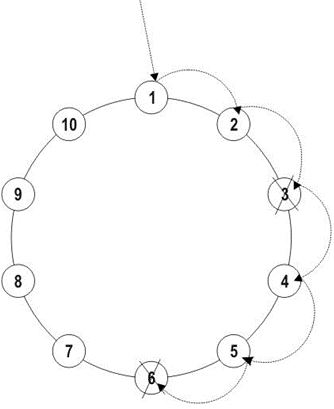
10 friends are playing a game. They have numbered themselves 1 to 10 and are standing in a circle. Now every third person starting from number 1 does the following:
He comes forward, tells a joke and leaves the circle.
After this, again the third person from the people remaining in the circle does the same, and so on till there is only one person left in the group.
Thus, first No. 3 leaves then No. 6, etc.
(a) No. 9 and No. 12
(b) No. 8 and No. 1
(c) No. 9 and No. 2
(d) No. 9 and No. 4
Answer : C
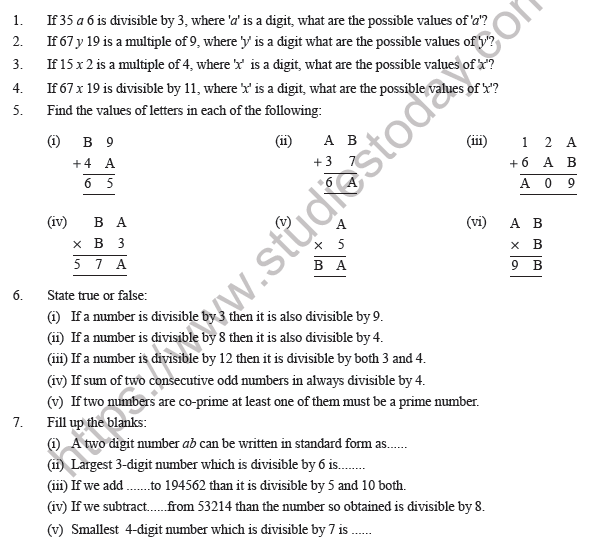
Click on the link below to download Class 8 Maths Playing with Numbers Worksheet
Free study material for Mathematics
Chapter 16 Playing with Numbers Practice Sheet and Solutions for Class 8 Mathematics
Chapter 16 Playing with Numbers Printable Worksheet for Class 8 Mathematics
Explore reliable practice questions for Chapter 16 Playing with Numbers tailored for Class 8 Mathematics learners. Use these structured worksheets to evaluate preparedness and strengthen problem-solving skills.
How to Use These Practice Sheets
Cross-reference your completed exercises with comprehensive NCERT solutions for Class 8 Mathematics to ensure absolute clarity across all sub-topics in this chapter.
Enhance Speed with Online Practice
Wrap up your chapter revision by testing your knowledge against standard question formats. Everything on our platform is provided free of charge.
FAQs
You can download the teacher-verified PDF for Class 8 Maths Playing with Numbers Worksheet from StudiesToday.com. These practice sheets for Class 8 Mathematics are designed as per the latest CBSE academic session.
Yes, our Class 8 Maths Playing with Numbers Worksheet includes a variety of questions like Case-based studies, Assertion-Reasoning, and MCQs as per the 50% competency-based weightage in the latest curriculum for Class 8.
Yes, we have provided detailed solutions for Class 8 Maths Playing with Numbers Worksheet to help Class 8 and follow the official CBSE marking scheme.
Daily practice with these Mathematics worksheets helps in identifying understanding gaps. It also improves question solving speed and ensures that Class 8 students get more marks in CBSE exams.
All our Class 8 Mathematics practice test papers and worksheets are available for free download in mobile-friendly PDF format. You can access Class 8 Maths Playing with Numbers Worksheet without any registration.