

Step-by-Step Textbook Solutions for Class 9 English Chapter 06 The Brook
Access comprehensive textbook solutions for Chapter 06 The Brook using the official curriculum guides for Class 9 English. Designed to align with the 2026-27 NCERT standards, these detailed answers help students reinforce core academic concepts.
Download Chapter 06 The Brook Textbook Solutions PDF
Access the complete solution PDF for Class 9 English below. Regular practice with these targeted textbook answers builds familiarity with standard question patterns and helps secure higher marks in final school evaluations.
NCERT Solutions for Class 9 English Communicative Chapter 6 The Brook
4. After reading the poem answer the following questions.
a)

(i) temporary
(ii) short-lived
(iii) eternal
(v) momentary
Answer
(iii) eternal
(b) The poet draws a parallelism between the journey of the brook with ___________.
(i) the life of a man
(ii) the death of man
(iii) the difficulties in a man's life
(iv) the endless talking of human beings
Answer
(i) the life of a man
(c) The poem is narrated in the first person by the brook. This figure of speech is ________.
(i) Personification
(ii) Metaphor
(iii) Simile
(iv) Transferred epithet
Answer
(i) Personification
(d) In the poem, below mentioned lines:
"And here and there a lusty trout ,
And here and there a grayling"
suggest that _____________.
(i) the brook is a source of life
(ii) people enjoy the brook
(iii) fishes survive because of water
(iv) the brook witnesses all kinds of scenes
Answer
(i) the brook is a source of life
7. Answer the following questions.
(a) How does the brook ‘sparkle’?
Answer
The brook sparkles because of the sun’s rays which shine on its water. The sudden emergence or rush of the brook is shown to be in a sparkling motion.
(b) ‘Bicker’ means ‘to quarrel’. Why does the poet use this word here?
Answer
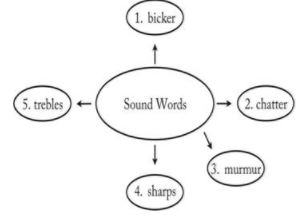
‘Bicker’ means a noisy discussion or an argument. The poet uses the word ‘bicker’ to describe the noisy flow of the brook as it flows through the valley as it sounds like quarrel.
(c) How many hills and bridges does it pass during is journey?
Answer
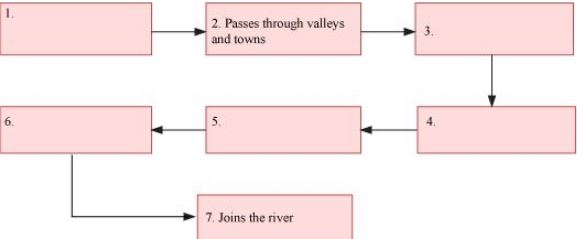
The brook passes thirty hills and fifty bridges during its journey.
(d) Where does it finally meet the river?
Answer
The brook finally meets the river near Phillip’s farm.
(e) Why has the word ‘chatter’ been repeated in the poem?
Answer
The word ‘chatter’ has been repeated in the poem because it represents the sound frequently made by the flowing brook. It seems that the brook talks about its journey that it has travelled throughout in a lively mood.
(f) With many a curve my banks I fret’- What does the poet mean by this statement?
Answer
The brook becomes tired occasionally as it has to curve and move round and round, again and again.
(g) ‘I wind about, and in and out.' What kind of a picture does this line create in your mind?
Answer
The brook does not flow in a straight line but veers and twists itself along its way. It creates a picture of flowing waters of the brook resembling a maze or whirlpool.
(h) Name the different things that can be found floating in the brook.
Answer
The different things that can be found floating in the river are pumice, flowers, wood chips, foamy flakes, bark of trees, twigs and leaves.
(i) What does the poet want to convey by using the words ‘steal’ and ‘slide’?
Answer
By using the words ‘steal’ and ‘slide’, the poet refers to smooth and noiseless movement of the brook.
(j) The poem has many examples of alliteration. List five examples.
Answer
Five examples of alliteration in the poem are:
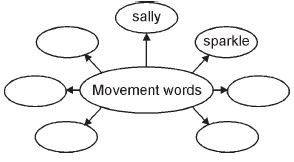
‘Sudden sally’
‘Field and fallow’
‘Willow-weed’
‘Golden gravel’
‘Slip, slide’
(k) ‘I make the netted sunbeam dance.’ What does ‘the netted sunbeam’ mean? How does it dance?
Answer
The sunrays filtering through the leaves and bushes make a net-like pattern on shallow water-pools. They are reflected on the surface of water and appear to be dancing as the water flows.
(l) What is the ‘refrain’ in the poem? What effect does it create?
Answer
In the referred poem, the refrain is:
‘For men may come and men may go
But I go on for ever.’
The repetition of the refrain emphasises the transitory nature of man and the eternal nature of the brook.
8. Read the given lines and answer the questions
I chatter, chatter, as I flow
To join the brimming river,
For men may come and men may go,
But I go on for ever.
(a) Who does ‘I’ refer to in the given lines?
(b) How does it 'chatter'?
(c) Why has the poet used the word 'brimming'? What kind of a picture does it create?
(d) Explain the last two lines of the stanza.
Answer
(a) ‘I’ refers to the brook in the given lines.
(b) The brook chatters by flowing over the pebbles making a lot of meaningless noise.
(c) ‘Brimming’ means full to the brim or top. It creates an impression on our mind of the picture of a big river in flood.
Answer
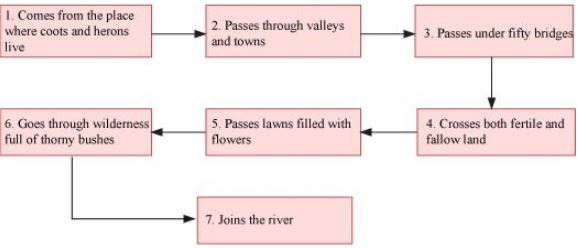
The first vivid image created by the poet is that
of the brook flowing through hills and valleys, under the
bridges and by the villages.
By thirty hills I hurry down
Or slip between the ridges
By twenty thorpes, a little town,
And half a hundred bridges.
The second striking image is that of serpent. Like flow of the brook, with flowers and fish floating on it. This image is most appealing because it is apt, colourful and poetic.
11. The brook appears to be a symbol for life. Pick out examples of parallelism between life and the brook.
Answer
The brook appears to be a symbol for life, which becomes the central theme of the poem. Various instances that can be seen in the poem which draw parallel between brook and life. The brook is a small stream that is born in somemountain. It grows bigger and stronger in the course of its journey. It makes so many types of sounds as it flows through the pebbles. Its movements are also varied. It slips and slides; it steals and winds its curves and flows. It chatters and babbles, it makes musical as well as harsh sounds. The brook’s birth and growth, chattering and babbling are very much similar to the activities of a human being. The brook represents life in general. Both have an origin, a middle stage and an end. Both struggle against various adversities, odds and keep moving towards their goal. Above all, the brook represents life. Men may come and men may go, but life goes on forever. The same rule applies in the case of the brook. It keeps flowing eternally, like life.
Free study material for English
English Class 9 Curriculum Solutions: Chapter 06 The Brook
Accessing Chapter 06 The Brook Solutions
Explore reliable textbook solutions for Chapter 06 The Brook tailored for Class 9 learners. Utilizing these complete exercise answers ensures your preparation aligns exactly with official NCERT standards for English.
Concept-Driven Answers for Class 9 English
Clear, methodical explanations accompany every challenging problem within the Class 9 English text. Engaging with these detailed answers lays a solid foundation for advanced learning and improves foundational clarity for upcoming assessments.
Maximizing Study Efficiency
These resources act as an effective roadmap for daily homework tasks and independent study. Supplement your review of Chapter 06 The Brook with official sample papers and interactive practice tests available on our platform free of charge.
FAQs
The complete and updated NCERT Solutions Class 9 English Chapter 6 The Brook is available for free on StudiesToday.com. These solutions for Class 9 English are as per latest NCERT curriculum.
Yes, our experts have revised the NCERT Solutions Class 9 English Chapter 6 The Brook as per 2026 exam pattern. All textbook exercises have been solved and have added explanation about how the English concepts are applied in case-study and assertion-reasoning questions.
Toppers recommend using NCERT language because NCERT marking schemes are strictly based on textbook definitions. Our NCERT Solutions Class 9 English Chapter 6 The Brook will help students to get full marks in the theory paper.
Yes, we provide bilingual support for Class 9 English. You can access NCERT Solutions Class 9 English Chapter 6 The Brook in both English and Hindi medium.
Yes, you can download the entire NCERT Solutions Class 9 English Chapter 6 The Brook in printable PDF format for offline study on any device.