

Here is CBSE Class 4 Maths HCF and LCM HOTs for your advanced practice. Find detailed High Order Thinking Skills (HOTS) questions and solutions for Class 4 Mathematics HCF and LCM. Built for the 2026-27 exam session, these expert-tested questions sharpen your problem-solving skills according to standard CBSE, NCERT, and KVS rules.
Download Class 4 Mathematics HCF and LCM HOTS Practice
Want to boost your grades in Mathematics? Solving Class 4 Mathematics HOTS Questions is a great way to build strong logic. Review the step-by-step answers below to increase your speed and feel fully ready for your Class 4 exams.
HCF and LCM HOTS Solutions for Class 4 Mathematics
HOTS
1. What is the smallest number of 5-digits which is exactly divisible by 12, 24 and 60?
Answer: LCM of 12, 24 and 60 = 120.
Smallest 5-digit multiple of 120 is 10,000.
2. I am organising a BBQ. I am trying to avoid any leftovers. Sausages come in packets of 8. Rolls come in packets of 12. Packets of sausages and rolls cannot be split in the shop. What is the fewest number of packets of sausages that I can buy so that each sausage has a roll?
Answer: LCM of 8 and 12 is 24.
To get 24 sausages (24÷8=3)
I need 3 packets.
SUMMARY
1. 2 is the smallest and the only even prime number. 4 is the smallest composite number.
2. Number 1 is neither a prime nor a composite number. It is called a unique number.
3. The HCF of two co-prime numbers is 1 and LCM is their product.
4. The HCF of two or more numbers, is the greatest number that divides the numbers evenly.
5. The LCM of two or more numbers, is the smallest non-zero number that is a multiple of both.
6. If one number is the factor of another number, then HCF is the smaller number, LCM is the larger number.
ERROR ANALYSIS
1. Students tend to make mistakes while writing multiples.
2. Students tend to get confused in finding HCF and LCM of co-prime numbers.
ACTIVITY I
This grid shows the highest common factor of each pair of numbers. Can you complete it? 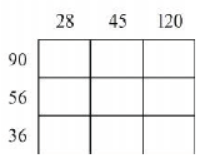
HCF Buckets
2 buckets / bowls can be placed, with following numbers in each respectively. 
Make 2 teams
• One player from each team picks up a number from separate bowls.
• Teacher asks them to show the numbers and find the HCF of two numbers.
• The player in each team tries to be the first.
• The first person to correctly answer the HCF gets 5 points for their team.
• Repeat the same with other team members.
ACTIVITY III
Answer each of the following questions. Match the letter next to each answer to the corresponding space below to answer the following riddle.
What do you call a bear with no teeth?
1. What is the HCF of 8 and 24? M ____________________
2. What is the LCM of 7 and 5? B ____________________
3. What is the LCM of 9 and 15? Y ____________________
4. What is the HCF of 33 and 44? R ____________________
5. What is the HCF of 6 and 27? G ____________________
6. What is the LCM of 6 and 14? A ____________________
7. What is the HCF of 12 and 18? M ____________________
8. What is the LCM of 9 and 12? E ____________________
9. What is the LCM of 11 and 4? U ____________________
10. What is the HCF of 15 and 25? A ____________________
____ ____ ____ ____ ____ ____ ____ ____ ____ ____
42 3 44 8 6 45 35 36 5 11
ACTIVITY IV
To find LCM of two or three numbers say 21, 6 and 7.
Material required :Grid sheet and colour pencils.
Method :On a grid sheet or a number grid, circle the multiples of 21 in red, the multiples of 6 in blue and the multiples of 7 in green colour.
The first number which is circled by all the three colours is the LCM of 21, 6 and 7.
ACTIVITY V
Can be used for recapitulation
Write all the numbers from 2 to 100 on cards and put in a box. Call two students. One student picks up a card.
The student will get as many points as the number. His partner writes all the factors of the number on the board and he will get as many points as the sum of all factors.
Note 1 : Do not include 1 and the number itself as factors.
Example : If the boy picks up 10, he gets 10 points. His partner gets 7 points. ( factors of 10 are
2 and 5). Thus, 2+5=7.
Note 2 : If a number is picked, that card is to be kept aside. Same number cannot be used again.
Note 3 : If a student forgets a factor, 2 points will be deducted from his total score as penalty.
So, this team of 2 scores (10+7) 17 points. Now comes another pair of students to repeat the same with different numbers.
ACTIVITY VI
Number Patterns
(Multiples)
In the first circle, multiples of three are arranged around the circumference. Start from 0 and join with scale to 3, then from 3 to 6, then from 6 to 9 and so on. In the end join back to 0. You will end up with a pattern. Do the same with other circles. 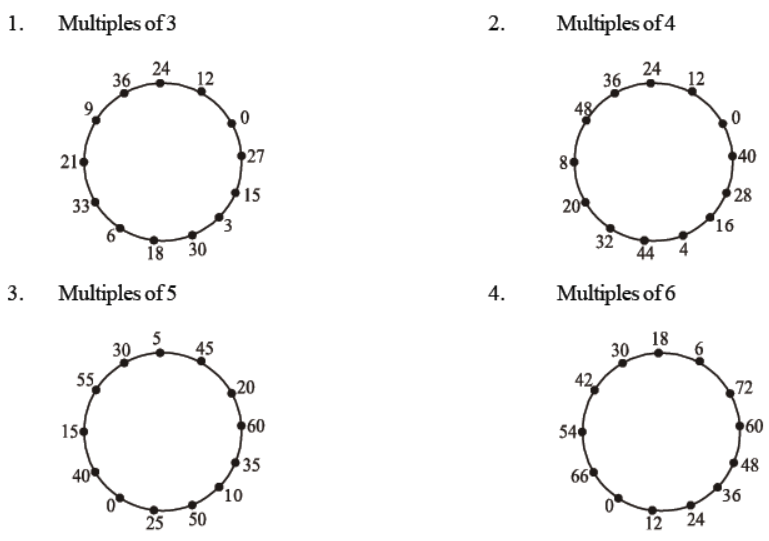
Free study material for Mathematics
Advanced HOTS Questions with Solutions: Class 4 Mathematics HCF and LCM
High Order Thinking Skills: HCF and LCM Overview
Download high-level analytical questions for HCF and LCM. Designed in alignment with the latest CBSE syllabus for Class 4 Mathematics, these problem sets test deep conceptual understanding and prepare students for complex exam questions.
Verified Solutions for Better Concept Clarity
All analytical exercises for HCF and LCM are structured around standard CBSE textbooks. Cross-reference your answers with our professional step-by-step guides to ensure complete conceptual accuracy.
Additional Revision and Practice Tests
To reinforce your revision after completing these HOTS, try our online Mathematics MCQ test for Class 4. All learning materials on our platform are completely free and updated for the current academic session.
FAQs
You can download the teacher-verified PDF for CBSE Class 4 Maths HCF and LCM HOTs from StudiesToday.com. These questions have been prepared for Class 4 Mathematics to help students learn high-level application and analytical skills required for the 2026-27 exams.
In the 2026 pattern, 50% of the marks are for competency-based questions. Our CBSE Class 4 Maths HCF and LCM HOTs are to apply basic theory to real-world to help Class 4 students to solve case studies and assertion-reasoning questions in Mathematics.
Unlike direct questions that test memory, CBSE Class 4 Maths HCF and LCM HOTs require out-of-the-box thinking as Class 4 Mathematics HOTS questions focus on understanding data and identifying logical errors.
After reading all conceots in Mathematics, practice CBSE Class 4 Maths HCF and LCM HOTs by breaking down the problem into smaller logical steps.
Yes, we provide detailed, step-by-step solutions for CBSE Class 4 Maths HCF and LCM HOTs. These solutions highlight the analytical reasoning and logical steps to help students prepare as per CBSE marking scheme.