CBSE Class 8 English Reported Speech Narration Direct to Indirect Notes

Download the latest CBSE Class 8 English Reported Speech Narration Direct to Indirect Notes in PDF format. These Class 8 English revision notes are carefully designed by expert teachers to align with the 2025-26 syllabus. These notes are great daily learning and last minute exam preparation and they simplify complex topics and highlight important definitions for Class 8 students.

Chapter-wise Revision Notes for Class 8 English Reported Speech Narration Direct to Indirect

To secure a higher rank, students should use these Class 8 English Reported Speech Narration Direct to Indirect notes for quick learning of important concepts. These exam-oriented summaries focus on difficult topics and high-weightage sections helpful in school tests and final examinations.

Reported Speech Narration Direct to Indirect Revision Notes for Class 8 English

Reported Speech/Narration/Direct to Indirect
INTRODUCTION:-
Direct speech is also known as reported speech. In grammar,when we report someone else’s statement in our own words without any change in the meaning of the statement, it is called indirect speech. Quoting a person’s words without using his own word and bringing about any change in the meaning of the statement is a reported speech. Look at the following sentences:
CBSE Class 8 English Reported Speech Narration Direct to Indirect Notes
Direct Speech: She says, “I am a little bit nervous.”
 
Indirect Speech: She says that she is a little bit nervous.
 
In the first sentence, the reporter conveys the message of the girl using her actual words (e.g., “I am a little bit nervous.”) In the second sentence, the reporter conveys her message but in his own words without any change in the meaning. Thus, both direct and indirect speeches are two different ways of reporting a statement of person. In simple words, quoting a person using your own words is called an indirect speech.
 
Key Terminology
During the process, you will come across many important terms that you need to know better so that you can convert any direct speech into indirect speech easily and without any hassle. Consider the following sentences:
 
Direct Speech: She says, “I am a little bit nervous.”
 
Indirect Speech: She says that she is a little bit nervous.
 
Now consider the different grammatical aspects of both.
 
Reporting Speech: The first part in the direct speech is called reporting speech.
 
Reported Speech: The second part of the sentence, which is closed in inverted commas or quotation marks, is called reported speech.
 
Reporting Verb: The verb of the reporting speech is called the reporting verb.
 
Reported Verb: The verb of the reported speech is called the reported verb.
 
BASIC RULES:-

a) Changes in Person of Pronouns:

• 1st Person pronouns in reported speech are always changed according to the subject of the reporting speech.
 
• 2nd Person pronouns in reported speech are always changed according to the object of the reporting speech.
 
• 3rd Person pronouns in reported speech are not changed.
 
b) Changes in Verbs:
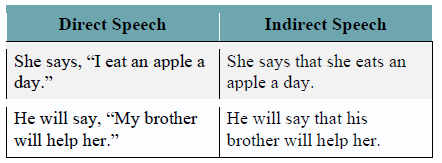
• If the reporting speech is in present tense or future tense, then no change is required to be made in the verb of reported speech. This verb could be in any tense i.e., present, past, or future. For example:
 
Direct Speech: He says, “I am ill.”
 
Indirect Speech: He says that he is ill.
 
Direct Speech: She says, “She sang a song.”
 
Indirect Speech: She says that she sang a song.
 
Direct Speech: You say, “I shall visit London.”
 
Indirect Speech: You say that you will visit London.
 
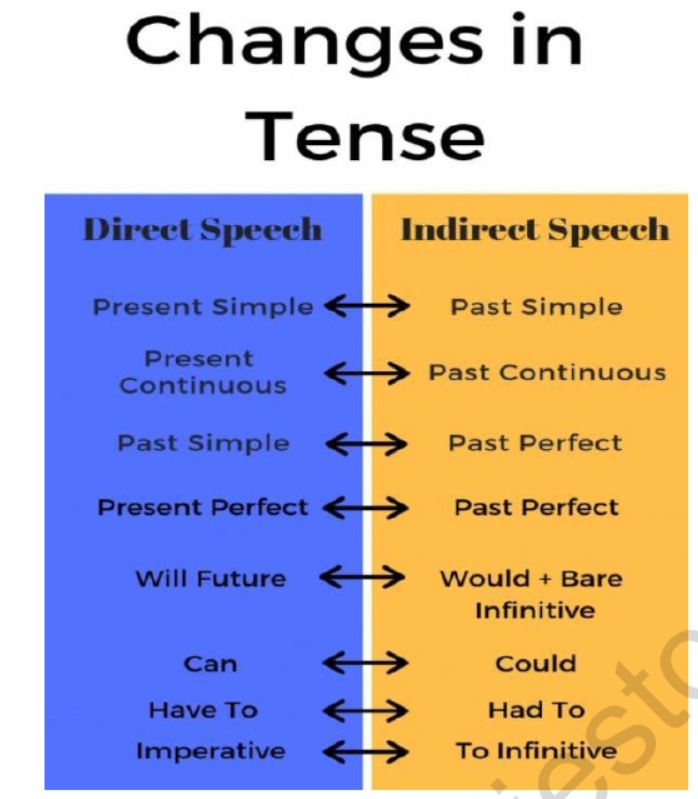
• If the reporting verb is in past tense, then reported verb will be changed as per the following criterion:
 
• Present indefinite tense is changed into past indefinite tense. For example:
 
Direct Speech: They said, “They take exercise every day.”
 
Indirect Speech: They said that they took exercise every day.
 
• Present continuous is changed into past continuous tense.
 
Direct Speech: They said, “They are taking exercise every day.”
 
Indirect Speech: They said that they were taking exercise every day.
 
• Present perfect is changed into the past perfect tense.
 
Direct Speech: They said, “They have taken exercise.”
 
Indirect Speech: They said that they had taken exercise.
 
• Present perfect continuous tense is changed into past perfect continuous tense.
 
Direct Speech: They said, “They have been taking exercise since morning.”
 
Indirect Speech: They said that they had been taking exercise since morning.
 
• Past indefinite is changed into past perfect tense.
 
Direct Speech: They said, “They took exercise.”
 
Indirect Speech: They said that they had taken exercise.
 
• Past continuous tense is changed into past perfect continuous tense.
 
Direct Speech: They said, “They were taking exercise.”
 
Indirect Speech: They said that they had been taking exercise.
 
• No changes are required to be made into past perfect and past perfect continuous tenses.
 
Direct Speech: They said, “They had taken exercise.”
 
Indirect Speech: They said that they had taken exercise.
 
• In Future Tense, while no changes are made except shall and will are changed into would.
 
Direct Speech: They said, “They will take exercise.”
 
Indirect Speech: They said that they would take exercise
CBSE Class 8 English Reported Speech Narration Direct to Indirect Notes
CBSE Class 8 English Reported Speech Narration Direct to Indirect Notes_1

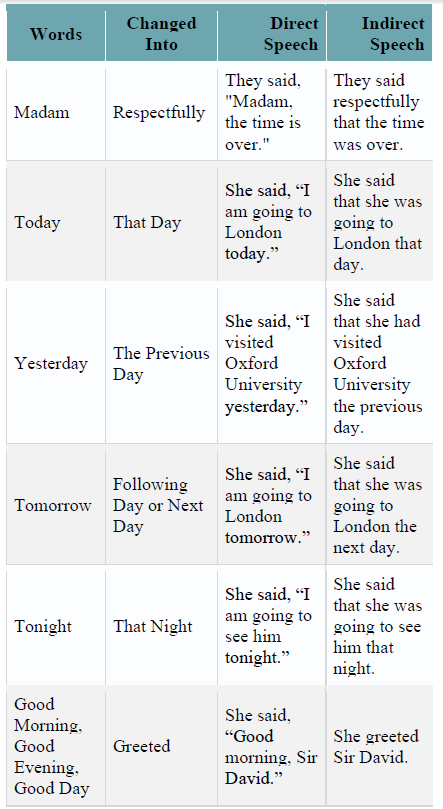
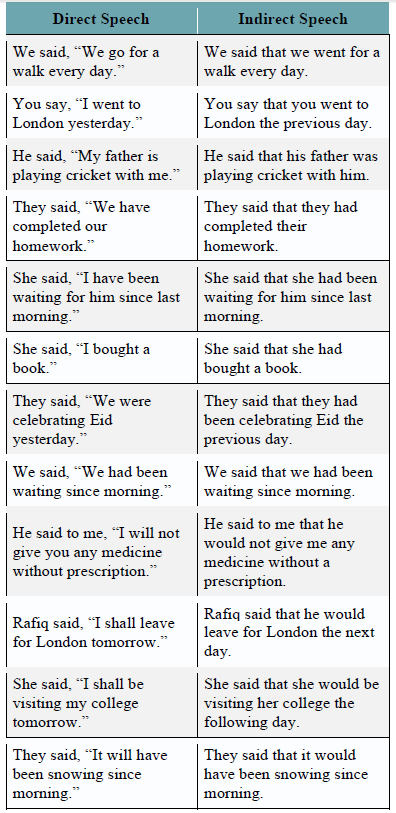
The rules above are mandatory for converting direct speech into indirect speech. Hence, they should be memorized thoroughly. The following examples cover all the aforementioned rules. So, focus on every sentence to know how the above-mentioned rules have been used here.

SOLVED EXAMPLES:-
CBSE Class 8 English Reported Speech Narration Direct to Indirect Notes_2

CBSE Class 8 English Reported Speech Narration Direct to Indirect Notes_3

Assertive Sentences

Sentences that make a statement are called assertive sentences. These sentences may be positive, negative, false, or true statements. To convert such sentences into indirect narration, use the rules as mentioned above except said is sometimes replaced with told. Look at the following examples:

• Direct Speech: She says, “I am writing a letter to my brother.”

Indirect Speech: She says that she is writing a letter to her brother.

• Direct Speech: She says, “I was not writing a letter to my brother.”

Indirect Speech: She says that she was not writing a letter to her brother.

• Direct Speech: She said to me, “I am writing a letter to my brother.”

Indirect SpeechShe told me that she was writing a letter to her brother.


Please click the link below to download CBSE Class 8 English Reported Speech Narration Direct to Indirect Notes.

CBSE Class 8 English Reported Speech Narration Direct to Indirect Notes

Students can use these Revision Notes for Reported Speech Narration Direct to Indirect to quickly understand all the main concepts. This study material has been prepared as per the latest CBSE syllabus for Class 8. Our teachers always suggest that Class 8 students read these notes regularly as they are focused on the most important topics that usually appear in school tests and final exams.

NCERT Based Reported Speech Narration Direct to Indirect Summary

Our expert team has used the official NCERT book for Class 8 English to design these notes. These are the notes that definitely you for your current academic year. After reading the chapter summary, you should also refer to our NCERT solutions for Class 8. Always compare your understanding with our teacher prepared answers as they will help you build a very strong base in English.

Reported Speech Narration Direct to Indirect Complete Revision and Practice

To prepare very well for y our exams, students should also solve the MCQ questions and practice worksheets provided on this page. These extra solved questions will help you to check if you have understood all the concepts of Reported Speech Narration Direct to Indirect. All study material on studiestoday.com is free and updated according to the latest English exam patterns. Using these revision notes daily will help you feel more confident and get better marks in your exams.

Where can I download the latest PDF for CBSE Class 8 English Reported Speech Narration Direct to Indirect Notes?

You can download the teacher prepared revision notes for CBSE Class 8 English Reported Speech Narration Direct to Indirect Notes from StudiesToday.com. These notes are designed as per 2025-26 academic session to help Class 8 students get the best study material for English.

Are these English notes for Class 8 based on the 2026 board exam pattern?

Yes, our CBSE Class 8 English Reported Speech Narration Direct to Indirect Notes include 50% competency-based questions with focus on core logic, keyword definitions, and the practical application of English principles which is important for getting more marks in 2026 CBSE exams.

Do these Class 8 notes cover all topic-wise concepts for English?

Yes, our CBSE Class 8 English Reported Speech Narration Direct to Indirect Notes provide a detailed, topic wise breakdown of the chapter. Fundamental definitions, complex numerical formulas and all topics of CBSE syllabus in Class 8 is covered.

How can I use CBSE Class 8 English Reported Speech Narration Direct to Indirect Notes for quick last-minute revision?

These notes for English are organized into bullet points and easy-to-read charts. By using CBSE Class 8 English Reported Speech Narration Direct to Indirect Notes, Class 8 students fast revise formulas, key definitions before the exams.

Is there any registration required to download Class 8 English notes?

No, all study resources on StudiesToday, including CBSE Class 8 English Reported Speech Narration Direct to Indirect Notes, are available for immediate free download. Class 8 English study material is available in PDF and can be downloaded on mobile.