

Official CBSE Assignments for Class 2 Mathematics
Explore structured practice materials through the CBSE Class 2 Mathematics Revision Assignment Set 01. Tailored for Class 2 learners, utilizing these Mathematics assignments ensures thorough preparation and strengthens foundational knowledge before final CBSE evaluations.
Solved Practice Assignments for Mathematics
View or download the dedicated CBSE Class 2 Mathematics Revision Assignment Set 01 resource below. Engaging with these assignments under focused study conditions ensures continuous academic progress and mastery of the 2026-27 curriculum.
Cardinal number Ordinal number Representation
11 Eleventh 11th
12 Twelfth 12th
13 Thirteenth 13th
14 Fourteenth 14th
15 Fifteenth 15th
16 Sixteenth 16th
17 Seventeenth 17th
18 Eighteenth 18th
19 Nineteenth 19th
20 Twentieth 20th
Fill in the blanks-:
a. January is the first month of the year.
b. Thursday is the fourth day of the week.
c. D is the fourth letter of English alphabet.
d. C is the first letter in CAT.
e. S is the third letter in NEST.
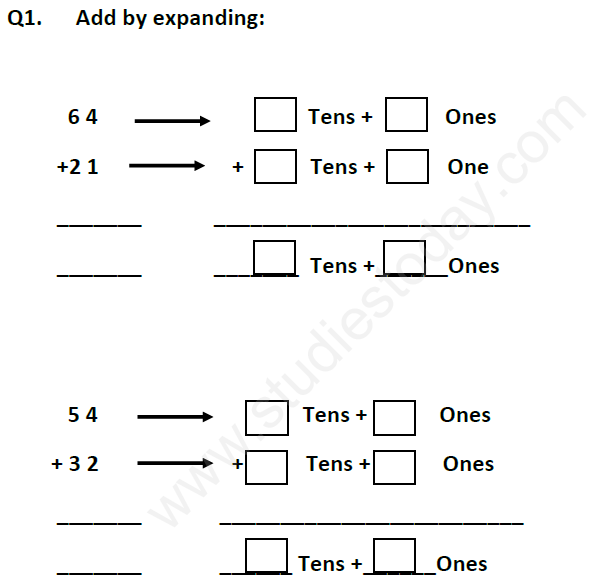
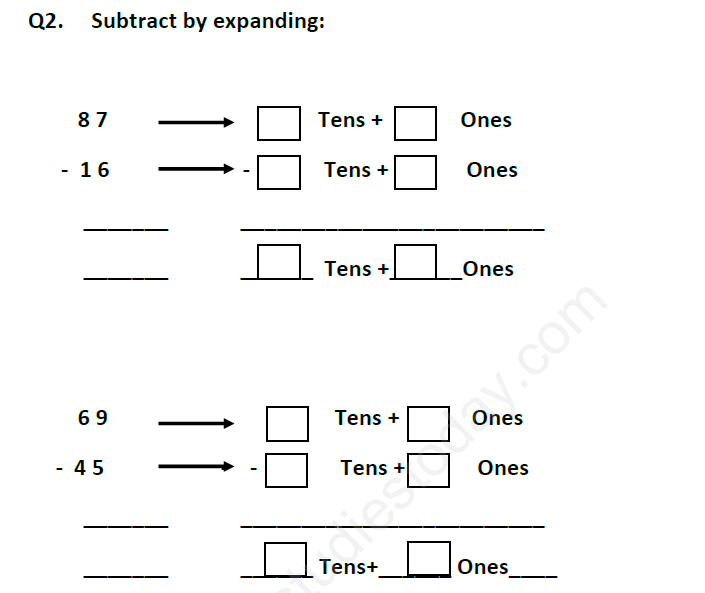
Fill in the blanks-:
a. _____________ numbers tell the number of objects in a list.
b. In the word SUCCESS the letter U is on _________number.
c. 7 + 8 = 8 + ______
d. 9 + _____ = 9
e. 21 – 9 = _______
f. Repeated addition is called ___________ .
g. 456 x 0 = ___________
h. 892 x 1 = ___________
i. Equal sharing is called ____________ .
j. 63 / 7 = ___________ .
k. ____________ is a part of a whole .
l. A quarter of 36 is __________ .
m. Half of 32 is _____________ .
n. 5 twenty rupee note will make __________ rupee.
o. 2 ten rupee note will make rupee __________ .
Measurement of Weight
Solve the following word problems-:
a. There is 25 kg 750 g of sugar in a sack. 18 kg 50 g is sold by the shopkeeper in a week. How much sugar is left in the sack?
Ans :
Amount of sugar left in the sack
b. Smitha’s mother is going to her grandmother’s house. She has two bags weighing 13 kg and 10 kg 200 g. What is the total weight of bags that her mother has to carry?
c. Ans
Total weight of bags that mother has to carry is
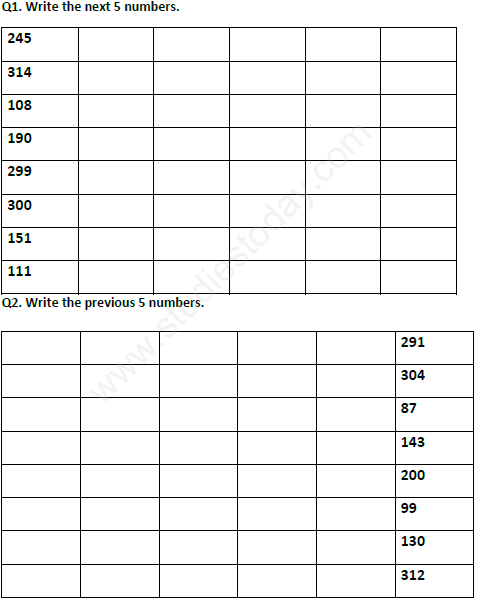
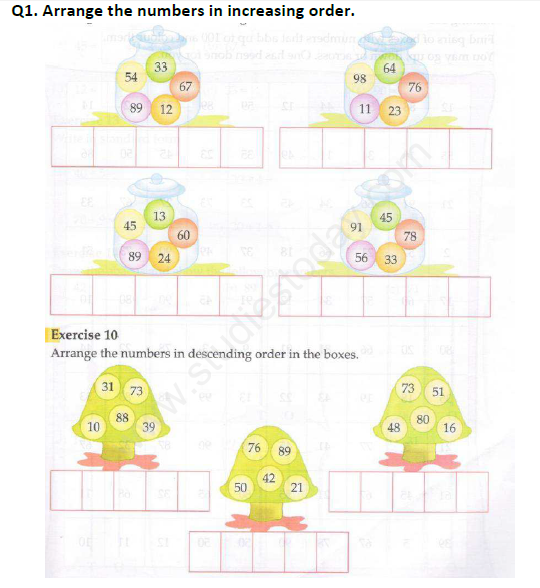
Q1. Write the multiplication facts for the following -:
a. 3 + 3+ 3+ 3+ 3+ 3 = ___________________
b. 5 + 5+ 5+ 5+5 = ___________________
c. 6+ 6+ 6 = ___________________
Q2. Write the division fact for the following-:
a. 6 x 4 = 24 ________________ ________________
b. 7 x 3 = 21 ________________ ________________
c. 9 x 2 = 18 ________________ ________________
Q3. Solve the following-:
a. 32/ 8= __________
b. 45 x 5 = __________
c. 60/10 = __________
d. 22 x 4 = __________
Q4. Solve the following word problems-:
a. It is Sonam’s birthday . she has given 2 toffees to 27 children. How many toffees has she distributed?
b. If 7 days make a week . How many weeks will be there in 63 days?
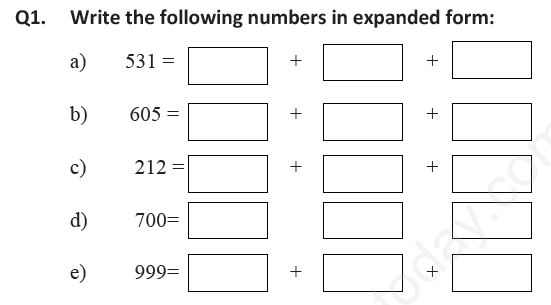
Q2. Write the following numbers in reduced form:
a) 400 + 40 + 9 = __________
b) 700 + 10 + 1 = __________
c) 900 + 00 + 0 = __________
d) 500 + 00 + 1 = __________
e) 200 + 20 + 2 = __________
Q3. Write the following numbers as even or odd:
a) 56 __________
b) 89 __________
c) 176 __________
d) 55 __________
e) 350 __________
f) 94 __________
g) 257 __________
h) 73 __________
Fill in the blanks :
a. ____________ is the first month of the year.
b. Thursday is the _________ day of the week.
c. D IS the __________ letter of English alphabet.
d. C is the ________ letter in word CAT.
e. ____________ is the third letter in NEST.
f. My rank in class first was ____________
g. The fourth letter in the word HONESTY IS _______
h. A number that says how many of something are there is called as ______________________ number.
i. Ordinal number is a number that tells a ____________ of a thing in a list
j. For the cardinal number 1 ,the ordinal number is ___________
k. I am the student of ____________ grade
l. Gandhi Jayanti is celebrated on ____________ of October.
m. Christmas is celebrated on _____________ month of the year.
n. August is the ____________ month of the year.
o. Eleventh month of the year is __________________ .
Arrange the numbers in descending order-: (bigger to smaller)
a. 68 , 86 , 74 , 42 , 11
Ans -: _______________________________
b. 50 , 64 , 70 , 11 ,9
Ans-: ________________________________
c. 46 , 29 , 38 , 12 , 4
Ans-: ________________________________
What comes before , after and between the following -:
a. ________ 8
b. 72 __________
c. 89 __________
d. ______ 11
e. _______ 40
f. 69 _________
g. 18 ______ 2
h. 30 ______ 32
i. 17 ______ 19
j. 7 __________
Solve the following word problems-:
a. A shopkeeper has 500 apples . 180 are rotten . How many apples are fresh?
Ans a.
b. In a class there are 75 boys and 55 girls .How many students are there in that class ?
Ans.
c. In a bus 150 passengers can sit. How many passengers can sit in 5 buses ?
Ans.
d. If 25 pencils are to be equally distributed among 5 boys.
How many pencil will each boy get?
Ans.
Periodic Test - 1
Course - Chapter 1 and 2
Chapter-1 (Numbers up to 200)
1. Write the number names of :
a. 101 - One hundred one
b. 114 - One hundred fourteen
c. 160 - One hundred sixty
d. 122 - One hundred twenty two
e. 148 - One hundred forty eight
Answer:
a. 101 - One hundred one
b. 114 - One hundred fourteen
c. 160 - One hundred sixty
d. 122 - One hundred twenty-two
e. 148 - One hundred forty-eight
In simple words: Write the spellings of the given numbers.
Exam Tip: Spellings like fourteen and forty must be written correctly without missing letters.
2. Write the numerals
a. One hundred fifty - 150
b. One hundred ninety-nine - 199
c. One hundred seventy-eight - 178
Answer:
a. One hundred fifty = 150
b. One hundred ninety-nine = 199
c. One hundred seventy-eight = 178
In simple words: Convert the number names into digits.
Exam Tip: Identify the hundreds, tens, and ones places carefully from the number name.
3. Write tables from 0 to 6
Answer:
Table of 0:
\(0 \times 1 = 0\)
\(0 \times 2 = 0\)
\(0 \times 3 = 0\)
\(0 \times 4 = 0\)
\(0 \times 5 = 0\)
\(0 \times 6 = 0\)
\(0 \times 7 = 0\)
\(0 \times 8 = 0\)
\(0 \times 9 = 0\)
\(0 \times 10 = 0\)
Table of 1:
\(1 \times 1 = 1\)
\(1 \times 2 = 2\)
\(1 \times 3 = 3\)
\(1 \times 4 = 4\)
\(1 \times 5 = 5\)
\(1 \times 6 = 6\)
\(1 \times 7 = 7\)
\(1 \times 8 = 8\)
\(1 \times 9 = 9\)
\(1 \times 10 = 10\)
Table of 2:
\(2 \times 1 = 2\)
\(2 \times 2 = 4\)
\(2 \times 3 = 6\)
\(2 \times 4 = 8\)
\(2 \times 5 = 10\)
\(2 \times 6 = 12\)
\(2 \times 7 = 14\)
\(2 \times 8 = 16\)
\(2 \times 9 = 18\)
\(2 \times 10 = 20\)
Table of 3:
\(3 \times 1 = 3\)
\(3 \times 2 = 6\)
\(3 \times 3 = 9\)
\(3 \times 4 = 12\)
\(3 \times 5 = 15\)
\(3 \times 6 = 18\)
\(3 \times 7 = 21\)
\(3 \times 8 = 24\)
\(3 \times 9 = 27\)
\(3 \times 10 = 30\)
Table of 4:
\(4 \times 1 = 4\)
\(4 \times 2 = 8\)
\(4 \times 3 = 12\)
\(4 \times 4 = 16\)
\(4 \times 5 = 20\)
\(4 \times 6 = 24\)
\(4 \times 7 = 28\)
\(4 \times 8 = 32\)
\(4 \times 9 = 36\)
\(4 \times 10 = 40\)
Table of 5:
\(5 \times 1 = 5\)
\(5 \times 2 = 10\)
\(5 \times 3 = 15\)
\(5 \times 4 = 20\)
\(5 \times 5 = 25\)
\(5 \times 6 = 30\)
\(5 \times 7 = 35\)
\(5 \times 8 = 40\)
\(5 \times 9 = 45\)
\(5 \times 10 = 50\)
Table of 6:
\(6 \times 1 = 6\)
\(6 \times 2 = 12\)
\(6 \times 3 = 18\)
\(6 \times 4 = 24\)
\(6 \times 5 = 30\)
\(6 \times 6 = 36\)
\(6 \times 7 = 42\)
\(6 \times 8 = 48\)
\(6 \times 9 = 54\)
\(6 \times 10 = 60\)
In simple words: Multiplication tables show repeated addition of numbers.
Exam Tip: Memorize tables thoroughly to solve multiplication problems quickly.
4. Mixed tables [0 to 6]
a. \(5 \times 0 =\) _
b. \(6 \times 3 =\) _
c. \(5 \times 5 =\) _
Answer:
a. \(5 \times 0 = 0\)
b. \(6 \times 3 = 18\)
c. \(5 \times 5 = 25\)
In simple words: Multiply the given numbers using tables.
Exam Tip: Any number multiplied by 0 always gives 0.
5. What comes before:
a. 199 : 200
b. 132 : 133
c. 112 : 113
Answer:
a. 198
b. 131
c. 111
In simple words: Find the number that comes immediately before the given number by subtracting 1.
Exam Tip: 'Before' means predecessor, which is obtained by subtracting 1.
6. What comes after:
a. 126 : 127
b. 169 : 170
c. 155 : 156
Answer:
a. 127
b. 170
c. 156
In simple words: Find the number that comes immediately after the given number by adding 1.
Exam Tip: 'After' means successor, which is obtained by adding 1.
7. What come between:
a. 159 _ 161
b. 183 _ 185
c. 138 _ 140
Answer:
a. 160
b. 184
c. 139
In simple words: Find the missing middle number.
Exam Tip: The middle number is one more than the first number and one less than the last number.
8. Represent the following numbers on the abacus:
a) 128
b) 105
Answer:
a) For 128: Draw 1 bead in the Hundreds (H) spike, 2 beads in the Tens (T) spike, and 8 beads in the Ones (O) spike.
b) For 105: Draw 1 bead in the Hundreds (H) spike, 0 beads in the Tens (T) spike, and 5 beads in the Ones (O) spike.
In simple words: Show the digits using beads on the abacus rods.
9. Expand the numbers in two ways:
a. 136 = 1 hundred + 4 tens + 6 ones (Note: 1 hundred + 3 tens + 6 ones)
100 + 40 + 6 (Note: 100 + 30 + 6)
b. 172 = 1 hundred + 7 tens + 2 ones
100 + 70 + 2
c. 148 = 1 hundred + 4 tens + 8 ones
100 + 40 + 8
Answer:
a. 136 = 1 hundred + 3 tens + 6 ones = \(100 + 30 + 6\)
b. 172 = 1 hundred + 7 tens + 2 ones = \(100 + 70 + 2\)
c. 148 = 1 hundred + 4 tens + 8 ones = \(100 + 40 + 8\)
In simple words: Write a number by splitting it into hundreds, tens, and ones.
Exam Tip: Always write both word expansion and number expansion forms.
10. Write the place value of each digit
a) 372
b) 184
Answer:
a) In 372:
Place value of 2 = 2 ones = 2
Place value of 7 = 7 tens = 70
Place value of 3 = 3 hundreds = 300
b) In 184:
Place value of 4 = 4 ones = 4
Place value of 8 = 8 tens = 80
Place value of 1 = 1 hundred = 100
In simple words: Place value tells the value of a digit based on its position in the number.
Exam Tip: Place value depends on the position of the digit (ones, tens, hundreds).
11. Write the place value and face value of the underlined digit
a) 163 - place value - 3, face value - 3
b) 192 - place value - 90, face value - 9
c) 158 - place value - 100, face value - 1
Answer:
a) 163 : Place value = 3, Face value = 3
b) 192 : Place value = 90, Face value = 9
c) 158 : Place value = 100, Face value = 1
In simple words: Face value is the digit itself, while place value is its value according to its position.
Exam Tip: Face value never changes regardless of the digit's position.
12. Put >, <, or = sign:
a) 68 < 143
b) 200 = 200
c) 133 < 162
d) 186 > 145
Answer:
a) \(68 < 143\)
b) \(200 = 200\)
c) \(133 < 162\)
d) \(186 > 145\)
In simple words: Compare two numbers to see which is greater, smaller, or equal.
Exam Tip: The open mouth of the sign always points towards the greater number.
13. Arrange in ascending order:
a) 163, 46, 128, 110
b) 125, 126, 120, 124
Answer:
a) 46, 110, 128, 163
b) 120, 124, 125, 126
In simple words: Arrange numbers from smallest to largest.
Exam Tip: Start by comparing the hundreds digit, then tens, then ones.
14. Arrange in descending order:
a) 149, 39, 129, 189
b) 123, 122, 131, 107
Answer:
a) 189, 149, 129, 39
b) 131, 123, 122, 107
In simple words: Arrange numbers from largest to smallest.
Exam Tip: Look for the biggest number first and place it at the beginning.
15. Form the smallest and largest number from given digits:
Digits | Smallest number | Largest number
a) 6, 3 | 36 | 63
b) 9, 0 | 09 (9) | 90
c) 6, 6 | 66 | 66
Answer:
a) Digits: 6, 3 -> Smallest: 36, Largest: 63
b) Digits: 9, 0 -> Smallest: 9, Largest: 90
c) Digits: 6, 6 -> Smallest: 66, Largest: 66
In simple words: For smallest number write smaller digit first (except 0). For largest write greater digit first.
Exam Tip: Never start a number with 0 when forming the smallest number if other digits are available.
16. Definition
a) Even numbers.
A number is even if it has 0, 2, 4, 6, 8 at ones place.
b) Odd numbers.
A number is odd if it has 1, 3, 5, 7 and 9 at ones place.
Answer:
a) Even numbers: Numbers that are completely divisible by 2, ending in 0, 2, 4, 6, or 8.
b) Odd numbers: Numbers that leave a remainder of 1 when divided by 2, ending in 1, 3, 5, 7, or 9.
In simple words: Even numbers can be paired up completely; odd numbers always leave one leftover.
Exam Tip: Always check the digit in the ones place to determine if a number is even or odd.
17. Choose and write the even numbers:
a) 90, 37, 56, 31
Ans: 90, 56
b) 22, 17, 31, 98
Ans: 22, 98
Answer:
a) 90, 56
b) 22, 98
In simple words: Select numbers ending in 0, 2, 4, 6, or 8.
Exam Tip: Ignore numbers ending with odd digits.
18. Choose and write the odd numbers:
a) 13, 16, 21, 28
Ans: 13, 21
b) 29, 16, 90, 81
Ans: 29, 81
Answer:
a) 13, 21
b) 29, 81
In simple words: Select numbers ending in 1, 3, 5, 7, or 9.
Exam Tip: Check the last digit of each number carefully.
19. a) skip counting in 2's
a) 12, 14, 16, 18, 20
b) 116, 118, 120, 122, 124
b) skip counting in 5's
a) 120, 135, 140, 145, 150 (Note: 125, 130, 135, 140, 145, 150)
b) 25, 30, 35, 40, 45
c) skip counting in 10's
a) 140, 150, 160, 170, 180
b) 30, 40, 50, 60, 70
Answer:
a) Skip counting in 2's: 12, 14, 16, 18, 20 and 116, 118, 120, 122, 124
b) Skip counting in 5's: 120, 125, 130, 135, 140, 145, 150 and 25, 30, 35, 40, 45
c) Skip counting in 10's: 140, 150, 160, 170, 180 and 30, 40, 50, 60, 70
In simple words: Add 2, 5, or 10 continuously to get the next numbers.
Exam Tip: Add the given skip number to the previous term to verify each step.
20. Write ordinal numbers from (1 to 10)
1 - First
2 - Second
3 - Third
4 - Fourth
5 - Fifth
6 - Sixth
7 - Seventh
8 - Eighth
9 - Ninth
10 - Tenth
Answer:
1 - First
2 - Second
3 - Third
4 - Fourth
5 - Fifth
6 - Sixth
7 - Seventh
8 - Eighth
9 - Ninth
10 - Tenth
In simple words: Ordinal numbers show position or order.
Exam Tip: Memorize spellings of ordinal numbers like eighth and ninth.
Chapter - 2 : Addition
I. Fill in the blanks
a. When we put things together we do addition
b. The sign of addition is +
c. Numbers that are added are called addends
d. The answer of addition is called the sum
e. \(7 + 0 = 7\)
f. \(9 + 1 = 10\)
g. \(8 + 2 = 2 + 8\)
Answer:
a. addition
b. +
c. addends
d. sum
e. 7
f. 10
g. 8
In simple words: Addition means combining quantities together.
Exam Tip: Changing the order of addends does not change the sum ( commutative property ).
II. Arrange and add
a) \(156 + 34\)
b) \(130 + 6\)
c) \(174 + 12\)
Answer:
a) \(156 + 34 = 190\)
b) \(130 + 6 = 136\)
c) \(174 + 12 = 186\)
In simple words: Align numbers by columns (ones, tens, hundreds) and add from right to left.
Exam Tip: Always align numbers properly from the ones column.
III. Arrange and add
a) \(1 + 6 + 3\)
b) \(1 + 7 + 4\)
c) \(2 + 5 + 5\)
d) \(3 + 6 + 4\)
e) \(12 + 23 + 12\)
f) \(15 + 31 + 42\)
Answer:
a) \(1 + 6 + 3 = 10\)
b) \(1 + 7 + 4 = 12\)
c) \(2 + 5 + 5 = 12\)
d) \(3 + 6 + 4 = 13\)
e) \(12 + 23 + 12 = 47\)
f) \(15 + 31 + 42 = 88\)
In simple words: Add three numbers together column by column.
IV. Word Problem
a) Rinky saw 56 birds on the tree and 12 birds on the ground. How many birds did she in all?
Answer:
Number of birds on the tree = 56
Number of birds on the ground = 12
Total number of birds = \(56 + 12 = 68\)
Ans: She saw 68 birds in all.
In simple words: Add the number of birds on the tree and on the ground to find the total.
Exam Tip: Always write proper statements for word problems.
Download Practice Assignments: Class 2 Mathematics All topics
Class 2 Mathematics All topics Printable Assignments
Review targeted chapter assignments for Class 2 Mathematics All topics. Built according to official CBSE guidelines, these downloadable problem sets help students build accuracy and prepare effectively for school tests.
Key Advantages of Solving All topics Assignments
- Exam Alignment: Questions strictly follow contemporary CBSE sample papers and grading schemes.
- Comprehensive Coverage: Features objective drills, case studies, and structured descriptive problems for All topics.
- Pacing & Precision: Regular problem-solving builds critical calculation speed and test-taking accuracy.
Steps to Complete All topics Assignments Successfully
- Initial Reading: Begin by reading the NCERT book for Class 2 Mathematics to build a baseline understanding.
- Independent Testing: Attempt assignment questions unassisted, then verify work using provided answer keys.
- Supplementary Aids: Leverage revision notes and worksheets whenever you encounter difficult topics.
FAQs
You can download free PDF assignments for Class 2 Mathematics All topics from StudiesToday.com. These practice sheets have been updated for the 2026-27 session covering all concepts from latest NCERT textbook.
Yes, our teachers have given solutions for all questions in the Class 2 Mathematics All topics assignments. This will help you to understand step-by-step methodology to get full marks in school tests and exams.
Yes. These assignments are designed as per the latest CBSE syllabus for 2026. We have included huge variety of question formats such as MCQs, Case-study based questions and important diagram-based problems found in All topics.
Practicing topicw wise assignments will help Class 2 students understand every sub-topic of All topics. Daily practice will improve speed, accuracy and answering competency-based questions.
Yes, all printable assignments for Class 2 Mathematics All topics are available for free download in mobile-friendly PDF format.