

Official CBSE Assignments for Class 4 Environmental Studies
Access comprehensive school assignments for All topics using the CBSE Class 4 EVS Assignment Set 01. Designed to align with the 2026-27 CBSE academic guidelines, these practice sets help Class 4 Environmental Studies students reinforce core concepts and improve their problem-solving accuracy.
Solved Practice Assignments for Environmental Studies
View or download the dedicated CBSE Class 4 EVS Assignment Set 01 resource below. Engaging with these assignments under focused study conditions ensures continuous academic progress and mastery of the 2026-27 curriculum.
Q.1 Tick the correct answer. (1x6=6)
i) The oxygen we take in helps to produce :
(a) food from water and carbon dioxide
(b) energy from food
Answer: (b) energy from food
Oxygen absorbed during respiration breaks down digested food to release energy for body activities.
In simple words: Oxygen helps release energy from the food we eat.
Exam Tip: Remember that respiration is the process where oxygen burns food to give energy.
ii) Air reaches your lungs through your :
(a) food pipe
(b) windpipe
Answer: (b) windpipe
The windpipe (trachea) connects the throat to the lungs, allowing air to pass through.
In simple words: Air travels down the windpipe to reach the lungs.
Exam Tip: Food pipe carries food to the stomach, while windpipe carries air to the lungs.
iii) If someone gets bitten by a snake, you should tie a piece of cloth firmly
(a) on the wound
(b) just above the wound
Answer: (b) just above the wound
Tying a cloth firmly just above the snake bite slows down the flow of venom towards the heart through blood vessels.
In simple words: Tie a band just above the bite to stop poison from spreading quickly.
Exam Tip: Never tie directly on the wound; tie it between the wound and the heart.
iv) Coffee is made from roasted
(a) seeds
(b) leaves
(c) fruit
Answer: (a) seeds
Coffee powder is made by roasting and grinding coffee beans, which are actually seeds of the coffee plant.
In simple words: Coffee comes from roasted coffee seeds.
Exam Tip: Tea is made from leaves, but coffee is made from seeds (beans).
v) Dry cleaners use this to clean clothes
(a) petrol
(b) naphthalene
(c) detergent
Answer: (a) petrol
Dry cleaners use special solvents like petrol or special liquids instead of water to clean delicate clothes without damaging them.
In simple words: Petrol is used in dry cleaning delicate garments.
Exam Tip: Do not confuse dry cleaning solvents with regular laundry detergents which require water.
vi) Multi-storeyed buildings are made to -
(a) get more air
(b) get more light
(c) save space
Answer: (c) save space
In crowded cities where land is limited, multi-storeyed buildings accommodate many families by building upwards instead of outwards.
In simple words: Tall buildings save ground space.
Exam Tip: Multi-storeyed buildings are common in cities due to shortage of land.
Q.2 Fill in the blanks. (1x6=6)
i) Water and carbondioxide change into __________ in the leaves.
Answer: food (or glucose / starch)
Plants use sunlight, water, and carbon dioxide to prepare their food through photosynthesis.
In simple words: Plants make food from water and carbon dioxide.
Exam Tip: Photosynthesis literally means making things with light.
ii) Different parts of your body move when your muscles __________.
Answer: contract (and relax)
Muscles are attached to bones and pull on them by contracting to cause movement.
In simple words: Muscles pull bones when they contract to create movement.
Exam Tip: Muscles can only pull; they cannot push.
iii) Fire cannot burn without __________.
Answer: oxygen (or air)
Oxygen supports combustion, making it an essential requirement for any fire to burn.
In simple words: Fire needs air or oxygen to keep burning.
Exam Tip: Fire triangle consists of fuel, heat, and oxygen.
iv) The main food that people eat is called __________ food.
Answer: staple
Staple food forms the basis of the daily diet in a particular region, such as rice or wheat.
In simple words: Our primary daily food is called staple food.
v) __________ are the people who move from place to place.
Answer: Nomads
Nomads do not have a permanent home and travel continuously in search of food, water, or pasture for animals.
In simple words: Nomads travel from place to place instead of settling down.
Exam Tip: Nomads often live in tents or temporary shelters.
vi) When something expands, it becomes __________.
Answer: bigger (or larger / expands in size)
Heating causes substances to expand, increasing their volume or size.
In simple words: Expansion makes objects increase in size.
Exam Tip: Opposite of expansion is contraction (becoming smaller).
Q.3 Write 'True' or 'False' against each statement. (1x6=6)
i) Your brain does not do any work when you sleep.
Answer: False
The brain remains active during sleep, controlling breathing, heartbeat, and processing memories.
In simple words: The brain works even while we are sleeping.
Exam Tip: Vital organs like the heart, lungs, and brain never rest.
ii) Exercise tires your muscles and makes them weak.
Answer: False
Regular exercise makes muscles strong and keeps the body fit, rather than making them weak.
In simple words: Exercise makes muscles strong, not weak.
Exam Tip: Proper exercise improves stamina and muscle tone.
iii) In places where there are earthquakes, people build strong houses with stones.
Answer: False
In earthquake-prone zones, people prefer lightweight houses made of wood or bamboo because heavy stone houses can collapse easily during tremors.
In simple words: Heavy stone houses are dangerous during earthquakes; light wood or bamboo houses are preferred.
Exam Tip: Earthquake-resistant structures are designed to be flexible and lightweight.
iv) Concrete is used to join wood.
Answer: False
Concrete is used in making roofs, floors, and heavy foundations, whereas nails, screws, and glue are used to join wood.
In simple words: Concrete is used for buildings and roads, not for joining wood.
Exam Tip: Adhesives and nails join wood pieces together.
v) Cold air moves downwards.
Answer: True
Cold air is heavier than warm air, so it sinks or moves downwards.
In simple words: Cold air is heavy and sinks down.
Exam Tip: Warm air rises up because it is lighter.
vi) Your liver helps in breathing.
Answer: False
Breathing is controlled by the respiratory system organs like the nose, windpipe, and lungs, along with the diaphragm.
In simple words: Lungs help in breathing, not the liver.
Exam Tip: The liver is a digestive gland that produces bile, not a respiratory organ.
Q.4 Answer in one word. (1x6=6)
i) What is the green substance in leaves called?
Answer: Chlorophyll
Chlorophyll is the green pigment present in leaves that traps sunlight for making food.
In simple words: Chlorophyll makes leaves green and traps sunlight.
Exam Tip: Chlorophyll is essential for photosynthesis.
ii) Which is the biggest organ in our body?
Answer: Skin
The skin covers the entire external surface of the human body, making it the largest organ.
In simple words: Skin is the largest organ covering our body.
iii) What are the holes in our teeth called? cavities
Answer: Cavities (or Tooth decay)
Cavities are structural damages or holes caused by bacterial action on food particles stuck in teeth.
In simple words: Holes in teeth are called cavities.
Exam Tip: Regular brushing prevents cavities.
iv) What are the tiny plants that grow on damp clothes called?
Answer: Fungus (or Mildew / Mould)
Fungi grow rapidly in damp, dark, and warm places like wet clothes left unwashed or stored improperly.
In simple words: Mould or fungus grows on damp clothes.
Exam Tip: Drying clothes thoroughly prevents fungal growth.
v) What is the art of building called?
Answer: Architecture
Architecture is the art and science of designing and constructing buildings and structures.
In simple words: Architecture is the science of building design.
Exam Tip: An architect plans and designs houses and buildings.
vi) Which gas helps things burn?
Answer: Oxygen
Oxygen is a supporter of combustion, which means it is necessary for any fire to burn.
In simple words: Oxygen helps fires burn.
Exam Tip: Carbon dioxide is used to put out fires, while oxygen helps them burn.
Q.5 Give two examples for each of the following. (7x2=14)
i) Human body waste.
Answer: Sweat, Urine
Human body produces waste materials that need regular removal through excretion.
In simple words: Urine and sweat are human body wastes.
Exam Tip: Kidneys remove urine, and skin removes sweat.
ii) Blood carrying tubes.
Answer: Arteries, Veins
Blood vessels form a network of tubes that circulate blood throughout the body.
In simple words: Arteries and veins carry blood.
Exam Tip: Arteries carry oxygenated blood away from the heart, and veins carry deoxygenated blood back to the heart.
iii) Cereals
Answer: Wheat, Rice
Cereals are grass-cultivated grains used widely as food sources.
In simple words: Wheat and rice are common cereals.
iv) Underground stems that we eat as vegetable.
Answer: Potato, Ginger
Some plants store food in their underground stems instead of roots.
In simple words: Potato and ginger are underground stems we eat.
Exam Tip: Potatoes have buds (eyes) which prove they are stems, not roots.
v) Natural fibres
Answer: Cotton, Wool
Natural fibres are obtained directly from plants or animals.
In simple words: Cotton from plants and wool from sheep are natural fibres.
Exam Tip: Silk and jute are also natural fibres.
vi) Things used to protect stored clothes from insects.
Answer: Naphthalene balls, Dried neem leaves
These substances repel moths and insects that damage woolen and cotton clothes.
In simple words: Naphthalene balls and dried neem leaves keep insects away from clothes.
Exam Tip: Keeping clothes clean and dry also prevents insect damage.
vii) Things used to make concrete.
Answer: Cement, Sand (along with gravel and water)
Concrete is a heavy building mixture made by binding aggregates together.
In simple words: Cement and sand are mixed with gravel and water to make concrete.
Exam Tip: Concrete hardens over time and provides immense strength to structures.
Q.6 Match the following. (6)
Answer:
i) The gas plants use to make food - Carbon dioxide
ii) A plant waste that is useful to us - Rubber
iii) Pulses, eggs, meat - help you grow
iv) Colouring fabric or yarn - Dyeing
v) Making yarn from fibres - Spinning
vi) Houses on stilts - Places which get flooded very often
In simple words: Correctly pairing plants, food types, textiles, and housing types with their matching descriptions.
Exam Tip: Read both columns carefully before matching to avoid errors.
Q.7 Give answer in 1-2 lines. (2x8=16)
i) The air you breathe in has many gases. Which of these are used up inside your body?
Answer: Oxygen is the main gas used up inside our body during respiration to release energy from food.
In simple words: Our body consumes oxygen from the air we breathe.
Exam Tip: Nitrogen and other gases are exhaled back out unchanged.
ii) What are organs?
Answer: Organs are specialized parts of the body made up of different tissues that perform specific vital functions.
In simple words: Organs are body parts like the heart, lungs, and stomach that perform specific jobs.
iii) Name any two sense organs.
Answer: Eyes and ears (or nose, tongue, skin).
In simple words: Eyes and ears are sense organs.
Exam Tip: Humans have five main sense organs.
iv) What is the first thing you should do with a burn?
Answer: Wash the burnt area with plenty of cold water immediately to cool down the skin and reduce pain.
In simple words: Pour cold water on a burn immediately.
Exam Tip: Never apply greasy ointments or ice directly to fresh burns.
v) What is a dairy?
Answer: A dairy is a place where milk-producing animals are kept and milk or milk products are processed and sold.
In simple words: A dairy is a farm or place for milk production and processing.
Exam Tip: Butter, cheese, and curd are dairy products.
vi) How is yarn made?
Answer: Yarn is made by twisting loose fibres together in a process called spinning.
In simple words: Spinning loose fibres together creates yarn.
Exam Tip: Spinning can be done manually using a charkha or on industrial machines.
vii) What is the best way of ventilating a house?
Answer: Having enough opposite windows and doors allows cross-ventilation, letting fresh air in and stale air out.
In simple words: Proper windows and doors on opposite sides ensure good cross-ventilation.
Exam Tip: Good ventilation keeps rooms fresh and healthy.
viii) What does our body need oxygen for?
Answer: Our body needs oxygen to break down digested food and release energy required for various life activities.
In simple words: Oxygen helps release energy from food inside our body.
Exam Tip: Without oxygen, cells cannot produce energy.
Q.8 Answer in 4-5 lines. (attempt any four) (4x4=16)
i) What do veins and arteries do?
Answer: Arteries and veins are blood vessels that transport blood throughout the body. Arteries carry oxygen-rich blood away from the heart to all body parts. Veins carry carbon dioxide-rich blood from body parts back to the heart. Together, they maintain continuous blood circulation.
In simple words: Arteries carry clean blood from the heart, and veins carry used blood back to the heart.
Exam Tip: Remember: Arteries start with 'A' (Away from heart).
ii) What makes holes in your teeth if you do not brush your teeth regularly?
Answer: When we eat, tiny food particles get stuck between our teeth. If we do not brush regularly, bacteria feed on these leftover food particles and produce acids. These acids gradually eat away the hard outer enamel of the teeth, forming holes or cavities.
In simple words: Bacteria feed on leftover food and produce acid that creates holes in teeth.
Exam Tip: Brush twice daily and rinse after eating to prevent tooth decay.
iii) Write the steps you will take to help a person who is choking.
Answer: 1. Stand behind the person and wrap your arms around their waist. 2. Make a fist with one hand and place it just above their navel. 3. Grasp your fist with your other hand. 4. Press hard into the abdomen with quick upward thrusts to dislodge the trapped object.
In simple words: Give sharp upward abdominal thrusts from behind to force out the blocked food.
iv) Write any four things that a good house should have.
Answer: 1. Proper ventilation with adequate windows and doors for fresh air and sunlight. 2. A clean and hygienic water supply and proper drainage system. 3. Wire netting on windows to keep flies and mosquitoes out. 4. Sufficient open space like a courtyard or balcony.
In simple words: A good house needs sunlight, fresh air, clean water, and proper cleanliness.
Exam Tip: Sunlight is a natural disinfectant that kills germs.
v) Why does the oxygen of the air not get over though all living beings use it?
Answer: Oxygen does not get exhausted because plants constantly replenish it in the atmosphere. During photosynthesis, green plants take in carbon dioxide and release oxygen as a byproduct. This natural cycle maintains the balance of oxygen and carbon dioxide in nature.
In simple words: Plants release fresh oxygen during photosynthesis, keeping the supply constant.
Q.9 Value based question. (2x2=4)
Rahul and his mother went to a party. Rahul was very happy to see all his favourite food served there. He took lots of food in his plate. When his mother saw this, she told Rahul that he should take only that much food which he can eat and also he should avoid overeating as overeating can cause indigestion. She explained to him that we should not waste food as farmers do lot of hard work to grow crops.
i) Why should we avoid overeating?
Answer: We should avoid overeating because it overworks our digestive system, leading to indigestion, stomach pain, and discomfort.
In simple words: Overeating causes indigestion and stomach aches.
Exam Tip: Eat only as much as your body requires to stay healthy.
ii) What value have you learnt from the paragraph?
Answer: We have learnt the values of not wasting food, respecting the hard work of farmers, and practicing healthy eating habits.
In simple words: We should never waste food and should respect farmers.
Exam Tip: Conserving food is crucial for a sustainable society.
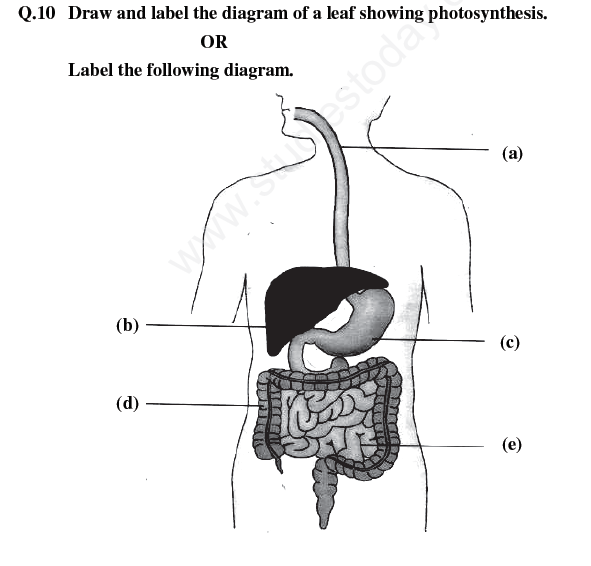
Q.10 Draw and label photosynthesis shown by a leaf. OR Label the diagram.
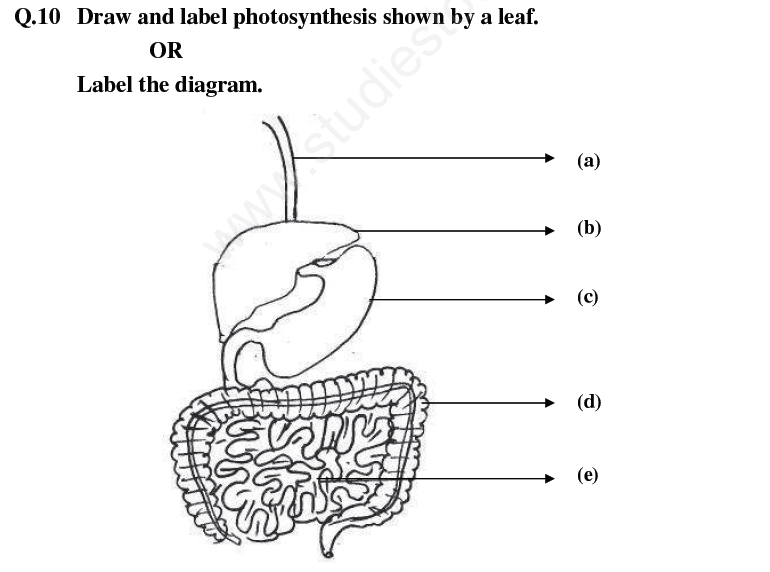
Answer:
(a) Esophagus (Food pipe)
(b) Stomach
(c) Liver
(d) Small intestine
(e) Large intestine
In simple words: Labeling the main parts of the human digestive system.
Exam Tip: Memorize the order of organs in the digestive tract from mouth to anus.
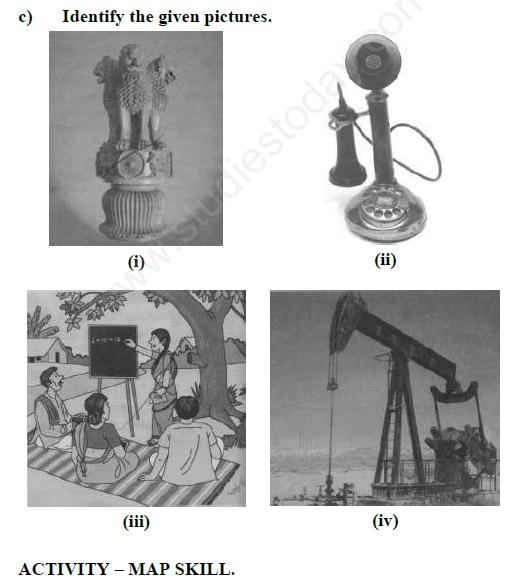
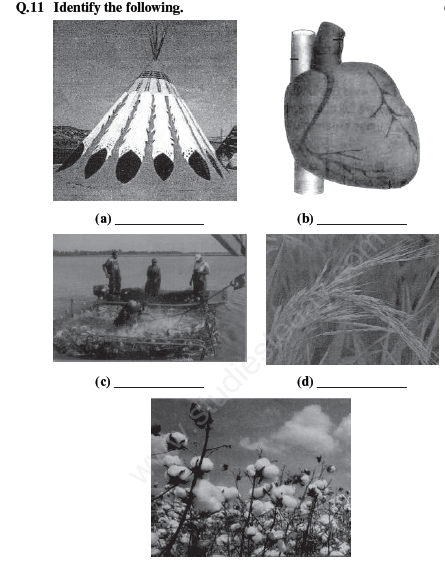
Q.11 Identify the following. (5)
Answer:
(a) Tent (Teepee / Nomad shelter)
(b) Human Heart
(c) Loom (Weaving setup)
(d) Rice crop (Wheat/Cereal grains)
(e) Silkworms
In simple words: Identifying shelters, organs, weaving tools, crops, and silkworms from images.
Exam Tip: Practice identifying diagrams from textbook chapters for picture-based questions.
PROJECT WORK (Practical Skill). (10)
Answer: Project work involves hands-on activities such as collecting samples of different fabrics (cotton, wool, silk), observing sprouting seeds, or charting daily weather conditions as assigned by the teacher.
In simple words: Practical activities designed to apply EVS concepts in real life.
Exam Tip: Complete all project assignments neatly with proper labels and observations.
Q.1 Tick the correct answer.
i) The area around the North Pole is called the –
a) Antarctic b) Arctic c) Equator
ii) Petroleum is purified in -
a) mines b) oil wells c) refineries
iii) Car pools help to save -
a) coal b) petrol c) none of these
iv) The members of a municipal council are called -
a) councillors b) residents c) mayors
v) The union ministers are chosen by the -
a) president b) prime minister c) chief minister
vi) When you heat a metal, it becomes -
a) hard b) soft c) shiny
Q.2 Fill in the blanks.
i) The sea that fills a large curve in the land is called a ______.
ii) General elections are held every ______ years in our country.
iii) The minimum age for voting in a gram panchayat election is ______ years.
iv) Compost is good for the growth of ______.
v) The water under the ground comes from ______.
vi) The earth rotates from ______ to ______.
Q.3 ‘True’ or ‘False’.
i) Our country is in the northern hemisphere.
ii) The changing of water into watervapour is called condensation.
iii) Coal and petroleum are metals.
iv) The people of our country pay taxes to build and maintain public property.
v) Learning to grow crops helped man settle down in villages.
Q.4 Answer in one word.
i) The holes dug to get the petroleum.
ii) Small solid unburnt particles present in smoke.
iii) The money that we pay to government.
iv) A song, which is written in praise of something.
v) To find something which already exists.
vi) Tax paid to use any road or bridge.
Q.5 Give two examples for each of the sentences.
i) Animals found in hot climatic areas.
ii) Mixed metals.
iii) Things that can be recycled.
iv) Things setup by gram panchayat
v) Animals seen in our national emblem.
vi) Inventions by early man.
Q.6 Match the following:
i) Jana, Gana, Mana toll booth
ii) The spokes of the chakra ration shop
iii) A place for paying toll national anthem
iv) The circle around the middle of the earth equator
v) Sells groceries at a fixed price hours
Q.7 Short answer questions.
i) What does recycling mean?
ii) Name three natural resources that all living beings need.
iii) Name five things that are built and maintained by municipality.
iv) Who elects the members of a gram panchayat?
v) What is the head of a gram panchayat called?
vi) Who makes laws for a state?
vii) Who elects the members of a municipality?
viii) Name the group of Indian islands that lie in the Arabian sea.
ix) What is written at the base of our emblem? What does it mean?
x) What were man’s earliest weapons made of ?
Q.8 Long answer questions.
i) What does a gram panchayat do? Write any four things.
ii) What do the members of parliament do? Who elects the president of our country?
iii) How to forest fires occur (happen)?
iv) What do the colours in our national flag stand for? What does the chakra at the centre of our flag stand for?
v) Write four things a municipality does.
Q.9 Read the paragraph given below and answer the following questions.
Mr. Mohan was coming back from his office.
He saw some garbage (kitchen waste) near his house. He called his son Sohan and asked him
“Who has thrown the garbage here?”
Sohan said that it was done by him.
Then Mr. Mohan explained Sohan that garbage should be thrown into a pit and then covered with soil.
It makes the soil fertile which is good for the growth of plants.
i) What is the product called when kitchen waste changes into fertile soil?
ii) What is the moral you get from above situation?
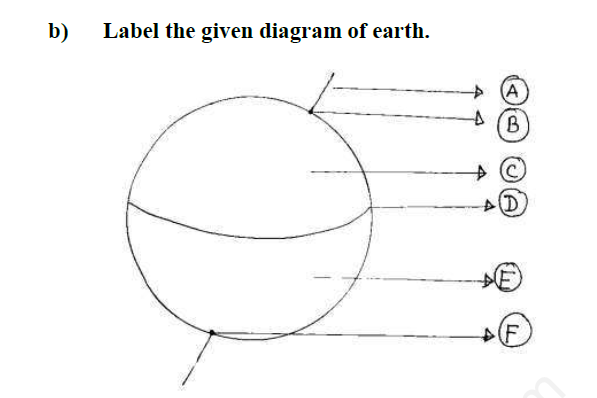
Q.10 a) Draw and label the following diagram. (any one)
Three climatic zones of the earth
OR
Land forms.
Q.1 Tick the correct answer. (1×6=6)
i) Oxygen and food combine inside the body to produce
a) carbondioxide, water vapour and energy b) only energy
ii) Air reaches to your lungs through
a) food pipe b) wind pipe
iii) If someone gets bitten by a snake, you should tie a piece of cloth
a) on the wound b) just above the wound
iv) Coffee is made from
a) seeds b) leaves c) fruits
v) A loom is used for
a) weaving b) spinning c) dyeing
vi) Multi-storeyed buildings are made to
a) get more air b) get more light c) save space
Q.2 Fill in the blanks. (1×6=6)
i) Plants breathe through tiny pores on their ___________.
ii) Different parts of your body move when your muscles ___________.
iii) A ___________ is bubblelike swelling on the skin.
iv) A water body where fish are ‘grown’ is called a ___________.
v) Drains should be covered so that ___________ do not breed in them.
vi) When something expands, it becomes ___________.
Q.3 Write ‘True’ or ‘False’. (1×6=6)
i) Your brain does not do any work when you sleep.
ii) Germs called bacteria live in your mouth.
iii) Exercise tires your muscles and make them weak.
iv) Thatched huts have roofs of concrete.
v) In places where there are earthquakes, people build strong houses with stones.
vi) Cement is used to join wood.
Q.4 Give answer in one word. (1×6=6)
i) Green substance in leaves.
ii) The biggest organ in human body.
iii) Substance produced by the bacteria in our mouth.
iv) A kind of tiny plant that grows on damp clothes.
v) A mixture of cement, chips of stone and water.
vi) The underground base of a house.
Q.5 Write two examples of each. (2×7=14)
i) Tubes that carry blood in our body.
ii) Organs that help in digesting the food we eat.
iii) Cereals
iv) Seeds from which we get oil.
v) Things used to protect our clothes.
vi) Temporary houses made by the nomads of North America.
vii) Natural fibres
Q.6 Match the following. (6)
i) Fruits and vegetables help you grow
ii) Colouring fabric or yarn chlorophyll
iii) Making fabric from yarn rubber
iv) Pulses, eggs and meat weaving
v) The green substance in leaves help you stay healthy
vi) A plant waste that is useful to us dyeing
Q.7 Answer the following questions. (2×8=16)
i) Which gas helps things burn?
ii) What is the best way of ventilating a house?
iii) How is yarn made?
iv) What is a dairy?
v) What is the first thing that you should do with a burn?
vi) Why should you not clean your ears with your nails?
vii) Why do the stomach and small intestine have to dissolve the food you eat?
Q.8 Write answer in 4-5 lines
i) What do veins and arteries do?
ii) What does the brain do when you sleep?
iii) Write the steps you will take to help a person who is choking?
iv) Write any four things that a good house should have or be?
v) Why does the oxygen of the air does not get over, though all living beings use it?
Q.9 Read the following paragraph and answer the questions
Rahul and his mother went to a party.
Rahul was very happy to see all his favourite food served there.
He took lot of food in his plate.
When his mother saw this, she told Rahul that he should take only that much food which he can eat easily to avoid wastage of food.
She explained that he should not overeat as overeating can cause indigestion.
She also explained that we should not waste food as farmers do lot of hard work to grow crops.
i) Why should we avoid overeating?
ii) What moral did you learn from the paragraph?
CBSE Class 4 Environmental Studies Assignments for All topics
Chapter Practice Questions for Class 4 Environmental Studies
Access structured practice assignments for All topics designed in alignment with the latest CBSE curriculum for Class 4 Environmental Studies. These printable sets cover objective and descriptive problem types to support thorough revision.
Maximize Exam Scores with Chapter Practice Sets
- Curriculum Standards: Assignments match modern CBSE sample formats to ensure relevant preparation.
- Thorough Revision: Detailed problem sets reinforce core concepts and eliminate conceptual weak spots.
- Execution Speed: Timed practice with assignment sets sharpens overall response timing.
How to Approach Environmental Studies All topics Assignments
- Concept Foundation: Review the NCERT book for Class 4 Environmental Studies thoroughly before diving into assignment tasks.
- Self-Evaluation: Solve exercises independently before inspecting professional answer guides.
- Progress Monitoring: Note down complex formulas or concepts, clearing them up using available online practice aids.
FAQs
You can download free PDF assignments for Class 4 Environmental Studies All topics from StudiesToday.com. These practice sheets have been updated for the 2026-27 session covering all concepts from latest NCERT textbook.
Yes, our teachers have given solutions for all questions in the Class 4 Environmental Studies All topics assignments. This will help you to understand step-by-step methodology to get full marks in school tests and exams.
Yes. These assignments are designed as per the latest CBSE syllabus for 2026. We have included huge variety of question formats such as MCQs, Case-study based questions and important diagram-based problems found in All topics.
Practicing topicw wise assignments will help Class 4 students understand every sub-topic of All topics. Daily practice will improve speed, accuracy and answering competency-based questions.
Yes, all printable assignments for Class 4 Environmental Studies All topics are available for free download in mobile-friendly PDF format.