

Class 11 Biology Competency-Based Questions: CBSE Class 11 Biology VBQs Cell And Its Structure
Explore authentic value-based practice materials through the CBSE Class 11 Biology VBQs Cell And Its Structure. Tailored for Class 11 learners, utilizing these Biology VBQs ensures thorough preparation and strengthens moral reasoning skills before final CBSE evaluations.
Download Chapter 08 Cell The Unit of Life VBQ PDF with Solutions
Navigate directly to the solved Biology Value Based Questions using the digital viewer below. Each practice set includes detailed solutions, allowing students to instantly cross-check their work and understand the ethical dimensions of the topic.
Question. The fluid mosaic model explains
(a) Only structural aspects of cell membrane
(b) Only functional aspects of cell membrane
(c) Both structural and functional aspects of cell membrane
(d) Only fluidity of membrane
Answer. C
Question. Cell membrane is …… to ions.
(a) permeable
(b) differentially permeable
(c) semipermeable
(d) impermeable
Answer. B
Question. Na + /K+ pump represents
(a) active transport
(b) passive transport
(c) osmosis
(d) simple diffusion
Answer. A
Question. The main difference between active and passive transport across cell membrane is
(a) passive transport is non-selective whereas active transport is selective
(b) passive transport requires a concentration gradient across a biological membrane whereas active transport requires energy to move solutes
(c) passive transport is confined to anionic carrier proteins whereas active transport is confined to cationic channel proteins
(d) active transport occurs more rapidly than passive transport
Answer. B
Question. Which of the following statements depict the function of cell wall?
I. Provides shape to the cell.
II. Protects the cell from mechanical damage and infection.
III. Helps in cell to cell interaction.
IV. Provides barrier to undesirable macromolecules.
V. Imbibes water.
Codes
(a) Only V
(b) Only IV
(c) II, IV and V
(d) I, II, III, IV and V
Answer. D
Question. Cell wall consists of
(a) lignin, hemicellulose, protein and lipid
(b) hemicellulose, cellulose, tubulin and lignin
(c) lignin, hemicellulose, pectin and lipid
(d) lignin, hemicellulose, pectin and cellulose
Answer. D
Question. The innermost portion of a mature plant cell wall possesses
(a) primary cell wall
(b) plasma membrane
(c) secondary cell wall
(d) plasmodesmata
Answer. C
Question. The layer of cell wall common to two adjacent cell walls in plants is called
(a) middle lamella
(b) middle layer
(c) common lamella
(d) common layer
Answer. A
Question. Middle lamella of plant cell ismade up of
(a) calcium oxalate
(b) calcium carbonate
(c) calcium silicate
(d) calcium pectate
Answer. D
Question. The cell wall and middle lamellae are transversed by
(a) plasmodesmata
(b) primary wall
(c) cytoplasm
(d) cortex
Answer. A
Question. The main organelle involved in modification and routing of newly synthesised proteins to their destination is
(a) mitochondria
(b) endoplasmic reticulum
(c) lysosome
(d) chloroplast
Answer. B
Question. Given below are the various structural modifications of ER and their characteristics.
I. Cisternae – Arranged parallel to each other to form lamellae
II. Tubules – Usually associated with ribosomes
III. Vesicles – Round isolated sacs, free of ribosomes
Choose the option containing incorrectly matched pair/s.
(a) Only I
(b) II and III
(c) Only II
(d) I and III
Answer. C
Question. Site of protein synthesis on endoplasmic reticulum is called
(a) ribosome
(b) cristae
(c) tubules
(d) vesicles and tubules
Answer. A
Question. Smooth endoplasmic reticulum acts as a major site for the synthesis of
(a) lipids and steroids
(b) proteins
(c) ribosomes
(d) DNA
Answer. A
Question. Which one of the following events does not occur in rough endoplasmic reticulum?
(a) Cleavage of signal peptide
(b) Protein glycosylation
(c) Protein folding
(d) Phospholipid synthesis
Answer. D
Question. Consider the following statements.
I. RER plays a major role in glycogenesis.
II. Sarcoplasmic reticulum of striated muscles is a modified form of SER.
III. SER plays a major role in the synthesis of steroid hormones.
IV. ER is one of the organelle of endomembrane system.
Choose the option containing incorrect statements.
(a) I and II
(b) II, III and IV
(c) Only I
(d) Only III
Answer. C
Question.The scientist, who first observed densely stained reticular structures near the nucleus is
(a) Robert Hooke
(b) Robert Brown
(c) Strasburger
(d) Camillo Golgi
Answer. D
Question. Which one of the following is the correct labelling of given structures of Golgi apparatus?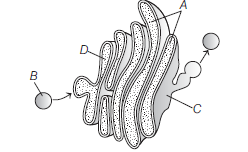
(a) A–Cisternae, B–Vesicle, C–Cis face,D–Trans face
(b) A–Cisternae, B–Vesicle, C–Trans face,D–Cis face
(c) A–Tubules, B–Vesicle, C–Trans face,D–Cis face
(d) A–Vesicle, B–Cisternae, C–Cis face,D–Trans face
Answer. B
Question. Which one of the following organelles is located near the nucleus and contains a collection of flattened membrane bound cisternae?
(a) Nucleolus
(b) Mitochondrion
(c) Centriole
(d) Golgi apparatus
Answer. D
Question. Golgi bodies aries from endoplasmic reticulum.
(a) True
(b) False
(c) Cannot say
(d) Partially true or false
Answer. A
Question. Important site for the formation of glycoprotein and glycolipid is
(a) lysosomes
(b) Golgi apparatus
(c) vacuoles
(d) plastids
Answer. B
Question. Match the following columns and select the correct option from the codes given below.
Column I Column II
A. Smooth endoplasmic reticulum 1. Protein synthesis
B. Rough endoplasmic reticulum 2. Lipid synthesis
C. Golgi complex 3. Glycosylation
D. Centriole 4. Spindle formation
Codes
A B C D
(a) 2 1 3 4
(b) 3 1 2 4
(c) 4 2 1 3
(d) 1 2 3 4
Answer. A
Question. Which one of the following cell organelles is enclosed by a single membrane?
(a) Chloroplasts
(b) Lysosomes
(c) Nuclei
(d) Mitochondria
Answer. B
Question. Match the following columns.
Column I Column II
(Cell organelles) (Functions)
A. Golgi apparatus 1. Synthesis of protein
B. Lysosomes 2. Trap waste and excretory products
C. Vacuoles 3. Packaging and secretion
D. Ribosomes 4. Digesting biomolecules
Codes
A B C D
(a) 3 4 2 1
(b) 4 3 1 2
(c) 3 2 4 1
(d) 1 2 4 3
Answer. A
Question. Which of the following pairs of organelles does not contain DNA?
(a) Chloroplast and vacuoles
(b) Lysosomes and vacuoles
(c) Nuclear envelope and mitochondria
(d) Mitochondria and lysosomes
Answer. B
Question. Vacuole in a plant cell
(a) is membrane bound and contains storage proteins and lipids
(b) is membrane bound and contains water and excretory substances
(c) lacks membrane and contains air
(d) lacks membrane and contains water and excretory substances
Answer. B
Question. The osmotic expansion of a cell kept in water is chiefly regulated by lysosomes.
(a) True
(b) False
(c) Cannot say
(d) Partially true or false
Answer. B
Question. Function of contractile vacuole is
(a) excretion
(b) elimination
(c) osmoregulation
(d) gaseous exchange
Answer. C
Question. Go through the sectional view of a mitochondrion showing the different parts and identify the structures A to E.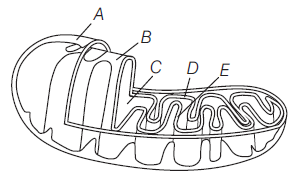
(a) A–Outer membrane, B–Inner membrane,C–Matrix, D–Inter membrane space,E–Crista
(b) A–Outer membrane, B–Inner membrane,C–Inter membrane space, D–Matrix,E–Crista
(c) A–Outer membrane, B–Inner membrane,C–Matrix, D–Crista, E–Inter membrane space
(d) A–Outer membrane, B–Inner membrane,C–Crista, D–Matrix, E–Inter membrane space
Answer. A
Question. The cristae in mitochondria is important because
(a) increases surface area
(b) decreases surface area
(c) have fluid in it
(d) None of the above
Answer. A
Question. Consider the following statements and choose the option containing the correct statements.
I. The endomembrane system includes plasma membrane, ER, Golgi complex, lysosomes and vacuoles.
II. ER helps in the transport of substances, synthesis of proteins,lipoproteins and glycogen.
III. Ribosomes are involved in protein synthesis.
IV. Mitochondria helps in oxidative phosphorylation and generation ofATP.
(a) I, II, III and IV
(b) Only I
(c) Only II
(d) Only III
Answer. A
Question. Mitochondria are semiautonomous as they possess
(a) DNA
(b) DNA + RNA
(c) DNA + RNA + Ribosomes
(d) Protein
Answer. C
Question. Choose the incorrect pair.
(a) Chloroplast — Traps light energy
(b) Chromoplast — Imparts colours to the plant
(c) Leucoplast — Stores nutrients
(d) None of the above
Answer. D
Question. Chromoplasts have fat soluble pigments called
(a) chlorophyll
(b) carotenoid
(c) chloroplast
(d) Both (a) and (b)
Answer. B
Question. Analyse the following pairs and identify the correct option given below.
I. Chromoplasts – Contain pigments other than chlorophyll
II. Leucoplasts – Devoid of any pigments
III. Amyloplasts – Store proteins
IV. Aleuroplasts – Store oils and fats
V. Elaioplasts – Store carbohydrates
Codes
(a) II and III
(b) III and IV
(c) IV and V
(d) I and II
Answer. D
Question. Identify A to F in the sectional view of a chloroplast showing the different parts.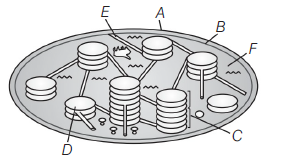
(a) A–Inner membrane, B–Granum, C–Outer membrane, D–Stroma lamella, E–Stroma,F–Thylakoid
(b) A–Outer membrane, B–Inner membrane,C–Granum, D–Thylakoid, E–Stroma lamella,F–Stroma
(c) A–Thylakoid, B–Outer membrane,C–Stroma, D–Stroma lamella, E–Granum,F–Inner membrane
(d) A–Outer membrane, B–Stroma, C–Innermembrane, D–Granum, E–Thylakoid,F–Stroma lamella
Answer. B
Question. Who discovered ribosomes as dense particles under the electron microscope?
(a) George Palade
(b) Kolliker
(c) Boveri
(d) Strasburger
Answer. A
Question. The solid linear cytoskeletal elements having a diameter of 6 nm and made up of a single type of monomer are known as
(a) microtubules
(b) microfilaments
(c) intermediate filaments
(d) lamins
Answer. B
Question. Identify A to D in the diagrammatic representation of internal structure of cilia.
(a) A–Interdoublet bridge, B–Central microtubule, C–Plasma membrane,D–Radial spoke
(b) A–Plasma membrane, B–Centralmicrotubule, C–Interdoublet bridge,D–Radial spoke
(c) A–Plasma membrane, B–Interdoublet bridge, C–Central microtubule, D–Radial spoke
(d) A–Plasma membrane, B–Interdoublet bridge, C–Radial spoke, D–Central microtubule
Answer. C
Question. What is common between a eukaryotic and prokaryotic flagella?
(a) Same structure
(b) Both are used for locomotion
(c) Composed of same proteins
(d) Both are extension of cell membrane
Answer. B
Question. The central part of the proximal region of the centriole is
(a) spokes
(b) hub
(c) centrosome
(d) axonema
Answer. B
Question. Which one of the following cellular parts is correctly described?
(a) Centrioles – Sites for active RNA synthesis
(b) Lysosomes – Optimally active at a pH of about 8.5
(c) Thylakoids – Flattened membranous sacs forming the grana of chloroplasts
(d) Ribosomes – Those on chloroplasts are larger (80S) while those in the cytoplasm are smaller (70S)
Answer. C
Question. The diagram of the ultrastructure of a plant cell is given below. Identify the functions of the organelles labelled as A, B, C, D and E in the diagram.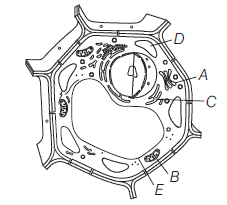
(a) A– Intracellular transport, B–Site of oxidative phosphorylation, C–Principle director of macromolecular traffic, D–Site of photophosphorylation, E–Storage of cell sap
(b) A–Principle director of macromolecular traffic, B–Site of oxidative phosphorylation, C–Intracellular transport, D–Site of photophosphorylation, E–Storage of cell sap
(c) A–Site of photophosphorylation, B–Storage of cell sap, C–Intracellular transport, D–Site of oxidative phosphorylation, E–Principle director of macromolecular traffic
(d) A–Storage of cell sap, B–Site of oxidative phosphorylation, C–Principle director of macromolecular traffic, D–Site of photophosphorylation, E–Intracellular transport
Answer. B
Question. Nucleus is stained by a ……… .
(a) acidic dye
(b) basic dye
(c) neutral dye
(d) iodine
Answer. B
Question. Within the nucleus, DNA is organised along with proteins into material called
(a) nuclear lamina
(b) chromosome
(c) chromatin
(d) chromatid
Answer. C
Question. The nuclear pores in the nuclear membrane allows the passage of
(a) proteins, enzymes into the nucleus
(b) ribosomal components out of the nucleus
(c) mRNA out of the nucleus
(d) All of the above
Answer. D
Question. Choose the incorrect pair.
(a) Histones — Basic proteins
(b) Centromere — Primary constriction
(c) Kinetochore — Disc-shaped structure
(d) None of the above
Answer. D
Question. In the given diagram of types of chromosomes, identify A-D.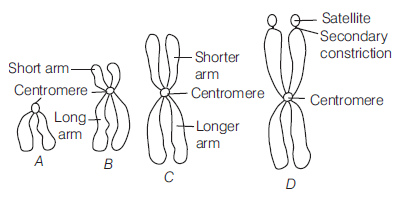
(a) A–Telocentric chromosome, B–Acrocentric chromosome, C–Submetacentric chromosome, D–Metacentric chromosome
(b) A–Acrocentric chromosome, B–Telocentric chromosome, C–Metacentric chromosome, D–Submetacentric chromosome
(c) A–Submetacentric chromosome, B–Metacentric chromosome, C–Telocentric chromosome, D–Acrocentric chromosome
(d) A–Metacentric chromosome,B–Submetacentric chromosome,C–Acrocentric chromosome, D–Telocentric chromosome
Answer. A
Assertion-Reasoning MCQs
Direction - Each of these questions contains two statements Assertion (A) and Reason (R). Each of these questions also has four alternative choices, any one of which is the correct answer. You have to select one of the codes (a), (b), (c) and (d) given below.
(a) Both A and R are true and R is the correct explanation of A
(b) Both A and R are true, but R is not the correct explanation of A
(c) A is true, but R is false
(d) A is false, but R is true
Question. Assertion (A) Smaller cells are usually metabolically active cells.
Reason (R) Smaller cells have higher nucleocytoplasmic ratio and higher surface volume ratio.
Answer. A
Question. Assertion (A) Cell is an open system.
Reason (R) Cell receives a number of materials including energy containing nutrients from outside and also release metabolic wastes into its surroundings.
Answer. A
Question. Assertion (A) Every cell behaves as a compartment.
Reason (R) Cells are partially covered over by a membrane.
Answer. C
Question. Assertion (A) A cell is a closed compartment.
Reason (R) Plasma membrane of a cell is selectively permeable.
Answer. B
Question. Assertion (A) The cisternae in Golgi complex have cis face and trans face.
Reason (R) The cis face is also called forming face and trans face is also called maturing face.
Answer. B
Question. Assertion (A) Peroxisomes are involved in photorespiration of the plant cells and help in lipid metabolism in animal cells.
Reason (R) These are the cell garbage disposal system.
Answer. C
Question. Assertion (A) In prokaryotes, mitochondria are absent.
Reason (R) In prokaryotes, mesosomes are present which help in respiration.
Answer. B
Question. Assertion (A) Mitochondria and chloroplast are semiautonomous organelles.
Reason (R) These are formed by the division of pre-existing organelles as well as they contain DNA, but lack protein synthesising machinery.
Answer. C
Question. Assertion (A) Mitochondria and chloroplast have their own genome.
Reason (R) ER and Golgi body are the cell organelles which have their own DNA.
Answer. C
Question. Assertion (A) Mitochondria are common to both plant and animal cells.
Reason (R) The number of mitochondria in a cell does not correspond to the function of the cell.
Answer. C
Question. Assertion (A) Chloroplast is a cell organelle.
Reason (R) An organelle is a distinct part of cell which has a particular structure and function.
Answer. A
Question. Assertion (A) The chromoplasts contain fat soluble carotenoid pigments.
Reason (R) These pigments provide colour to plant parts other than green.
Answer. B
Case Based MCQs
Observe the diagram given below and answer the questions that follow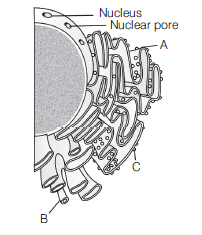
Question. Identify the labels A, B and C shown in the above diagram.
A B C
(a) Ribosomes SER RER
(b) RER SER Ribosomes
(c) SER Ribosomes RER
(d) RER Ribosomes SER
Answer. B
Question. The label ‘C’ in the given diagram is the site of
(a) respiration
(b) photosynthesis
(c) protein synthesis
(d) fat synthesis
Answer. C
Question. Difference between rough and smooth endoplasmic reticulum is that
(a) rough ER has ribosomes
(b) smooth ER has ribosomes
(c) smooth ER takes part in protein synthesis
(d) Both has F1 particles
Answer. A
Question. Ribosomes are
I. Non-membrane bound.
II. Absent in plastids and mitochondria.
III. Present in the cytoplasm and RER.
Choose the correct option.
(a) Only II
(b) I and II
(c) I, II and III
(d) I and III
Answer. D
Question. Which of the following statements are true about endoplasmic reticulum?
I. Smooth Endoplasmic Reticulum (SER) makes lipids.
II. It is also called the control centre of the cell.
III. It processes carbohydrates.
IV. It modifies chemicals that are toxic to the cell.
Choose the correct option
(a) I, II and III
(b) I, III and IV
(c) I and IV
(d) All of these
Answer. B
Observe the diagram shown below and answer the following questions.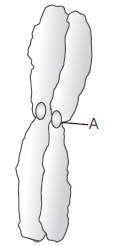
Question. Identify the label A in the above diagram.
(a) Chromatin fibre
(b) nuclear pore
(c) Kinetochore
(d) None of these
Answer. C
Question. Choose the correct pair.
(a) Histones — Basic proteins
(b) Centromere — Secondary constriction
(c) Kinetochore — Kidney-shaped structure
(d) None of the above
Answer. A
Question. For the study of structure of nucleus, the best cell is
(a) cell in the interphase
(b) cell in the late prophase
(c) cell in the divisional phase
(d) cell in the meiotic phase
Answer. A
Question. Which of the following table refers correctly to the chromosome?
Numbers of Numbers of Numbers
Centromere Kinetochore of Arm
(a) 2 1 4
(b) 1 2 4
(c) 2 2 4
(d) 1 2 2
Answer. B
Question. Which of the following stains is not used for staining chromosomes?
(a) Basic fuschsin
(b) Safranin
(c) Methylene blue
(d) Carmine
Answer. B
Direction Read the following and answer the questions that follow
Lysosomes are speciallised cell organelles present in the cytoplasm.
These are common in animal cells, but also found in plant cells. It is surrounded by a single unit membrane, which encloses a dense stroma and a large vacuole, which contains about 50 hydrolytic enzymes. These enzymes can digest most of the biological substances. Lysosomes exist in four forms, such as primary lysosomes,secondary lysosomes, residual bodies and autophagosomes.
Question. Which of the following sequence is correct regarding origin of lysosomes?
(a) Endoplasmic reticulum→Golgi bodies→ Lysosomes
(b) Golgi bodies→Endoplasmic reticulum→ Lysosomes
(c) Nucleus→Golgi bodies→Lysosomes
(d) Mitochondria→Endoplasmic reticulum→ Golgi bodies→Lysosomes
Answer. A
Question. Lysosomes have acidic environment inside their vesicles due to
(a) production of carboxylate ions inside it
(b) production of phosphate ions inside it
(c) high pH compared to outside
(d) None of the above
Answer. D
Question. Lysosomes are involved in
(a) digestion
(b) formation of polypeptides
(c) packaging
(d) None of the above
Answer. A
Question. Which of the following statements is not correct?
(a) Lysosomes have numerous hydrolytic enzymes
(b) The hydrolytic enzymes of lysosomes are active under acidic pH
(c) Lysosomes are membrane bound structures
(d) Lysosomes are formed by the process of packaging in the endoplasmic reticulum
Answer. D
Question. Which one of the following cell organelles exhibits polymorphism?
(a) Chloroplasts
(b) Lysosomes
(c) Nuclei
(d) Mitochondria
Answer. B
Direction Read the following and answer the questions that follow
Chloroplast, structure within the cells of plants and green algae that is the site of photosynthesis, the process by which light energy is converted to chemical energy, resulting in the production of oxygen and energy-rich organic compounds. Photosynthetic cyanobacteria are free-living close relatives of chloroplasts, endosymbiotic theory posits that chloroplasts and mitochondria (energy-producing organelles in eukaryotic cells) are descended from such organisms.
Question. The stack of thylakoid found inside plastids is
(a) thylakoid
(b) granum
(c) stroma
(d) oxysomes
Answer. B
Question. Stroma in the chloroplasts of higher plant contains
(a) light dependent reaction enzymes
(b) ribosomes
(c) chlorophyll
(d) light independent reaction enzymes
Answer. D
Question. What is common between chloroplasts,chromoplasts and leucoplasts?
(a) Presence of pigments
(b) Possession of thylakoids and grana
(c) Storage of starch, proteins and lipids
(d) Ability to multiply by a fission-like process
Answer. D
Question. Chlorophyll in chloroplast is located in
(a) grana
(b) pyrenoid
(c) stroma
(d) Both (a) and (c)
Answer. A
Question. Which is incorrect with reference to chloroplast?
(a) Presence in algae and plants
(b) ReleasesO2
(c) Occurs only in cells with aerobic respiration
(d) None of the above
Answer. C
Questions:
Question. A student purchase unripen tomato from market which were green in color. After few days he noticed that color has been changed to red .Next day he asked her teacher about the reason. What could be the possible reason according to you ?
Answer. Green color is due to the chloroplast and later on this chloroplast changed into the chromoplast.
Question. A student got injured some day .he took the medicine from the doctor and get cured .He wonders that how medicine got to know where to act. He asks doctor about the reason about. What could be the possible reason according to you ?
Answer. Every cell membrane has some receptor over it . Which perceives the drugs and this stimulate cascade effects in cell and disease is cured.
Question. A student collected water sample from water body and took it to the bio lab .there he observed the microorganism present in it .he observed one organism with small extension whole over the body and one organism with few long extension over the body .according to above information what hat extensions are these and explain about it.
Answer. Short extensions are cilia; long extensions are flagella.
Free study material for Biology
VBQs with Answers for Class 11 Biology Chapter 08 Cell The Unit of Life
Chapter VBQs with Solutions (CBSE)
Review important VBQs for Chapter 08 Cell The Unit of Life tailored for Class 11 learners. These structured exercises highlight core values and practical concepts essential for high-scoring exam performance.
Verified Answers for Class 11 Biology Chapter 08 Cell The Unit of Life
Built using the official NCERT book for Class 11 Biology, these solved problem sets provide reliable guidance. Cross-reference your answers with our expert-verified keys for complete conceptual clarity.
More Study Resources for Chapter 08 Cell The Unit of Life
Explore our wider library of free chapter notes, worksheets, and online mock tests to support your ongoing revision and secure top-tier academic results.
FAQs
The latest collection of Value Based Questions for Class 11 Biology Chapter 08 Cell The Unit of Life is available for free on StudiesToday.com. These questions are as per 2026 academic session to help students develop analytical and ethical reasoning skills.
Yes, all our Biology VBQs for Chapter 08 Cell The Unit of Life come with detailed model answers which help students to integrate factual knowledge with value-based insights to get high marks.
VBQs are important as they test student's ability to relate Biology concepts to real-life situations. For Chapter 08 Cell The Unit of Life these questions are as per the latest competency-based education goals.
In the current CBSE pattern for Class 11 Biology, Chapter 08 Cell The Unit of Life Value Based or Case-Based questions typically carry 3 to 5 marks.
Yes, you can download Class 11 Biology Chapter 08 Cell The Unit of Life VBQs in a mobile-friendly PDF format for free.