

Official CBSE Practice Papers for Class 10 Accountancy
Explore authentic exam practice materials through the CBSE Class 10 Elements of Book Keeping and Accountancy Sample Paper Set 02. Tailored for Class 10 learners, utilizing these Accountancy sample papers ensures thorough preparation and strengthens time management skills before final CBSE evaluations.
Solved Model Papers for Accountancy
Navigate directly to the solved Accountancy model papers using the digital viewer below. Each practice set includes detailed solutions, allowing students to instantly cross-check their work and identify areas requiring further revision.
Q1. The purpose of preparing final accounts is to ascertain:
a) Profit or loss
b) Capital
c) The value of assets
d) Profit or loss and financial position
Q2. Trading Account shows:
a) Financial position of the concern
b) Gross profit
c) Net profit
d) Net profit and financial position
Q3. Balance sheet shows:
a) Profit or loss
b) Financial position
c) Errors of accounts
d) Total debtors
Q4. Trading and Profit & Loss Account is prepared:
a) At the end of calendar year
b) At the beginning of the accounting year
c) On every Diwali
d) At the end of accounting year
Q5. Balance Sheet is prepared:
a) For a particular period
b) On a particular date
c) For the whole year
d) For a decade
Q6. Balance sheet shows:
a) Assets only
b) Liabilities only
c) Both assets & Liabilities
d) Neither assets nor liabilities
Q7. Excess of credit in Profit and Loss account is called:
a) Net profit
b) Net loss
c) Gross profit
d) Gross loss
Q8. Wages and Salaries appearing in Trial Balance is shown:
a) On the debit side of Trading A/c
b) On the debit side of Profit and Loss Account
c) On the Asset Side of the Balance Sheet
d) On the liabilities side of Balance Sheet
Q9. Land is:
a) Current Asset
b) Fixed asset
c) A liability
d) Capital
Q10. Identify the current asset from the following:
a) Plant
b) Cash at bank
c) Creditors
d) Capital
Q11. Generally accounts under single entry system are maintained by:
a) Sole Trader
b) Company
c) Society
d) Partnership Firms
Q12. Single entry system of book keeping is:
a) Accurate
b) Systematic
c) Unscientific
d) Rationale
Q13. When closing capital is more than the opening capital, it denotes:
a) Drawings
b) Loss
c) No profit no loss
d) Profit, if there is no introduction of fresh capital
Q14. When closing capital is less than the opening capital, it denotes:
a) Profit
b) Loss
c) Loss, if there is no drawing
d) Expenses
Q15. Which of the following is correct about Single Entry System:
a) Simple Method
b) Difficult Method
c) Expensive Method
d) Both difficult and expensive method
Q16. Single Entry System is a:
a) Complete System
b) Incomplete System
c) Hybrid System
d) None of the above
Q17. Drawer in bill of exchange is a person:
a) Who draws a bill
b) Who accepts the bill
c) Who makes the payment
d) Who receives the payment
Q18. Endorsing the bill means:
a) Giving the bill on charity
b) Depositing the bill with the government treasury
c) Transferring the bill to another person by the holder
d) Receiving the bill from creditors
Q19. Give three differences between Trading Account and Profit and Loss Account.
Q20. Calculate Closing Capital:
Opening capital Rs.1,70,000: Profit for the year Rs.1,20,000: Drawings Rs.70,000. During the year proprietor sold ornaments of his wife
for Rs.20,000 and invested the same in business.
Q21. What is meant by “Accounting from Incomplete Records”? State any two characteristics of incomplete records.
Q22. Give any three differences between Balance Sheet and Statements of Affairs.
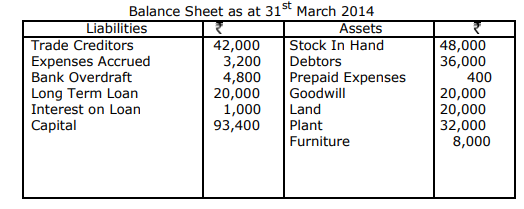
Q23. From the Balance Sheet given below, calculate:
1) Total Fixed Assets
2) Total Current Assets
3) Total Current Liabilities
Q24. Surya maintains books on Single Entry System. He gives you the following information:
Capital on 1st April,2014 Rs.30,000
Capital on 1st April, 2015 Rs.32,800
Drawings made during the period: April, 2014 to March, 2015- Rs.10,800.
Capital introduced on 1st August, 2012 Rs.5,000
You are required to calculate the profit or loss made by Mohan.
Q25. What is meant by a Bill of Exchange? State any two of its characteristics.
Q26. Explain any three terms:
a) Dishonour Of a Bill
b) Noting Charges
c) Discounting of a bill
d) Endorsement of a bill
Q27. Give any four objectives of preparing financial statements.
Q28. Calculate net sales and net purchases from the following information:
Sales Rs 1,00,000 , Purchases Rs 50,000
Sales Return Rs 5,000 , Purchase Return Rs 8,000
Q29. Explain any four advantages of Bills of Exchange.
Q30. State any four advantages of Single Entry System.
Q31. State any four limitations of Single Entry System.
Q32. If ‘Adjusted Purchases’ and ‘Closing Stock’ are given in the Trial Balance, will you transfer ‘Closing Stock’ to the trading account? Explain briefly.
Please click the link below to download CBSE Class 10 Elements of Book Keeping and Accountancy Sample Paper Set B
Free study material for Other Subjects
Download CBSE Sample Papers: Class 10 Accountancy
Access Sample Papers for Class 10 Accountancy
Review model practice papers for Class 10 Accountancy. Working through the CBSE Class 10 Elements of Book Keeping and Accountancy Sample Paper Set 02 under simulated test conditions at home ensures complete familiarity with upcoming school evaluations.
Maximize Your Scores with Model Papers
- Curriculum Insights: Clarify chapter-wise weightage rules and question trends across Class 10.
- Gap Analysis: Check performance drops across sets to isolate specific Class 10 Accountancy topics needing extra attention.
- Time Efficiency: Working through objective and descriptive problems builds critical pacing to finish exams comfortably.
Post-Practice Strategy for Class 10 Accountancy
- Review Solutions: Evaluate your completed papers using expert-verified guidance inside our solution sets.
- Target Weaknesses: Class 10 students should analyze missed questions to rectify conceptual misunderstandings.
- Deep Revision: Re-read sections in the NCERT book for Class 10 Accountancy to clear doubts before solving items again.
FAQs
You can download the complete PDF for CBSE Class 10 Elements of Book Keeping and Accountancy Sample Paper Set 02 for free from StudiesToday.com. Our resources for Class 10 Accountancy are updated for the latest academic session and follow the official exam pattern.
Yes, CBSE Class 10 Elements of Book Keeping and Accountancy Sample Paper Set 02 comes with detailed, teacher-verified solutions. We have provided step-by-step answers for Accountancy to help students of Class 10 understand correct methodology and marking scheme.
Practicing this Accountancy paper helps in time management and identifying important topics. For Class 10, solving mock papers is the best way to gain confidence and reduce exam-day anxiety.
Yes, all our study materials for Class 10 Accountancy are provided in a mobile-friendly PDF format. You can easily download CBSE Class 10 Elements of Book Keeping and Accountancy Sample Paper Set 02 on your mobile device.