

Download CBSE Class 11 Biology Question Papers
Explore authentic exam materials through the CBSE Class 11 Biology Question Paper Set 14 Solved. Tailored for Class 11 learners, utilizing these Biology previous year papers ensures thorough preparation and strengthens time management skills before final CBSE evaluations.
Access CBSE Question Papers and Solutions
Navigate directly to the solved Biology question papers using the digital viewer below. Each practice set includes detailed solutions, allowing students to instantly cross-check their work and identify areas requiring further revision.
1. Name the enzyme of gastric juice released as proenzyme in the human alimentary canal.
2. Name the first vertebra which articulates with the occipital condyles.
3. Some of the muscle fibres are red in colour.Why?
4. Mention the name of the hormone which inhibits the release of growth hormone from the Pituitary gland?
5. The embryo of monocotyledonous seed consists of one large, shield shaped cotyledon. What is it known as?
6. List two differences between Vital Capacity and Total Lung Capacity.
7. Define Cardiac Output, give its relationship with Stroke Volume.
8. Categorize nephrons into its two types and differentiate them with one valid point.
9. Draw a well labelled diagram of a sarcomere.
OR
i) Differentiate Bone and Cartilage on the basis of the matrix present in these connective tissues.
ii) Each coxal bone is formed by the fusion of three bones. Two of them are Ilium and Ischium. Name the third bone and the cavity formed at the point of the fusion of the above three bones.
10. Enumerate the specific function of the Ear ossicles and the Eustachian tube.
11. Anjum a nine year old girl frequently suffered from cold, cough and fever, she had a nutritious diet and maintained a hygienic life. She was told by her doctor that one of her endocrine glands was underdeveloped and non functional which automatically degenerates in old individuals.
i) Identify the gland and the hormone secreted by it.
ii) Give one reason for her frequent illness.
12. Write the technical terms for:
i) The sterile stamens
ii) When stamens are attached to the petals
13. i) Why are intestinal proteases normally secreted in an inactive form?
ii) What is the term given to the connective tissue that covers the hepatic lobules?
iii) Goblet cells of mucosal epithelium secrete mucus. List its function.
14. Observe the graph showing oxygen haemoglobin dissociation curve:
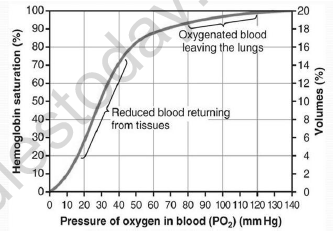
i)What is the nature (shape) of the curve?
ii) Find out the pressure at which haemoglobin is 50% saturated with oxygen?
iii) Binding of oxygen with haemoglobin is primarily related to partial pressure of O2. List the other three factors which can interfere with this binding.
iv) O2 gets bound to haemoglobin in the lung surface. Where will it get dissociated?
15. i) What is ECG?
ii) In standard ECG, what does the QRS complex and the T wave represent?
16. i) Define GFR.
ii) Renal Corpuscle comprises of two structural components. Name them.
iii) What are peritubular capillaries?
17. i) Illustrate a labelled Meromyosin protein.
ii) What are the two important parts of Meromyosin protein?
18. i) State two differences between rods and cones.
ii) Fovea is a thinned out portion of the retina. Why is it so thin yet so important?
OR
i) The left and the right cerebral hemispheres are connected by a tract of nerve fibres. Give the term for this structure.
ii) Give two functions undertaken by the limbic system along with the hypothalamus.
iii) What are the three layers of Cranial Meninges.
19. i) Vasopressin is called as anti-diuretic hormone(ADH). Give reason.
ii) The 24hour diurnal rhythm of our body is controlled by a hormone secreted by a small endocrine gland. Name the hormone and the gland.
iii) Give the names of specific hormone secreted by Leydig cells and Corpus luteum.
20. i) Name the disorder caused due to prolonged hyperglycemia ,which is associated with loss of glucose through urine and formation of ketone bodies.
ii) Hypothyroidism during pregnancy causes some defects in growing babies. State any two of them.
iii) Give the full form of CCK and GIP.
21. i) Differentiate between cymose and racemose inflorescence.
ii) Define phyllotaxy. Give one example each of alternate and opposite phyllotaxy.
22. Explain any three types of aestivation.
23. i) Draw the structure of a monocotyledonous seed.
ii) Name the two layers which form the seed coat in dicot.
24. i) Mango and coconut are ‘drupe’ type of fruits. How do they develop? Give one basic difference between the mesocarp of mango and the mesocarp of coconut.
ii) Define parthenocarpic fruit.
25. Give a brief account on the disorders of digestive system.
OR
Explain the pathway of heart beat conduction.
26. i) What is glomerulonephritis and renal calculi?
ii) State two points to support that counter current mechanism helps human kidneys to produce urine nearly four times concentrated than the initial filtrate formed.
iii) Name the excretory products eliminated by sebaceous glands.
OR
Briefly explain the generation and conduction of nerve impulse.
27. i) According to the position of floral parts on the thalamus, flowers are placed under three types. Explain.
ii) Write the floral formula of a actinomorphic, bisexual, hypogynous flower with five united sepals, five free petals, five free stamens and two united carpels with superior ovary.
OR
Briefly enumerate, the five types of placentation.
Please click on below link to download CBSE Class 11 Biology Question Paper Set N Solved
Free study material for Biology
Download CBSE Question Papers: Class 11 Biology
Previous Year Question Papers: Class 11 Biology
Review authentic examination papers for Class 11 Biology. Working through the CBSE Class 11 Biology Question Paper Set 14 Solved allows learners to decode recurring question trends and familiarize themselves with official CBSE evaluation standards.
Boost Your Exam Score with Past Papers
Practicing past question sets under timed home conditions helps refine pacing and time management skills, ensuring you complete your Biology examination comfortably within the official duration.
Enhance Practice with Sample Papers & Solutions
Download digital copies of these papers for convenient offline revision anywhere. Cross-check your completed steps against our expert solution guides to ensure complete accuracy.
FAQs
The CBSE Class 11 Biology Question Paper Set 14 Solved is available for download on StudiesToday.com. It includes complete set with all sections so that Class 11 students can practice with the exact same paper that came in the CBSE exams.
Yes, the solutions for CBSE Class 11 Biology Question Paper Set 14 Solved are prepared by subject matter experts as per official marking scheme. Class 11 students will understand the structure of answers and 'step-marks' methodology Biology.
Solving previous year papers like CBSE Class 11 Biology Question Paper Set 14 Solved is important to understand repeat themes and question difficulty levels of Biology. It helps Class 11 students to test their time management skills too.
Yes, where applicable, CBSE Class 11 Biology Question Paper Set 14 Solved is available in both English and Hindi mediums. All students from Class 11 can access Biology study material in their preferred language.
No, all previous year question papers on StudiesToday, including CBSE Class 11 Biology Question Paper Set 14 Solved, are provided free of charge in mobile-friendly PDF.