

Download Class 11 Mathematics Practice Worksheets
Access comprehensive chapter-wise worksheets for Chapter 09 Straight Lines using the CBSE Class 11 Mathematics Straight Lines Worksheet Set 02. Designed to align with the 2026-27 academic syllabus for Class 11 Mathematics, these printable practice sets help students reinforce key concepts and improve their overall exam readiness.
Access Chapter 09 Straight Lines Practice Papers and Solutions
Navigate directly to the solved Mathematics worksheets using the digital viewer below. Each practice set includes detailed step-by-step solutions, allowing students to instantly cross-check their work and identify areas requiring further revision.
Worksheet with questions and answers for Straight Lines for CBSE Class 11 Mathematics. These worksheets have been prepared by teachers from the best schools in India. These worksheets have been designed with detailed explanation which will help the students to clear their doubts and improve understanding of Straight lines chapter.
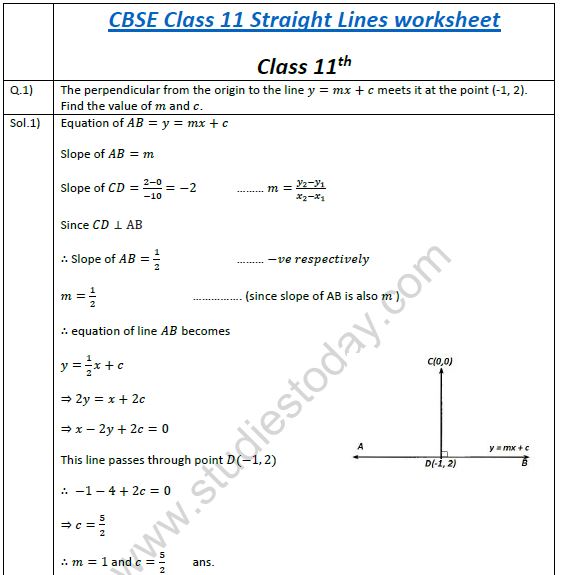
Question 1. The perpendicular from the origin to the line \( y = m * x + c \) meets it at the point (-1, 2). Find the value of \( m \) and \( c \).
Answer: Let the line be represented by \( AB \): \( y = mx + c \). The slope of \( AB \) is \( m \).
Let \( CD \) be the perpendicular line from the origin \( C(0,0) \) to \( AB \) meeting at \( D(-1, 2) \). The gradient of this perpendicular line is:
\( m_{CD} = \frac{2 - 0}{-1 - 0} = -2 \)
Since \( CD \) is perpendicular to \( AB \), the product of their slopes must be \( -1 \):
\( m \cdot (-2) = -1 \implies m = \frac{1}{2} \)
Substituting the value of \( m \), our equation for the line \( AB \) becomes:
\( y = \frac{1}{2}x + c \implies 2y = x + 2c \implies x - 2y + 2c = 0 \)
Since the point \( D(-1, 2) \) lies on the line \( AB \), we substitute its coordinates into the equation:
\( -1 - 2(2) + 2c = 0 \implies -5 + 2c = 0 \implies c = \frac{5}{2} \)
Thus, the required values are \( m = \frac{1}{2} \) and \( c = \frac{5}{2} \).
In simple words: We find the slope of the perpendicular line from the origin to the given point. Since the lines are perpendicular, we take the negative reciprocal to get \( m \). Then, we plug the point into the line equation to find \( c \).
Exam Tip: Remember that when two lines are perpendicular, their slopes \(m_1\) and \(m_2\) satisfy \(m_1 \cdot m_2 = -1\). This relationship is the easiest way to find the slope of a perpendicular line.
Question 2. Assuming that straight lines work as a plane mirror for a point, find the image of the point (1, 2) in the line \( x - 3y + 4 = 0 \).
Answer: Let \( P'(a, b) \) be the image of the point \( P(1, 2) \) in the line \( AB: x - 3y + 4 = 0 \) (equation (i)).
The slope of the line \( AB \) is given by:
\( m = -\frac{\text{coefficient of } x}{\text{coefficient of } y} = -\frac{1}{-3} = \frac{1}{3} \)
Since the line joining the point and its image (\( PP' \)) is perpendicular to the mirror line \( AB \), the gradient of \( PP' \) must be the negative reciprocal of \(\frac{1}{3}\), which is \( -3 \).
Applying the point-slope form for the line \( PP' \) through \( P(1, 2) \) with slope \( -3 \):
\( y - 2 = -3(x - 1) \implies y - 2 = -3x + 3 \implies 3x + y = 5 \) (equation (ii)).
Let \(\theta\) be the intersection point of \( AB \) and \( PP' \). We find \(\theta\) by solving equations (i) and (ii) simultaneously:
From (i): \( x = 3y - 4 \)
Substitute in (ii): \( 3(3y - 4) + y = 5 \implies 10y - 12 = 5 \implies 10y = 17 \implies y = \frac{17}{10} \)
Then, \( x = 3\left(\frac{17}{10}\right) - 4 = \frac{51 - 40}{10} = \frac{11}{10} \).
So the intersection point is \( \theta\left(\frac{11}{10}, \frac{17}{10}\right) \).
Since the mirror line bisects the segment joining the point and its image, \(\theta\) is the midpoint of \( P(1, 2) \) and \( P'(a, b) \). By the midpoint formula:
\( \frac{11}{10} = \frac{1 + a}{2} \implies 22 = 10 + 10a \implies 10a = 12 \implies a = \frac{6}{5} \)
\( \frac{17}{10} = \frac{2 + b}{2} \implies 34 = 20 + 10b \implies 10b = 14 \implies b = \frac{7}{5} \)
Thus, the coordinates of the image point \( P' \) are \( \left(\frac{6}{5}, \frac{7}{5}\right) \).
In simple words: To find the mirror image, we first find the equation of the perpendicular line passing from our point to the mirror. We find where they meet, and then use the midpoint formula because the mirror lies exactly halfway between the point and its image.
Exam Tip: The key to finding the image of a point is remembering two things: the line connecting the point and its image is perpendicular to the mirror line, and the midpoint of this connection lies directly on the mirror line.
Question 3. Show that the area of the triangle formed by the lines \( y = m_1x + c_1 \); \( y = m_2x + c_2 \) and \( x = 0 \) is \(\frac{(c_1 - c_2)^2}{2|m_1 - m_2|}\).
Answer: Let the three lines forming the sides of the triangle be:
\( AC: x = 0 \) (equation (i))
\( AB: y = m_1x + c_1 \) (equation (ii))
\( BC: y = m_2x + c_2 \) (equation (iii))
To find the coordinates of the vertices, we determine the intersection points of these lines:
First, solving (i) and (ii) gives the vertex \( A \):
Substituting \( x = 0 \) into (ii) yields \( y = c_1 \). So, \( A(0, c_1) \).
Second, solving (i) and (iii) gives the vertex \( C \):
Substituting \( x = 0 \) into (iii) yields \( y = c_2 \). So, \( C(0, c_2) \).
Third, solving (ii) and (iii) simultaneously gives the vertex \( B \):
\( m_1x + c_1 = m_2x + c_2 \)
\(\implies (m_1 - m_2)x = c_2 - c_1 \implies x = \frac{c_2 - c_1}{m_1 - m_2} \)
Substituting this \( x \) into (ii):
\( y = m_1\left(\frac{c_2 - c_1}{m_1 - m_2}\right) + c_1 = \frac{m_1c_2 - m_2c_1}{m_1 - m_2} \)
Thus, \( B\left(\frac{c_2 - c_1}{m_1 - m_2}, \frac{m_1c_2 - m_2c_1}{m_1 - m_2}\right) \).
Now, we apply the standard coordinates area formula for a triangle \(\Delta ABC\):
\( \text{Area} = \frac{1}{2} |x_1(y_2 - y_3) + x_2(y_3 - y_1) + x_3(y_1 - y_2)| \)
Since \( x_1 = 0 \) (for \( A \)) and \( x_3 = 0 \) (for \( C \)), the formula simplifies to:
\( \text{Area} = \frac{1}{2} |x_2(y_3 - y_1)| \)
Substituting the values of \( x_2 \), \( y_3 \), and \( y_1 \):
\( \text{Area} = \frac{1}{2} \left| \left(\frac{c_2 - c_1}{m_1 - m_2}\right) (c_2 - c_1) \right| \)
\( \text{Area} = \frac{(c_1 - c_2)^2}{2|m_1 - m_2|} \)
This completes the proof.
In simple words: We find where the three lines cross to get the coordinates of the triangle's three corners. Then, we use the coordinate area formula, which simplifies easily because two of the corners lie directly on the y-axis.
Exam Tip: When one side of a triangle is along the y-axis (\(x=0\)), the length of the base is simply \(|c_1 - c_2|\) and the height is the x-coordinate of the third vertex. Using \(\text{Area} = \frac{1}{2} \times \text{base} \times \text{height}\) is much faster than using the coordinate area formula.
Question 4. Find the distance of the line \( 4x - y = 0 \) from the point \( P(4, 1) \) measured along the line making an angle of \( 135^\circ \) with +ve \( X - \text{axis} \).
Answer: First, the equation of the given line is \( L: 4x - y = 0 \).
Let's find the slope of the line \( PQ \) along which the distance is measured. This line makes an angle of \( 135^\circ \) with the positive direction of the x-axis:
\( m = \tan(135^\circ) = \tan(180^\circ - 45^\circ) = -\tan(45^\circ) = -1 \)
Using the point-slope form, the equation of the line \( PQ \) passing through \( P(4,1) \) with slope \( -1 \) is:
\( y - 1 = -1(x - 4) \implies y - 1 = -x + 4 \implies x + y = 5 \) (equation (i)).
Next, we find the point of intersection \( Q \) of this line and the given line \( 4x - y = 0 \) (equation (ii)):
From (ii), \( y = 4x \). Substituting this into (i) gives:
\( x + 4x = 5 \implies 5x = 5 \implies x = 1 \)
Then, \( y = 4(1) = 4 \).
So the intersection point is \( Q(1, 4) \).
Now, we compute the distance between the two points \( P(4,1) \) and \( Q(1,4) \) using the distance formula:
\( PQ = \sqrt{(4 - 1)^2 + (1 - 4)^2} = \sqrt{3^2 + (-3)^2} = \sqrt{9 + 9} = \sqrt{18} = 3\sqrt{2} \text{ units} \).
Therefore, the required distance is \( 3\sqrt{2} \) units.
In simple words: We find the equation of the line that starts at our point and goes at a \(135^\circ\) angle. Then, we find where this line crosses the given line, and calculate the distance between the starting point and this crossing point.
Exam Tip: Pay close attention to "measured along the line". This means you cannot use the direct perpendicular distance formula. You must find the equation of the angled line, get the intersection point, and use the distance formula.
Question 5. Two lines passing through the point (2,3) intersects each other at an angle of 60°. If the slope of one line is 2. Find the equation of other line.
Answer: We are given that the slope of the first line is \( m_1 = 2 \).
Let \( m \) represent the slope of the second required line \( (m_2 = m) \).
Since the angle between the two intersecting lines is \( \theta = 60^\circ \):
We use the standard angle formula:
\( \tan\theta = \left| \frac{m_1 - m_2}{1 + m_1m_2} \right| \implies \tan(60^\circ) = \left| \frac{2 - m}{1 + 2m} \right| \)
\(\implies \sqrt{3} = \left| \frac{2 - m}{1 + 2m} \right| \implies \frac{2 - m}{1 + 2m} = \pm\sqrt{3} \)
Evaluating Case 1 with a positive sign:
\( \frac{2 - m}{1 + 2m} = \sqrt{3} \implies 2 - m = \sqrt{3} + 2\sqrt{3}m \)
\(\implies m(2\sqrt{3} + 1) = 2 - \sqrt{3} \implies m = \frac{2 - \sqrt{3}}{2\sqrt{3} + 1} \)
Applying the point-slope form with the point \((2,3)\) and this slope:
\( y - 3 = \left(\frac{2 - \sqrt{3}}{2\sqrt{3} + 1}\right) (x - 2) \)
\(\implies (2\sqrt{3} + 1)y - 6\sqrt{3} - 3 = (2 - \sqrt{3})x - 4 + 2\sqrt{3} \)
\(\implies (2 - \sqrt{3})x - (2\sqrt{3} + 1)y + 8\sqrt{3} - 1 = 0 \)
Evaluating Case 2 with a negative sign:
\( \frac{2 - m}{1 + 2m} = -\sqrt{3} \implies 2 - m = -\sqrt{3} - 2\sqrt{3}m \)
\(\implies m(2\sqrt{3} - 1) = -2 - \sqrt{3} \implies m = \frac{-2 - \sqrt{3}}{2\sqrt{3} - 1} \)
Applying the point-slope form with the point \((2,3)\) and this second slope:
\( y - 3 = \left(\frac{-2 - \sqrt{3}}{2\sqrt{3} - 1}\right) (x - 2) \)
\(\implies (2\sqrt{3} - 1)y - 6\sqrt{3} + 3 = (-2 - \sqrt{3})x + 4 + 2\sqrt{3} \)
\(\implies (2 + \sqrt{3})x + (2\sqrt{3} - 1)y - 8\sqrt{3} - 1 = 0 \)
Thus, the two possible equations for the other line are:
\( (2 - \sqrt{3})x - (2\sqrt{3} + 1)y + 8\sqrt{3} - 1 = 0 \) and \( (2 + \sqrt{3})x + (2\sqrt{3} - 1)y - 8\sqrt{3} - 1 = 0 \).
In simple words: We use the angle formula between two lines to find the slope of the second line. Because of the absolute value, we get two possible slopes, which give us the equations of two different lines passing through \((2,3)\).
Exam Tip: When solving equations with absolute values like \(|x| = y\), always remember to branch into two cases (\(\pm\)). Equilateral or inclined line problems will always yield two valid equations.
Question 6. Show that the equation of the line passing through the origin & making an angle \(\theta\) with the line \(y = mx + c\) is \(\frac{y}{x} = \frac{m \pm \tan \theta}{1 \mp m \tan \theta}\).
Answer: The equation of the given line is \( y = mx + c \), which has a slope of \( m \).
Let the slope of the required line passing through the origin be \( M \).
Since the angle between the two lines is \( \theta \), we apply the angle formula:
\( \tan\theta = \left| \frac{m - M}{1 + mM} \right| \implies \frac{m - M}{1 + mM} = \pm \tan\theta \)
Evaluating Case 1 with a positive sign:
\( \tan\theta = \frac{m - M}{1 + mM} \implies \tan\theta + mM \tan\theta = m - M \)
\(\implies M(1 + m\tan\theta) = m - \tan\theta \implies M = \frac{m - \tan\theta}{1 + m\tan\theta} \)
Evaluating Case 2 with a negative sign:
\( -\tan\theta = \frac{m - M}{1 + mM} \implies -\tan\theta - mM \tan\theta = m - M \)
\(\implies M(1 - m\tan\theta) = m + \tan\theta \implies M = \frac{m + \tan\theta}{1 - m\tan\theta} \)
Combining both cases, the possible slopes are:
\( M = \frac{m \pm \tan\theta}{1 \mp m\tan\theta} \)
Since this line passes through the origin \( (0,0) \), its equation in point-slope form is:
\( y - 0 = M(x - 0) \implies y = Mx \implies \frac{y}{x} = M \)
Substituting the value of \( M \):
\( \frac{y}{x} = \frac{m \pm \tan\theta}{1 \mp m\tan\theta} \)
Hence proved.
In simple words: We use the formula for the angle between two lines to find the slope of our new line. Since the line passes through the origin, its equation is simply \( y = Mx \), which we rearrange to prove the given statement.
Exam Tip: Be careful with the signs in the denominator when combining \(\pm\) cases. The opposite sign convention (\(\mp\)) ensures that the relation holds true for both possible directions.
Question 7. Point \( R(h, k) \) divides a line segment between the axis in the ratio 1: 2. Find the equation of line.
Answer: Let the line intersect the x-axis at \( A(x, 0) \) and the y-axis at \( B(0, y) \).
We are given that the point \( R(h, k) \) divides the segment \( AB \) internally in the ratio \( 1:2 \).
Applying the section formula:
\( h = \frac{1(0) + 2(x)}{1 + 2} = \frac{2x}{3} \implies x = \frac{3h}{2} \)
\( k = \frac{1(y) + 2(0)}{1 + 2} = \frac{y}{3} \implies y = 3k \)
Thus, the coordinates of the intercept points are \( A\left(\frac{3h}{2}, 0\right) \) and \( B(0, 3k) \).
This gives us the intercepts on the coordinate axes:
X-intercept: \( a = \frac{3h}{2} \)
Y-intercept: \( b = 3k \)
Using the intercept form of the line equation \(\frac{x}{a} + \frac{y}{b} = 1\):
\( \frac{x}{\frac{3h}{2}} + \frac{y}{3k} = 1 \implies \frac{2x}{3h} + \frac{y}{3k} = 1 \)
Multiplying the entire equation by \( 3 \):
\( \frac{2x}{h} + \frac{y}{k} = 3 \implies 2kx + hy = 3hk \) ans.
In simple words: We use the section formula to find the coordinates where the line cuts the two axes in terms of \( h \) and \( k \). Then, we substitute these intercepts into the standard line equation.
Exam Tip: Be careful to assign the ratio correctly to the axes. Since \(R\) divides \(AB\) in the ratio \(1:2\), make sure the section formula is applied with the coordinates of \(A\) and \(B\) in the correct order.
Question 8. Find the point on Y - axis whose distance from the line \(\frac{x}{3} + \frac{y}{4} = 1\) is 4 units.
Answer: The equation of the given line is:
\( \frac{x}{3} + \frac{y}{4} = 1 \implies 4x + 3y = 12 \implies 4x + 3y - 12 = 0 \)
Let the coordinates of the point on the y-axis be \( (0, y) \).
We are given that the perpendicular distance from this point to the line is \( 4 \) units.
Using the perpendicular distance formula:
\( d = \frac{|ax_1 + by_1 + c|}{\sqrt{a^2 + b^2}} \)
\( 4 = \frac{|4(0) + 3y - 12|}{\sqrt{4^2 + 3^2}} \)
\( 4 = \frac{|3y - 12|}{\sqrt{16 + 9}} \implies 4 = \frac{|3y - 12|}{5} \)
\(\implies 20 = |3y - 12| \)
This absolute value equation gives two cases:
\( \pm 20 = 3y - 12 \)
Case 1: \( 20 = 3y - 12 \)
\( 3y = 32 \implies y = \frac{32}{3} \)
Case 2: \( -20 = 3y - 12 \)
\( 3y = -8 \implies y = -\frac{8}{3} \)
Therefore, the required points on the y-axis are \( \left(0, \frac{32}{3}\right) \) and \( \left(0, -\frac{8}{3}\right) \) ans.
In simple words: We assume our point on the y-axis is \((0,y)\). We set up the distance formula to the line and solve. Since the point can be on either side of the line, we get two correct y-coordinates.
Exam Tip: Any point on the y-axis has its x-coordinate as \(0\). Always remember that solving an absolute value equation \(|X| = Y\) results in two distinct values, which correspond to points on either side of the line.
Question 9. If p is the length of perpendicular from the origin to the line whose intercepts on the axis are a & b. Show that 1/𝑝2 = 1/𝑎2 + 1/𝑏2.
Answer: The equation of a line with intercepts \( a \) and \( b \) on the coordinate axes is:
\( \frac{x}{a} + \frac{y}{b} = 1 \implies bx + ay - ab = 0 \)
The perpendicular distance from the origin \( (0,0) \) to this line is given as \( p \).
Using the perpendicular distance formula:
\( p = \frac{|b(0) + a(0) - ab|}{\sqrt{a^2 + b^2}} \)
\( p = \frac{|-ab|}{\sqrt{a^2 + b^2}} \implies p = \frac{ab}{\sqrt{a^2 + b^2}} \)
Squaring both sides of the equation:
\( p^2 = \frac{a^2b^2}{a^2 + b^2} \)
Taking the reciprocal on both sides:
\( \frac{1}{p^2} = \frac{a^2 + b^2}{a^2b^2} \)
\( \frac{1}{p^2} = \frac{a^2}{a^2b^2} + \frac{b^2}{a^2b^2} \)
\( \frac{1}{p^2} = \frac{1}{b^2} + \frac{1}{a^2} \)
\( \frac{1}{p^2} = \frac{1}{a^2} + \frac{1}{b^2} \) (proved).
In simple words: We write the line's equation in intercept form and find its perpendicular distance from the origin. Squaring and taking the reciprocal of this distance allows us to split and simplify the fraction to get the required relation.
Exam Tip: This is a classic identity relating the perpendicular from the origin to the intercepts. Taking the reciprocal of \(p^2\) is the easiest way to simplify the expression and prove the identity.
Question 10. if p and q are the length of perpendicular from the origin to the lines x cos 𝜃 − y sin 𝜃 = k cos(2𝜃) and x sec 𝜃 + y cosec 𝜃 = k respectively. Prove that p2 + 4q2 = k2.
Answer: Let's first find the perpendicular distance \( p \) from the origin \( (0,0) \) to the first line \( x \cos\theta - y \sin\theta - k\cos(2\theta) = 0 \):
\( p = \frac{|0 - 0 - k\cos(2\theta)|}{\sqrt{\cos^2\theta + \sin^2\theta}} = \frac{k\cos(2\theta)}{1} \implies p = k\cos(2\theta) \)
Now, we find the perpendicular distance \( q \) from the origin \( (0,0) \) to the second line \( x \sec\theta + y \csc\theta - k = 0 \):
\( q = \frac{|0 + 0 - k|}{\sqrt{\sec^2\theta + \csc^2\theta}} = \frac{k}{\sqrt{\sec^2\theta + \csc^2\theta}} \)
Let's simplify the denominator using basic trigonometric identities:
\( \sqrt{\sec^2\theta + \csc^2\theta} = \sqrt{\frac{1}{\cos^2\theta} + \frac{1}{\sin^2\theta}} = \sqrt{\frac{\sin^2\theta + \cos^2\theta}{\sin^2\theta \cdot \cos^2\theta}} = \frac{1}{\sin\theta\cos\theta} \)
Substituting this back into the expression for \( q \):
\( q = \frac{k}{\frac{1}{\sin\theta\cos\theta}} = k \sin\theta \cos\theta \)
Now, we evaluate the expression \( p^2 + 4q^2 \):
\( p^2 + 4q^2 = (k\cos(2\theta))^2 + 4(k \sin\theta \cos\theta)^2 \)
\( = k^2\cos^2(2\theta) + 4k^2\sin^2\theta\cos^2\theta \)
\( = k^2 \left[ \cos^2(2\theta) + (2\sin\theta\cos\theta)^2 \right] \)
Using the double-angle identity \( 2\sin\theta\cos\theta = \sin(2\theta) \):
\( p^2 + 4q^2 = k^2 \left[ \cos^2(2\theta) + \sin^2(2\theta) \right] \)
Using the identity \(\cos^2(2\theta) + \sin^2(2\theta) = 1\):
\( p^2 + 4q^2 = k^2(1) = k^2 \) (proved).
In simple words: We find the perpendicular distances \( p \) and \( q \) from the origin to both lines. After simplifying the trigonometric terms, we square and add them together, using the double-angle formulas to show they equal \( k^2 \).
Exam Tip: To simplify the term \(\sqrt{\sec^2\theta + \csc^2\theta}\), always convert secant and cosecant into sine and cosine first. It will elegantly reduce to \(\frac{1}{\sin\theta\cos\theta}\).
Click on link below to download CBSE Class 11 Mathematics Straight Lines Worksheet (3).
Free study material for Mathematics
Free CBSE Practice Worksheets: Class 11 Mathematics Chapter 09 Straight Lines
Practice Exercises for Class 11 Mathematics Chapter 09 Straight Lines
Review targeted practice exercises for Class 11 Mathematics Chapter 09 Straight Lines. Curated to match official CBSE guidelines, these printable problem sets support daily revision and improve overall test readiness.
Step-by-Step Solutions and Practice Guidelines
Each worksheet draws directly from authorized standard textbooks to maintain academic accuracy. Evaluating your finished exercises against expert-verified solutions helps master the formal presentation standards expected in school evaluations.
Enhance Speed with Online Practice
Consistent engagement with these exercises builds familiarity with recurring exam themes. If specific areas within Chapter 09 Straight Lines cause trouble, utilize our dedicated NCERT solutions for Class 11 Mathematics to clear up doubts immediately.
FAQs
You can download the latest chapter-wise printable worksheets for Class 11 Mathematics Chapter 09 Straight Lines for free from StudiesToday.com. These have been made as per the latest CBSE curriculum for this academic year.
Yes, Class 11 Mathematics worksheets for Chapter 09 Straight Lines focus on activity-based learning and also competency-style questions. This helps students to apply theoretical knowledge to practical scenarios.
Yes, we have provided solved worksheets for Class 11 Mathematics Chapter 09 Straight Lines to help students verify their answers instantly.
Yes, our Class 11 Mathematics test sheets are mobile-friendly PDFs and can be printed by teachers for classroom.
For Chapter 09 Straight Lines, regular practice with our worksheets will improve question-handling speed and help students understand all technical terms and diagrams.