

Chapter-wise Worksheets for Class 11 Mathematics: Chapter 09 Straight Lines
Explore structured practice materials through the CBSE Class 11 Mathematics Straight Lines Worksheet Set 01. Tailored for Class 11 learners, utilizing these Mathematics worksheets ensures thorough preparation and strengthens problem-solving accuracy before final school evaluations.
Practice Class 11 Mathematics Worksheets: Chapter 09 Straight Lines
View or download the dedicated CBSE Class 11 Mathematics Straight Lines Worksheet Set 01 resource below. Engaging with these practice papers under focused study conditions ensures continuous academic progress and mastery of the 2026-27 curriculum for Chapter 09 Straight Lines.
Multiple Choice Questions
Question. The point (− 3, 2) is located in the quadrant
(a) quadrant I
(b) quadrant II
(c) quadrant III
(d) quadrant IV
Answer : B
Question. A triangle ABC lying in the first quadrant has two vertices as A (1, 2) and B(3, 1). If ∠BAC = 90°, and ar (ΔABC) = 5√5 sq. units, then the abscissa of the vertex C is:
(a) 1+ √5
(b) 1+ 2√5
(c) 2 + √5
(d) 2√5 -1
Answer : B
Question. A triangle has a vertex at (1, 2) and the mid points of the two sides through it are (–1, 1) and (2, 3). Then the centroid of this triangle is :
(a) (1, 7/3)
(b) (1/3, 2)
(c) (1/3, 1)
(d) (1/3, 5/3)
Answer : B
Question. Let the orthocentre and centroid of a triangle be A(–3, 5) and B(3, 3) respectively. If C is the circumcentre of this triangle, then the radius of the circle having line segment AC as diameter, is :
(a) 2√10
(b) 3√5/2
(c) 3√5/2
(d) 10
Answer : B
Question. A light ray emerging from the point source placed at P( l, 3) is reflected at a point Q in the axis of x. If the reflected ray passes through the point R (6, 7), then the abscissa of Q is:
(a) 1
(b) 3
(c) 7/2
(d) 5/2
Answer : D
Question. Let A (h, k), B(1, 1) and C (2, 1) be the vertices of a right angled triangle with AC as its hypotenuse. If the area of the triangle is 1square unit, then the set of values which 'k' can take is given by
(a) {–1, 3}
(b){–3, –2}
(c) {1, 3}
(d) {0, 2}
Answer : A
Question. A square, of each side 2, lies above the x-axis and has one sertex at the origin. If one of the sides passing through the origin makes an angle 30 with the positive direction of the x-axis, then the sum of the x-coordinates of the vertices of the square is :
(a) 2√3 -1
(b) 2√3 - 2
(c) √3 - 2
(d) √3 -1
Answer : B
Question. If a straight line passing through the point P(–3, 4) is such that its intercepted portion between the coordinate axes is bisected at P, then its equation is :
(a) 3x – 4y + 25 = 0
(b) 4x – 3y + 24 = 0
(c) x – y + 7 = 0
(d) 4x + 3y = 0
Answer : B
Question. Let L be the line passing through the point P(1, 2) such that its intercepted segment between the co-ordinate axes is bisected at P. If L1 is the line perpendicular to L and passing through the point (–2, 1), then the point of intersection of L and L1 is :
(a) (4/5, 12/5)
(b) (3/5, 23/10)
(c) (11/20, 29/10)
(d) (3/10, 17/5)
Answer : A
Question. Two vertices of a triangle are (0, 2) and (4, 3). If its orthocentre is at the origin, then its third vertex lies in which quadrant?
(a) third
(b) second
(c) first
(d) fourth
Answer : B
Question. If the perpendicular bisector of the line segment oining the points P (1, 4) and Q (k, 3) has y-intercept equal to – 4, then a value of k is :
(a) – 2
(b) – 4
(c) √14
(d) √15
Answer : B
Question. The points (0, 8/3) (1, 3) and (82, 30) :
(a) form an acute angled triangle.
(b) form a right angled triangle.
(c) lie on a straight line.
(d) form an obtuse angled triangle.
Answer : C
Question. Locus of centroid of the triangle whose vertices are (a cos t, asin t), (bsin t,- bcos t) and (1, 0), where t is a parameter, is
(a) (3x +1)2 + (3y)2 = a2 - b2
(b) (3x -1)2 + (3y)2 = a2 - b2
(c) (3x -1)2 + (3y)2 = a2 + b2
(d) (3x +1)2 + (3y)2 = a2 + b2
Answer : C
Question. If a ΔABC has vertices A(–1, 7), B(–7, 1) and C(5, –5), then its orthocentre has coordinates :
(a) (- 3/5, 3/5)
(b) (-3, 3)
(c) (3/5, - 3/5)
(d) (3, -3)
Answer : B
Question. A ray of light is incident along a line which meets another line, 7x – y + 1 = 0, at the point (0, 1). The ray is then reflected from this point along the line, y + 2x = 1. Then the equation of the line of incidence of the ray of light is :
(a) 41x – 25y + 25 = 0
(b) 41x + 25y – 25 = 0
(c) 41x – 38y + 38 = 0
(d) 41x + 38y – 38 = 0
Answer : C
Question. A triangle with vertices (4, 0), (–1, –1), (3, 5) is
(a) isosceles and right angled
(b) isosceles but not right angled
(c) right angled but not isosceles
(d) neither right angled nor isosceles
Answer : A
Question. Let C be the centroid of the triangle with vertices (3, –1), (1, 3) and (2, 4). Let P be the point of intersection of the lines x + 3y – 1 = 0 and 3x – y + 1 = 0. Then the line passing through the points C and P also passes through the point:
(a) (–9, –6)
(b) (9, 7)
(c) (7, 6)
(d) (–9, –7)
Answer : A
Question. Let O(0, 0) and A(0, 1) be two fixed points. Then the locus of a point P such that the perimeter of ΔAOP is 4, is :
(a) 8x2 – 9y2 + 9y = 18
(b) 9x2 – 8y2 + 8y = 16
(c) 9x2 + 8y2 – 8y = 16
(d) 8x2 + 9y2 – 9y = 18
Answer : C
Question. The slope of line, whose inclination is 60°, is
(a) 1/√3
(b) 1
(c) 3
(d) Not defined
Answer : C
Question. Area of the triangle whose vertices are (4, 4), (3, −2) and (− 3, 16), is
(a) 54
(b) 27
(c) 53
(d) 106
Answer : B
Question. The value of y is, if the distance between points P (2, − 3) andQ (10, y ) is 10 units.
(a) 3
(b) 9
(c) − 3
(d) None of these
Answer : A
Question. The line passing through the points (− 4, 5) and (− 5, 7) also passes through the point (l , m), then 2l + m + 3 is equal to
(a) 1
(b) −1
(c) 2
(d) 0
Answer : D
Question. The angle between the lines y = (2 − √3)(x +5) and y = (2 + √3)(x − 7) is
(a) 30°
(b) 90°
(c) 45°
(d) 120°
Answer : D
Question. The angle between the X -axis and the line joining the points (3, − 1) and (4, − 2) is
(a) 45°
(b) 135°
(c) 90°
(d) 180°
Answer : B
Question. If the vertices of a triangle are P (1, 3), Q (2, 5) and R(3, − 5), then the centroid of a DPQR is
(a) (1, 2)
(b) (1, 3)
(c) (3, 1)
(d) (2, 1)
Answer : D
Question. The value of y will be, so that the line through (3, y ) and (2, 7) is parallel to the line through (−1, 4) and (0, 6).
(a) 7
(b) 8
(c) 9
(d) 10
Answer : B
Question. A line cutting off intercept −3 from the Y-axis and the tangent at angle to the X-axis is 3/5, its equation is
(a) 5y − 3x + 15 = 0
(b) 3y −5x + 15 = 0
(c) 5y − 3x −15 = 0
(d) None of these
Answer : A
Question. The points A (x, 4), B (3, − 2) and C (4, − 5) are collinear in the value of x is
(a) 1
(b) 2
(c) −1
(d) 0
Answer : A
Question. The point on X-axis which is equidistant from the points (3, 2) and (−5, − 2) is
(a) (1, 0)
(b) (2, 0)
(c) (−1,0)
(d) (−2,0)
Answer : C
Question. The slope of a line whose inclination is 90°, is
(a) 1
(b) 0
(c) −1
(d) not defined
Answer : D
Question. The equation of the lines parallel to the X-axis and passing through the point (− 3, 5) is
(a) x = − 3
(b) y = − 3
(c) x = 5
(d) y = 5
Answer : D
Assertion-Reasoning MCQs
Directions Each of these questions contains two statements : Assertion (A) and Reason (R). Each of these questions also has four alternative choices, any one of which is the correct answer. You have to select one of the codes (a), (b), (c) and (d) given below.
(a) A is true, R is true; R is a correct explanation for A.
(b) A is true, R is true; R is not a correct explanation for A.
(c) A is true; R is false.
(d) A is false; R is true.
Question. Assertion (A) Area of the triangle whose vertices are (4, 4), (3, −2) and (− 3, 16), is
Reason (R) Area of triangle whose vertices are (x1, y1), (x2 , y2 ) and (x3 , y3 ), is 1/2 | x1 (y2 − y3) + x2 (y3 − y1) + x3 (y1 − y2 ) |.
Answer : A
Question. Assertion (A) If x cosq + y sin q = 2 is perpendicular to the line x − y = 3, then one of the value of θ is π/4.
Reason (R) If two lines y = m1 x + c1 and y = m2 x + c2 are perpendicular then m1 = m2.
Answer : C
Question. Assertion (A) The point (3, 0) is at 3 units distance from theY -axis measured along the positive X -axis and has zero distance from the X -axis.
Reason (R) The point (3, 0) is at 3 units distance from the X -axis measured along the positiveY -axis and has zero distance from theY -axis.
Answer : C
Question. If the vertices of a triangle are (1, a), (2, b ) and (c2 , − 3 ). Then,
Assertion (A) The centroid cannot lie on the Y-axis.
Reason (R) The condition that the centroid may lie on the X-axis is a + b = 3.
Answer : B
Question. Assertion (A) The slope of the line x + 7y = 0 is 1/7 and y-intercept is 0.
Reason (R) The slope of the line 6x + 3y − 5 = 0 is − 2 and y-intercept is 5/3
Answer : B
Question. Assertion (A) Slope of X -axis is zero and slope ofY -axis is not defined.
Reason (R) Slope of X -axis is not defined and slope ofY -axis is zero.
Answer : C
Question. Assertion (A) Slope of line 3x − 4y + 10 = 0 is 3/4.
Reason (R) x-intercept and y-intercept of 3x − 4y + 10 = 0 respectively are − 10/3 and 5/2
Answer : B
Question. If the equation of line is x − y = 4, then
Assertion (A) The normal form of same equation is x cosa + y sin a = p, where a = 315° and p = 2√2.
Reason (R) The perpendicular distance of line from the origin is 3√2.
Answer : C
Question. If A (− 2, − 1), B (4, 0),C (3, 3) and D (− 3, 2) are the vertices of a parallelogram, then
Assertion (A) Slope of AB = Slope of BC and Slope ofCD = Slope of AD.
Reason (R) Mid-point of AC = Mid-point of BD
Answer : D
Case Based MCQs
Four friends Rishabh, Shubham, Vikram and Rajkumar are sitting on vertices of a rectangle, whose coordinates are given.
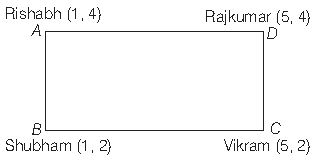
Based on the above information answer the following questions.
Question. The equation formed by Shubham and Rajkumar is
(a) x + 2y + 3 =0
(b) x −2y − 3 =0
(c) x −2y + 3 =0
(d) None of the above
Answer : C
Question. The equation formed by Rishabh and Vikram is
(a) x + 2y + 9 =0
(b) x + 2y −9 =0
(c) x −2y −9 =0
(d) None of the above
Answer : B
Question. The intersection point of above two equations is
(a) (1, 1)
(b) (2, 2)
(c) (3, 3)
(d) (4, 4)
Answer : C
Question. Slope of equation of line formed by Rishabh and Rajkumar is
(a) zero
(b) 1
(c) 2
(d) 3
Answer : A
Question. Pair for the same slope is
(a) Rishabh-Rajkumar and Shubham-Vikram
(b) Rishabh-Rajkumar and Rajkumar-Vikram
(c) Rishabh-Rajkumar andRishabh-Shubham
(d) None of the above
Answer : A
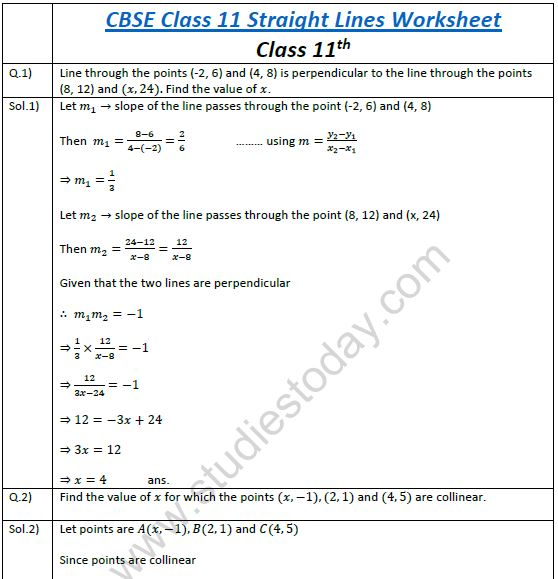
Question 1. Line through the points (-2, 6) and (4, 8) is perpendicular to the line through the points (8, 12) and (𝑥, 24). Find the value of 𝑥.
Answer: Let \( m_1 \) denote the slope of the line passing through the points \((-2, 6)\) and \((4, 8)\):
\( m_1 = \frac{8 - 6}{4 - (-2)} = \frac{2}{6} = \frac{1}{3} \)
Let \( m_2 \) be the slope of the line through the points \((8, 12)\) and \((x, 24)\):
\( m_2 = \frac{24 - 12}{x - 8} = \frac{12}{x - 8} \)
Since the two lines are perpendicular to each other:
\(\implies m_1 \cdot m_2 = -1\)
\(\implies \frac{1}{3} \times \frac{12}{x - 8} = -1\)
\(\implies \frac{12}{3x - 24} = -1\)
\(\implies 12 = -3x + 24\)
\(\implies 3x = 12\)
\(\implies x = 4\) ans.
In simple words: When two lines are perpendicular, multiplying their slopes gives \(-1\). We calculate the slope of both lines using their points, multiply them together, and solve the equation to find \( x \).
Exam Tip: To find the slope of a line passing through two points, always use the formula \(m = \frac{y_2 - y_1}{x_2 - x_1}\). Remember that perpendicular lines satisfy the condition \(m_1 \cdot m_2 = -1\).
Question 2. Find the value of 𝑥 for which the points (𝑥, −1), (2, 1) and (4, 5) are collinear.
Answer: Let the three points be defined as \( A(x, -1) \), \( B(2, 1) \), and \( C(4, 5) \).
Because these points lie on the same straight line (collinear):
The slope of segment \( AB \) must be equal to the slope of segment \( BC \):
\(\implies \frac{1 - (-1)}{2 - x} = \frac{5 - 1}{4 - 2}\)
\(\implies \frac{2}{2 - x} = \frac{4}{2}\)
\(\implies \frac{2}{2 - x} = 2\)
\(\implies 2 - x = 1\)
\(\implies x = 1\) ans.
In simple words: If three points are in a straight line, the slope between any two of them will be the same. We find the slope of the first two points and make it equal to the slope of the last two points to find \( x \).
Exam Tip: Collinearity can be solved either by equating slopes (\(\text{Slope of } AB = \text{Slope of } BC\)) or by setting the area of the triangle formed by the points to zero. The slope method is usually much quicker and less prone to calculation errors.
Question 3. Without using Pythagoras theorem, show that 𝐴(4, 4), 𝐵(3, 5) and 𝐶(−1, −1) are the vertices of a right angled triangle.
Answer: Let the given vertices be \( A(4, 4) \), \( B(3, 5) \), and \( C(1, 1) \).
The slope of side \( AB \), denoted as \( m_1 \), is calculated as:
\( m_1 = \frac{5 - 4}{3 - 4} = \frac{1}{-1} = -1 \)
The slope of side \( BC \), denoted as \( m_2 \), is:
\( m_2 = \frac{-1 - 5}{-1 - 3} = \frac{-6}{-4} = \frac{3}{2} \)
The slope of side \( AC \), denoted as \( m_3 \), is:
\( m_3 = \frac{-1 - 4}{-1 - 4} = \frac{-5}{-5} = 1 \)
We can see that the product of the slopes of \( AB \) and \( AC \) is \( -1 \):
\( m_1 \cdot m_3 = (-1) \cdot (1) = -1 \)
\(\implies AB \perp AC\)
Therefore, \( \Delta ABC \) is a right-angled triangle with the right angle at vertex \( A = 90^\circ \) ans.
In simple words: We find the slopes of all three sides of the triangle. Since the slope of side \( AB \) multiplied by the slope of side \( AC \) equals \(-1\), these two sides are perpendicular, meaning there is a \(90^\circ\) angle at vertex \( A \).
Exam Tip: To prove a triangle is right-angled without using the distance formula, simply show that the product of the slopes of any two sides is \(-1\). This indicates that those two sides are perpendicular.
Question 4. The slope of a line is double of the slope of another line. If tangent of the angle between them is \frac{1}{3} .Find the slopes of the lines.
Answer: Let the slope of the first line be denoted as \( m \).
Consequently, the slope of the second line is \( 2m \):
The angle \( \theta \) between the two lines satisfies the relation:
\( \tan\theta = \left| \frac{m_1 - m_2}{1 + m_1m_2} \right| \)
Substituting \( m_1 = m \), \( m_2 = 2m \), and \( \tan\theta = \frac{1}{3} \):
\( \frac{1}{3} = \left| \frac{m - 2m}{1 + 2m^2} \right| \)
\( \frac{1}{3} = \left| \frac{-m}{1 + 2m^2} \right| = \left| \frac{m}{1 + 2m^2} \right| \)
Eliminating the absolute value sign yields two cases:
\(\pm \frac{1}{3} = \frac{m}{1 + 2m^2}\)
Case 1: \(\frac{1}{3} = \frac{m}{1 + 2m^2}\)
\(\implies 1 + 2m^2 = 3m \implies 2m^2 - 3m + 1 = 0\)
\(\implies 2m^2 - 2m - m + 1 = 0 \implies 2m(m - 1) - 1(m - 1) = 0\)
\(\implies (m - 1)(2m - 1) = 0 \implies m = 1 \text{ or } m = \frac{1}{2}\)
Case 2: \(-\frac{1}{3} = \frac{m}{1 + 2m^2}\)
\(\implies -1 - 2m^2 = 3m \implies 2m^2 + 3m + 1 = 0\)
\(\implies 2m^2 + 2m + m + 1 = 0 \implies 2m(m + 1) + 1(m + 1) = 0\)
\(\implies (2m + 1)(m + 1) = 0 \implies m = -1 \text{ or } m = -\frac{1}{2}\)
Therefore, the possible slopes of the first line are \( 1 \), \( \frac{1}{2} \), \( -1 \), and \( -\frac{1}{2} \).
The corresponding slopes of the second line (being double) are \( 2 \), \( 1 \), \( -2 \), and \( -1 \) ans.
In simple words: We use the formula for the angle between two lines, substituting one slope as \( m \) and the other as \( 2m \). Since the angle has an absolute value, we solve both positive and negative cases to find all possible slopes.
Exam Tip: Do not forget that the absolute value in the angle formula \(\tan\theta = \left|\frac{m_1 - m_2}{1 + m_1 m_2}\right|\) leads to two distinct quadratic equations. Make sure you solve both to get all four sets of possible slopes.
Question 5. A ray of light passing through the point (1, 2) reflects on the 𝑋 − 𝑎𝑥𝑖𝑠 at point 𝐴 and the reflected ray passes through the point (5, 3). Find the coordinates of 𝐴.
Answer: Let the coordinates of the point of reflection \( A \) on the x-axis be \( (x, 0) \).
Let \( C(5, 3) \) be the point on the reflected ray. The slope of \( AC \) is:
\( m_{AC} = \frac{3 - 0}{5 - x} = \frac{3}{5 - x} \)
Using the angle of reflection \( \theta \), the slope of the line \( AC \) is also:
\(\tan\theta = \frac{3}{5 - x}\) ........... (i)
Let \( B(1, 2) \) be the point on the incident ray. The slope of the line \( AB \) is:
\( m_{AB} = \frac{2 - 0}{1 - x} = \frac{2}{1 - x} \)
The angle of incidence is \( 180^\circ - \theta \), so the slope of \( AB \) is:
\( \tan(180^\circ - \theta) = -\tan\theta \)
\(\implies -\tan\theta = \frac{2}{1 - x} \implies \tan\theta = \frac{-2}{1 - x}\) ........... (ii)
Equating the two expressions for \(\tan\theta\) from (i) and (ii):
\(\frac{3}{5 - x} = \frac{-2}{1 - x}\)
\(\implies 3(1 - x) = -2(5 - x) \implies 3 - 3x = -10 + 2x\)
\(\implies 13 = 5x \implies x = \frac{13}{5}\)
Thus, the required point is \( A\left(\frac{13}{5}, 0\right) \) ans.
In simple words: A light ray reflects off the x-axis, meaning the angle of the incoming ray and the outgoing ray with the x-axis are supplementary. We find the slopes of both lines, equate them with a negative sign, and solve for \( x \).
Exam Tip: In physics-based reflection problems, the angle of incidence equals the angle of reflection. This geometrically translates to \(m_{\text{incident}} = -m_{\text{reflected}}\) when reflecting off a horizontal axis.
Question 6. Find the equation of a line passing through the point (2, 2) and cutting of intercepts on the axis whose sum is 9.
Answer: Let the equation of the line in intercept form be:
\( \frac{x}{a} + \frac{y}{b} = 1 \)
Since the sum of the intercepts is \( 9 \), we have:
\( a + b = 9 \implies b = 9 - a \)
The coordinates \((2,2)\) must satisfy the equation of the line:
\( \frac{2}{a} + \frac{2}{9 - a} = 1 \)
\(\implies \frac{2(9 - a) + 2a}{a(9 - a)} = 1\)
\(\implies 18 = 9a - a^2\)
\(\implies a^2 - 9a + 18 = 0\)
\(\implies (a - 6)(a - 3) = 0 \implies a = 6 \text{ or } a = 3 \)
If \( a = 6 \), then \( b = 9 - 6 = 3 \). The equation is:
\( \frac{x}{6} + \frac{y}{3} = 1 \implies x + 2y = 6 \) ans.
If \( a = 3 \), then \( b = 9 - 3 = 6 \). The equation is:
\( \frac{x}{3} + \frac{y}{6} = 1 \implies 2x + y = 6 \) ans.
In simple words: We write the line in intercept form and use the fact that the two intercepts add up to \( 9 \). We plug in the point \((2,2)\) to solve for the intercepts, which gives us two possible equations.
Exam Tip: When you are given relations between intercepts, always use the intercept form \(\frac{x}{a} + \frac{y}{b} = 1\). This reduces the number of variables immediately and leads to straightforward quadratic equations.
Question 7. Find the equation of the line passing through the point of intersection of the lines 4𝑥 + 7𝑦 = 3 and 2𝑥 − 3𝑦 = -1 that has equal intercepts with axes.
Answer: The equations of the given lines are:
\( 4x + 7y = 3 \) ........... (i)
\( 2x - 3y = -1 \) ........... (ii)
By solving these two equations simultaneously, we find their point of intersection:
\( x = \frac{1}{13} \) and \( y = \frac{5}{13} \)
Thus, the lines intersect at the point \( \left(\frac{1}{13}, \frac{5}{13}\right) \).
Since the required line has equal intercepts on both axes, we can write its equation as:
\( \frac{x}{a} + \frac{y}{a} = 1 \implies x + y = a \)
Since this line passes through the intersection point:
\( \frac{1}{13} + \frac{5}{13} = a \implies a = \frac{6}{13} \)
Substituting this value of \( a \) back into our equation:
\( \frac{x}{\frac{6}{13}} + \frac{y}{\frac{6}{13}} = 1 \)
\(\implies \frac{13x}{6} + \frac{13y}{6} = 1\)
\(\implies 13x + 13y = 6 \) ans.
In simple words: First, we find where the two given lines cross each other. Since our new line has equal intercepts on both axes, its equation is simply \( x + y = a \). We plug in the crossing point to find \( a \) and get the final line.
Exam Tip: For lines with equal intercepts, always use the equation \(x + y = a\). This is much simpler than carrying around two separate variables.
Question 8. A line perpendicular to the line segment joining the points (1,0) and (2,3) divide it in the ratio 1: 𝑛. Find the equation of the line
Answer: Let \( A(1, 0) \) and \( B(2, 3) \) be the given points. The slope of the segment \( AB \) is:
\( m_{AB} = \frac{3 - 0}{2 - 1} = 3 \)
Since the required line \( CD \) is perpendicular to \( AB \), its slope is the negative reciprocal:
\(\text{Slope of } CD = -\frac{1}{3}\)
Let the line intersect \( AB \) at point \( D \), which divides the segment in the ratio \( 1:n \). Applying the section formula, we find the coordinates of \( D \):
\( D = \left(\frac{2 + n}{1 + n}, \frac{3}{1 + n}\right) \)
Now, using the point-slope form with the point \( D \) and slope \( -\frac{1}{3} \):
\( y - \frac{3}{1 + n} = -\frac{1}{3}\left(x - \frac{2 + n}{1 + n}\right) \)
\(\implies \frac{(1 + n)y - 3}{1 + n} = -\frac{1}{3}\left[\frac{x(1 + n) - 2 - n}{1 + n}\right]\)
\(\implies 3(1 + n)y - 9 = -(1 + n)x + 2 + n\)
\(\implies x(1 + n) + y(3n + 3) = 11 + n\) ans.
In simple words: First, we find the slope of the line connecting the two points, and then find the perpendicular slope. We use the section formula to find the exact point where our new line cuts the segment, and then write its equation.
Exam Tip: This problem combines the section formula with perpendicular lines. Be careful with algebraic simplification when coordinates and slopes contain the parameter \(n\) - group the \(x\) and \(y\) terms clearly at the end.
Question 9. Find the coordinates of the foot of perpendicular from the point (-1, 3) to the line 3𝑥 − 4𝑦 − 16 = 0.
Answer: Let the given line be \( AB \): \( 3x - 4y - 16 = 0 \) ........... (i)
The slope of this line \( AB \) is:
\(\text{Slope} = \frac{-3}{-4} = \frac{3}{4}\)
Since the perpendicular line \( CD \) from point \( C(-1, 3) \) is perpendicular to \( AB \), its slope is:
\(\text{Slope of } CD = -\frac{4}{3}\)
Using the point-slope form with the point \( C(-1, 3) \) and slope \( -\frac{4}{3} \), we find the equation of \( CD \):
\( y - 3 = -\frac{4}{3}(x + 1) \)
\(\implies 3y - 9 = -4x - 4\)
\(\implies 4x + 3y = 5\) ........... (ii)
To find the coordinates of the foot of the perpendicular \( D \), we solve equations (i) and (ii) simultaneously:
We get \( x = \frac{68}{25} \) and \( y = -\frac{49}{25} \).
Thus, the coordinates of the foot of the perpendicular are \( D\left(\frac{68}{25}, -\frac{49}{25}\right) \).
In simple words: We find the equation of the line that is perpendicular to the given line and passes through the point \((-1,3)\). The point where these two lines intersect is the foot of the perpendicular.
Exam Tip: The foot of the perpendicular is simply the point of intersection of the given line and the perpendicular line passing through the given point. Alternatively, you can use the direct formula: \(\frac{x - x_1}{a} = \frac{y - y_1}{b} = -\frac{ax_1 + by_1 + c}{a^2 + b^2}\).
Question 10. The vertices of a triangle are 𝐴(10, 4), 𝐵(−4, 9) and 𝐶(−2, −1). Find the equations of its altitudes. Also find its ORTHOCENTRE.
Answer: The orthocentre of a triangle is defined as the point of intersection of its three altitudes.
First, let's find the equation of the altitude \( AD \) from vertex \( A(10, 4) \) to side \( BC \):
Slope of \( BC = \frac{-1 - 9}{-2 - (-4)} = -5 \)
Since \( AD \perp BC \), the slope of \( AD = \frac{1}{5} \).
The equation of \( AD \) using the point \( A(10, 4) \) is:
\( y - 4 = \frac{1}{5}(x - 10) \)
\(\implies 5y - 20 = x - 10\)
\(\implies x - 5y = -10\) ........... (i)
Next, let's find the equation of the altitude \( BE \) from vertex \( B(-4, 9) \) to side \( AC \):
Slope of \( AC = \frac{-1 - 4}{-2 - 10} = \frac{5}{12} \)
Since \( BE \perp AC \), the slope of \( BE = -\frac{12}{5} \).
The equation of \( BE \) using the point \( B(-4, 9) \) is:
\( y - 9 = -\frac{12}{5}(x + 4) \)
\(\implies 5y - 45 = -12x - 48\)
\(\implies 12x + 5y = -3\) ........... (ii)
Similarly, the equation of the third altitude \( CF \) is calculated as:
\( 14x - 5y = -23 \) ........... (iii)
So the equations of the altitudes are:
\( AD = x - 5y = -10 \), \( BF = 12x + 5y = -3 \), and \( CF = 14x - 5y = -23 \).
To find the coordinates of the orthocentre, we solve any two of these altitude equations simultaneously (for example, (i) and (ii)):
Solving \( x - 5y = -10 \) and \( 12x + 5y = -3 \):
We get \( x = -1 \) and \( y = \frac{9}{5} \).
Thus, the orthocentre of the triangle is \( \left(-1, \frac{9}{5}\right) \) ans.
In simple words: An altitude is a perpendicular line from a corner of a triangle to the opposite side. We find the equations of these perpendicular lines and find where they cross to get the orthocentre.
Exam Tip: The orthocentre is the intersection of the altitudes. You only need to find the equations of any two altitudes and solve them simultaneously to get the orthocentre - finding the third altitude is a great way to verify your answer.
Click on link below to download CBSE Class 11 Mathematics Straight Lines Worksheet (2).
Free study material for Mathematics
CBSE Class 11 Mathematics Worksheets for Chapter 09 Straight Lines
Practice Exercises for Class 11 Mathematics Chapter 09 Straight Lines
Access structured practice worksheets for Chapter 09 Straight Lines aligned with the 2026 CBSE curriculum. These downloadable exercises for Class 11 Mathematics help students build accuracy and reinforce core concepts for upcoming school tests.
Step-by-Step Solutions and Practice Guidelines
Built using official NCERT guidelines for Class 11 Mathematics, these practice sheets provide reliable academic support. Cross-reference your completed work with our detailed solutions to learn standard answer-writing formats for CBSE exams.
Enhance Speed with Online Practice
Follow up your worksheet practice by attempting the interactive online MCQ tests for Chapter 09 Straight Lines to evaluate your execution speed. All printable assignments and revision sheets on our platform are updated for the 2026 session and available free of charge.
FAQs
You can download the latest chapter-wise printable worksheets for Class 11 Mathematics Chapter 09 Straight Lines for free from StudiesToday.com. These have been made as per the latest CBSE curriculum for this academic year.
Yes, Class 11 Mathematics worksheets for Chapter 09 Straight Lines focus on activity-based learning and also competency-style questions. This helps students to apply theoretical knowledge to practical scenarios.
Yes, we have provided solved worksheets for Class 11 Mathematics Chapter 09 Straight Lines to help students verify their answers instantly.
Yes, our Class 11 Mathematics test sheets are mobile-friendly PDFs and can be printed by teachers for classroom.
For Chapter 09 Straight Lines, regular practice with our worksheets will improve question-handling speed and help students understand all technical terms and diagrams.