

Download Class 11 Biology Practice Worksheets
Access comprehensive chapter-wise worksheets for Chapter 08 Cell The Unit of Life using the CBSE Class 11 Biology Cell The Unit Of Life Worksheet. Designed to align with the 2026-27 academic syllabus for Class 11 Biology, these printable practice sets help students reinforce key concepts and improve their overall exam readiness.
Access Chapter 08 Cell The Unit of Life Practice Papers and Solutions
Access the complete worksheet PDF for Class 11 Biology below. Regular practice with these targeted academic tasks builds familiarity with standard question patterns and helps secure higher marks in final school examinations.
Question. A cell organelle containing hydrolytic enzymes is
(a) lysosome
(b) microsome
(c) ribosome
(d) mesosome.
Answer. A
Question. Mitochondria and chloroplast are
(A) semi-autonomous organelles
(B) formed by division of pre-existing organelles and they contain DNA but lack protein synthesising machinery.
Which one of the following options is correct?
(a) (A) is true but (B) is false.
(b) Both (A) and (B) are false.
(c) Both (A) and (B) are correct.
(d) (B) is true but (A) is false.
Answer. A
Question. Microtubules are the constituents of
(a) centrioles, spindle fibres and chromatin
(b) centrosome, nucleosome and centrioles
(c) cilia, flagella and peroxisomes
(d) spindle fibres, centrioles and cilia.
Answer. D
Question. Which one of the following cell organelles is enclosed by a single membrane?
(a) Lysosomes
(b) Nuclei
(c) Mitochondria
(d) Chloroplasts
Answer. A
Question. Water soluble pigments found in plant cell vacuoles are
(a) carotenoids
(b) anthocyanins
(c) xanthophylls
(d) chlorophylls.
Answer. B
Question. Match the columns and identify the correct option.
Column I Column II
A. Thylakoids (i) Disc-shaped sacs in Golgi apparatus
B. Cristae (ii) Condensed structure of DNA
C. Cisternae (iii) Flat membranous sacs in stroma
D. Chromatin (iv) Infoldings in mitochondria
(a) A-(iii), B-(i), C-(iv), D-(ii)
(b) A-(iii), B-(iv), C-(ii), D-(i)
(c) A-(iv), B-(iii), C-(i), D-(ii)
(d) A-(iii), B-(iv), C-(i), D-(ii)
Answer. D
Question. Cellular organelles with membranes are
(a) endoplasmic reticulum, ribosomes and nuclei
(b) lysosomes, Golgi apparatus and mitochondria
(c) nuclei, ribosomes and mitochondria
(d) chromosomes, ribosomes and endoplasmic reticulum.
Answer. B
Question. Which of the following are not membrane bound?
(a) Lysosomes
(b) Mesosomes
(c) Vacuoles
(d) Ribosomes
Answer. D
Question. DNA is not present in
(a) nucleus
(b) mitochondria
(c) chloroplast
(d) ribosomes.
Answer. D
Question. Nuclear envelope is a derivative of
(a) microtubules
(b) rough endoplasmic reticulum
(c) smooth endoplasmic reticulum
(d) membrane of Golgi complex.
Answer. B
Question. The structures that are formed by stacking of organised flattened membranous sacs in the chloroplasts are
(a) stroma lamellae
(b) stroma
(c) cristae
(d) grana.
Answer. D
Question. Select the correct matching in the following pairs.
(a) Rough ER – Synthesis of glycogen
(b) Rough ER – Oxidation of fatty acids
(c) Smooth ER – Oxidation of phospholipids
(d) Smooth ER – Synthesis of lipids
Answer. D
Question. The chromosomes in which centromere is situated close to one end are
(a) telocentric
(b) sub-metacentric
(c) metacentric
(d) acrocentric.
Answer. D
Question. The solid linear cytoskeletal elements having a diameter of 6 nm and made up of a single type of monomer are known as
(a) microtubules
(b) microfilaments
(c) intermediate filaments
(d) lamins.
Answer. B
Question. The osmotic expansion of a cell kept in water is chiefly regulated by
(a) mitochondria
(b) vacuoles
(c) plastids
(d) ribosomes.
Answer. B
Question. Match the following and select the correct answer.
(A) Centriole (i) lnfoldings in mitochondria
(B) Chlorophyll (ii) Thylakoids
(C) Cristae (iii) Nucleic acids
(D) Ribozymes (iv) Basal body of cilia or flagella
A B C D
(a) (iv) (ii) (i) (iii)
(b) (i) (ii) (iv) (iii)
(c) (i) (iii) (ii) (iv)
(d) (iv) (iii) (i) (ii)
Answer. A
Question. The Golgi complex plays a major role
(a) as energy transferring organelles
(b) in post translational modification of proteins and glycosylation of lipids
(c) in trapping the light and transforming it into chemical energy
(d) in digesting proteins and carbohydrates.
Answer. B
Question. Which one of the following organelle in the figure correctly matches with its function?
(a) Golgi apparatus, formation of glycolipids
(b) Rough endoplasmic reticulum, protein synthesis
(c) Rough endoplasmic reticulum, formation of glycoproteins
(d) Golgi apparatus, protein synthesis
Answer. B
Question. A major site for synthesis of lipids is
(a) symplast
(b) nucleoplasm
(c) RER
(d) SER
Answer. D
Question. Which of the following types of plastid does not contain stored food material?
(a) Chromoplasts
(b) Elaioplasts
(c) Aleuroplasts
(d) Amyloplasts
Answer. A
Question. Select the correct statement from the following regarding cell membrane.
(a) Na+ and K+ ions move across cell membrane by passive transport.
(b) Proteins make up 60 to 70% of the cell membrane.
(c) Lipids are arranged in a bilayer with polar heads towards the inner part.
(d) Fluid mosaic model of cell membrane was proposed by Singer and Nicolson.
Answer. D
Question. What is true about ribosomes?
(a) The prokaryotic ribosomes are 80S, where “S” stands for sedimentation coefficient.
(b) These are composed of ribonucleic acid and proteins.
(c) These are found only in eukaryotic cells.
(d) These are self-splicing introns of some RNAs.
Answer. B
Question. Which one of the following does not differ in E.coli and Chlamydomonas?
(a) Ribosomes
(b) Chromosomal organization
(c) Cell wall
(d) Cell membrane
Answer. D
Question. Which one of the following cellular parts is correctly described?
(a) Thylakoids - flattened membranous sacs forming the grana of chloroplasts
(b) Centrioles - sites for active RNA synthesis
(c) Ribosomes - those on chloroplasts are larger (80S) while those in the cytoplasm are smaller (70S)
(d) Lysosomes - optimally active at a pH of about 8.5
Answer. A
Question. Which one of the following structures is an organelle within an organelle?
(a) Ribosome
(b) Peroxisome
(c) ER
(d) Mesosome
Answer. A
Question. Peptide synthesis inside a cell takes place in
(a) chloroplast
(b) mitochondria
(c) chromoplast
(d) ribosomes.
Answer. D
Question. Important site for formation of glycoproteins and glycolipids is
(a) vacuole
(b) Golgi apparatus
(c) plastid
(d) lysosome.
Answer. B
Question. Which one of the following is not considered as a part of the endomembrane system?
(a) Golgi complex
(b) Peroxisome
(c) Vacuole
(d) Lysosome
Answer. B
Question. The plasma membrane consists mainly of
(a) phospholipids embedded in a protein bilayer
(b) proteins embedded in a phospholipid bilayer
(c) proteins embedded in a polymer of glucose molecules
(d) proteins embedded in a carbohydrate bilayer.
Answer. B
Question. The main area of various types of activities of a cell is
(a) plasma membrane
(b) mitochondrion
(c) cytoplasm
(d) nucleus.
Answer. C
Question. The branch of biology dealing with structure, function and reproduction of cell is
(a) cytology
(b) anatomy
(c) histology
(d) cell biology
Answer. D
Question. Name the scientist, who saw a live cell first time.
(a) Robert Brown
(b) Antonie van Leeuwenhoek
(c) RobertWhite
(d) Schleiden
Answer. B
Question. Robert Hooke used the term cell in the year
(a) 1664
(b) 1665
(c) 1666
(d) 1667
Answer. B
Question. Robert Hooke developed a microscope using which he studied the internal structure of
(a) cork cells
(b) onion peel cells
(c) human cheek cells
(d) blood cells
Answer. A
Question. Identify the correct statements.
I. Division of labour is a result of differentiation occurring in the different types of tissues, organs and organ systems.
II. A new cell always develops by the division of pre-existing cells.
III. Cells are totipotent.
IV. Cell is the smallest unit, capable of independent existence and performing the essential functions of life.
Choose the correct option.
(a) I, II and III
(b) I, III and IV
(c) II, III and IV
(d) I, II, III and IV
Answer. B
Question. Cell theory was formulated by
(a) Schleiden and Schwann
(b) Rudolf Virchow
(c) Robert Brown
(d) Robert Hooke
Answer. A
Question. ‘Omnis cellula-e-cellula (all cells arise from pre-existing cells). Who gave this concept and modified the cell theory?
(a) Schleiden and Schwann
(b) Virchow
(c) Robert Brown
(d) Leeuwenhoek
Answer. B
Question. The cell theory, jointly given by Schleiden and Schwann did not explain
(a) all living organisms are composed of cells and their products
(b) cell is the structural and functional unit of living organisms
(c) formation of new cells
(d) None of the above
Answer. C
Question. Which of the following represents the incorrect pair?
Answer. C
Question. Which of the following represents prokaryotic cells?
(a) PPLO
(b) Mycoplasma
(c) Bacteria
(d) All of the above
Answer. D
Question. The genetic material of prokaryotic cell
(a) possess small circular DNA called plasmids
(b) is not enveloped by nuclear membrane
(c) composed of a single circular DNAmolecule
(d) All of the above
Answer. D
Question. The cell envelope of bacteria is composed of
(a) outermost cell wall followed by glycocalyx and plasma membrane
(b) plasma membrane and cell wall
(c) outermost glycocalyx followed by cell wall and plasma membrane
(d) plasma membrane
Answer. C
Question. Choose the incorrect pair.
(a) Gram-positive bacteria–Take up the Gram stain
(b) Cell wall–Prevents bacterium from collapsing
(c) Capsule–Thick and tough glycocalyx
(d) Pili– Locomotory structure in bacteria
Answer. D
Question. What is true about mesosomes?
(a) Help in cell wall formation
(b) Help in cellular respiration
(c) Help in DNA replication
(d) All of the above
Answer. D
Question. Mesosomes are the infoldings of cell membrane, which
I. are in the form of vesicles tubules and lamellae.
II. increase the surface area of plasma membrane.
III. are present in both prokaryotic and eukaryotic cells.
Which of the following option is most appropriate?
(a) II and III
(b) I and II
(c) I and III
(d) I, II and III
Answer. B
Question. The longest portion in a bacterial flagellum is
(a) hook
(b) basal body
(c) filament
(d) pili
Answer. C
Question. Which one of the following is not an inclusion body found in prokaryotes?
(a) Cyanophycean granule
(b) Glycogen granule
(c) Polysome
(d) Phosphate granule
Answer. C
Question. What is the function of polysome?
(a) Active protein synthesis
(b) Formation of multiple copies of same polypeptide
(c) Both (a) and (b)
(d) None of the above
Answer. C
Question. Which of the following features is common to prokaryotes and many eukaryotes?
(a) Cell wall is present
(b) Chromosomes are present
(c) Subcellular organelles are present
(d) Nuclear membrane is present
Answer. A
Question. The following diagram shows some of the missing structures in a plant cell (A-E). Identify the structures.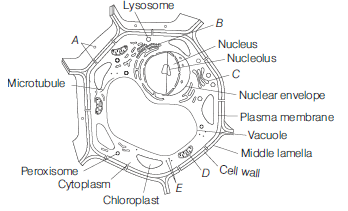
(a) A–Plasmodesmata, B–Rough endoplasmic reticulum, C–Golgi apparatus,D–Mitochondrion, E–Ribosomes
(b) A–Desmosome, B–Rough endoplasmic reticulum, C–Golgi apparatus,D–Mitochondrion, E–Ribosomes
(c) A–Plasmodesmata, B–Smooth endoplasmic reticulum, C–Golgi apparatus,D–Mitochondrion, E–Ribosomes
(d) A–Tight junction, B–Rough endoplasmic reticulum, C–Golgi apparatus,D–Mitochondrion, E–Ribosomes
Answer. A
Question. The following diagram shows some of the missing structures in an animal cell (A-E). Identify the structures.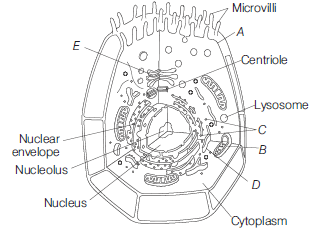
(a) A–Plasma membrane, B–Rough endoplasmic reticulum, C–Ribosomes,D–Mitochondrion, E–Golgi apparatus
(b) A–Plasma membrane, B–Mitochondrion,C–Ribosomes, D–Rough endoplamic reticulum, E–Golgi apparatus
(c) A–Plasma membrane, B–Mitochondria,C–Ribosomes, D–Smooth endoplasmic reticulum, E–Golgi apparatus
(d) A–Plasma membrane, B–Mitochondria,C–Golgi apparatus, D–Smooth endoplasmic reticulum, E–Ribosomes
Answer. C
Question. Which one of the following differentiates plant cells from animal cells?
(a) Large vacuole, plastid and cell wall
(b) Cell wall, plastid and centriole
(c) Cell wall, plastid and mitochondria
(d) Cell membrane, plastid and cell wall
Answer. A
Question. Most abundant lipid in cell membrane is
(a) phospholipid
(b) starch
(c) oil
(d) sulpholipid
Answer. A
Question. Each phospholipid molecule in a cell membrane consists of one polar head and two non-polar tails.
(a) True
(b) False
(c) Cannot say
(d) Partially true or false
Answer. A
Question. A student made a pictorial representation of a eukaryotic cell membrane and labelled the components as follows.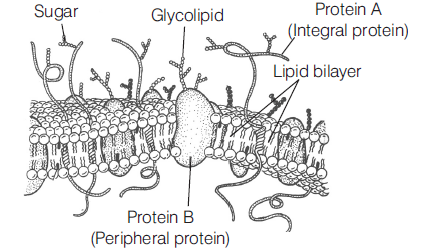
The student has made errors while labelling the components of membrane.
Which of the following statements hold true regarding the error?
I. Protein A should be labelled as trans-membrane protein only and not as integral protein.
II. The polarity of the protein A should be reversed because the cytosolic phase always shows reducing environment.
III. Glycolipid should be labelled as glycoprotein.
IV. Protein B should be labelled as integral membrane protein and not as peripheral glycoprotein.
(a) I and II
(b) III and IV
(c) II and III
(d) I and IV
Answer. B
Question. Which of the following organelles contain enzymes that have digestive action?
(a) Ribosomes
(b) Polysomes
(c) Plastids
(d) Lysosomes
Answer: D
Question. In mitochondria, cristae act as sites for
(a) protein synthesis
(b) phosphorylation of flavoproteins
(c) breakdown of macromolecules
(d) oxidation-reduction reaction.
Answer: D
Question. Centromere is required for
(a) replication of DNA
(b) chromosome segregation
(c) poleward movement of chromosomes
(d) cytoplasmic cleavage.
Answer: C
Question. Which one of the following organelles is located near the nucleus and contains a collection of flattened membrane bound cisternae?
(a) Nucleolus
(b) Mitochondrion
(c) Centriole
(d) Golgi apparatus
Answer: D
Question. The inner membrane of the mitochondria is, usually, highly convoluted forming a series of infoldings known as
(a) thylakoids
(b) lamellae
(c) cristae
(d) grana.
Answer: C
Question. Besides giving out secretory vesicles, the Golgi apparatus is also concerned with the formation of
(a) lysosomes
(b) plastids
(c) grana of chloroplasts
(d) cell plates after cell division in plants.
Answer: A
Question. Active and passive transports across cell membrane differ in
(a) passive transport is nonselective
(b) passive transport is along the concentration gradient while active transport is due to metabolic energy
(c) active transport is more rapid
(d) passive transport is confined to anions while active transport is confined to cations.
Answer: B
Question. Balbiani rings (puffs) are sites of
(a) DNA replication
(b) RNA and protein synthesis
(c) synthesis of polysaccharides
(d) synthesis of lipids.
Answer: B
Question. In plant cells, peroxisomes are associated with
(a) photorespiration
(b) phototropism
(c) photoperiodism
(d) photosynthesis.
Answer: A
Question. Membranous bag with hydrolytic enzymes which is used for controlling intracellular digestion of macromolecules is
(a) endoplasmic reticulum
(b) nucleosome
(c) lysosome
(d) phagosome.
Answer: C
Question. Golgi apparatus is absent in
(a) higher plants
(b) yeast
(c) bacteria and blue-green algae
(d) none.
Answer: C
Question. Cell recognition and adhesion occur due to biochemicals of cell membranes named
(a) proteins
(b) lipids
(c) proteins and lipids
(d) glycoproteins and glycolipids.
Answer: D
Question. In salivary gland chromosomes/polytene chromosomes, pairing is
(a) absent
(b) occasional
(c) formed between non-homologous chromosomes
(d) formed between homologous chromosomes.
Answer: D
Question. All types of plastids possess essentially the same structure because they
(a) perform the same function
(b) store food materials like starch, fat and protein
(c) occur in aerial parts
(d) can transform from one form to another.
Answer: D
Question. Experiments on Acetabularia by Hammerling proved the role of
(a) cytoplasm in controlling differentiation
(b) nucleus in heredity
(c) chromosomes in heredity
(d) nucleo-cytoplasmic ratio.
Answer: B
Question. Which one is apparato reticolare?
(a) Golgi apparatus
(b) Endoplasmic reticulum
(c) Microfilaments
(d) Microtubules
Answer: A
Question. An outer covering membrane is absent over
(a) nucleolus
(b) lysosome
(c) mitochondrion
(d) plastid.
Answer: A
Question. All plastids have similar structure because they can
(a) store starch, lipids and proteins
(b) get transformed from one type to another
(c) perform same function
(d) be present together.
Answer: B
Question. Oxysomes or F0 – F1 particles occur on
(a) thylakoids
(b) mitochondrial surface
(c) inner mitochondrial membrane
(d) chloroplast surface.
Answer: C
Question. Ribosomes are the centre for
(a) respiration
(b) photosynthesis
(c) protein synthesis
(d) fat synthesis.
Answer: C
Question. Which is distributed more widely in a cell?
(a) DNA
(b) RNA
(c) Chloroplasts
(d) Sphaerosomes
Answer: B
Question. Addition of new cell wall particles amongst the existing ones is
(a) deposition
(b) apposition
(c) intussusception
(d) aggregation.
Answer: C
Question. Cell wall shows
(a) complete permeability
(b) semipermeability
(c) differential permeability
(d) impermeability.
Answer: A
Question. Ribosomes were discovered by
(a) Golgi
(b) Porter
(c) de Robertis
(d) Palade.
Answer: D
Question. Fluid mosaic model of cell membrane was put forward by
(a) Danielli and Davson
(b) Singer and Nicolson
(c) Garner and Allard
(d) Watson and Crick.
Answer: B
Question. Hammerling’s experiments of Acetabularia involved exchanging
(a) cytoplasm
(b) nucleus
(c) rhizoid and stalk
(d) gametes.
Answer: C
Question. The latest model for plasma membrane is
(a) lamellar model
(b) unit membrane model
(c) fluid mosaic model
(d) molecular lipid model.
Answer: C
Question. Nucleoproteins are synthesised in
(a) nucleoplasm
(b) nuclear envelope
(c) nucleolus
(d) cytoplasm.
Answer: D
Question. Polyribosomes are aggregates of
(a) ribosomes and rRNA
(b) only rRNA
(c) peroxisomes
(d) several ribosomes held together by string of mRNA.
Answer: D
Question. Plasma membrane is made of
(a) proteins and carbohydrates
(b) proteins and lipids
(c) proteins, lipids and carbohydrates
(d) proteins, some nucleic acid and lipids.
Answer: C
Question. Acetabularia used in Hammerling’s nucleocytoplasmic experiments is
(a) unicellular fungus
(b) multicellular fungus
(c) unicellular uninucleate green algae
(d) unicellular multinucleate green algae.
Answer: C
Question. According to fluid mosaic model, plasma membrane is composed of
(a) phospholipids and oligosaccharides
(b) phospholipids and hemicellulose
(c) phospholipids and integral proteins
(d) phospholipids, extrinsic proteins and intrinsic proteins.
Answer: D
Free study material for Biology
Download Class 11 Biology Chapter 08 Cell The Unit of Life Practice Worksheets
Download Chapter Worksheets: Class 11 Biology
Review targeted practice exercises for Class 11 Biology Chapter 08 Cell The Unit of Life. Curated to match official CBSE guidelines, these printable problem sets support daily revision and improve overall test readiness.
Concept Clarification for Chapter 08 Cell The Unit of Life
Built using official NCERT guidelines for Class 11 Biology, these practice sheets provide reliable academic support. Cross-reference your completed work with our detailed solutions to learn standard answer-writing formats for CBSE exams.
Effective Revision Strategies for School Exams
Wrap up your chapter revision by testing your knowledge against standard objective question formats. Explore our full library of free, up-to-date printable assignments to maximize your academic results in upcoming CBSE evaluations.
FAQs
You can download the latest chapter-wise printable worksheets for Class 11 Biology Chapter 08 Cell The Unit of Life for free from StudiesToday.com. These have been made as per the latest CBSE curriculum for this academic year.
Yes, Class 11 Biology worksheets for Chapter 08 Cell The Unit of Life focus on activity-based learning and also competency-style questions. This helps students to apply theoretical knowledge to practical scenarios.
Yes, we have provided solved worksheets for Class 11 Biology Chapter 08 Cell The Unit of Life to help students verify their answers instantly.
Yes, our Class 11 Biology test sheets are mobile-friendly PDFs and can be printed by teachers for classroom.
For Chapter 08 Cell The Unit of Life, regular practice with our worksheets will improve question-handling speed and help students understand all technical terms and diagrams.