

Download Class 11 Biology Practice Worksheets
Access comprehensive chapter-wise worksheets for Chapter 04 Animal Kingdom using the CBSE Class 11 Biology Animal Kingdom Worksheet. Designed to align with the 2026-27 academic syllabus for Class 11 Biology, these printable practice sets help students reinforce key concepts and improve their overall exam readiness.
Access Chapter 04 Animal Kingdom Practice Papers and Solutions
Navigate directly to the solved Biology worksheets using the digital viewer below. Each practice set includes detailed step-by-step solutions, allowing students to instantly cross-check their work and identify areas requiring further revision.
Important Questions for NCERT Class 11 Biology Animal Kingdom
Question. Metamorphosis of insects is regulated through hormone
(a) pheromone
(b) thyroxine
(c) ecdysone
(d) all of these.
Answer. C
Question. Classification of Porifera is based on
(a) branching
(b) spicules
(c) reproduction
(d) symmetry.
Answer. B
Question. The excretory structures of flatworms/ Taenia are
(a) flame cells
(b) protonephridia
(c) Malpighian tubules
(d) green glands.
Answer. A
Question. Bladderworm/cysticercus is the larval stage of
(a) tapeworm
(b) roundworm
(c) pinworm
(d) liver fluke.
Answer. A
Question. Ecdysis is shedding of
(a) stratum corneum
(b) epidermis
(c) dermis
(d) stratum malpighi
Answer. A
Question. Penguin occurs in
(a) Australia
(b) Antarctica
(c) Africa
(d) America.
Answer. B
Question. Kala-azar and Oriental Sore are spread by
(a) housefly
(b) bed bug
(c) sand fly
(d) fruit fly.
Answer. C
Question. Malpighian tubules are
(a) excretory organs of insects
(b) excretory organs of annelids
(c) respiratory organs of insects
(d) respiratory organs of annelids.
Answer. A
Question. Taenia saginata differs from Taenia solium in
(a) absence of scolex hooks
(b) absence of scolex hooks and uterine branching
(c) absence of scolex hooks and presence of both male and female reproductive organs
(d) presence of scolex hooks.
Answer. A
Question. Onchosphere occurs in
(a) Ascaris
(b) Fasciola
(c) Taenia
(d) Planaria.
Answer. C
Question. Eutherians are characterised by
(a) hairy skin
(b) true placentation
(c) ovoviviparity
(d) glandular skin.
Answer. B
Question. Wish bone of birds is from
(a) pelvic girdle
(b) skull
(c) hind limbs
(d) pectoral girdle/clavicles.
Answer. D
Question. Flight muscles of bird are attached to
(a) clavicle
(b) keel of sternum
(c) scapula
(d) coracoid.
Answer. B
Question. A chordate character is
(a) gills
(b) spiracles
(c) post-anal tail
(d) chitinous exoskeleton.
Answer. C
Question. Transfer of Taenia to secondary host occurs as
(a) oncosphere
(b) cysticercus
(c) morula
(d) egg.
Answer. A
Question. Jelly fish belongs to Class
(a) Hydrozoa
(b) Scyphozoa
(c) Anthozoa
(d) none of these.
Answer. B
Question. Fish which can be used in biological control of mosquitoes/larvicidal fish is
(a) Eel
(b) carp
(c) cat fish
(d) Gambusia.
Answer. D
Question. Hair occur in all mammals except those of
(a) rodentia
(b) chiroptera
(c) primata
(d) cetacea.
Answer. D
Question. Bird vertebrae are
(a) acoelous
(b) heterocoelous
(c) amphicoelous
(d) procoelous.
Answer. B
Question. Feet of kingfisher are modified for
(a) wading
(b) perching
(c) running
(d) catching.
Answer. A
Question. Both male and female pigeons secrete milk through
(a) salivary glands
(b) modified sweat glands
(c) crop
(d) gizzard.
Answer. C
Question. Typhlops is
(a) sea snake
(b) glass snake
(c) blind snake
(d) grass snake.
Answer. C
Question. Necturus is
(a) hell bender
(b) congo eel
(c) mud puppy
(d) blind worm.
Answer. C
Question. Fire bellied toad is
(a) Amphiuma
(b) Bombina
(c) Necturus
(d) Salamandra.
Answer. B
Question. Which is not a true amphibian animal?
(a) Salamander
(b) Toad
(c) Tortoise
(d) Frog
Answer. C
Question. A wood boring mollusc/shipworm is
(a) Chiton
(b) Teredo
(c) Limax
(d) Patella.
Answer. B
Question. Organ Pipe Coral is
(a) Tubipora
(b) Astraea
(c) Helipora
(d) Fungia.
Answer. A
Question. In most simple type of canal system of Porifera, water flows through which one of the following way?
(a) Ostia→Spongocoel→Osculum→Exterior
(b) Spongocoel→Ostia→Osculum→Exterior
(c) Osculum→Spongocoel→Ostia→Exterior
(d) Osculum→Ostia→Spongocoel→Exterior
Answer. A
Question. In case of poriferans, the spongocoel is lined with flagellated cells called
(a) ostia
(b) oscula
(c) choanocytes
(d) mesenchymal cells
Answer. C
Question. The skeleton of animals belonging to phylum—Porifera are made up of
(a) spicules
(b) spiracles
(c) calcareous shells
(d) keratin fibres
Answer. A
Question. Examine the figures A, B and C. In which one of the four options, all the animals (poriferans) are correct?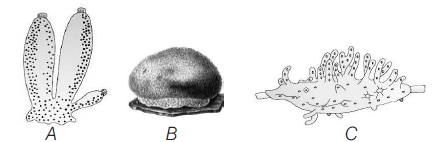
(a) A–Sycon, B–Euspongia, C–Spongilla
(b) A–Euspongia, B–Spongilla, C–Sycon
(c) A–Spongilla, B–Sycon, C–Euspongia
(d) A–Euspongia, B–Sycon, C–Spongilla
Answer. A
Question. Which of the following is not true regarding phylum– Coelenterata?
(a) They are diploblastic animals
(b) They have cellular level of organisation
(c) They have nematocyte cells present on the tentacles
(d) The gastrovascular opening is called the hypostome
Answer. B
Question. Metagenesis is observed in
(a) Hydra
(b) Sycon
(c) Obelia
(d) Adamsia
Answer. C
Question. Body forms present in cnidarians are
(a) cylindrical and umbrella-shaped
(b) corals and coral reefs
(c) polyp and medusa
(d) cnidoblasts and nematocysts
Answer. C
Question. Choose the correct option for the following diagram.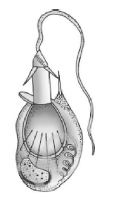
(a) It represents choanocyte in Porifera
(b) It represents cnidoblasts in Platyhelminthes
(c) It represents cnidoblast in Coelenterata
(d) It represents choanocyte in Coelenterata
Answer. C
Question. Match the animals in Column I with common names in Column II and choose the correct option from the codes given below.
Column I Column II
A. Obelia 1. Portuguese man of war
B. Meandrina 2. Sea fan
C. Gorgonia 3. Sea fur
D. Physalia 4. Brain coral
Codes
A B C D
(a) 1 3 2 4
(b) 1 2 4 3
(c) 3 4 2 1
(d) 3 1 2 4
Answer. C
Question. Comb jellies is the name given to phylum
(a) Echinodermata
(b) Ctenophora
(c) Annelida
(d) Mollusca
Answer. B
Question. Identifying feature of phylum– Ctenophora is
(a) the presence of comb plates and appearance like jellies
(b) the presence of comb plates only
(c) the presence of tentacles only
(d) alternation of generations only
Answer. A
Question. Bioluminescence is a characteristic feature of phylum
(a) Ctenoplana
(b) Coelenterata
(c) Ctenophora
(d) Mollusca
Answer. C
Question. Reproduction in Ctenoplana takes place by
(a) budding
(b) sexual reproduction
(c) binary fission
(d) multiple fission
Answer. B
Question. The level of organisation in Platyhelminthes is
(a) cellular level
(b) tissue level
(c) organ level
(d) organ system level
Answer. C
Question. Match the following columns.
Column I Column II
(Specialised cells or parts) (Animal phyla)
A. Choanocytes 1. Platyhelminthes
B. Cnidoblasts 2. Ctenophora
C. Flame cells 3. Porifera
D. Comb plates 4. Coelenterata
Codes
A B C D
(a) 2 1 4 3
(b) 2 4 1 3
(c) 2 1 3 4
(d) 3 4 1 2
Answer. D
Question. Platyhelminthes have hooks and suckers and act as an endoparasite on other animals.
(a) True
(b) False
(c) Cannot say
(d) Partially true or false
Answer. A
Question. Aschelminthes are usually
(a) dioecious
(b) hermaphrodites
(c) metagenic
(d) coelomates
Answer. A
Question. Identify the correct statement describing Wuchereria?
I. Triploblastic with the presence of an excretory pore.
II. Presence of a muscular pharynx.
III. Cellular level of organisation.
IV. Males longer than females.
(a) II and III
(b) I and IV
(c) I and II
(d) III and IV
Answer. C
Question. Identify the given diagram of the animal and select the correct option which includes the correct features of that animal?
(a) A is&Ascaris and B is %Ascaris. Male Ascaris is smaller than female Ascaris
(b) A is%Ascaris and B is&Ascaris. Posterior terminal of male is curved while in& Ascaris, it is straight
(c) A is%Ascaris and B is &Ascaris. Male Ascaris is more longer than female Ascaris
(d) A is&Ascaris and B is%Ascaris.&Ascaris has curved posterior end while in%Ascaris, it is straight
Answer. B
Question. The phylum–Annelida derived its name due to
(a) more organs are placed towards anterior part of the body
(b) the presence of antenna
(c) the presence of nephridia
(d) the presence of metameres
Answer. D
Question. Identify the incorrect statement(s) for the phylum-Annelida.
I. They show metameric segmentation.
II. They have both monoecious and dioecious animal representatives.
III. Excretory system consists of flame cells.
IV. They do not have asexual reproduction.
(a) I and II
(b) II and IV
(c) only III
(d) I, III and IV
Answer. C
Question. Members of phylum–Annelida have
(a) Nephridia – Excretion
(b) Parapodia – Swimming
(c) Double ventral nerve cord – Neural system
(d) All of the above
Answer. D
Question. The animals belonging to phylum–Annelida use the following in locomotion.
(a) Nephridia and nephridial pores
(b) Longitudinal and circular muscles
(c) Organs of bursa
(d) Spicules and ostia
Answer. B
Question. Consider the following statements.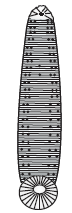
I. Triploblastic, bilateral symmetry.
II. Metamerically segmented and coelomate animals.
III. Dioecious
IV. Closed circulatory system.
V. Lateral appendages.
VI. Annelida
Which of the following information belongs to the given figure?
(a) I, II, IV and VI
(b) I, III, IV and V
(c) I, III, IV and V
(d) III, IV, V and VI
Answer. A
Question. Arthropoda is the second largest phylum of kingdom–Animalia.
(a) True
(b) False
(c) Cannot say
(d) Partially true or false
Answer. B
Question. Which one of the following features is not present in the phylum–Arthropoda?
(a) Metameric segmentation
(b) Parapodia
(c) Jointed appendages
(d) Chitinous exoskeleton
Answer. B
Question. The option that is not the respiratory organ of phylum–Arthropoda is
(a) tracheal system
(b) gills
(c) water vascular system
(d) book lungs
Answer. C
Question. Malpighian tubules are
(a) excretory organs of insects
(b) excretory organs of frog
(c) respiratory organs of insects
(d) endocrine glands of insects
Answer. A
Question. Mark which statement is incorrect regarding to the phylum—Arthropoda?
I. Open type of circulatory system.
II. Bilaterally symmetrical, coelomate animals.
III. Diploblastic with head, thorax and abdomen.
IV. Presence of Malpighian tubules and antennae.
(a) II and III
(b) I, II and III
(c) Only III
(d) II and IV
Answer. C
Question. The body of organisms belonging to phylum–Mollusca is divided into
(a) head, thorax and abdomen
(b) head, muscular foot and abdomen
(c) head, thorax, visceral hump and muscular foot
(d) head, muscular foot and visceral hump
Answer. D
Question. What is true about Mollusca?
(a) The presence of metameric segmentation
(b) The presence of mantle cavity and coelomic cavity
(c) The presence of tissue level of organisation
(d) The presence of chitinous exoskeleton
Answer. B
Question. Choose the incorrect option for phylum–Mollusca.
(a) Body is covered by a calcareous shell and unsegmented
(b) Feather-like gills present for excretion and respiration
(c) The anterior head region has sensory tentacles
(d) Mostly terrestrial, triploblastic and acoelomates
Answer. D
Question. The organ that enables feeding in phylum–Mollusca is
(a) ctenidia
(b) undulatingmembrane
(c) ganglia
(d) radula
Answer. D
Question. The nature of exoskeleton in echinoderms is
(a) calcareous
(b) chitinous
(c) siliceous
(d) tunicin
Answer. B
Question. Which of the following is not a correct identification or characteristic feature of the organism depicted below in the diagram?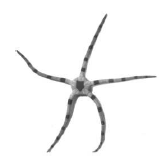
(a) The organism illustrated in the figure is Ophiura (brittle star)
(b) They are exclusively in marine waters
(c) The adults are radially symmetrical, but larvae are bilaterally symmetrical
(d) They are triploblastic, coelomate and segmented animals
Answer. D
More Question
Q1. What is open and closed type of circulatory system?
Q2. Which type of symmetry do the following animals have, explain the symmetry also:- sponges, echinoderms, annelids.
Q3. Give single terms for:-
(a) Animals which have ectoderm & endoderm only.
(b) Animals which ectoderm, mesoderm and endoderm.
Q4. Define coelom. Give e.g. of animals who are coelomates.
Q5. What are pseudocoelomates & acoelomates animals? Give egs also.
Q6. What is metamerisation ?
Q7. Give flowchart of classification of animals.
Q8. Explain the terms of Phylum Porifera: - Water canal system, coenocytes & types of skeleton sponges have.
Q9 (a) In which phylum do you find endoblasts? What is its function?
(b) Give differences between polyp & medusa.
Q10. What is bioluminescence?
Q11. What is the function of flame cells? In which phylum are they found?
Q12. Which phylum has the characteristic – bilaterally symmetrical, triploblastic, pseudocoelomates animal?
Q13. What are the functions of parapodia & nephridia?
Q14. Which is the largest phylum of Animalia?
Q15. Describe the following features of an arthropod (a) Body exoskeleton (b) appendages (c) organs of respiration, balance organs & organs of excretion.
Q16. Give characteristic features of Phylum Mollusca.
Q17. Which are the most distinctive features of an Echinoderm?
Q18. Give differences between chordates & Nonchordates.
Q19. Which are the three subphylum of Phylum chordata?
Q20. List the features of Vertebrata & give its flowchart.
Q21. List the features of with examples: - (i) Class cyclostomata (ii) Class chondrichytes (ii) Class Osteichythes
(iv) Class Amphibia (v) Class Reptilia (vi) Class Aves (vii) Class Mammalia
Free study material for Biology
Download Class 11 Biology Chapter 04 Animal Kingdom Practice Worksheets
Daily Practice Questions for Class 11 Biology
Access structured practice worksheets for Chapter 04 Animal Kingdom aligned with the 2026 CBSE curriculum. These downloadable exercises for Class 11 Biology help students build accuracy and reinforce core concepts for upcoming school tests.
Detailed Answers for Class 11 Biology Chapter 04 Animal Kingdom
Designed around the official curriculum for Class 11 Biology, these practice sheets guarantee standard compliance. Reviewing step-by-step solutions after completion sharpens your accuracy and clarifies complex sub-topics within Chapter 04 Animal Kingdom.
Complete Your Chapter Revision
Wrap up your chapter revision by testing your knowledge against standard objective question formats. Explore our full library of free, up-to-date printable assignments to maximize your academic results in upcoming CBSE evaluations.
FAQs
You can download the latest chapter-wise printable worksheets for Class 11 Biology Chapter 04 Animal Kingdom for free from StudiesToday.com. These have been made as per the latest CBSE curriculum for this academic year.
Yes, Class 11 Biology worksheets for Chapter 04 Animal Kingdom focus on activity-based learning and also competency-style questions. This helps students to apply theoretical knowledge to practical scenarios.
Yes, we have provided solved worksheets for Class 11 Biology Chapter 04 Animal Kingdom to help students verify their answers instantly.
Yes, our Class 11 Biology test sheets are mobile-friendly PDFs and can be printed by teachers for classroom.
For Chapter 04 Animal Kingdom, regular practice with our worksheets will improve question-handling speed and help students understand all technical terms and diagrams.