

Official Class 8 Science Worksheets: Chapter 04 Materials Metals and Non-Metals
Access printable practice worksheets for Chapter 04 Materials Metals and Non-Metals designed to align with the 2026-27 academic syllabus for Class 8 Science. These structured exercises help students evaluate their conceptual understanding and improve exam readiness.
Chapter-wise Practice Material: Chapter 04 Materials Metals and Non-Metals
Access the complete worksheet PDF for Chapter 04 Materials Metals and Non-Metals below. Regular practice with these targeted questions builds familiarity with standard exam patterns and helps secure higher marks in final Science evaluations.
Question. Water is said to be 'hard' when it__________________.
(a) cannot be easily compressed
(b) is not easy to find in drought conditions
(c) is coloured using pigments
(d) does not easily lather with soap
Answer : D
Question. During the process of evaporation, liquid water becomes___________.
(a) tiny droplets of water
(b) separate atoms of water
(c) atoms of hydrogen and oxygen
(d) water vapour
Answer : D
Question. Hydrochloric acid reacts with sodium hydroxide to release water and sodium chloride. Which of these is a balanced chemical equation for this reaction?
(a) 2HCl + NaOH------->2H2O + NaCl
(b) HCl + NaOH---------->H2O + NaCl
(c) HCl + 2NaOH--------->H2O + 2NaCl
(d) 2HCl + 2NaOH--------->H2O + 2NaCl
Answer : B
Question. Some thermometers use alcohol instead of mercury. Alcohol is used in thermometers because it__________ .
(a) changes colour with temperature
(b) is a clear gas when it evaporates
(c) expands and contracts noticeably
(d) is a very volatile liquid
Answer : C
Question. What happens when salt water is boiled?
(a) The water evaporates and the salt remains in the beaker.
(b) The salt evaporates leaving hot, pure water in the beaker.
(c) The salt and the water both evaporate leaving the beaker empty.
(d) A new compound is formed by the reaction of the salt and the water.
Answer : A
Question. Study the table given here. The specific heat of a substance is the amount of heat required to raise the temperature of 1 gram of the substance by 1 degree Celsius. Which of the following needs the maximum amount of energy?
No | Substancr | Specifie Hear (Col/go C) |
| 1 | Water | 1.0 |
| 2 | Iron | 0.11 |
| 3 | Kerosene | 0.5 |
| 4 | Aluminium | 0.2 |
| 5 | Cooking Oil | 0.47 |
(a) To raise the temperature of 250 g of aluminium from 20° C to 30°C.
(b) To raise the temperature of 300 g of iron from 50° C to 80°C.
(c) To raise the temperature of 200 g of kerosene from 25° C to 45°C.
(d) To raise the temperature of 400 g of cooking oil from 30° C to 50°C.
Answer : D
Question. Two beakers contain the same amount of water at the same temperature. An antacid tablet is CRUSHED and dropped into beaker P. The time taken for it to dissolve is recorded. Next, an identical antacid tablet is taken, dropped into beaker Q and the time taken for it to dissolve is also recorded. Which of them will dissolve faster and why?
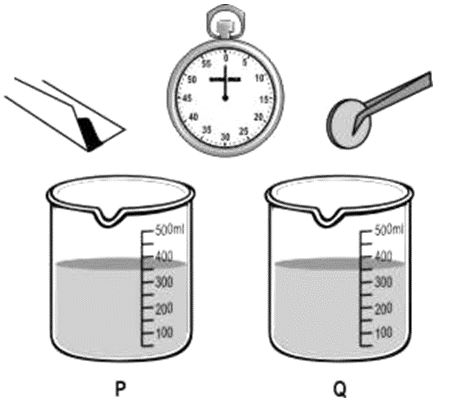
(a) The powder in beaker P because the increase in surface area increases the rate at which it dissolves.
(b) The tablet in beaker Q because the area is less and hence it will increase the rate at which it dissolves.
(c) Both will take the same time because both the powder and the tablet are made of the same material.
(d) It depends on the atmospheric temperature.
Answer : A
Question. Which of the following is NOT a factor that needs to be taken into account when a railway line is laid?
(a) The maximum and minimum temperatures at the place.
(b) The extent to which the metal expands.
(c) The total length of the railway track to be laid.
(d) The reaction of the metal with the oxygen in the air.
Answer : C
Question. A glass containing stones is placed inside a larger jar containing some water as shown. Then a dry plastic sheet is tied around the mouth of the jar, which is then placed out in the sun on a hot summer day.
Which of the following is likely to happen?
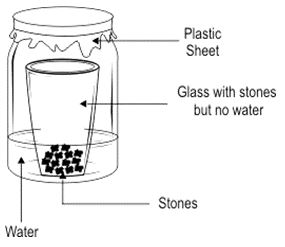
(a) The stones will become wet.
(b) There will be water outside the plastic sheet.
(c) The water level in the larger container will increase.
(d) There will be no change.
Answer : A
Question. The gas present in maximum and almost same quantity in both inhaled and exhaled air is:
(a) Nitrogen
(b) Oxygen
(c) Carbon dioxide
(d) Water vapour
Answer : A
Question. Which among the following would happen first if suddenly ice became denser than water?
(a) a lot of snow will melt in the polar regions
(b) marine life will be severely affected in cold regions
(c) ice skating would become impossible
(d) water vapour content in air would decrease
Answer : B
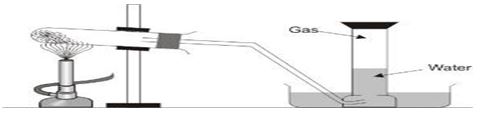
Question. See the figure showing how a certain gas is collected when it is produced. From this figure we can tell that the gas is ________.
(a) a supporter of combustion
(b) a colourless, odourless gas
(c) much lighter than air
(d) not very soluble in water
Answer : D
Question. The process of iron combining with oxygen to form rust is considered a chemical change because rust has_______________.
(a) properties that differ from both iron and oxygen
(b) the same chemical composition as iron
(c) atoms of iron and oxygen
(d) greater chemical reactivity than oxygen
Answer : A
Question. Fe(OH)3+ H2SO4-------> Fe2(SO4)3+H2O
What is the valency of iron in the above reaction?
(a) 2
(b) 3
(c) 4
(d) 6
Answer : B
Question. Metal + Water -------> Metal hydroxide + _________ What is the other product in this reaction?
(a) hydrogen
(b) oxygen
(c) acid
(d) salt
Answer : A
Question. The property of metals by which they can be beaten in to thin sheets is called-
(a) malleability
(b) Ductility
(c) conduction
(d) Expansion
Answer : A
Question. The property of metal by which it can be drawn into wires is called
(a) Conductivity
(b) malleability
(c) Ductility
(d) Decorating
Answer : C
Question. The metals that produce ringing sounds, are said to be-
(a) malleable
(b) sonorous
(c) Lustrous
(d) hard
Answer : B
Question. Sodium metal is stored in-
(a) Water
(b) Alcohol
(c) Kerosene
(d) Ether
Answer : C
Question. Which one of the following metal reacts vigorously with oxygen and water?
(a) Sodium
(b) Potassium
(c) Calcium
(d) Magnesium
Answer : A
Question. Which metal is present in Calcium Hydroxide?
(a) C
(b) O
(c) Ca
(d) H
Answer : C
Question. Which metal is found in liquid state t room temperature?
(a) Fe
(b) Zn
(c) Hg
(d) Al
Answer : C
Question. The solution of ash of magnesium ribbon is-
(a) Acidic
(b) Basic
(c) Neutral
(d) All of these
Answer : B
Question. What is the product when sulphur reacts with oxygen?
(a) Sulphuric acid
(b) Sulphur trioxide
(c) Sulphurous acid
(d) Sulphur dioxide
Answer : D
Question. When sulphur dioxide is dissolve in water then-
(a) Sulphur is formed
(b) Sulphur trioxide is formed
(c) Sulphuric acid is formed
(d) Sulphurous acid is forme(d)
Answer : C
Question. What is the chemical formula of sulphurous acid-
(a) H2SO4
(b) SO2
(c) SO3
(d) H2SO3
Answer : D
Question. The sulphuric acid turns blue litmus paper into-
(a) Red
(b) Green
(c) Yellow
(d) Dark blue
Answer : A
Question. Which one of the following is a good conductor of electricity?
(a) Iron
(b) Plastic
(c) Wood
(d) Glass
Answer : A
Question. Oxides of non metals are _______ in nature
(a) Basic
(b) Acidic
(c) Neutral
(d) All of these
Answer : B
Question. Which non-metal catches fire if the exposed to air
(a) Sodium
(b) Phosphorous
(c) Calcium
(d) Uranium
Answer : B
Question. What is the chemical formula of copper sulphate?
(a) CuSO4
(b) CuCO3
(c) CuCl2
(d) CuO
Answer : B
Question. Which gas are produced when metal react with acids
(a) Oxygen
(b) Nitrogen
(c) Hydrogen
(d) Carbon dioxide
Answer : C
Question. Which one of the following does not react with acids?
(a) Cu
(b) Ni
(c) Cr
(d) O
Answer : D
Question. Which gas produced by piece of burning charcoal?
(a) CO2
(b) CO
(c) H2S
(d) O2
Answer : B
Question. Which non metal is essential for our life and inhale during breathing?
(a) H
(b) O
(c) C
(d) N
Answer : B
Question. Non metals used in-
(a) Aeroplanes
(b) making machinery
(c) Water boilers
(d) Fertilisers
Answer : D
Question. Which one of the following gas burns with the “pop” sound?
(a) Oxygen
(b) Hydrogen
(c) Chlorine
(d) Hydrogen sulphide
Answer : B
Question. Which of the following can be beaten in to thin sheets?
(a) Zinc
(b)Phosphorus
(c) Sulphur
(d) Oxygen
Answer : A
Question. Which one of the following is metal?
(a) C
(b) N
(c) Na
(d) O
Answer : C
Question. Which one of the following is non metal?
(a) Zn
(b) Al
(c) Fe
(d) N
Answer : D
Questions
Very Short Answer
Q1) Define ductility?
Q2) Why silver foil is used for decorating sweets?
Q3) What is malleability?
Q4) What is sonorous?
Q5) Which metal is found in the liquid state at the room temperature?
Short Answer
Q6) Why sodium metal is stored in the kerosene?
Q7) What do you mean by displacement reactions?
Q8) How non-metals react with acids?
Q9) What are the uses of aluminium and copper wires?
Q10) How metals reacts with the oxygen?
Long Answer
Q11) Difference between non-metals and metals?
Q12) Explain the physical properties of metals?
Q13) State the difference between ductility and malleability?
Q14) What are the uses of metals and non-metals?
Q15) Explain the physical properties of non-metals?
Free study material for Science
Chapter 04 Materials Metals and Non-Metals Practice Sheet and Solutions for Class 8 Science
Chapter Practice Questions for Class 8 Science
Access structured practice worksheets for Chapter 04 Materials Metals and Non-Metals designed in alignment with the latest CBSE curriculum for Class 8 Science. These printable problem sets help students build accuracy and prepare effectively for school tests.
Expert Practice Material for Class 8 Science
Each worksheet is structured around standard CBSE textbooks, allowing students to check their working steps and correct mistakes early in their revision.
Complete Your Chapter Revision
Wrap up your chapter revision by testing your knowledge against standard question formats. Everything on our platform is provided free of charge.
FAQs
You can download the teacher-verified PDF for CBSE Class 8 Science Materials Metals and Non Metals Worksheet Set 01 from StudiesToday.com. These practice sheets for Class 8 Science are designed as per the latest CBSE academic session.
Yes, our CBSE Class 8 Science Materials Metals and Non Metals Worksheet Set 01 includes a variety of questions like Case-based studies, Assertion-Reasoning, and MCQs as per the 50% competency-based weightage in the latest curriculum for Class 8.
Yes, we have provided detailed solutions for CBSE Class 8 Science Materials Metals and Non Metals Worksheet Set 01 to help Class 8 and follow the official CBSE marking scheme.
Daily practice with these Science worksheets helps in identifying understanding gaps. It also improves question solving speed and ensures that Class 8 students get more marks in CBSE exams.
All our Class 8 Science practice test papers and worksheets are available for free download in mobile-friendly PDF format. You can access CBSE Class 8 Science Materials Metals and Non Metals Worksheet Set 01 without any registration.