

Class 8 Science Practice Set: Chapter 11 Force and Pressure
Access printable practice worksheets for Chapter 11 Force and Pressure designed to align with the 2026-27 academic syllabus for Class 8 Science. These structured exercises help students evaluate their conceptual understanding and improve exam readiness.
Download Chapter 11 Force and Pressure Worksheet PDF
Navigate directly to the printable exercises for Chapter 11 Force and Pressure using the digital viewer below. Each practice set allows students to isolate specific topics for thorough review and uninterrupted practice alongside standard textbooks.
Question. A hydrometer is an instrument used to measure the density of liquids. Its markings are not linear. A hydrometer, whose markings have got erased, is placed in three vessels containing petrol (density 750 g/cc), water (density 1000 g/cc) and glycerine (density 1250 g/cc). Which of these could be the correct markings on the hydrometer?
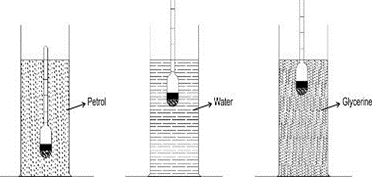
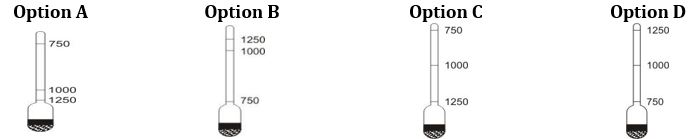
Answer : B
Question. Study the figure and steps involved in the working of a cycle pump. These steps are NOT in the correct sequence. 1. Air from the outside passes through the inner valve
2. Push the handle down and the inner valve is closed
3. Pull up the handle and the inner valve is opened
4. Piston forces the air out of the outer valve 5. Air fills the space between the piston and the outer valve The correct sequence of steps is:
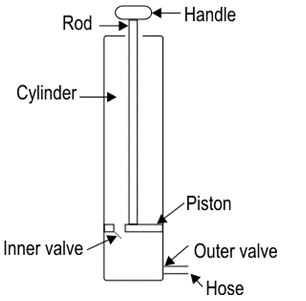
(a) 3, 1, 5, 2, 4
(b) 1, 5, 3, 4, 2
(c) 1, 3, 2, 5, 4
(d) 4, 5, 1, 3, 2
Answer : A
Question. The diagram shows the mass and dimensions of three cuboids. Which one of the following statements is TRUE?

(a) The blocks all have the same density
(b) Blocks 2 and 3 are twice as dense as Block 1.
(c) Block 1 is one-third as dense as Block 3
(d) All three blocks have different densities
Answer : B
Question. We know that all matter consists of molecules. When a gas is compressed, what happens to its molecules?
(a) Nothing happens to the molecules, their arrangement or their movement.
(b) Each of the molecules gets compressed by about the same amount.
(c) Nothing happens to the molecules, but the space between them reduces.
(d) Nothing happens to the molecules or their arrangement, but they start moving faster.
Answer : C
Question. Three identical balls are taken at three different places P, Q and R on the earth as shown in the diagram. When the balls are dropped, gravity makes them fall. Which of the following diagrams best shows the directions in which the balls will fall at P, Q and R?
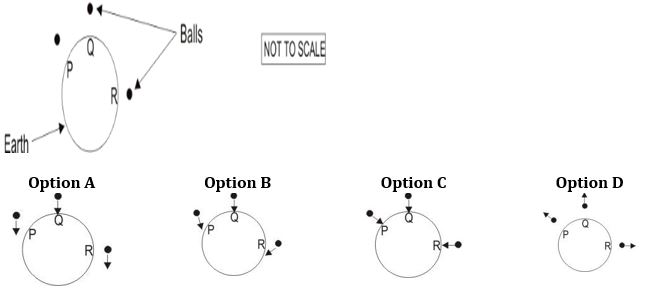
Answer : C
Question. In which of these situations will the net force on the object be zero?
(a) A satellite moving at constant speed in a circular orbit.
(b) An automobile braking to a sudden stop at a traffic signal.
(c) A bicycle moving at constant speed on a straight, level road.
(d) A cricket ball moving at 90 km/h being hit by the bat.
Answer : C
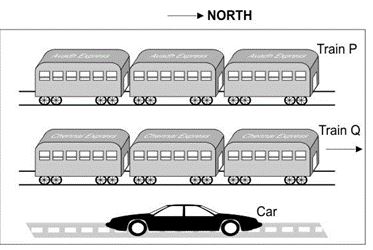
Question. See the figure below. Two trains P and Q and a car are moving along parallel paths. Train Q is moving northwards but the directions of train P and the car are not known. All are moving at constant speeds. To a passenger in train Q it appears that train P is moving backwards at a speed of 20 km/h, while the car is moving backwards at a speed of 180 km/h. If the speed of the fastest train is 120 km/h, what is the speed and direction of the car?
(a) 60 km/h southward
(b) 60 km/h northward
(c) 40 km/h southward
(d) 40 km/h northward
Answer : A
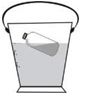
Question. A plastic bottle partially filled with water floats on water, even though the density of the plastic (1.2 g/cc) is more than that of water. Why is that?
(a) Because of the water in it, the bottle will stay at any position within a bucket of water.
(b) Because of the air in it, the density of the partly-filled bottle is less than that of water.
(c) The floating of a substance in another has nothing to do with their relative densities.
(d) (The information is wrong - if the density of plastic is more than water's, it will sink.)
Answer : B
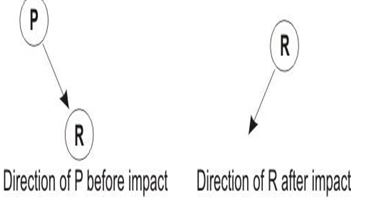
Question. Two balls P and Q simultaneously hit a stationary ball R. The direction in which P was moving when it hit R, and the final direction in which R moves are shown. Which of these could be the direction in which Q was moving when it hit R?
(a) A
(b) B
(c) C
(d) D
Answer : D
Question. A gas is taken in a vessel which is then sealed. The gas is then heated. How will the temperature, pressure and volume of the gas change?
(a) Since the vessel is sealed, all of them will remain the same.
(b) The temperature will increase, the pressure and volume will remain the same.
(c) The temperature and pressure will increase, the volume will remain the same.
(d) The temperature, pressure and volume will all increase.
Answer : C
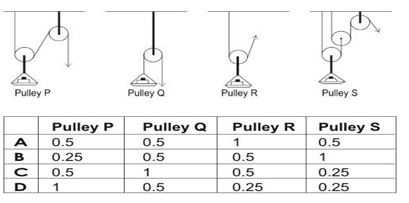
Question. Four different pulley combinations are used to lift a load of 1 kg each. Which of the following matches the pulley with the corresponding effort?
(a) A
(b) B
(c) C
(d) D
Answer : C
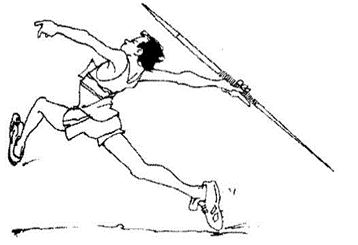
Question. The figure shows a boy throwing a javelin. For a given javelin mass, the distance the javelin travels depends upon the force exerted by the boy's arm and the time for which it is exerted.
The force exerted multiplied by the time for which it is exerted is called the impulse.
Impulse = Force X time
The greater the impulse, the greater is the distance to which the javelin will travel.
Which of these would be the units of impulse?
(a) kg
(b) kg.m.s2
(c) kg.m/s
(d) Kg.m/ s2
Answer : A
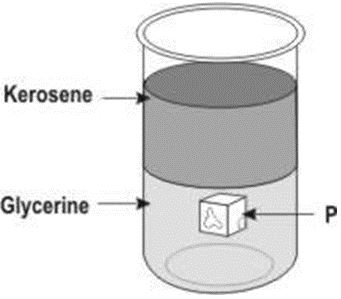
Question. A body P, when dropped into a jar containing kerosene and glycerine, sinks below the kerosene level to float in glycerine exactly as shown in the figure. What can we say about the densities of kerosene, glycerine and P?
(a) density of P > density of glycerine > density of kerosene
(b) density of P = density of glycerine > density of kerosene
(c) density of P < density of glycerine > density of kerosene
(d) density of P > density of glycerine = density of kerosene
Answer : C
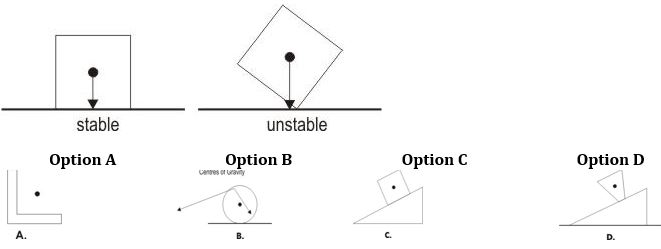
Question. An object's centre of gravity is a point at or near the object through which its entire weight can be assumed to pass. An object is stable if a vertical line drawn from its centre of gravity passes through it base. Which of following is UNSTABLE
Answer : D
Question. If a car travelling uphill has trouble climbing up the slope, what should the driver do?
(a) Press the accelerator
(b) Stop the car and start again
(c) Shift to a lower gear
(d) Shift to a higher gear
Answer : C
Please click on below link to download CBSE Class 8 Science Force and Pressure Worksheet Set C
Free study material for Science
Chapter 11 Force and Pressure Practice Sheet and Solutions for Class 8 Science
Chapter 11 Force and Pressure Printable Worksheet for Class 8 Science
Access structured practice worksheets for Chapter 11 Force and Pressure designed in alignment with the latest CBSE curriculum for Class 8 Science. These printable problem sets help students build accuracy and prepare effectively for school tests.
How to Use These Practice Sheets
Each worksheet is structured around standard CBSE textbooks, allowing students to check their working steps and correct mistakes early in their revision.
Enhance Speed with Online Practice
Follow up your worksheet practice by attempting the interactive online Science MCQ test for this chapter to evaluate your execution speed. All platform resources are free to access.
FAQs
You can download the teacher-verified PDF for CBSE Class 8 Science Force and Pressure Worksheet Set 03 from StudiesToday.com. These practice sheets for Class 8 Science are designed as per the latest CBSE academic session.
Yes, our CBSE Class 8 Science Force and Pressure Worksheet Set 03 includes a variety of questions like Case-based studies, Assertion-Reasoning, and MCQs as per the 50% competency-based weightage in the latest curriculum for Class 8.
Yes, we have provided detailed solutions for CBSE Class 8 Science Force and Pressure Worksheet Set 03 to help Class 8 and follow the official CBSE marking scheme.
Daily practice with these Science worksheets helps in identifying understanding gaps. It also improves question solving speed and ensures that Class 8 students get more marks in CBSE exams.
All our Class 8 Science practice test papers and worksheets are available for free download in mobile-friendly PDF format. You can access CBSE Class 8 Science Force and Pressure Worksheet Set 03 without any registration.