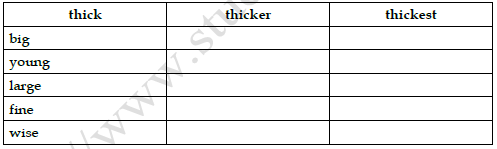
Avoiding incorrect comparisons
Some adjectives need the words “more” or “most” for comparing.
Most adjectives with two or more syllables need the words “more” or “most” for comparing nouns. Use “more” when comparing nouns, and use “most” when comparing more than two nouns.
Example:
→ I think apples are more delicious than grapes. I think kiwi is the most delicious fruit of all.
→ Never use both “er” and “more” or “est” and “most”when you compare with adjectives.
Exercise:
Write each word in the parentheses using the correct form of comparing adjective.
1. A foal is (young) than a horse. __________________________________
2. Donkeys are (stubborn) than horses are.__________________________
3. Chickens are (friendly) birds than geese are.________________________
4. Animals are the (good) helpers on a farm. _________________________
Adverbs
An adverb is a word that describes, or tells about a verb.
Some adverbs tell how an action happens.
Example: Firefighters and police officers work hard for you. The librarian asked us to work quietly in the library. Juan carefully crossed the street.
Exercise:
Name the adverb that tells how. Then name the verb it describes.
Example: The storyteller closed the book gently. Gently, closed
1. Librarians search the internet quickly.______________________________
2. They happily help people do research. ____________________________
3. They worked hard to keep the library in order. _______________________
More about adverbs
Some adverbs tell when or where an action happens.
Example: I always like talking with firefighters about their work. The word “always” tells when. I just saw a firefighter outside. The word “outside” tells where.
Exercise:
Identify the adverb and state whether it tells when or where.
Example: May we visit the police station soon? Soon, when
1. Police workers work there._____________________________________
2. The police always help people. __________________________________
3. You can find community helpers everywhere. ________________________
4. The light is green, so let’s cross now. _____________________________
Comparing with adverbs
Adverbs can compare two or more actions. Add “er” to most short adverbs when comparing two actions. Use more before two or more syllables.Add “est” most short adverbs when comparing more than two actions. Use most before adverbs with two or more syllables.
Example: This fire spread faster than last week’s fire.
This fire spreads the fastest of all the fires.
The firefighters came more rapidly than the police.
They came the most rapidly of all the workers.
Don’t use both “er” and more or “est” and most when you compare with adverbs.
Exercise:
Change the underlined adverb to make the sentence correct.
Example: the dear ran more quickly from the fire than the turtles did. More quickly
1. Some campers act more carefully than the others. ____________________
2. Some fires spread fast than others. _______________________________
3. The flames jumped high than the tree. ____________________________
4. Water from the hoses sprayed hard than a rainstorm.__________________
Part 1
Write each word in the parentheses using the correct form of comparing adjective.
1. The (clumsy) horse of all is a newborn foal. __________________________
2. The (careful) sheepherder of all is the dog. __________________________
3. That bull is the (fearless) animal on the farm. ________________________
4. The (wild) horses of all don’t live on the farm. _______________________
5. The (large) farms in the United States are in the Midwest. ______________
Part 2
Name the adverb that tells how. Then name the verb it describes.
1. Librarians carefully replace books on shelves._______________________
2. We must talk softly in the library._________________________________
3. My group finished the book quickly. ______________________________
4. Our class easily won the reading contest. __________________________
5. We must treat the books gently. _________________________________
Part 3
Identify the adverb and state whether it tells when or where.
1. We sometimes ask the police for information.______________________
2. May we visit the fire station tomorrow? __________________________
3. We should stand here until the light changes. ______________________
4. The firefighters will go anywhere someone needs help. _______________
5. Lidia is waiting outside for the crossing guard. _____________________
Part 4
Change the underlined adverb to make the sentence correct.
1. The top of the fire burned the hot. _______________________________
2. The wind changed, and the fire burned wildly than ever.________________
3. The fire spread slowly than before. _______________________________
4. When the fire was out, firefighters stayed longto make sure new fires didn’t start. ________________________________
5. No one cheered loudly than the chief after the fire was out.__________________________________
Competency : Vocabulary
I. Make new words using the letters from the given words :
wholesome ____________ , ____________ , ____________
ancestors ____________ , ____________ , ____________
vegetables ____________ , ____________ , ____________
checklist ____________ , ____________ , ____________
course book ____________ , ____________ , ____________
II. Give the words of comparison for these.
E.g., :
Click below to download practice worksheet for CBSE Class 3 English Practice Worksheet Dont Tell Set D