

Official NCERT Solutions for Class 9 Social Science: Chapter 01 Size and Location
Access comprehensive textbook solutions for Chapter 01 Size and Location using the official curriculum guides for Class 9 Social Science. Designed to align with the 2026-27 NCERT standards, these detailed answers help students reinforce core academic concepts.
Chapter-wise Solutions for Social Science: Chapter 01 Size and Location
View or download the dedicated Chapter 01 Size and Location solution resource below. Engaging with these textbook answers under focused study conditions ensures continuous academic progress and mastery of the 2026-27 curriculum for Social Science.
NCERT Solutions for Class 9 Social Science Geography for Chapter 1 Size and Location
1. Choose the right answer from the four alternatives given below.
(i) The Tropic of Cancer does not pass through
(a) Rajasthan
(b) Odisha
(c) Chhattisgarh
(d) Tripura
Answer:
(b) Odisha
(ii) The easternmost longitude of India is
(a) 97° 25' E
(b) 68° 7' E
(c) 77° 6' E
(d) 82° 32' E
Answer: (a) 97° 25' E
(iii) Uttarakhand, Uttar Pradesh, Bihar, West Bengal and Sikkim have common frontiers with
(a) China
(b) Bhutan
(c) Nepal
(d) Myanmar
Answer: (c) Nepal
(iv) If you intend to visit Kavarati during your summer vacations, which one of the following Union Territories of India you will be going to
(a) Puducherry
(b) Lakshadweep
(c) Andaman and Nicobar
(d) Diu and Daman
Answer:
(b) Lakshadweep
(v) My friend hails from a country, which does not share land boundary with India. Identify the country.
(a) Bhutan
(b) Tajikistan
(c) Bangladesh
(d) Nepal
Answer: (b) Tajikistan
2. Answer the following questions briefly.
(i) Name the group of islands lying in the Arabian Sea.
Answer: Lakshadweep Islands are found in the Arabian Sea.
(ii) Name the countries which are larger than India.
Answer: Russia, Canada, USA, China, Brazil and Australia are larger than India.
(iii) Which island group of India lies to its south- east?
Answer: Andaman and Nicobar group of islands lie to its southeast.
(iv) Which island countries are our southern neighbours?
Answer: Sri Lanka and Maldives are our southern neighbours.
3. The sun rises two hours earlier in Arunachal Pradesh as compared to Gujarat in the west but the watches show the same time. How does this happen?
Answer: The latitudinal and longitudinal extent of the mainland is about 30°. The Earth rotates 360˚ in 24 hours in west to east direction. It means 15˚ in 1 hour or 30˚ in 2 hours. Hence, the sun rises two hours earlier in Arunachal Pradesh, which lies in east as compared to Gujarat, which lies in west.
4. The central location of India at the head of the Indian Ocean is considered of great significance. Why?
Ans. The Indian landmass has a central location between the East and the West Asia. It is a southward extension of the Asian Continent. The Trans Indian Ocean routes, which connect the countries of Europe in the West and the countries of East Asia, provide a strategic central location to India. The Deccan Peninsula protrudes into the Indian Ocean, thus helping India to establish close contact with West Asia, Africa and Europe from the western coast and with Southeast and East Asia from the eastern coast. It has a long coastline on the Indian Ocean which gives it eminent position in the Indian Ocean.
MAP SKILLS
Identify the following with the help of map reading.
(i) The Island groups of India lying in the Arabian Sea and the Bay of Bengal.
(ii) The countries constituting Indian Subcontinent.
(iii) The states through which the Tropic of Cancer passes.
(iv) The northernmost latitude in degrees.
(v) The southernmost latitude of the Indian mainland in degrees.
(vi) The eastern and the western most longitude in degrees.
(vii) The place situated on the three seas.
(viii) The strait separating Sri Lanka from India.
(ix) The Union Territories of India.
Answer-
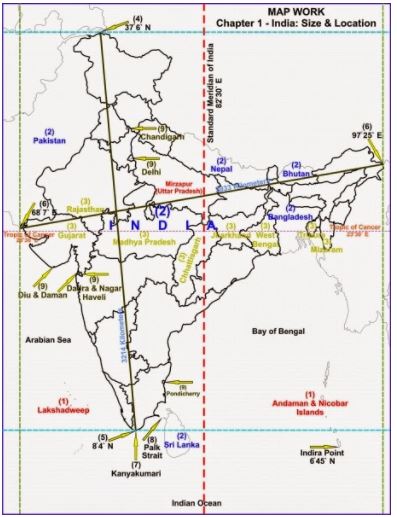
(ii) Countries which make the Indian subcontinent are Pakistan in the north-west, India at the core, Nepal in the north, Bhutan in the north-east and Bangladesh in the east.
(iii) Tropic of Cancer passes through the states of Gujarat, Rajasthan, Madhya Pradesh, Chhattisgarh, Jharkhand, West Bengal, Tripura and Mizoram.
Free study material for Social Science
Social Science Class 9 Curriculum Solutions: Chapter 01 Size and Location
Chapter Exercise Answers for Class 9 Social Science
Review comprehensive exercise answers for Class 9 Social Science Chapter 01 Size and Location. Fully updated to match current NCERT syllabus guidelines, these textbook solutions help students verify their work and maintain accurate study notes.
Detailed Answer Guides for Chapter 01 Size and Location
Each solution includes detailed reasoning to foster genuine comprehension of Chapter 01 Size and Location concepts. Reviewing these step-by-step breakdowns allows learners to master both analytical and descriptive questions expected in school evaluations.
Complete Preparation Kit for Class 9 Exams
Frequent review of these structured answers builds strong analytical capabilities and response efficiency. Maximize your academic readiness by combining these textbook solutions with our curated study materials and mock evaluations for Class 9 Social Science.
FAQs
The complete and updated NCERT Solutions Class 9 Social Science Chapter 1 Size and Location is available for free on StudiesToday.com. These solutions for Class 9 Social Science are as per latest NCERT curriculum.
Yes, our experts have revised the NCERT Solutions Class 9 Social Science Chapter 1 Size and Location as per 2026 exam pattern. All textbook exercises have been solved and have added explanation about how the Social Science concepts are applied in case-study and assertion-reasoning questions.
Toppers recommend using NCERT language because NCERT marking schemes are strictly based on textbook definitions. Our NCERT Solutions Class 9 Social Science Chapter 1 Size and Location will help students to get full marks in the theory paper.
Yes, we provide bilingual support for Class 9 Social Science. You can access NCERT Solutions Class 9 Social Science Chapter 1 Size and Location in both English and Hindi medium.
Yes, you can download the entire NCERT Solutions Class 9 Social Science Chapter 1 Size and Location in printable PDF format for offline study on any device.