

Step-by-Step Textbook Solutions for Class 9 English Chapter 02 The Sound of Music
Access comprehensive textbook solutions for Chapter 02 The Sound of Music using the official curriculum guides for Class 9 English. Designed to align with the 2026-27 NCERT standards, these detailed answers help students reinforce core academic concepts.
Download Chapter 02 The Sound of Music Textbook Solutions PDF
View or download the dedicated Chapter 02 The Sound of Music solution resource below. Engaging with these textbook answers under focused study conditions ensures continuous academic progress and mastery of the 2026-27 curriculum for English.
NCERT Solutions for Class 9 English Beehive Chapter 2 The Sound of Music
Part I Evelyn Glennie Listens to Sound without Hearing It By Deborah Cowley
I. Answer these questions in a few words or a couple of sentences each.
1. How old was Evelyn when she went to the Royal Academy of Music?
2. When was her deafness first noticed? When was it confirmed?
Answer
1. Evelyn was seventeen years old when she went to the Royal Academy of Music in London.
2. Her deafness was first noticed when she was eight years old and it was confirmed when she was eleven.
II. Answer each of these questions in a short paragraph (30–40 words).
1. Who helped her to continue with music? What did he do and say?
2. Name the various places and causes for which Evelyn performs.
Answer
1. Percussionist Ron Forbes helped Evelyn to continue with music. He began by tuning two large drums to different notes. He asked her not to listen to them through her ears but to try and sense the sound in some other manner.
2. Evelyn, with a hectic international schedule, gives solo performances at regular concerts. Apart from these, she gives free concerts in prisons and hospitals. She also accords high priority to classes for young musicians.
III. Answer the question in two or three paragraphs (100–150 words).
1. How does Evelyn hear music?
Answer
Evelyn heard music by sensing the notes in different parts of her body. When Ron Forbes tuned two drums to different notes and asked her to sense the sound without using her ears, she realized that she could feel the higher drum from the waist up and the lower drum from the waist down. She learnt how to open her mind and body to sounds and vibrations. It was sheer determination and hard work. When she played the xylophone, she could sense the sound passing up the stick into her fingertips. By leaning against the drums, she could feel the resonances flowing into her body. On a wooden platform, she removed her shoes so that the vibrations could pass through her bare feet and up her legs. She herself said that music poured in through every part of her body. It tingled in the skin, her cheekbones and even in her hair.
Part II - The Shehnai of Bismillah Khan
I. Tick the right answer.
1. The (shehnai, pungi) was a ‘reeded noisemaker.’2. (Bismillah Khan, A barber, Ali Bux) transformed the pungi into a shehnai.
3. Bismillah Khan’s paternal ancestors were (barbers, professional musicians).
4. Bismillah Khan learnt to play the shehnai from (Ali Bux, Paigambar Bux, Ustad Faiyaaz Khan).
5. Bismillah Khan’s first trip abroad was to (Afghanistan, U.S.A., Canada).
Answer
1. The pungi was a ‘reeded noisemaker.’
2. A barber transformed the pungi into a shehnai.
3. Bismillah Khan’s paternal ancestors were professional musicians.
4. Bismillah Khan learnt to play the shehnai from Ali Bux.
5. Bismillah Khan’s first trip abroad was to Afghanistan.
II. Find the words in the text which show Ustad Bismillah Khan’s feelings about the items listed below. Then mark a tick (✔ ✔) in the correct column. Discuss your answers in class.
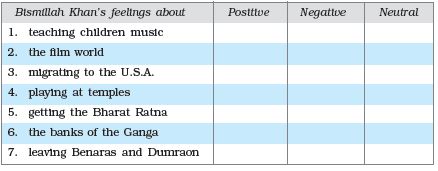
Answer
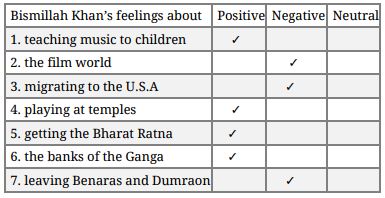
III. Answer these questions in 30–40 words.
1. Why did Aurangzeb ban the playing of the pungi?
Answer
Aurangzeb banned the playing of musical instrument pungi because it had a shrill, unpleasant sound.
2. How is a shehnai different from a pungi?
Answer
Shehnai has a better tonal quality than pungi. It is a natural hollow stem pipe with holes on its body and is longer and broader than the pungi. Shehnai is, in a way, an improvement upon the pungi.
3. Where was the shehnai played traditionally? How did Bismillah Khan change this?
Answer
The shehnai was traditionally played in royal courts, temples and weddings. Ustaad Bismillah khan, an undisputed monarch of shehnai brought this instrument onto the classical stage.
4. When and how did Bismillah Khan get his big break?
Answer
Bismillah khan got his big break in 1938. The All India Radio opened in Lucknow and Bismillah khan played shehnai on radio. He soon became an often heard player on radio. He became the first Indian to greet the nation with his shehnai from the Red Fort on 15 August, 1947.
5. Where did Bismillah Khan play the shehnai on 15 August 1947? Why was the event historic?
Answer
On 15 August 1947, Bismillah Khan played the Raag Kaafi on his shehnai from the Red Fort. The event was historical because it was on the occasion of India's Independence from British Rule.
6. Why did Bismillah Khan refuse to start a shehnai school in the U.S.A.?
Answer
Bismillah Khan refused one of his student's request to start a shehnai school in the U.S.A. because he would not live away from Hindustan, specifically, from Benaras, the River Ganga and Dumraon.
7. Find at least two instances in the text which tell you that Bismillah Khan loves India and Benaras.
Answer
The first instance is when he turned down his student’s offer to start a shehnai school in U.S.A. The second instance is when Khansaab was asked by Shekhar Gupta about moving to Pakistan during the partition, he said that he would never leave Benaras.
Thinking about language
I. Complete the following sentences. Beginning with a to-verb, try to answer the questions in brackets.
1. The school sports team hopes (What does it hope to do?)
2. We all want (What do we all want to do?)
3. They advised the hearing-impaired child’s mother (What did they advise her to do?)
4. The authorities permitted us to (What did the authorities permit us to do?)
5. A musician decided to (What did the musician decide to do?)
Answer
1. The school sports team hopes to win the match.
2. We all want to go to succeed in our life.
3. They advised the hearing-impaired child’s mother to consult a doctor.
4. The authorities permitted us to construct the building.
5. A musician decided to open a school for children.
II. From the text on Bismillah Khan, find the words and phrases that match these definitions and write them down. The number of the paragraph where you will find the words/phrases has been given for you in brackets.
1. the home of royal people (1) ______________ .
2. the state of being alone (5) ______________ .
3. a part which is absolutely necessary (2)_________________ .
4. to do something not done before (5) ________________ .
5. without much effort (13) ____________ .
6. quickly and in large quantities (9) _____________ and ______________ .
Answer
1. the royal residence
2. solitude
3. indispensable
4. invent
5. effortlessly
6. thick and fast
III. Tick the right answer.
1. When something is revived, it (remains dead/lives again).
2. When a government bans something, it wants it (stopped/started).
3. When something is considered auspicious, (welcome it/avoid it).
4. When we take to something, we find it (boring/interesting).
5. When you appreciate something, you (find it good and useful/find it of no use).
6. When you replicate something, you do it (for the first time/for the second time).
7. When we come to terms with something, it is (still upsetting/no longer upsetting).
Answer
1. When something is revived, it lives again.
2. When a government bans something, it wants it stopped.
3. When something is considered auspicious, welcome it.
4. When we take to something, we find it interesting.
5. When you appreciate something, you find it good and useful.
6. When you replicate something, you do it for the second time.
7. When we come to terms with something, it is no longer upsetting.
Consult your dictionary and complete the following table. The first one has been done for you.
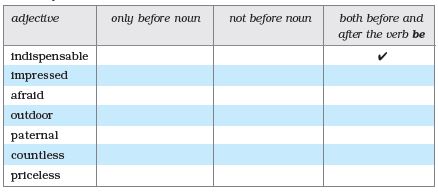
Answer
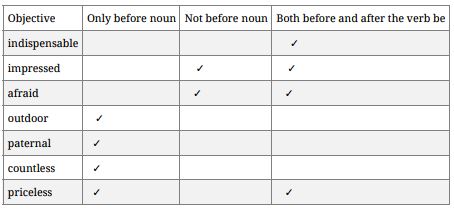
Some sentences using these adjectives are:
1. She is indispensable for the successful completion of the project.
2. Sunita was impressed by my singing.
3. He is afraid of the dark.
4. I enjoy the company of my paternal uncle.
5. Gennie was showered with countless gifts.
6. My grandmother gave me a priceless piece of advice.
Free study material for English
English Class 9 Curriculum Solutions: Chapter 02 The Sound of Music
Official NCERT Solutions for Chapter 02 The Sound of Music
Review comprehensive exercise answers for Class 9 English Chapter 02 The Sound of Music. Fully updated to match current NCERT syllabus guidelines, these textbook solutions help students verify their work and maintain accurate study notes.
Step-by-Step Explanations for Chapter 02 The Sound of Music
Clear, methodical explanations accompany every challenging problem within the Class 9 English text. Engaging with these detailed answers lays a solid foundation for advanced learning and improves foundational clarity for upcoming assessments.
Next Steps in Your English Revision
These resources act as an effective roadmap for daily homework tasks and independent study. Supplement your review of Chapter 02 The Sound of Music with official sample papers and interactive practice tests available on our platform free of charge.
FAQs
The complete and updated NCERT Solutions Class 9 English Chapter 2 The Sound of Music is available for free on StudiesToday.com. These solutions for Class 9 English are as per latest NCERT curriculum.
Yes, our experts have revised the NCERT Solutions Class 9 English Chapter 2 The Sound of Music as per 2026 exam pattern. All textbook exercises have been solved and have added explanation about how the English concepts are applied in case-study and assertion-reasoning questions.
Toppers recommend using NCERT language because NCERT marking schemes are strictly based on textbook definitions. Our NCERT Solutions Class 9 English Chapter 2 The Sound of Music will help students to get full marks in the theory paper.
Yes, we provide bilingual support for Class 9 English. You can access NCERT Solutions Class 9 English Chapter 2 The Sound of Music in both English and Hindi medium.
Yes, you can download the entire NCERT Solutions Class 9 English Chapter 2 The Sound of Music in printable PDF format for offline study on any device.