

NCERT Solutions for Class 9 English: Chapter 08 The Solitary Reaper
Access comprehensive textbook solutions for Chapter 08 The Solitary Reaper using the official curriculum guides for Class 9 English. Designed to align with the 2026-27 NCERT standards, these detailed answers help students reinforce core academic concepts.
Practice Class 9 English Solutions: Chapter 08 The Solitary Reaper
Navigate directly to the solved English textbook exercises using the digital viewer below. Each solution includes detailed step-by-step explanations, allowing students to instantly cross-check their work and identify areas requiring further revision.
NCERT Solutions for Class 9 English Communicative Chapter 8 The Solitary Reaper
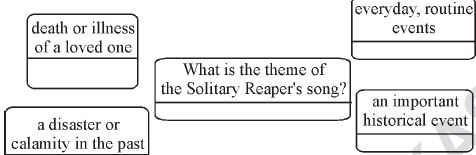
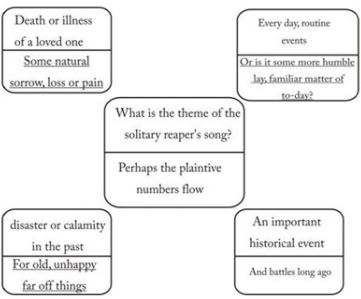
5. The poet could not understand the words of the song, yet he raised several possibilities about its theme. In the diagram below are some of these possibilities. Read the third stanza again, and find the phrase that matches each. Copy and complete the diagram, writing each phrase in the empty boxes. Work in pairs.
Answer
6. On the basis of your understanding of the poem, answer the following questions by ticking the correct choice.
(a) The central idea of the poem ‘The Solitary Reaper’ is__________.
(i) well sung songs give us happiness
(ii) melodious sounds appeal to all
(iii) beautiful experience give us life-long pleasure
(iv) reapers can sing like birds
Answer
(iii) beautiful experience give us life-long pleasure
(b) In the poem ‘The Solitary Reaper’ to whom does the poet say ‘Stop here or gently pass’?
(i) to the people cutting corn
(ii) to himself
(iii) to the people who make noise
(iv) to all the passers by
Answer
(iv) to all the passers by
(c) The Solitary Reaper is a narrative poem set to music. This form of verse is called a__________.
(i) ballad
(ii) soliloquy
(iii) monologue
(iv) sonnet
Answer
(i) ballad
(d) The poet's lament in the poem 'The Solitary Reaper' is that __________
(i) he cannot understand the song
(ii) he did not know the lass
(iii) she stopped singing at once
(iv) he had to move away
Answer
(i) he cannot understand the song
(e) The setting of the poem is__________
(i) Arabia
(ii) Hebrides
(iii) Scotland
(iv) England
Answer
(iii) Scotland
7. (a) Read the second stanza again, in which Wordsworth compares the solitary reaper's song with the song of the nightingale and the cuckoo. On the basis of your reading (and your imagination), copy and complete the table below. (Work in groups of four, then have a brief class discussion.)
|
Place
|
Heard by
|
Impact on listener
|
|
|
Solitary Reaper
|
Scottish Highlands
|
The poet
|
Holds him spellbound
|
|
Nightingale
|
|||
|
Cuckoo
|
Answer
|
Place
|
Heard by
|
Impact on listener
|
|
|
Solitary Reaper
|
Scottish Highlands
|
The poet
|
Holds him spellbound
|
|
Nightingale
|
Arabian sands
|
Travellers
|
reduces the tiredness of travellers
|
|
Cuckoo
|
Hebrides
|
People from far off lands
|
has far-reaching effect, heralds the
coming of spring, end of winter |
(b) Why do you think Wordsworth has chosen the song of the nightingale and the cuckoo for comparison with the solitary reaper’s song?
Answer
The nightingale and the cuckoo are known as song-birds. Many poets have written about their melodious notes and there is a reference to nightingale even in the Bible. So the poet has chosen their songs for comparison with the Solitary Reaper’s song.
(c) As you read the second stanza, what pictures come to your mind? Be ready to describe them in your own words, to the rest of the class. (Do not be afraid to go beyond what the poet has written.)
8. In the sixth line of the first Stanza, we read:
“... and sings a melancholy strain...”
This “s” sound at the beginning of sings and strain has been repeated. Poets often do this. Do you know why? Do you know what this “poetic repetition” is called? Can you find instances of this in The Solitary Reaper?
Answer
Poets often repeat such sounds to make the effect more intense and ornamental. This “poetic repetition” is called alliteration.
In line 15 we find an instance of alliteration in “silence of the seas.” In line 18 we find alliteration in “perhaps the plaintive numbers flow.” Line 27 also has alliteration in “I saw her singing at her work.”
9. In the first Stanza, some words or phrases have been used to show that the girl working in the fields is alone. Which are those words and phrases? What effect do they create in the mind of the reader?
Answer
The words and phrases that have been used to show that the girl working in the fields is alone are ‘single in the field’, ‘solitary’, ‘singing by herself’.
The words and phrases create in the readers mind an image of a lonely Scottish maiden who is reaping and singing all alone in the field. While she is working, she is singing a sad melancholy song. The song is so intense that the poet asks the passersby to listen but to not disturb her.
Free study material for English
Free NCERT Textbook Explanations: Class 9 English Chapter 08 The Solitary Reaper
Accessing Chapter 08 The Solitary Reaper Solutions
Access structured NCERT textbook solutions for Chapter 08 The Solitary Reaper. Designed in alignment with the latest academic curriculum for Class 9 English, these answers cover all end-of-chapter exercises to support daily learning and homework completion.
Concept-Driven Answers for Class 9 English
Each solution includes detailed reasoning to foster genuine comprehension of Chapter 08 The Solitary Reaper concepts. Reviewing these step-by-step breakdowns allows learners to master both analytical and descriptive questions expected in school evaluations.
Maximizing Study Efficiency
Frequent review of these structured answers builds strong analytical capabilities and response efficiency. Maximize your academic readiness by combining these textbook solutions with our curated study materials and mock evaluations for Class 9 English.
FAQs
The complete and updated NCERT Solutions Class 9 English Chapter 8 The Solitary Reaper is available for free on StudiesToday.com. These solutions for Class 9 English are as per latest NCERT curriculum.
Yes, our experts have revised the NCERT Solutions Class 9 English Chapter 8 The Solitary Reaper as per 2026 exam pattern. All textbook exercises have been solved and have added explanation about how the English concepts are applied in case-study and assertion-reasoning questions.
Toppers recommend using NCERT language because NCERT marking schemes are strictly based on textbook definitions. Our NCERT Solutions Class 9 English Chapter 8 The Solitary Reaper will help students to get full marks in the theory paper.
Yes, we provide bilingual support for Class 9 English. You can access NCERT Solutions Class 9 English Chapter 8 The Solitary Reaper in both English and Hindi medium.
Yes, you can download the entire NCERT Solutions Class 9 English Chapter 8 The Solitary Reaper in printable PDF format for offline study on any device.