

Download NCERT Solutions for Class 6 Science Chapter 12 Electricity and Circuits
Access comprehensive textbook solutions for Chapter 12 Electricity and Circuits using the official curriculum guides for Class 6 Science. Designed to align with the 2026-27 NCERT standards, these detailed answers help students reinforce core academic concepts.
Access NCERT Solutions and Answers
View or download the dedicated Chapter 12 Electricity and Circuits solution resource below. Engaging with these textbook answers under focused study conditions ensures continuous academic progress and mastery of the 2026-27 curriculum for Science.
NCERT Solutions for Class 6 Science for chapter 12 Electricity and Circuits
1. Fill in the blanks:
- A device that is used to break an electric circuit is called a _____.
- An electric cell has _____
Answer:
(a) A device that is used to break an electric circuit is called a switch.
Explanation: Switch is a simple device that either breaks the circuit or completes it. It controls the flow of electricity in the circuit.
(b) An electric cell has two terminals.
Explanation: An electric cell has two terminals, a negative terminal and a positive terminal.
2. Mark ‘True’ or ‘False’ for the following statements:
(a) Electric current can flow through metals.
(b) Instead of metal wires, a jute string can be used to make a circuit.
(c) lectric current can pass through a sheet of thermocol.
Answer:
(a) Electric current can flow through metals. (True)
Explanation: Electric current can pass through metals as they allow an electric current to flow through them easily.
(b) Instead of metal wires, a jute string can be used to make a circuit. (False)
Explanation: Jute string is an insulator. Hence, electric current cannot pass through it.
(c) Electric current can pass through a sheet of thermocol. (False)
Explanation: Thermocol is also an insulator. Hence, electric current cannot pass through it.
3. Explain why the bulb would not glow in the arrangement shown in Fig.12.13.
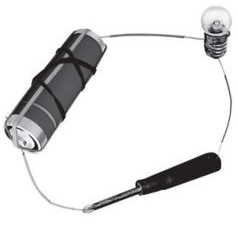
Answer: In the given circuit, a tester holder is connected in series. Electric current cannot pass through tester holders because it is a bad conductor
of electricity. Hence, the current will not flow through the circuit and hence, the bulb will not glow.
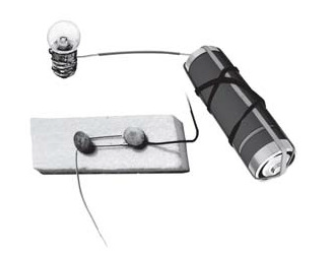
4. Complete the drawing shown in Fig 12.14 to indicate where the free ends of the two wires should be joined to make the bulb glow
Answer:
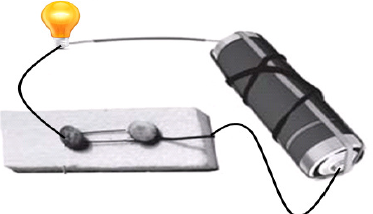
In order to complete the circuit, the positive terminal of the cell should be connected to one end of the bulb, and the other terminal of the bulb should be connected to the other end of the bulb. It can be shown in the above figure.
5. What is the purpose of using an electric switch? Name some electric gadgets that have switched built into them.
Answer: A switch is used to complete or break an electric circuit. If the switch is ‘ON’, then current will flow through the circuit. On the other hand, if the switch is ‘OFF’, then current will not flow through the circuit. Electric fans, electric lamps, washing machines, juicers and mixers, etc. have switches built into them.
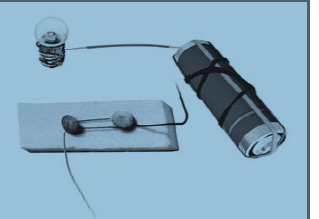
6. Would the bulb glow after completing the circuit shown in Fig. 12.14, if we use an eraser instead of a safety pin?
Answer:
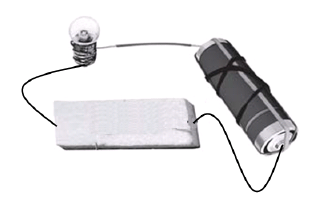
No. The bulb will not glow if we connect an eraser in the circuit. It is because erasers are bad conductor of electricity. They do not conduct electricity. The circuit becomes an open circuit.
7. Would the bulb glow in the circuit shown in Fig. 12.15?
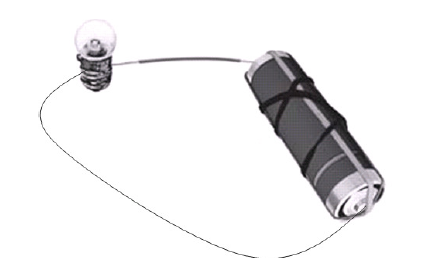
Answer: No. The bulb will not glow because the two terminals of the cell are connected to the single terminal of the bulb. In order to complete the circuit, the two terminals of the battery should be connected to the two terminals of the bulb.
8. Using the ‘conduction tester’ on an object, it was found that the bulb begins to glow. Is the object a conductor or an insulator? Explain.
Answer: The bulb of the conduction tester glows when the tester is touched with the object. It shows that the given object conducts electricity. Hence, the object is a conductor in nature.
9. Why should an electrician use rubber gloves while repairing an electric switch at your home? Explain.
Answer: An electric switch conducts electricity through its internal parts and one may get an electric shock if it is touched with naked hands. Hence, it should be touched with rubber gloves in hand because rubber cannot conduct electricity.
10. Handles of tools such as screwdrivers and pliers used by electricians for repair work usually have plastic or rubber cover on them. Can you explain why?
Answer: Plastics and rubbers are the bad conductor of electricity. Therefore, handle of tools such as screwdrivers, pliers, etc. which are used by electricians to repair electrical appliances usually have plastic or rubber cover on them.
Free study material for Science
NCERT Solutions for Class 6 Science Chapter 12 Electricity and Circuits
Chapter Exercise Answers for Class 6 Science
Review comprehensive exercise answers for Class 6 Science Chapter 12 Electricity and Circuits. Fully updated to match current NCERT syllabus guidelines, these textbook solutions help students verify their work and maintain accurate study notes.
Detailed Answer Guides for Chapter 12 Electricity and Circuits
Each solution includes detailed reasoning to foster genuine comprehension of Chapter 12 Electricity and Circuits concepts. Reviewing these step-by-step breakdowns allows learners to master both analytical and descriptive questions expected in school evaluations.
Complete Preparation Kit for Class 6 Exams
Consistent practice with these solution guides cultivates faster problem-solving habits and clearer logical structuring. For a complete preparation experience, pair these textbook answers with our dedicated revision notes and sample papers for Class 6 Science.
FAQs
The complete and updated NCERT Solutions Class 6 Science Chapter 12 Electricity and Circuits is available for free on StudiesToday.com. These solutions for Class 6 Science are as per latest NCERT curriculum.
Yes, our experts have revised the NCERT Solutions Class 6 Science Chapter 12 Electricity and Circuits as per 2026 exam pattern. All textbook exercises have been solved and have added explanation about how the Science concepts are applied in case-study and assertion-reasoning questions.
Toppers recommend using NCERT language because NCERT marking schemes are strictly based on textbook definitions. Our NCERT Solutions Class 6 Science Chapter 12 Electricity and Circuits will help students to get full marks in the theory paper.
Yes, we provide bilingual support for Class 6 Science. You can access NCERT Solutions Class 6 Science Chapter 12 Electricity and Circuits in both English and Hindi medium.
Yes, you can download the entire NCERT Solutions Class 6 Science Chapter 12 Electricity and Circuits in printable PDF format for offline study on any device.