

Multiple Choice Questions (MCQs) for Class 11 Biology: Chapter 10 Cell Cycle and Cell Division
Access targeted multiple-choice questions for Chapter 10 Cell Cycle and Cell Division designed to align with the latest CBSE academic syllabus for Class 11 Biology. These objective practice sets help students evaluate their conceptual understanding and improve exam readiness.
Practice Chapter 10 Cell Cycle and Cell Division MCQs for Class 11 Biology
View or download the dedicated Chapter 10 Cell Cycle and Cell Division MCQ resource below. Practicing these 50 objective questions regularly builds familiarity with standard exam patterns and helps secure higher marks in final Biology evaluations.
Question: Number of chromatids at metaphase is
a) two each in mitosis and meiosis
b) two in mitosis and one in meiosis
c) two in mitosis and four in meiosis
d) one in mitosis and two in meiosis.
Answer: a
Question: During which stages (or prophase I substages) of meiosis do you expect to find the bivalents and DNA replication respectively?
a) Pachytene and interphase (between two meiotic divisions)
b) Pachytene and interphase (just prior to prophase I)
c) Pachytene and S phase (of interphase just prior to prophase I)
d) Zygotene and S phase (of interphase prior to prophase I)
Answer: d
Question: Best material for the study of mitosis in laboratory is
a) anther
b) root tip
c) leaf tip
d) ovary.
Answer: b
Question: Microtubule is involved in the
a) muscle contraction
b) membrane architecture
c) cell division
d) DNA recognition.
Answer: c
Question: The correct sequence of phases of cell cycle is
a) G1 → S → G2 → M
b) M → G1 → G2 → S
c) G1 → G2 → S → M
d) S → G1 → G2 → M.
Answer: a
Question: Which of the following represents the best stage to view the shape, size and number of chromosomes?
a) Prophase
b) Metaphase
c) Interphase
d) Telophase
Answer: b
Question: During cell division in apical meristem, the nuclear membrane appears in
a) telophase
b) cytokinesis
c) metaphase
d) anaphase.
Answer: a
Question: Meiosis II performs
a) separation of sex chromosomes
b) synthesis of DNA and centromere
c) separation of homologous chromosomes
d) separation of chromatids.
Answer: d
Question: Identify the correct statement with regard to G1 phase (Gap 1) of interphase.
a) DNA synthesis or replication takes place.
b) Reorganisation of all cell components takes place.
c) Cell is metabolically active, grows but does not replicate its DNA.
d) Nuclear division takes place.
Answer: c
Question: Which of the following structures will not be common to mitotic cell of a higher plant?
a) Centriole
b) Spindle fibre
c) Cell plate
d) Centromere
Answer: a
Question: Which of the following options gives the correct sequence of events during mitosis ?
a) Condensation → nuclear membrane disassembly → arrangement at equator → centromere division → segregation → telophase
b) Condensation → crossing over → nuclear membrane disassembly → segregation → telophase
c) Condensation → arrangement at equator → centromere division → segregation → telophase
d) Condensation → nuclear membrane disassembly → crossing over → segregation → telophase
Answer: a
Question: Mitotic spindle is mainly composed of which protein?
a) Actin
b) Myosin
c) Actomyosin
d) Myoglobin
Answer: c
Question: In meiosis crossing over is initiated at :
a) Pachytene
b) Leptotene
c) Zygotene
d) Diplotene
Answer: a
Question: The enzyme recombinase is required at which stage of meiosis :
a) Pachytene
b) Zygotene
c) Diplotene
d) Diakinesis
Answer: a
Question: Interphase includes :-
a) G0, G1 , S, G2
b) Prophase, Metaphase, Anaphase, Telophase
c) Cytokinesis
d) Mitosis/M-phase
Answer: a
Question: In which stage of cell cycle, DNA replication occurs?
a) G1-phase
b) S-phase
c) G2-phase
d) M-phase
Answer: b
Question: Which of the following is longest phase of the cell cycle ?
a) Prophase
b) Interphase
c) Telophase
d) M – phase
Answer: b
Question: Spindle fibre unite with which structure of chromosomes?
a) Chromocentre
b) Chromomere
c) Kinetochore
d) Centriole
Answer: c
Question: Spindle fibres of mitotic cells are made up of
a) tubulin
b) actin
c) myosin
d) collagen
Answer: a
Question: The complex formed by a pair of synapsed homologous chromosomes is called :
a) Axoneme
b) Equatorial plate
c) Kinetochore
d) Bivalent
Answer: d
Question: A somatic cell that has just completed the S phase of its cell cycle, as compared to gamete of the same species, has :
a) same number of chromosomes but twice the amount of DNA
b) twice the number of chromosomes and four times the amount of DNA
c) four times the number of chromosomes and twice the amount of DNA
d) twice the number of chromosomes and twice the amount of DNA
Answer: b
Question: How many mitotic divisions are needed for a single cell to make 128 cells?
a) 28
b) 32
c) 7
d) 14
Answer: c
Question: At metaphase, chromosomes are attached to the spindle fibres by their :-
a) Centromere
b) Satellites
c) Secondary constrictions
d) Kinetochores
Answer: d
Question: In ‘S’ phase of the cell cycle :-
a) Amount of DNA doubles in each cell.
b) Amount of DNA remains same in each cell.
c) Chromosome number is increased.
d) Amount of DNA is reduced to half in each cell.
Answer: a
Question: During cell cycle in which phase normal components of cell are synthesized, and assembled?
a) S
b) G2
c) G1
d) M
Answer: c
Question: The drawing below shows a cell whose diploid chromosome number is four. This cell is in:-
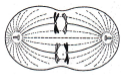
a) Metaphase of mitosis
b) Anaphase of mitosis
c) First anaphase of meiosis
d) Second anaphase of meiosis
Answer: c
Question: Match the stages of meiosis in Column I to their characteristic features in Column II and select the correct option using the codes given below : Codes :
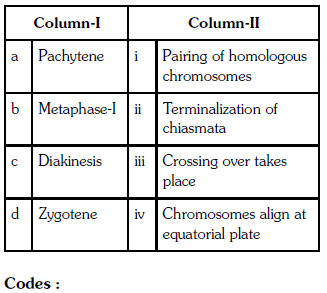
a b c d
a) ii iv iii i
b) iv iii ii i
c) iii iv ii i
d) i iv ii iii
Answer: c
Question: Arrange the following events of meiosis in the correct sequence –
A. Terminalisation of chiasmata
B. Crossing over
C. Synapsis
D. Disjunction of chromosomes
E. Dissolution of synaptonemal complex
The correct sequence is-
a) A → B → C → D → E
b) E → D → C → B → A
c) C → B → D → E → A
d) C → B → E → A → D
Answer: d
Question: Arrange the following events of meiosis in correct sequence :
a) Crossing over
b) Synapsis
c) Terminalisation of chaismata
d) Disappearance of nucleolus
a) (b), (c), (d), (a)
b) (b), (a), (d), (c)
c) (b), (a), (c), (d)
d) (a), (b), (c), (d)
Answer: c
Free study material for Biology
Practice MCQs for Class 11 Biology Chapter 10 Cell Cycle and Cell Division
Class 11 Biology Chapter 10 Cell Cycle and Cell Division Objective Test Questions
Test your conceptual understanding of Chapter 10 Cell Cycle and Cell Division with these targeted multiple-choice questions. Designed in alignment with the latest CBSE curriculum for Class 11 Biology, these problem sets build accuracy and prepare students for objective exams.
NCERT-Aligned Objective Questions and Solutions
Built using the official NCERT book for Class 11, these Biology objective sets provide reliable academic guidance. Pair your practice with our recommended NCERT solutions to master optimal problem-solving approaches.
Next Steps in Your Exam Preparation
Follow up your worksheet practice by attempting the interactive online Biology MCQ test for this chapter to evaluate your execution speed. All platform resources are free to access.
FAQs
You can get most exhaustive CBSE Class 11 Biology Cell Cycle and Cell Division MCQs Set 04 for free on StudiesToday.com. These MCQs for Class 11 Biology are updated for the 2026-27 academic session as per CBSE examination standards.
Yes, our CBSE Class 11 Biology Cell Cycle and Cell Division MCQs Set 04 include the latest type of questions, such as Assertion-Reasoning and Case-based MCQs. 50% of the CBSE paper is now competency-based.
By solving our CBSE Class 11 Biology Cell Cycle and Cell Division MCQs Set 04, Class 11 students can improve their accuracy and speed which is important as objective questions provide a chance to secure 100% marks in the Biology.
Yes, Biology MCQs for Class 11 have answer key and brief explanations to help students understand logic behind the correct option as its important for 2026 competency-focused CBSE exams.
Yes, you can also access online interactive tests for CBSE Class 11 Biology Cell Cycle and Cell Division MCQs Set 04 on StudiesToday.com as they provide instant answers and score to help you track your progress in Biology.